I contend therefore that we have allowed these chemicals to be used with little or no advanced investigation of their effect on soil, water, wildlife and man himself. Future generations are unlikely to condone our lack of prudent concern for the integrity of the natural world that supports all life. Rachel Carson, Silent Spring
Today we are faced with a challenge that calls for a shift in our thinking, so that humanity stops threatening its life-support system. We are called to assist the Earth to heal her wounds and in the process heal our own – indeed to embrace the whole of creation in all its diversity, beauty and wonder. Wangari Maathai
I want you to feel the fear I feel every day. And then I want you to act. Greta Thunberg
We are calling all women and our allies to come together to save the earth that sustains us all. Is it any wonder that from Rachel Carson to Wangari Maathai to the emerging young leader Greta Thunberg, women have been in the forefront of environmental movements for a century? As daughters, sisters, mothers, grandmothers, and aunts, we have long cared and advocated for the most vulnerable among us, the very young, the very old, the disabled, those who are the first to suffer the consequences of climate catastrophe and the many kinds of pollution that are poisoning the earth we share.
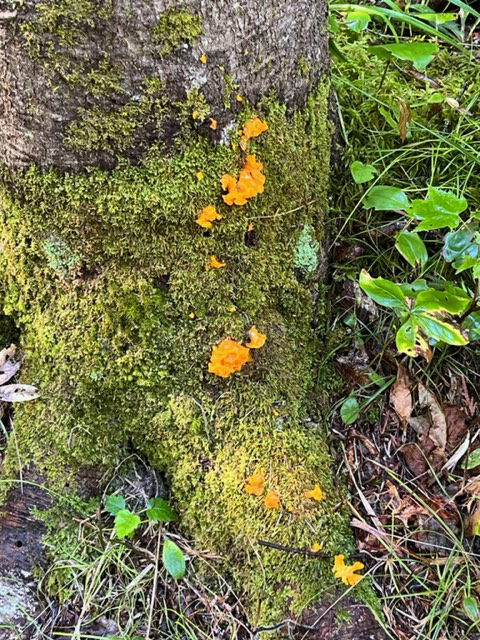
The other day I found the most beautiful fungus on an aging white pine set against deep green moss that was almost arcing over the brook. When I looked up Dacrymyces palmatis I discovered that it’s common name was “Witches Butter.” That figures I thought – this must mean that this plant has medicinal qualities, and of course it does along with the fact that the fungus is edible.
Any time I see the word witch associated with a plant if I am not familiar with it I start digging into research inevitably coming up with the same kind of information – the plant/ tree/ fungus/slime mold is edible and has medicinal value.
The word witch as many of us know has at its root to bend or shape. Shape -shifting by non –ordinary means.
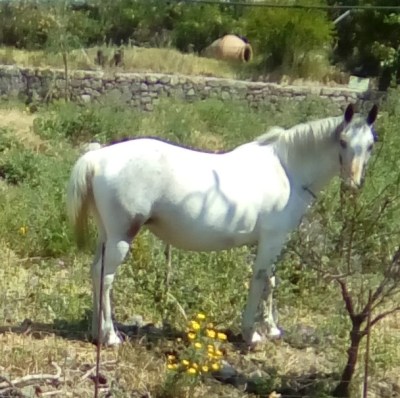
Imagine my surprise when, a few days ago, I looked out my window to see a dappled horse munching on flowers in the field across the street from my house. In the next days I got used to her being there. I would look for her in the mornings and at odd times during the day. Sometimes she was visible and sometimes she was not. When I could see her, I would open the window and call out, “Hello, white horse, you are very beautiful.” Once or twice she turned her head to look at me and seemed to respond, “Thank you for noticing.”
Many hundreds of years ago, Sappho must have had a similar vision in a field near a grove of trees where she and her students waited for the Goddess to appear, for she wrote: “In meadows where horses have grown sleek among spring flowers, dill scents the air.“ These lines are part of a longer poem addressed to Aphrodite that begins: “Leave Crete and come to us.” In this place, “incense smokes on the altar,” there is a stream, there are apple trees and rose bushes and horses in a field of flowers.
Apple trees have always been dear to my heart and of course, they are associated with the goddess. What follows is a little story where the goddess is made manifest.
Torn Apple Heart
Three years ago I had a beloved apple pruned – I do not normally prune trees, believing that to do so may harm them, but because I once trusted a young boy who also loved trees, I allowed him to make a few cuts that spring.
Last year my apple struggled and dropped her apples too soon.
I worried.
This year rain has been scarce except for monsoons that first drown the trees, leave roots barren, with most of the moisture rushing down the hill to the brook. When I noticed so many many apples on too thin young branches I became uneasy….
It’s almost mid August; since mid July we have experienced the hottest summer I have ever endured.
we need a god who bleeds now a god whose wounds are not some small male vengeance some pitiful concession to humility a desert swept with dryin marrow in honor of the lord
we need a god who bleeds spreads her lunar vulva & showers us in shades of scarlet thick & warm like the breath of her our mothers tearing to let us in this place breaks open like our mothers bleeding the planet is heaving mourning our ignorance the moon tugs the seas to hold her/to hold her embrace swelling hills/i am not wounded i am bleeding to life
we need a god who bleeds now whose wounds are not the end of anything
I personally think the quality of endurance is underrated. Remember Celie in The Color Purple? After living through hell this woman became who she was meant to be. Sometimes endurance does seem to be the way through. Just now the Woman’s Movement seems to be quite dead, but perhaps if we can just endure in time this situation may shift. That at least is my fervent hope.
Endurance and the Long Winding Road
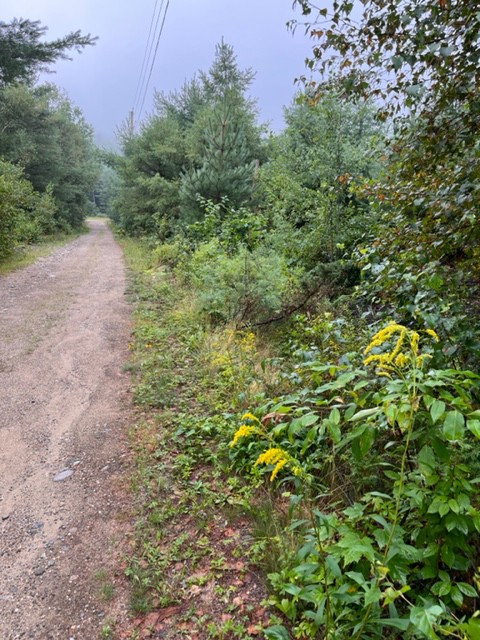
From the day I bought this property almost 40 years ago I walked down this lovely road with a sense of the deepest pleasure. The trees were young then. In spring wild cherries burst with pure white or rosy pink blossoms, the bark of each a different hue, emerald pines bore startling white candles, chattering poplars multiplied, pale gray and pearl white birches leaned in for intimate conversation, smooth barked red maples graced open spaces all lemony lime in spring – leaves and needles etched against cobalt blue. The trees were healthy then.
On the recent Goddess Pilgrimage to Crete, I visited the Historical Museum in Heraklion where I saw a beautiful embroidered silk panel of a mermaid identified only as having come from Koustogerako, a village in western Crete. As it is unlikely that a man in a Cretan village would have been talented in embroidery, in this case “Anonymous” most definitely “was a woman.”
In this thread painting a mermaid surrounded by fish is holding the anchor of a ship in one hand and a fish in the other. In Greece the mermaid is the protectress of sailors. In a well-known legend, a mermaid said to be the sister of Alexander the Great, emerges from the sea in front of a ship during a storm and asks: “Is Alexander the Great still living?” If the sailors answer, “Yes, he lives and reigns,” the ship is saved.