“Queen Sugar:” Must-See Ecowomanist TV by Elise M. Edwards

elise-edwardsHave you been watching “Queen Sugar”?  It is a thoughtful, compelling, and gorgeous TV show that evokes ecowomanist sensibilities.

“Queen Sugar” is a television drama in its second season on OWN, Oprah Winfrey’s network. It was created by celebrated filmmaker Ava DuVernay, who is also the show’s executive producer.  The show has an all-female directing team and an inclusive crew.  Like many of the original series on OWN, “Queen Sugar” features a predominately African-American cast, and like many other programs on the network, it delivers content intended to stir the viewer’s soul.  But notably, “Queen Sugar”’s soulful messages are not mediated by the cadre of life coaches and inspirational leaders often seen on Oprah’s network.  Instead, it is the fictional Bordelon family who invites us to reflect on their world and ours. The series’ three main characters, Nova, Charley, and Ralph Angel, are siblings who take over their father’s sugar cane farm in Louisiana after his death. Their narrative and the lush cinematography that captures it offers viewers the opportunity to consider the complexity, joy, and hardship of African-American characters who are rarely depicted on screen.  The show’s themes and aesthetics are expressive of ecowomanist spirituality.

Continue reading ““Queen Sugar:” Must-See Ecowomanist TV by Elise M. Edwards”

The Gendered Cost of Fast-Fashion by Elisabeth Schilling

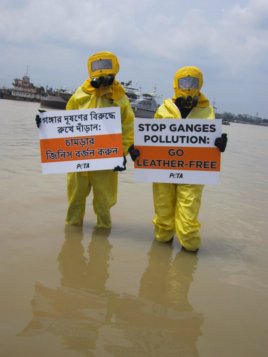
This last week, my students watched True Cost (2015), a documentary about the environmental impacts and human casualties of the fashion industry. According to the film, fashion is the number two most polluting industry in the world (oil is number one) and more lethal than some of us know. This is due to the incredible rate of people in the Global North consuming cheap clothes. I used to buy clothes weekly in graduate school, accumulating 100s of pieces, some that I never wore.

I never really thought about where my clothes came from (well, I would buy most of them second-hand, but they still had a former origin). I did not think about the pesticides flooding millions of acres of cotton and seeping into the ground and causing brain tumors and early deaths to farmers, and I did not think about the (mostly) women who made my clothes in other countries in poor working conditions, their own countries being polluted by factory run-off in their sacred rivers and the soil from where they fed their families. Continue reading “The Gendered Cost of Fast-Fashion by Elisabeth Schilling”

Announcing the 2017 Rosemary Radford Ruether Conference by Grace Yia-Hei Kao

On October 7, 2017, five distinguished panelists will speak at a one-day event: the Rosemary Radford Ruether Conference for Justice and Peace. Co-sponsored by the Friends of Sabeel—North America (FOSNA), Claremont Area FOSNA, Claremont School of Theology, and the Women’s Studies in Religion program at Claremont Graduate University, the conference will be held at Pilgrim Place (Decker Hall)–the retirement community for folks serving in religious or charitable organizations where Dr. Ruether currently resides.

Continue reading “Announcing the 2017 Rosemary Radford Ruether Conference by Grace Yia-Hei Kao”

Embodying Gaia by Christy Sim

Rosemary Radford Ruether wrote a classic text: “Gaia and God: An Ecofeminist Theology of Earth Healing.” Ever since I laid eyes on this amazing book and was convinced of the genius Ruether offered within these pages, I adored images of Gaia.

The great goddess is usually pictured holding the world as her womb, a loving representation of compassionately pulling all the hurt and agony to her abdomen for healing.

Ruether says in “Classical Western cultural traditions” of which “Christianity is a major expression,” we “have justified and sacralized” notions of God and domination (3). Such ideas teach us that domination is “the ‘natural order'” and “the will of God” for the “male monotheistic God” and his followers (3).

But Gaia is so much more and challenges these patriarchical messages in today’s culture. To imagine the divine with this motherly image helps with “ecological healing” (as Ruether says), and, being able to picture a “personified being” in the feminine (4). Gaia is truly special.

Continue reading “Embodying Gaia by Christy Sim”

Musings On My Recent Road Trip by Esther Nelson

I love a road trip.  It’s exciting to get behind the wheel of a car, get out on the highway (or bi-way), and just go.  The road seems to stretch out forever in front of me, full of possibilities, adventure, and fun.  Again, this summer I drove two thirds of the way across the United States from Virginia to New Mexico and back again.  I varied my route because why not?  The country is vast and diverse.  I want to see as much of it as I can.  The broad, open, colorful skies of Texas and New Mexico.  The wheat fields in Kansas.  The green, rolling hills of Kentucky and Tennessee.  On this particular trip back to Virginia, though, one of the sights disturbed me deeply.

The second day of my journey eastward, I drove from Amarillo, Texas, to Springfield, Missouri.  All along the panhandle of Texas and into Oklahoma, I encountered feedlots.  These are places where cattle live for several months in order to fatten up before slaughter.  The animals are fed grain (mainly corn), growth hormones, and antibiotics.  They live in crowded spaces and in the feedlots I saw, the cattle had difficulty walking due to the layers of muck, mire, and manure all over the ground.  I could smell a feedlot long before I saw one.  The stench nauseated me.

Continue reading “Musings On My Recent Road Trip by Esther Nelson”

Woman and Nature: Our Bodies Are Ourselves by Carol P. Christ

This earth is my sister; I love her daily grace, her silent daring, and how loved I am how we admire the strength in each other, all that we have suffered, all that we have lost, all that we know. We are stunned by this beauty, and I do not forget: what she is to me, what I am to her.

These words are from Susan Griffin’s Woman and Nature which I often recommend as one of my favorite books. Over the years I have read this passage and others from Woman and Nature aloud with my students, and we have always been moved, most  of us to tears. More recently these words have become the center of the “Morning Blessing” on the Goddess Pilgrimage to Crete.

In the epigraph to the book Griffin writes,

These words are written for those of us whose language is not heard, whose words have been stolen or erased, those robbed of language, who are called voiceless or mute, even the earthworms, even the shellfish and the sponges, for those of us who speak our own language . . .

Continue reading “Woman and Nature: Our Bodies Are Ourselves by Carol P. Christ”

Painting, Privilege, and “Going Tiny” in Hawai’i by Angela Yarber

Pelé by A. Yarber

It started with Pelé, the Hawai’ian Volcano Goddess who governs fire, lightning, volcanoes, and the flow of lava. When my little family set off on a big adventure in June 2015, I knew I’d research and paint her as a Holy Woman Icon, but I wanted to get to Hawai’i first so that I could experience her power firsthand. After three months volunteering without running water in Vermont, a month in southern Virginia’s finest fall foliage, and a holiday season traversing the country from east to west in a camper named Freya, we crossed the Pacific in search of Pelé.

The long-term goal of nearly two years of full-time travel was to discern next steps for our queer little family, and to find land to open an intersectionally ecofeminist retreat center. We always imagined returning to the southeast, likely buying land and creating the retreat center in the North Carolina mountains. Pelé had something else in store.

After three wild months volunteering on the Big Island, we fell in love, enlivened by this place we now call home: its beauty, the diversity of people, access to living off-grid, access to growing your own food, its rich culture and history, access to a vegan lifestyle, and the ability to live the majority of our life outside. In short, all of our plans were upended and recreated in the most beautiful and challenging ways because we knew Hawai’i must become our home. Continue reading “Painting, Privilege, and “Going Tiny” in Hawai’i by Angela Yarber”

The Blue No Gaia Wants: Protecting the Sacred through our Lawns by Elisabeth Schilling

blue lawnIf Gaia is a living body, why are we painting her blue? Whether it is public parks or residential lawns, when there is that special odor in the air, I know to look down and there it is, an endless dye job on the grass indicating treatment. My city is concrete and blue dye for miles. Furthermore, I have sales people knocking at my door monthly asking if I want to spray pesticide around the house to decimate wasps, ants and spiders.  

Many religious texts encourage us to mindfully consider the earth. The Jain Acaranga sutra, for instance, says, “a wise [person] should not act sinfully toward plants” (I.1.5.7). One way we sin against the earth so casually is by these mindless manipulations of our lawns, if we have them. (Technically, I do not have a lawn, but my roommate does, and I try to protect it). I do not think most people think about researching what they allow into the earth. Continue reading “The Blue No Gaia Wants: Protecting the Sacred through our Lawns by Elisabeth Schilling”

The Tree of Life and the Forest of Friendship: Circle Dance to Restore our Hope by Laura Shannon

Tree and Goddess motifs on the ‘Wall of the Foremothers’ (Ahninnenwand), Bodensee, Germany, 4th Millenium BCE

Yes, times are tough. But a better understanding of our interconnectedness can help us move beyond the cynicism, frustration, and despair we may be feeling in the modern world. A closer look at trees, and at women’s traditional circle dances, can offer valuable lessons about friendship, community, and the interconnectedness of all life.

The sacred Tree is found in virtually all cultures, often identified with the life-giving figure of the Goddess. Both motifs appear abundantly in archaeological finds dating back to the early Neolithic era. Dance archaeologist Yosef Garfinkel affirms that humans have been dancing in circles since then and probably for far longer.

The Tree of Life is central to the women’s traditional circle dances of the Balkans and the Near East, which I have been researching for over thirty years.  The pattern of the Tree of Life is encoded in the steps of dances, many dance songs refer to women as sacred or magical trees, people often dance around or under sacred trees, and Tree and Goddess motifs are featured on the textiles worn while dancing.  Furthermore, each dancer resembles a tree, with her ‘trunk’ upright and centred, arms symmetrically extended like branches, and hands joined so that we support each other in the circle.   Continue reading “The Tree of Life and the Forest of Friendship: Circle Dance to Restore our Hope by Laura Shannon”

A Return to Light by Judith Shaw

judith shaw photoSpring is here in the northern hemisphere and with it the return of light in the yearly round of seasons. Today is Earth Day. Flowers bloom, new seedlings emerge and birdsong fills the air. As the cold and dark of winter gives way once again to warmth and light, cultures across the world celebrate fertility and the rebirth of life and light.

Continue reading “A Return to Light by Judith Shaw”