


When we meet
our deep
brown eyes
mirror a
mutual need
for light
to penetrate
human darkness.
Your eyes are
wary and fearful;
Mine hunger
for your touch.
I cry out softly
“Don’t be afraid…
I love you”.
We share
a haunted skin –
hunted down
by Difference.
You are slaughtered
by men with guns.
I am knifed by wounding
man words,
– boy threats,
a ‘gift’ of a still warm
grouse – her neck twisted
and broken – dropped
at my door.
There are so many ways
to kill an animal.
You have shiny black fur
and my skin is light
but our senses scream
as one
in torment –
our bodies feel
the earth moving
under our feet.
We have no place
left to go –
no hope of peace.
What’s left?
Courage
to endure.
Working notes:
Some nights I walk down to the field, the one I call “field of dreams” to gaze up at the constellation of the Great Bear who circumnavigates the sky. In the Northern Hemisphere the Great Bear was probably the first image and manifestation of the Goddess. As a bear She denned in the fall, gave birth in dead winter, was reborn in the spring, feasted during the summer, and re –entered the cave of night in the fall, participating in an endless round of becoming. This year I feel the loss of Her Presence keenly. It has been a year of endurance; one in which hope has been absent. A year permeated by fear, drought, heat, stagnancy, unbearable waiting for house repairs to begin. It is almost October; un – dealt with house repairs loom as parched leaves drift to the ground and rains never come… I am losing perspective and I know it.
Wild bears have been for the most part absent from my life. For the first time ever. The absence of day bears mirrors the apparent loss of the Great Mother in me. I am drowning in doubt, depression, and uncertainty.
Of course, hunting pressure has reduced the number of bears to almost zero and those that still haunt what’s left of these broken forests have little food or protection. Even though I offer sanctuary, treats and friendship bears have been too wary, visiting only under the cover of night. I almost never see them.
The exception was Coal, a timid 300lb adult female that barely allowed me to get a few glimpses of her during the month of June…Although Coal knows me she is no longer interested in friendship. That she has survived long enough to reach adulthood and is of breeding age (she bred last year but lost her cubs to god knows what horror) guarantees that she has had too many threatening encounters with men to trust any human, including me – a woman who loves her.
Because we are in the midst of the three month black bear slaughter I think about Coal every day hoping that somehow she has managed to escape the hunters raging gun, wild dogs that ‘hound’ her, the ugly steel traps illegal in every state but this one…I look at her picture wondering if there is some way to reach her, to protect her – to help her survive. But I suspect that I am as powerless to help her, as I am to help myself.
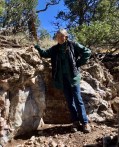
Sara is a naturalist, ethologist ( a person who studies animals in their natural habitats) (former) Jungian Pattern Analyst, and a writer. She publishes her work regularly in a number of different venues and is presently living in Maine.
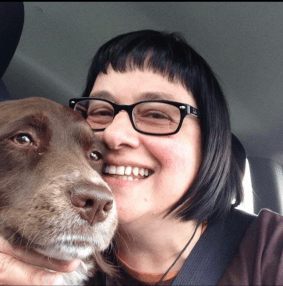 Brother Francesco, known to the world as Saint Francis of Assisi, left us many sweet and lovely poems and songs. In “The Canticle of the Sun,” he wrote about the gifts of nature. Brother Sun, his light and radiance.
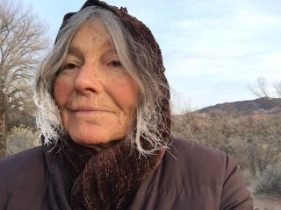 I recently returned to Maine after what can only be called a harrowing journey from the Southwest. Grateful to feel beloved earth under my feet, I walk along the pine strewn woodland paths to keep myself sane. My animals have been ill, my neighbor was hospitalized briefly, other neighbors deliberately destroyed my garden wall crushing a baby balsam, and used this property as their personal ski slope, the threat of the C/virus looms – there are no words to describe this kind of exhaustion. As a PTSD survivor all my senses are on permanent scream. The simplest task has become monumental. And I am only one of so many…
 For almost 35 years nature has been my sacred place. As an 8-year old, I started to pray to Mother Earth even though the protestant tradition in which I grew up only recognised ‘God the Father’. I went outside in my inflatable rowing boat to seek solitude (as an only child in a quiet family!) on a small island in the lake of our local park. I practised rowing and walking quietly to not break the sacred silence. I collected herbs to brew infusions in my little thermos flask with boiled water brought from home. I sung to the moon, and danced my love for all creation back through my moving body. Over the last 15 or so years, I spent many days and nights at Neolithic monuments, dreaming in ancestral burial mounds, time traveling in stone circles in Cornwall, Wales, Scotland, England, Ireland and Brittany. This nature-based practice evolved naturally, and later incorporated my training with the Scandinavian Centre for Shamanic Studies and the School of Movement Medicine. Nature is where I reconnect most easily with the Sacred, and listen to the whispers on the great web of life in which all of nature is a great teacher. Nature, for me, is a strong place of prayer, solace, awe, reverence, gratitude, joy, guidance, reconnection, healing and transformation.
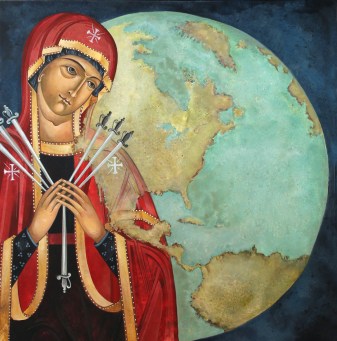

 I was one of millions inspired by Greta Thunberg’s
 My community and many others have been watching in awe as Greta Thunberg makes waves around the world—her lone climate change protest in Sweden growing in a single year into a climate strike with millions of demonstrators around the world. Of course, Greta isn’t asking us to listen to her. She is asking us to listen to the science that will save us. And Greta is not alone: there are young indigenous female protesters like performance poet and peace activist Lyla June Johnston of the Dine (Navajo) and Tsetsehestahese (Cheyenne) peoples and water protector Autumn Peltier of the Anishnaabe people, who are speaking before the UN and in other public settings about global warming, and revitalizing our spiritual relationship with Mother Earth. Yet Greta knows that her fame (and her youth) gives her a platform. She is conscientiously using that platform to testify before Congress and the UN, Tweet, post on Facebook, and do whatever else she can do to make an impact. Recently, I’ve noticed that some people in my home Jewish community, when they post about Greta on social media, have given her a nickname: they call her “the prophetess.”

 Feminism and Religion