Demagogues, Scientists, or Saints: Michael Specter’s Neglected Territory in the Global Food Landscape of Vandana Shiva and the Biotech Industry by Sarah E. Robinson

sarah robinson
Photo credit: Matt Blowers

Written in response to Michael Specter’s article, “Seeds of Doubt: An Activist’s Controversial Crusade against Genetically Modified Crops” in The New Yorker (August 25, 2014). The activist whose work he criticizes is renowned Indian scientist and ecofeminist Vandana Shiva. This is Part One of two. 

In Michael Specter’s article in The New Yorker, “Seeds of Doubt: An Activist’s Controversial Crusade against Genetically Modified Crops,” the author was remiss in omitting overarching narratives in the global food conversation, as well as vital details to clarify the agricultural and ethical landscape in which food scholar-activist Vandana Shiva works.  In his celebration of genetic innovation, Specter ignores sciences, such as agroecology, that criticize and co-exist with biotechnology.  Most appallingly, Specter repeats a slanderous remark against Shiva without challenging its accuracy.  While I appreciate Specter’s attempt to weigh both sides of an issue, as a non-profit director seeking food security for peasants, Shiva cannot be compared with deep-pocketed agribusinesses, which must first attend to a financial bottom line before meeting any humanitarian goals that may be quite honest, despite the smell of greenwashing.

Specter’s article is dubiously well-timed to belittle the hard work of anti-GMO (Genetically Modified Organisms) activists and policymakers in Vermont who face legal challenges to a GMO labeling law passed in April 2014.  State-level GMO labeling has become an important political issue in the U.S., as other states prepare ballot measures and similar legislation.  Consumers in the E.U., Australia, China, New Zealand, Russia, South Korea, and the U.K. have already either banned or required labeling of genetically modified foods.  Just like the so-called “debate” over climate change, the conversation on food safety continues with a hefty dose of political maneuvering.  Continue reading “Demagogues, Scientists, or Saints: Michael Specter’s Neglected Territory in the Global Food Landscape of Vandana Shiva and the Biotech Industry by Sarah E. Robinson”

Eating: Thinking about Bodily Practices, Pt. 1 by Elise M. Edwards

Elise EdwardsI am currently preparing to teach a course on bioethics in the fall. I plan on combining some common, secular materials on biomedical ethics with some theological material and some feminist readings. After all, in a course that centers around practices related to the body, birth, and death, there seems ample opportunity to introduce feminist themes. Some feminist perspective, of course, is typical, like when we will discuss abortion and contraception. (Or at least it is common in my courses where try to present multiple sides of an issue.) Anything related to conception, pregnancy, and birth is easily understood as a “women’s issue” and therefore something that feminists address. I’ve discussed abortion and contraception in previous posts on this forum.

However, I realized in going through readings for this course that I have not focused much on other practices related to the body in my scholarship or personal reflection. Specifically, I have not connected them to theological principles or feminist convictions. Perhaps not everything concerning the body is directly relevant to feminism. But I am sure if I thought about it, I would be able to make the connections. We are physical creatures and the feminist movement generally affirms recognizing our embodiment.

Continue reading “Eating: Thinking about Bodily Practices, Pt. 1 by Elise M. Edwards”

WANGARI MUTA MAATHAI AND SACRED MOUNT KENYA by Carol P. Christ

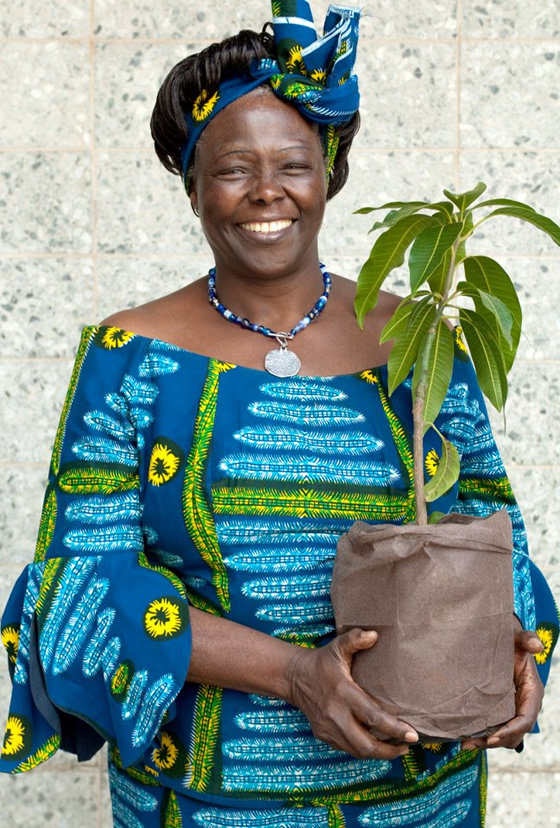
carol-christWangari-Maathai-1September 25, 2013 is the second anniversary of the death of environmental, peace, justice, and democracy advocate and Nobel Peace Prize recipient Wangari Muta Maathai.

Wangari Muta was born in 1940 in a round hut in rural tribal Kenya.  Wangari’s tribe considered the fig tree to be holy, and she was taught that one is never to cut a fig tree down or to use its branches for firewood.  Wangari spent many happy childhood hours in the shade of a fig tree that grew by a nearby stream.  Fig trees play an important role in the ecological system of the Rift Valley of Kenya.  Their roots penetrate the hard rock surface of the mountains to find underground water, thus opening channels where the water flows upward to fill streams and rivers.

As an adult Maathai learned that the fig tree she played under had been cut down by a settler with the result that the river had dried up.  This was happening all over Kenya on a massive scale to make room for cash crop plantations.  Rivers were silting up and widespread erosion threatened to turn the fertile Rift Valley into a desert. Crops were failing, animals were starving, there was no wood for cooking fires, and rural people were suffering.

Maathai  says that as she was thinking about this problem “It just came to me: ‘Why not plant trees?’ … This is how the Green Belt Movement began.”  Continue reading “WANGARI MUTA MAATHAI AND SACRED MOUNT KENYA by Carol P. Christ”

Appreciating the Sacrament of the Present Moment by Michele Stopera Freyhauf

In order to be at peace, it is necessary to find a sense of history – that you are both part of what has come before and part of what is yet to come. Being thus surrounded, you are not alone; and the sense of urgency that pervades the present is put in perspective. Do not frivolously use the time that is yours to spend.  Cherish it, that each day may bring new growth, insight, and awareness.  Use this growth not selfishly, but rather in service of what may be, in the future tide of time. Never allow a day to pass that did not add to what was understood before. Let each day be a stone in the path of growth. Do not rest until what was intended has been done. But remember – go as slowly as is necessary in order to sustain a steady pace; do not expend energy in waste. Finally, do not allow the illusory urgencies of the immediate to distract you from your vision of the eternal.

                                                     (Elisabeth Kubler-Ross, The Final Stage of Growth, 167)

Freyhauf, Feminism, Religion, Durham, Old Testament, Blogger, Bible, Gender, Violence, Ursuline, John CarrollLast month we lost a good friend unexpectedly.  His death, just days after his 49th birthday caused me to confront my own mortality. His death also makes me think about that void in life that we leave as well as the legacies we leave behind. How will I be remembered?  Did I make a difference while on earth? Have I served and given back enough?   Continue reading “Appreciating the Sacrament of the Present Moment by Michele Stopera Freyhauf”

A Calling, A Vocation by Elise M. Edwards

Elise Edwards

In my previous post The Feminist Influence, I began discussing what a feminist perspective might bring to a theological study of architecture.  I asserted that a feminist perspective on the ethical function of architecture offers at least two contributions: (1) it provokes questioning about what flourishing is for all peoples and the Earth, and (2) it provokes examination of systems of power and privilege and how they are constructed into our built landscape.  I think a feminist vision of architecture could help all of us (even those of us who are not design professionals) promote design that respects and responds to our environment, addressing the harm we have done.  I do want to give some thought, though, to what it means especially for architects and other design professionals. Continue reading “A Calling, A Vocation by Elise M. Edwards”

For the Love of Gaia by Jassy Watson

For the Love of Gaia Jassy WatsonOn January 26, 2013 a rare, devastating tornado hit our community in Queensland, Australia, a coastal town on this sub-tropical coast. My family experienced nature’s elemental force firsthand and hopefully will never again. The tornado viciously shattered houses, peeled away roofs, uplifted cars and trees, and took down power lines, tearing apart everything in its path. With absolutely no warning, literally out of the blue, it formed over the churning sea, rapidly intensifying before striking land, awakening the vulnerability and fragility of all life in its midst.

When it struck, our four kids and I were waiting in our car while my husband ducked into a mate’s house to borrow a tool. We heard the sound of a roaring jet plane overhead, as my husband came running, screaming at us to get out of the car. Turning to my left, in a vision imprinted forever, a spiral of debris flew toward us. Scrambling, we got the kids out of their harnesses and safely indoors. I lagged behind, taking care of the children first, and fell out of the side door of the van with the wind’s impact. As I got up to run, a large piece of roofing tin flew straight for my head. I dove, seeking safety under the front of our running car. My life flashed before my eyes. All of us in a state of shock, the tornado was gone as quickly as it had come, we were unscathed except for a few minor cuts and bruises. It was only a few moments before the immediate danger passed. We ventured outside to inspect the damage, destruction surrounded us. Continue reading “For the Love of Gaia by Jassy Watson”

The Danger of the Patriarchal Domination Mindset: Can We Do Anything About It? by Thea Iberall

The Danger of the Patriarchal Domination Mindset: Can We Do Anything About It? By Thea Iberall The Swallow and the Nightingale

At the confluence of misogyny, prejudice, homophobia, religious intolerance, environmental destruction, and violence is the patriarchy. We all know this and talk about it here from our own perspectives. I come as a scientist and writer. I have a love of history and science as well as a skill at simplifying complicated things. I abhor what some people are doing to our planet and the arrogance with which they do it. Unfortunately, because we want the stuff they are manufacturing, because there are too many of us, and because we are letting them do it, they do it with our blessings. I want to help change this situation with a novel I’ve been working on for almost 15 years.

In the year 2000, I sat in a dinghy in the caldera of the active underwater volcano at Santorini helping my geologist sister count the bubbles coming from below us. The experiment was part of my father’s research into the origins of life. I had had the seed for a novel thirteen years earlier when I heard Mimi Fariña sing The Swallow Song, talking with her about her deceased husband Richard Fariña and how lost his music has become. I began developing ideas, learning about the nightingale connection and discovering a 12th century Sufi master’s epic allegory about god. Sitting in that dinghy, everything coalesced: the story of how western civilization went off course. My book of contextual poems, The Sanctuary of Artemis, explores the roots of Western patriarchal culture and tells some of it. The novel would have a backdrop of a world collapsing as ornithologist Dr. Deborah Wright is unwittingly guided by the Sufi to figure out why the Capistrano swallows are dying. It would include an underlying history of an egalitarian world lost when this volcano erupted in 1628 BC. Richard Farina’s song would be playing throughout the pages.  Continue reading “The Danger of the Patriarchal Domination Mindset: Can We Do Anything About It? by Thea Iberall”

The Feminist Influence by Elise M. Edwards

Elise Edwards

In these past few months, as I’ve been finishing my dissertation about a theological and ethical perspective on architecture, I’ve had the pleasure of speaking often about my work.  In March, I was invited to give a talk at a symposium titled “On Christ and Architecture” at Judson University.  As they introduced me, the speakers noted that I am a black feminist.  Because of the brevity of my presentation, I didn’t speak about things that most people associate with feminism. So I was especially excited when at the end, one of the organizers complimented me by saying, “I really see the feminist influence in your work and I thank you for bringing that to us.” So exactly what does a feminist perspective bring to a theological study of architecture?

Perhaps first I should explain what my theological study of architecture is.  The purpose of architecture is sometimes understood as aesthetic or functional—to either make buildings that look nice or serve their purposes well (or both).  However, I discuss an ethical approach that expands this common understanding of architecture.  Grounding my research in philosopher Karsten Harries’ The Ethical Function of Architecture and theologian Timothy Gorringe’s A Theology of the Built Environment, I argue that architecture presents interpretations of a community ethos, or way of life, for its specific time and place.  These representations can either promote or inhibit human flourishing, and therefore, are the proper concern of Christian theology and ethics, which is concerned with questions about how Christians and those in the broader society are to live rightly in the world. Continue reading “The Feminist Influence by Elise M. Edwards”

To Garden by Kathryn House

My work is transformed when I view the task at hand through verbs I learned through gardening: tend, nurture, sow, dig, weed, share, till, harvest, nourish, rest.

Yesterday was the autumnal equinox, which means that fall is officially here. Right on cue, the first leaves are changing from green to shades of gold and crimson. The air is crisp, and the nights are cooler. In the Northern Hemisphere, fall also marks the beginning of the harvest season. Tending a garden has certainly changed the way I think about food, but it has also given me a lens through which to reflect more broadly on community, justice, faith, and hope. I love that gardening invites me to consider a way of being that is governed by a rhythm all its own. This steady beat brings my tendency to rush without reflecting to a halt. Every garden is unique and every gardener has a different philosophy, of course. For myself and for the housemates with whom I have gardened over the years, these three raised beds have come to constitute a sacred space. A space of hospitality, of nurture and delight, they are a space around which we are reminded of finitude, of beginnings and endings, of gratitude. Continue reading “To Garden by Kathryn House”

Painting Pachamama and Gaia by Angela Yarber

 Pachamama prevails.  Her body is one with the Andes and she births the caverns, canyons, and rivers that sustain the earth.  

This month, the indigenous people of the Andes celebrate a high holy season in Incan mythology, honoring their beloved Pachamama.  Pachamama is venerated as the earth goddess and during August, her followers give her payment (pago) with their central ritual of Challa.  So, I’d like for my monthly article about Holy Women Icons to celebrate this earthy goddess of Peru, along with a similar manifestation of mother earth, Gaia.  Thus far, the biblical dancer, the Shulamite, feminist scholar, Mary Daly, and literary figure, Baby Suggs, have been the icons with a folk feminist twist that I have discussed on Feminism and Religion.  Now, I’d like us to join with our Andean sisters in toasting the holy women icons of mythology: Pachamama and Gaia. Continue reading “Painting Pachamama and Gaia by Angela Yarber”