

 As a Jewish feminist, I’m often critical of marriage. And, as a 26-year old (this month) who attended Jewish camp, leadership/environmental programs in Israel, and was active in Jewish youth groups growing up, I’ve been frequenting my fair share of Jewish weddings lately. These occasions bring me joy, nostalgia, and an overall reminder in the beautiful power of ritual and ceremony. But they also bring me a piercing sense of anxiety – one that I’m sure I am not alone in experiencing. I see marriage as a heteronormative and ideologically oppressive institution that promotes a hierarchy of relationships – being married as the most desirable form of a relationship, and remaining single as a failure of the female, much like not having children is seen as a failure of womanhood. I see the seventy billion dollar (or more) American wedding industry as representative of the capitalist impulse involved in the planning of weddings, bachelorette parties, and honeymoons, not to mention the violence involved in the so-called “blood diamonds” of so many engagement rings. Continue reading “Jewish Weddings: Identity, Desire, and Anxiety by Amy Levin”
Category: Family
The Crime of Being a Girl Scout: The Sin of Raising Strong Female Leaders by Michele Stopera Freyhauf
 Cradle Catholic and Woman
Educated by the U. S. Vowed Religious
Support the U. S. Catholic Sisters
Support, Minister, and Live the Social Gospel
Theologian, Feminist, and Critical Thinker
Former Girl Scout Leader of Three Troops
Former Girl Scout
I am all of these things and more. By the recent attacks by the hierarchy of the Catholic Church, I am beginning to think I am the problem. I seem to stand for everything the Vatican and USCCB seek to silence. Is it because of my organizational ties with the U. S. Vowed Religious and Girl Scouts, or my writings as a Feminist and Theologian? Maybe the answer is simply – because I am a woman.
According to the criticisms launched by the USCCB and the Vatican, I seem to be part of the problem rather than the solution. Why is this so? It was not until I started my journey in ministry that my idealistic “Catholic” bubble popped – not so much by me, but by those in ministry and leadership, by those that did not like laity to pose questions and think critically about their faith beliefs, and by those that do not like people who do not fit within the preconceived mold of what a “good Catholic” should be. This ideological construct is difficult enough when you are part of a Church community, but when you begin to embrace leadership as a woman, question teachings, exercise your canonical rights, your peers and even people you thought were your friends, no longer talk or associate with you. The betrayal is vicious and runs deep – it is behavior not becoming of a minister or one who professes the Catholic faith.
If the attack on you is not enough, these same people victimize your children through their words and behavior. It is a difficult position for anyone to survive spiritually. For children of the Church who bear witness to this hypocritical behavior, a journey begins – they search for meaning within the spiritual realm and become disgruntled with anything that resembles organized religion. A place where one seeks community and spiritual nourishment becomes a place of oppression and starvation. If attacking family is not enough, let’s start attacking groups that promote community – groups like the Girl Scouts of America.
So, what is the USCCB’s problem with the Girl Scouts of America? Basically, this organization is under fire for suspected deviant thinking and positions that stand opposed to Church teaching. Continue reading “The Crime of Being a Girl Scout: The Sin of Raising Strong Female Leaders by Michele Stopera Freyhauf”
Feminist Family Values by Gina Messina-Dysert
 As a new mother, something that is constantly on my mind is how to teach my daughter morals and values. She just turned three and has a strong awareness of what is going on around her. Her vocabulary is vast and continues to grow daily. I know that if I don’t start teaching her values now, I am missing out on an important opportunity.
Although I was raised Catholic and consider myself a “cultural Catholic,” I am uncomfortable with Catholic traditional prayers because of their lack of gender inclusiveness, among other things. We don’t attend church as we have not yet found a community that we feel is a good fit for our family.
Thus, I have found myself creating new prayers to recite at dinner and bed time; prayers that encompass our family values, are feminist in nature, and are simple enough that our daughter can remember and recite them on her own. Continue reading “Feminist Family Values by Gina Messina-Dysert”
Why I Failed Feminism 101: Gender, Sexuality, and the Power of Relationships
I forgot, that relationships, like feminism, are not easy, and that it is a conscious and continual effort of renewal to remind yourself everyday why you love the person you love and more importantly, in the case of feminism, why you fight, “the good fight.”
 I was once told by my ardent feminist advisor in undergrad to “not put all my proverbial eggs in one man basket” after discussing my relationship with my boyfriend over a cup of coffee. Thinking my relationship was different and that we were special, I heeded the warning but thought of it no further. Now, looking back on it three in a half years later, I wish I would have.
Relationships are a powerful tool. They help to make you feel special. They help to bring you joy. They help you discover the reason why a divine presence may have endowed us with the ability to love and most importantly they help you realize and discover things about yourself you may have never taken the time to notice.
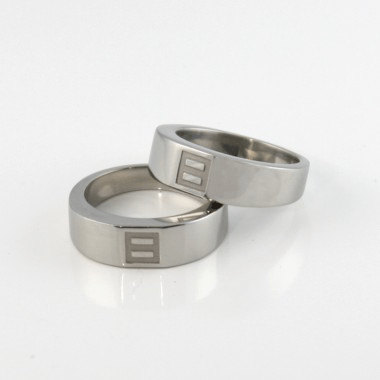 Feminism 101 is more than just the pop culture stereotype of a bunch of women advising the younger generation of girls to be weary of men and the pain they can bring. Feminism, specifically as what I now call Feminism 101, is the transformative ability to listen to your elders, trust yourself, and ultimately, if you happen to trust in the relationship you have built, knowing deep down that it is built on equality, love, and trust. Continue reading “Why I Failed Feminism 101: Gender, Sexuality, and the Power of Relationships”
JUDGES 19: A BRIEF PAUSE FROM JUSTICE-WORK TO BE WITH HER IN THE SILENCE BY IVY HELMAN
 Elie Wiesel, Holocaust survivor and renowned Jewish thinker, believes that no one can ever truly understand the profundity and tragedy of the Shoah unless one experienced it. For him, silence is the best way to express the events since words fail to do justice. The principle of letting silence speak, when words no longer can, when pain is so real it debilitates and when tears flow more freely than thoughts, is not original to the twentieth century. The Bible contains many events and personal stories in which this is the case.
Judges 19 begins with two characters: a Levite and his concubine. The concubine has recently run away to her father’s house, when her husband decides to visit her there trying to win her back. He seems to have only good intentions in mind. After leaving her father’s house with his wife, the Levite discusses his future plans with his servant who apparently accompanied him on the journey. He still has not spoken a word to his wife.
The servant and the Levite decide to spend the night in Gibeah, a Benjaminite city. The three of them sit in the city’s square waiting for someone to take them in but no one arrives until evening. At dusk, an old man comes by and offers to take care of the needs of the entire party, including the donkeys, as long as they promised not to spend the night in the city square. Continue reading “JUDGES 19: A BRIEF PAUSE FROM JUSTICE-WORK TO BE WITH HER IN THE SILENCE BY IVY HELMAN”
A MEDITATION ON A MIDRASH: “ABRAHAM’S DAUGHTER” BY ARCADE FIRE by Sara Frykenberg
 The wages of the sin of sacrificing our children is their death, whether the sacrifice is to some supposed higher order, to absolute obedience or to appear to be the “good Christians” we are “supposed to be”…
Maybe its because I enjoyed the books more, or because of my sister’s all too expectation-garnering reviews or even, because I’d seen this theme before, in an amazing yet gruesome Japanese movie, Battle Royal, I left the theater unsatisfied after watching The Hunger Games. I did however, LOVE the song that played at the end of the movie, which I downloaded before we left the theater. I listened to it in the car on the way home. I listened to it the next day, the day after that and for days after that… I listened and listened, and I found surprise, power, anger, sorrow and a channel for grieving that I had needed in the Midrash “Abraham’s Daughter” by Arcade Fire.
Abraham took Isaac’s hand and led him to the lonesome hill
While his daughter hid and watched, she dare not breathe
She was so still.
I discovered the practice and potential power of Midrash from my teachers in graduate school. The idea of an “extra-biblical” story that might help to expound upon Biblical passages that are all too often unexplained or unsatisfactory to (my) feminist consciousness was very appealing to me—and it is still appealing to me. But I have to admit that the feminist Midrash I read in my classes seemed too positive and did not resonate with me. The pieces were too much like a tender hug or a mother hen covering my wounds with her wings. I wanted to hear a story of Bible that could help me make sense of the violence I’d discovered in my childhood religion. I needed a story of Bible that honored my violent struggle to counter the abuse within it and within me.
Like Isaac, I was too intimate with my abuser: unable to avoid walking hand and hand with him when pushed to do so. Asked to create a prayer or Midrash for a class once, I wrote about the way I would turn the radio in my car up when I started to hear ‘God’ speak to me. I didn’t know how to listen and tune out the abusive maxims that played over and over again in my head (maxims that surfaced every time I even thought about the divine). Continue reading “A MEDITATION ON A MIDRASH: “ABRAHAM’S DAUGHTER” BY ARCADE FIRE by Sara Frykenberg”
Resurrecting Scars by Shelly Rambo

What does it mean to be created through the scars of a (m)other? And what does it mean to be made new—to be recreated—by them?
It is my first Easter without my mother. My sister Jody reminded me of how much my mother loved religious holidays, especially Easter. One of my striking last moments with my mother was in the hospital operating room when the nurse was preparing her for a surgical procedure. As the nurse opened up the back of the hospital gown, she exclaimed: “What beautiful markings you have.” She was referring to the scars on my mother’s back from a previous heart surgery. “It’s like a work of art.” My mother never viewed them like that. Instead, she often kept her multiple scars hidden from us. But there were moments, as a young girl, when I would glimpse them, those in the front between the buttons of her tightly starched blouses, and those on her back when she’d be ironing her Sunday dress in her satin slip. I was both intrigued and scared by these tracks on my mother’s body, just as I was by the ticking of her mechanical heart valve that I could hear when I stood next to her, the traffic in the house at a standstill. Both were reminders to us that her life was sustained yet fragile.
Much of Western literature tells the stories of fathers and son. And the dominant Christian storyline has also been patrilineal. Continue reading “Resurrecting Scars by Shelly Rambo”
A Family Conceived, Lost, and Resurrected by Gina Messina-Dysert
 As I had written about in a previous post, my husband and I had a very long struggle with infertility. After nine years, multiple failed rounds of infertility treatments, and much heartache, we decided to look at alternative options to grow our family. Once we had made the decision to adopt, I felt new hope. There was a light at the end of the tunnel and I knew a child would be coming home to us before long. I had a dream that Mary, the mother of Jesus, had come to me and told me that I would be a mother. She promised that a child was waiting that needed our love and would arrive soon. I began praying to a shrine of Mary at a local parish near my home; she became my source of strength and solace.
Not long after we had been approved for the adoption waiting list, we took a family trip to Italy to visit my father’s hometown and meet our relatives. It was quite an adventure and during our excursion I stopped in every church we passed to say a prayer to Mary. Half way through the trip we received a call that a child had been matched with us. To say we were overjoyed would be a complete understatement. We tried to catch an earlier flight home but were unable. A once in a lifetime trip to Italy was suddenly of no interest to us as we sat around our hotel room looking at baby items, reading parenting info, and preparing for the homecoming of our first child. Continue reading “A Family Conceived, Lost, and Resurrected by Gina Messina-Dysert”
“If You Allow Gay Marriage…” by John Erickson
“We need to start examining the underlying questions of counter-cultural relationships that view one man marrying many women to be hip because we begin to see that although a polygamist idea of marriage may be sexy from a popular culture standpoint, the thought of legally recognized gay marriage always then gets likened to bestiality.”
… you have to allow polygamy, bestiality, and everything else!” The title for my post this week is a quote from an individual I used to associate with. This individual, haling from a conservative evangelical background, tried to explain to several others and myself the reasons why gay marriage would eventually lead to the repeal of anti-polygamy and bestiality laws across the United States.
The problems that I have with this particular argument are conflating gay marriage with religious freedom. Activists and scholars can draw comparisons to anti-polygamy cases such as the 1878 U.S. Supreme Court case Reynolds v United States and the 1882 Edmunds Act and 1887 Edmunds-Tucker Act that disfranchised and led to the imprisonment of Mormon polygamists. But in the end, gay marriage is not about religious freedom but rather human rights.
I often feel that there is this need both within and outside religious communities to promulgate the idea that LGBTQ individuals want to get married within the sanctified walls of “the church” just as much as heterosexual couples do. Although I do not want to disqualify those who desire to see LGBTQ equality within their faith based communities, buying into a heternormative ideal of what traditional marriage should look like needs to result in LGBTQ individuals asking why marriage should be performed in sacred spaces in the first place The normative traditions that have often defined marriage have also served as shackles keeping LGBTQ couples in the mindset that to achieve fully marriage equality with their heterosexual counterparts is to fully immerse themselves within the same traditions and practices. Continue reading ““If You Allow Gay Marriage…” by John Erickson”
On Cooking and Eating by Ivy Helman
 In patriarchal heterosexist societies women do most if not all of the cooking for their families. Women are also usually assigned the tasks of cleaning, raising children, tending the family garden, gathering water and anything else that is considered part and parcel of caring for the family. These feminine tasks are often devalued compared to the activities men spend their time doing. I wholeheartedly support the reevaluation of the significance of these tasks and the movement toward shared responsibility for family life among heterosexual couples, however that is not what I want to discuss today.
I want to explore the religious and spiritual significance of the food cooked by our mothers, grandmothers, aunts, sisters and female friends, especially those dishes we would consider to be comfort food. Every person, every family has their own idea of what meals are comfort foods. Bubbe’s matzah ball soup on Shabbat maybe? Aunt Betsy’s Easter ham? Mom’s turkey, gravy and oyster stuffing on Thanksgiving? Your sister’s famous mac and cheese? Continue reading “On Cooking and Eating by Ivy Helman”
 Feminism and Religion