

During the past week I have been thinking about Greek spring fountains while designing a water fountain for my new apartment in Heraklion, Crete. When the architect sent photos showing that the tiles had been removed from my balconies, I noticed an enclosed niche that could be used for stacking wood, turned into a closet, or as I began to imagine, would be the perfect place for a fountain to bring the soothing sound of running water to my balcony. Continue reading “Designing with the Goddess in Mind: A Meditation on Greek Spring Fountains by Carol P. Christ”
Category: Feminism and Religion
Safe Hands in the Moria Refugee Camp in Lesbos: A Starfish Project
 Imagine that you are a young mother of three from Syria, and that after fleeing your home with your husband and family, you arrived in Lesbos and have been waiting for months to have your asylum papers processed. You don’t know when that will happen, it could take more than a year, you have been told. You are staying in a tent with other families because the containers are full. You have no privacy. When it is cold you are cold, and when it rains you get wet. You try to keep your family clean and healthy, but there are not enough toilets and showers for everyone. In addition, you are afraid to leave the tent at night because some of the men without families drink too much and harass you and the other women.
You have heard that a strange new disease is killing people all over the world. It has a name but you cannot remember it. You don’t know what the symptoms are, and you don’t know what to do to protect yourself and your family. What you do know is that the camp is on lockdown, which means that no one can leave. This is especially hard on the men, including your husband. They have been used to feeling at least a little bit free when they walked outside the camp. Now they feel like they are in prison. They get angry easily, and this makes life harder for you and the other women. Continue reading “Safe Hands in the Moria Refugee Camp in Lesbos: A Starfish Project”
I Am a Progressive because of Not in spite of My Feminist Spirituality by Carol P. Christ
 Feminist spirituality is often disparaged in academic feminist and progressive communities. Many of the strongest critics are Marxists, but there is a general agreement that religion is the opiate of the people, a false belief system that diverts energy from the difficult work of creating justice in this world. This view is rooted in the habit of thought known as classical dualism in which spirit and nature, spirit and body, and this world and the next are viewed as antithetical. From this, it would seem to follow, feminist spirituality focuses attention on an imagined spiritual world as opposed to the material world in which real people live and interact with each other. Nothing could be farther from the truth.
Feminist spirituality is rooted in a strong critique of classical dualism, which sets mind above body, spirit above nature, and male above female. Feminist Goddess spirituality asserts that the female body has been especially disparaged in traditional theologies rooted in classical dualism. This can be seen in the image of the naked Eve as the source of evil, sin, and temptation. In contrast, Goddess spirituality is inspired by images of the female body of the Goddess as a symbol of the Source of Life. Goddess spirituality understands nature (or the world) to be the body of the Goddess and affirms this world as our true home. This world is understood to be an interconnected web of life shared by humans and other than human beings. Continue reading “I Am a Progressive because of Not in spite of My Feminist Spirituality by Carol P. Christ”
Coronavirus: The Villain Is Not Mother Nature: It Is Ourselves by Carol P. Christ
 Over the past few weeks of lockdown in Greece, I have asked myself numerous times: if we can shut down the world economy because of a virus, why don’t we shut everything down until we end war or find real solutions to global climate change? In my mind the horrors of war are much worse than the horrors of disease and dying and the threat and reality of global extinctions pose a much greater threat to humanity (not to mention nature) than the Coronavirus.
Why is it that we are willing to take extreme measures to defeat the Coronavirus but we are not willing to take extreme measures to end war or to stop global climate change? A thought keeps creeping into the back of my mind: the fight against disease and death is (understood to be) a fight against Mother Nature and (sadly) we are well used to fighting against Her. If we recognized that human beings have brought the Coronavirus upon ourselves, we would have to face up to our responsibility for it. Continue reading “Coronavirus: The Villain Is Not Mother Nature: It Is Ourselves by Carol P. Christ”
Last Will and Testament by Carol P. Christ
 Just over a month ago and shortly before Greece went into Coronavirus lockdown, I signed the contract on my new apartment in Crete (after waiting 6 months for the owner to submit his paperwork). Though I did not realize it until I had been sitting in the notary’s office for several hours, the date of the signing was February 25, my father’s birthday. My father and I had a troubled relationship, due to the fact that he could not accept that I did not “know my place” in a world where women were expected to be submissive to men.
My father and I did not see each other during the last thirteen years of his life. After having received “the silent treatment” for two of the four months when I was teaching in California and living less than a mile away from him and his third wife, I had gradually come to the conclusion that I did not want to put either of us in the position where he could be cruel to me again. When he developed a heart problem a few years before he died, I decided not to visit. Nor did he ask me to do so. Continue reading “Last Will and Testament by Carol P. Christ”
Dignity of Women Across the World’s Wisdom: Parliament of World Religions Webinar by Carol P. Christ
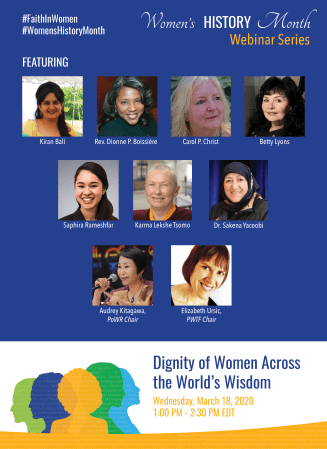 I have been asked to post my contribution to the Parliament of World Religions Webinar: Dignity of Women Across World’s Wisdom.
I am participating in this discussion as a representative of women who are on a Goddess path. I do not represent any established or newly formed religious or spiritual tradition. Rather I speak for an increasingly large number of women who are seeking alternatives to established traditions that celebrate and legitimate male power as power over or domination. We do not follow leaders or gurus and we place no trust in any sacred texts.
Most of us have grown up in cultures where the most prominent religious traditions feature male Gods, male teachers, and male religious leaders. We agree with Mary Daly who said that when God is male the male is God. In traditions where God is male, male teachers and religious leaders are viewed as reflecting or being in the image of the male divinity. We do not assume that images of God as male are never valid, but we do assert the need for images of God as female.
As I said in my often re-published essay, “Why Women Need the Goddess,” the most important meaning conveyed by the symbol of Goddess as the ultimate creative power in the universe is that female power is legitimate and good. This does not mean that female power is always good, but it clearly undermines the widely held view that female power exercised apart from male control is always evil or bad. This view is reinforced by images of women as evil in religious traditions, for example, Eve seduced by the snake. Continue reading “Dignity of Women Across the World’s Wisdom: Parliament of World Religions Webinar by Carol P. Christ”
Women’s Circles Need Well-Established Structures to Ensure that Everyone’s Voice Is Heard by Carol P. Christ
 In a recent blog on Feminism and Religion, “Insights on Sisterhood,” Eirini Delaki opened a dialogue about problems that arise in women’s circles. According to her, many of us are reacting against the poisonous pedagogy of control which is all too familiar in patriarchal families and patriarchal cultural, religious, and economic institutions. Desiring to be free of hierarchical structures that inhibit our growth and happiness, we often react against all structures.
We imagine that groups without structure will provide a space where we can learn and grow together. We begin with a vision of sisterhood in which everyone’s voice will be heard. In practice, however, groups without structure usually end up being dominated by those with the loudest voices and the biggest egos. The quieter and less sure members of the group find themselves dominated again. When the vision of sisterhood is not realized, the group is likely to dissolve. Continue reading “Women’s Circles Need Well-Established Structures to Ensure that Everyone’s Voice Is Heard by Carol P. Christ”
Insights on Sisterhood: An Offering to the Great Goddess by Eirini Delaki
 I have been facilitating women’s circles in Europe since 2006. This has involved years of deep, challenging, thankful, and fun teaching and learning. During that time, I have collaborated with different facilitators in the fields of art and spirituality and connected with different cultures, experiences that have reinforced a vision of SISTERHOOD.
Let me clarify that in no manner am I excluding men from these reflections. On the contrary, I believe that many dysfunctional and suffering men have been shaped by women who haven’t managed to stand up for themselves. They harm their children through manipulation while not directly challenging an oppressive system out of fear or a need to feel accepted and to belong.
My students and I are going through an important transition. Most of us come from parents who have spent their lives seeking material possessions, safety, comfort, and success in terms of competition enforced through harsh discipline. Then we moved to the other extreme: we have a reactive attitude towards the previous patterns that is manifested as procrastination, avoidance of tasks that involve responsibility towards ourselves and others, being too permissive, confusing freedom with doing whatever feels right at the moment, and so on. Continue reading “Insights on Sisterhood: An Offering to the Great Goddess by Eirini Delaki”
Grief, Disappointment, and the Big Comforting White Guy Who Can Make It All Right by Carol P. Christ
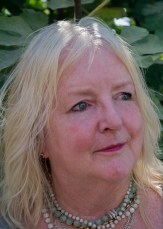 As the results from America’s Super Tuesday election primaries came in, I found myself feeling disoriented. I could not focus on any task and found myself obsessively reading the news and checking my Facebook timeline. Many of my friends who had supported Elizabeth Warren were embracing Biden as the next best hope to defeat Donald Trump. Sometime on Thursday, I came across Starhawk’s Facebook post on the grief and disappointment so many of us were feeling following the latest primary results.
In the post, Starhawk spoke of her disappointment that Bernie and Elizabeth did not do better and that Biden did so well. She spoke first of her grief that Elizabeth’s campaign never took hold. No doubt she, like me and many of you, had heard feminist friends express the fear that a woman could not win, saying that as much as they wanted to vote for her, they probably would not. Starhawk said that we simply do not have enough archetypes of female power to enable people to imagine a woman as President. Continue reading “Grief, Disappointment, and the Big Comforting White Guy Who Can Make It All Right by Carol P. Christ”
Matriarchal Politics by Heide Goettner-Abendroth
 Today’s blog is a sequel to: “Matriarchies Are Not Just a Reversal of Patriarchies: A Structural Analysis.”
On the basis of modern Matriarchal Studies, we can develop the vision of a new matriarchal, egalitarian form of society. This is called “Matriarchal Politics.”
The path to such a society has to combine matriarchal spirituality with politics, to create another kind of economy and another society. How this can be achieved is clearly portrayed by traditional matriarchal societies. Their economy, politics, social life and spirituality are inseparably connected: their goal is to provide a good life for all and this is assured through their structure and conventions.
Of course, we cannot go back and simply transfer historical patterns to the present. It is unlikely that we will return to societies based on the blood-relatedness of clans or sole dependence on agriculture. History and its social development cannot be turned backwards. But for our own path into new matriarchal, egalitarian societies, we can gain much stimulation and great insights from patterns which have been tried and tested for millennia. Continue reading “Matriarchal Politics by Heide Goettner-Abendroth”
 Feminism and Religion