Death and Re-birth through a Project by Elisabeth Schilling

Art by Magdalena_Korzeniewska

For about a year and a half, I have been working on a collection of poetry that I feel is worth something. I have been writing poetry since I scribed pages hidden between my math textbook when I was 9, gone through poetry workshops in graduate school where I produced a creative thesis, and continued to write off-and-on after that. I have an extensive cornucopia of poetry, but it was around last October of 2016, perhaps, that I decided to write my experience.

As a pre-teen, I wrote about what I thought my life could be, fantasizing about being an older woman with mottled relationships, missing opportunities to discuss my fragile relationship with my parents as the only-child-golden-child, my passion and doubts as a religious, my shame at not being more experienced. Even when I was in graduate school for poetry in Ohio, I didn’t think my life was worth excavating. I wrote dreamy, dense poetry that was surreal and symbolic but largely incoherent. I could again have written about my evolving religious beliefs, my curiosities and risks I took living outside of my home state of Oklahoma as a young woman for the first time, my declining relationship with my mother, or my insecurities again, but this time as a lesser-prepared graduate student in comparison with my literary and theory-laden colleagues.

On one hand, some might say the culture I come from is narcissistic and navel-gazing. I would agree, but just like I feel women can sometimes be selfish in a quite necessary and liberating way (as opposed to those around her accusingly saying she is “so selfish” for abandoning them/following her own path/needing a room of her own), I feel the confessional and self-reflective can be the healing and helpful side of the coin. For me, at least in my experience, my “finished” collection feels exactly this way.

Continue reading “Death and Re-birth through a Project by Elisabeth Schilling”

Sex is a Feminist Issue: An Interview with Rev. Dr. Beverly Dale by Jera Brown

Sex is a feminist issue. Harmful perspectives on sex and our physical bodies have been used to disempower and invalidate the sexuality of women, LGBTQIA folks, and people of color. It runs through our theology and cultural traditions within the church.

I run a personal blog which speaks positively about sex and queerness. And when folks find it, frequently, their first questions to me is what other resources are out there that teach a better Christian perspective? I often tell them to start with The Incarnation Institute for Sex and Faith.

IISF offers “inclusive, science-friendly, sex-positive” educational programming for church leaders and lay people. Founder Rev. Dr. Beverly Dale, affectionately known as “Rev Bev,” is ordained through the Christian Church (Disciples of Christ) and currently teaches courses on sexuality and religion at Lancaster Theological Seminary.

The institute recently released a four-part web series, Reading the Bible with Sex-Positive Eyes, which includes the topics: “Introduction to Christian Sex Negativity: The Beginnings,” “Discerning Truth, Discerning Culture,” “Sex in the Bible: The Good, The Bad & the Ugly,” and “Sex: Whether, When, and How.”

I interviewed Rev Bev about the new series.

Continue reading “Sex is a Feminist Issue: An Interview with Rev. Dr. Beverly Dale by Jera Brown”

The Exclusion and Embrace of Trans-women within Feminist Spirituality by Kelly Palmer

Women-only circles have long existed within the Goddess movement, the Red Tent movement for example exists as an inter-faith, grass-roots movement for women only to come together to claim safe and sacred space. But too often ‘women-only’ in fact means ‘cis women only’. Trans women are not allowed. This has been the topic of much heated debate in recent years, culminating last year in the publication of ‘Female Erasure’ an anthology of essays on gender politics and feminist spirituality that has led to calls for the editor Ruth Barrett to be expelled from her thealogical seminary on grounds of transphobia. Barrett and many of her contemporaries openly call for the exclusion of transwomen from women-only Goddess circles and respond to criticism by saying that asking for ‘women born women only’ space is not meant to be antitrans but simply carving out a space for people with similar life experience – in the same way that people of specific ethnic minorities may gather, or LGBTQ people. Surely, they may say, the answer is for trans women to create their own spaces?

There are two problems with this. Firstly, trans women are in a significant minority, making access to groups of other trans women practicing Goddess spirituality difficult. If a local woman’s circle is their only means to practicing their religion with others, and they are excluded by this on the basis of their genitalia, this exclusion is incredibly hurtful and undermines not just one’s ability to practice a faith but one’s very identity and esteem. Secondly, it is not just local, personal groups that are practicing this exclusion, but large and public gatherings, making very public pronouncements that trans women are not welcome. They have been excluded from womens rituals at PantheaCon in 2011 and Michigan Womyns Music Festival has a policy of excluding trans women from the entire event.

Continue reading “The Exclusion and Embrace of Trans-women within Feminist Spirituality by Kelly Palmer”

Israel Francisco Haros Lopez by Sara Wright

Borderless Haiku:

We have forgotten the names of each other underneath the shedding skin those names written in our blood that have danced to tonantzin tonatiuh before they knew they were lovers. (IFHL)

Last week I was fortunate to have attended a poetic reading and performance by a remarkably gifted young Mexican man named Israel Francisco Haros Lopez who was born to immigrant parents in Los Angelos. He is both a visual and performance artist, and his work transcends borderlands of all kinds. Israel believes that it is critical to honor and remember the ancestors so that we may once again become one with the winged ones, all those who crawl or walk on this earth, the Four Directions, Earth Air Fire and Water,  Tonanztin and Tonatiuh – the Aztec Earth Goddess and the Sun God – Israel’s expression of unity in divinity, and the universe as a whole. His visual motifs are drawn from Pre – Columbian America and his work is an attempt to search for personal truths within the context of today’s world incorporating Mexican/Indigenous stories into the whole.

Continue reading “Israel Francisco Haros Lopez by Sara Wright”

Kingdom of Women BOOK REVIEW by Katie M. Deaver

In her novel, Kingdom of Women, Rosalie Morales Kearns imagines a reality that is post-patriarchy, and post male violence while showing us what near-future women had to go through in order to get to that reality.  Morales Kearns weaves this story through the voices of multiple characters.  One of these characters is Averil Parnell, a female Catholic priest. Part I of the book opens with a woman visiting Averil to seek her counsel in regards to taking revenge on her male college professor who has been harassing her ever since she refused to sleep with him.

While Averil seems to be of little help with this particular conversation, we learn that Averil was one of the twenty three original female priests that were to be ordained by the Catholic Church. On the day of their joint ordination however, the Cathedral Massacre took place and twenty two of the female seminarians were killed in cold blood.  Averil then, is most definitely a woman who understands the yearning for revenge, the feeling of survivors guilt, and the expectation to be a wonderful priest for her dear friends who had that chance ripped away from them.

At the same time this conversation is taking place it has become clear that small groups of vigilante women are popping up around the world and punishing men for acts of violence against women.  The male dominated government of course sees all these punishing acts as coincidental, explaining them away in one way or another, or ignoring them completely, never imagining that it is in fact the beginning of women rising up to truly end male dominance and violence.

Continue reading “Kingdom of Women BOOK REVIEW by Katie M. Deaver”

A Prophet in Our Midst: Vandana Shiva by Carol P. Christ

She is not crying in the wilderness. She is not railing in the streets.


She sits quietly and speaks softly and with absolute clarity and certainty.

To let all the water systems and food systems and planetary climate systems get destroyed. That is the stupidity which rules us today.

No fire and brimstone, no angry God.

I do not think the planet will die. I think the earth is too powerful.

A simple truth.

We need to protect our home.

Men have lost the way.

Going to war and killing was considered important. Making profits at the cost of others was considered important.

Women must lead.

The values we need are in the knowledge of how to live with nature. That’s what women’s knowledge is. We need knowledge of how to care. That’s knowledge: it’s … called emotional intelligence now. We need knowledge of how to share.

We are part of the earth.

Working with our hands is not a degradation.

Could it really be as simple as that?

Some gender scholars will protest. “This is essentialism,” they will say. “This will keep women in the home where they have always been,” they will say.

If they say this, they will miss the point. This is not gender essentialism. The situation Shiva describes is a product of history. A history in which powerful men determined that war, killing, and profit are the highest values. It may or may not be in women’s nature to know how to live with nature, to care, and to share. These values are part of “women’s knowledge”* because they derive from the work women have been doing while men were making war and making profit on the backs of others.

Shiva is not telling women to stay in the home. She is telling women to confront “deceitful, dishonest, brutal power.”  She is telling women to teach those who rule the world how to live with nature, how to share, how to care.

If women are can teach what they know, how to live with nature, how to care, how to share, women’s knowledge will become human knowledge once again and we may be able to save our home.

If not,

. . . we are dispensable. She’ll find a way.

A prophet is speaking. listen to her words. Etch them on your heart. And save the world.

*Shiva has stated that women do most of the farming in the world. Women who are not farmers care and share and may tend gardens. Women’s knowledge is a relative term. Some women in industrialized countries place ambition, competiton, and profit above caring and sharing. Even in this situation, women generally care for children. See Shiva’s Staying Alive: Women, Ecology, and Development.

Carol P. Christ is an internationally known feminist writer, activist, and educator currently living in Lasithi Prefecture, Crete. Carol’s recent book written with Judith Plaskow, Goddess and God in the World: Conversations in Embodied Theology, is on Amazon. A Serpentine Path: Mysteries of the Goddess is on sale for $9.99 on Amazon. Carol  has been leading Goddess Pilgrimage to Crete for over twenty years: join her in Crete. Carol’s photo by Michael Bakas. Carol will be speaking at the 25th Anniversary Celebration of the Re-Imagining Conference at Hamline University in St. Paul Minnesota on November 1 and 3 and at the Parliament of World Religions in Toronto, Canada on November 5.

I Was Brainwashed to Believe I Wasn’t Human. Now I’m on a Mission Against that Cult – Part 2 by Trelawney Grenfell-Muir

Trigger warning: rape, sexual assault, domestic abuse, graphic sexual content

In Part 1 of this story, I introduced a discussion of Johan Galtung’s theory of cultural violence as it relates to my experience as a young woman in an abusive relationship. To recap:

Cultural violence is: “…any aspect of a culture that can be used to legitimize violence in its direct or structural form. Symbolic violence built into a culture does not kill or maim like direct violence or the violence built into the structure. However, it is used to legitimize either or both.”[1]

Cultural violence against women is: Normalization and promotion of pornography, prostitution, degradation, and sexual objectification of females in media, predominantly male language in civic, business, and religious institutions, gender roles and stereotypes, misogynist humor, gaslighting, minimizing or denying any of these forms of violence.

Part 1 ended right before my ex convinced me to leave MIT and move with him to Minnesota. I had been trying my best to please him by sculpting my appearance to match his preferences, believing that it was my job as a female partner to try to satisfy my male partner sexually.

Continue reading “I Was Brainwashed to Believe I Wasn’t Human. Now I’m on a Mission Against that Cult – Part 2 by Trelawney Grenfell-Muir”

Open Letter to the Pope and all the King’s Men by Natalie Weaver

Dear Sirs,

It breaks me down.  My anger, my revulsion, my powerlessness.   I have been searching for the way since I was a child old enough to remember my mind.  For a time, I thought Jesus was a white guy knocking on my door after having seen a religious pamphlet placed under our windshield wiper.  I’m not sure he has blond hair anymore, but I still feel him knocking.  I have been in love with him for as long as I have been a self, so much so that I baptized myself as a little girl.

Somewhere along the way, I figured my little, lonely way wasn’t good enough, and I wanted a church home.  I finished a doctoral dissertation trying to find some place I could hang my hat.  I picked the Roman Catholic Church, despite what I knew of it and what I had to defend about its patriarchy and history to family and friends.  I loved the conversation, the so-called “Catholic Intellectual Tradition.”  I always felt myself to be a covert, a conversa, a definitive outsider, and someone not to be trusted entirely as a cradle Catholic might be trusted, yet I tried to be family. I’ve been bringing up my kids in the Church, volunteering, working in Catholic education, paying the boys’ tuition.  I do work-arounds, making excuses for the exclusion of women, defying the Church’s stance on sexuality with a critical repertoire of cross-disciplinary scholarship.  Lord, I even had to help my Seventh-Day Adventist mom with a hostile annulment process that was dropped on her unsuspecting by a horrendously insensitive marriage tribunal.  It wounded us all. Yet, here I have sat, until this.

Continue reading “Open Letter to the Pope and all the King’s Men by Natalie Weaver”

Remembering Ginny by Esther Nelson

My husband’s stepmother, Ginny, died last week.  She lived several months past her 97th birthday.  Here is her obituary.

Ginny shared her life with three husbands, outliving each one.  Three sons were born from her first union.  She then married John, my husband’s father, and warmly welcomed us (John’s family) into her life.  When John died, Ginny married Fred.  After Fred’s death, Ginny told me, “Of all my husbands, Fred was my favorite. He was fun.”

Ginny lived at the Brethren Village Retirement Community in Lancaster, Pennsylvania—a home with several levels of care—for over 30 years, moving there a few years after marrying my father-in-law.  She said, “We made a good decision.  I never wanted to be a financial burden on my children.”  And she wasn’t.

Throughout her life, Ginny attended a fundamental, evangelical church.  Had she been able to vote in the 2016 national election, she would no doubt have voted Republican.  She had no use for feminism (women who rail against God’s ordained order), liberalism (the Devil’s message), homosexuality (perversion of God’s perfect creation) and immigrants (they siphon resources from hard-working Americans).

Yet, at the same time, Ginny was generous, giving to causes that fit with her ideological worldview such as missions.  It was important to her that people come to understand the “truth” as seen through the prism of the theology she embraced.  Within her community, she was loving, actively engaged, and caring, helping people in practical ways—donating food and other necessities to organizations sponsored by her church.

Continue reading “Remembering Ginny by Esther Nelson”

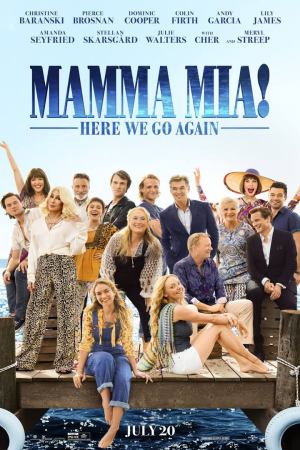
Mamma Mia and the Mother-Daughter Connection by Katie M. Deaver

A couple of weeks ago I went to see the new Mamma Mia: Here We Go Again! movie.  In addition to being a fan of movies inspired by musicals I also loved the emphasis that was placed on the mother/daughter relationship in the first Mamma Mia and had heard that this new installment would continue to focus on that relationship.  It definitely didn’t disappoint!

This second movie takes place five years after the original Mamma Mia, and roughly a year after the death of Donna Sheridan, with Donna’s daughter Sophie preparing for the grand reopening of the Hotel Bella Donna.  This second movie also features lots of flashbacks where we are able to see a young Donna arrive at the island of Kalokairi as well as see how she first meets Sam, Bill, and Harry, her daughter Sophie’s three possible fathers.

As one might imagine, even if you aren’t familiar with the movie there is a lot going on, but the part that I found most intriguing was the very end of the movie.  At this point Sophie has given birth to her own baby and is bringing the child to the church to be baptized.  During the ceremony Donna’s spirit is there at the font with her daughter and new grandchild and you could feel this amazing sense of connection and love between not only three generations but across the lines of physical and spiritual presence and space.

Continue reading “Mamma Mia and the Mother-Daughter Connection by Katie M. Deaver”