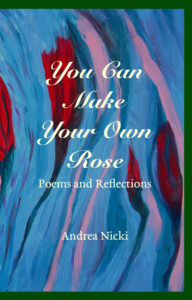
You Can Make Your Own Rose by Andrea Nicki is a collection of poems infused with the spirit of feminist sensibility, social justice and activism. The poems offer more than mere therapeutic comfort while depicting shamanic-inspired healing rituals and magical encounters. They are trauma-free in the sense that Nicki doesn’t ask for our sympathy nor does Nicki simply wish to share traumatic memories. On the contrary, she utilizes somewhat analytical and educational language, interlaced with subtle picturesque and lyrical details alongside a severe social critique, to depict the emotional, intellectual, and social landscape of her reflections on incest and other gender-related forms of abuse.
The United States used to get some respect. But now, except for the most gullible Trumpeters, people all over the world are seeing the damage the Troll-in-Chief is doing to our nation with his narcissism and corruption. What can a community like ours do? We can certainly vote next month and in 2020…and maybe we can also create some magic.
In her book The Cosmic Doctrine, originally written in 1923-24 as channeled from the Inner Planes, British occultist Dion Fortune (1890-1946) describes the Ring-Pass-Not, which is the ultimate outer limit of the universe. Fortune tells us that the Ring-Pass-Not (which was also described, but in a different way, by Madame H.P. Blavatsky) is a purely abstract ring of energy that protects our universe from the demons in other universes. Primal atoms also exist at the Ring-Pass-Not. It sounds like a highly useful place to send the Ogre-in-Chief so that, for once in his narcissistic life, he can clearly face the multitude of demons he embodies. Let us visualize a magical journey for him.
Most of us are trying to make it to a place of material comfort where we are living in a way that feels honorable. Some of us feel we could have made better decisions in the past so that we might have figured out how to do such before the age we are now. I recently did a tarot card reading that I interpreted as mainly positive or neutrally-revelatory. But one of the cards stood out from the rest, and I really didn’t understand it. I was feeling positive that day, and, even though I have often felt unsure and longing in my recent travels despite all I have accomplished materially and psychologically, I have to say it wasn’t a card I was expecting: the III of Swords, which symbolizes disappointment and heartache, especially due to mental happenings. What could I feel heartache at? Perhaps I am disappointed that creating that place of safety and material comfort seems a long way down the road.
Our whole lives, we are taught to be nice. To be considerate of others. To play fairly. To fess up when we mess up. Do unto others, turn the other cheek, respect your elders, obey the rules.
And for what? For what?
So some hyper-entitled coldhearted sneering rapist fuckheads can cheat and steal and lie and game the system until rape survivors are criminals and rapists are victims, while they rob us all blind, crush our freedoms, and rip away our future?
Fuck this sexist shit.
I am so done with this fucking misogynist society, where the president of the most powerful world empire mocks a rape survivor and laughs about assaulting women.
My dad took me to see Bill Cosby in Columbus, Ohio when I was a kid. We used to listen to a record of him talking, which I could only pretend to find funny even then, but dad liked it and wanted to see him in person. The venue had really narrow seating, and although I could barely hear Cosby’s routine, I laughed for most of the show. I had brought a friend with me, who was heavier set, and she squirmed miserably the whole time, at one point looking pleadingly at me and whispering, “I’m trying to get comfortable.” Now, he’s in the slammer, and I get a little ill every time I think of Pudding Pops.
Not too long ago, Uncle Frank died. He terrorized three generations of women in my family. My mom was a little girl when he exposed himself behind a door jam, so that all she could see was his ghostly pale member protruding through the open walkway. She would laugh when she told the story but reminded us to stay clear of him. He was regarded as a family clown, but on his death bed, as my mom put it, he finally “got her.” As she sat at the edge of his bed to bid him farewell, his toes wriggled contentedly into her buttocks. He died with a smile on his face. We laugh, but it isn’t funny. Who knows what he did on his free time?
At the 2009 meeting of the Parliament of World Religions, former US President Jimmy Carter called the worldwide abuse of girls and women the greatest unaddressed human rights crisis of our time. He stated that this problem is “largely caused by a false interpretation of carefully selected religious texts and a growing tolerance of violence and warfare.” Carter discussed these issues in A Call to Action.
In my address to the Parliament of World Religions on November 5, I will agree with Carter that religions play a major role in the abuse of women and girls, but I will question his view that religion’s contribution to the abuse of women and girls stems from the misinterpretation of a few selected texts. Rather I will argue that patriarchal ideas permeate most of the so-called great religions. Continue reading “Religions and the Abuse of Women and Girls by Carol P. Christ”
According to poet Muriel Rukeyser, “the world would split open.”
This poem accurately describes what many women experienced in consciousness raising in the 1970s and what many women experience today in the #MeToo movement.
For many of us the world did split open. We began to take ourselves and our experiences seriously. To do so we had to question received wisdom encoded in such questions as: “What was she doing there in the first place?” “Was she drinking too?” “Why didn’t she change out of her bathing suit?” Underlying these questions is the assumption that: “whatever happened, she must have asked for it.”
This semester I am teaching the course EcoJustice and chose Sallie McFague’s A New Climate for Theologyas our foundational text. Something I greatly appreciate about McFague is that she continually calls us to radically redefine our understanding of the Divine and of our roles as human beings — fundamental questions that could easily lead to an existential crisis as one student reminded me.
My class and I ponder these questions, discussing our own interpretations of God, why we exist, what it means to pray, and understandings of salvation. Not surprisingly, many of us have an anthropocentric theology — one that puts ourselves at the center. We are so focused on what we need from God, we forget to ask what God needs from us.Continue reading “EcoJustice and Our Relationship with God by Gina Messina”
Though represented by its detractors as an incursion of paganism into Christianity, and presented as an integrally and intrinsically Christian phenomenon by its supporters, the truth about the Re-Imagining Conference and movement is that it was a product of a wider feminist awakening. The critique of patriarchal religions that emerged in the academy and in churches and synagogues in the late 1960s and early 1970s was part of the emerging feminist uprising. The feminist movement placed a question mark over all patriarchal texts and traditions, secular and religious, and as such was beholden to none.
In the spring of 1971, Roman Catholic Christian Mary Daly published “After the Death of God the Father” in the liberal Catholic magazine Commonweal. She asserted that the God whose death was touted in the “Death of God” movement was an idol fashioned in the image of male power and authority. She called for “the becoming of new symbols” to express the new becoming of women. In the summer of 1971, a group of nuns from Alverno College convened the first Conference of Women Theologians. Besides sparking dialogue about the role of women in religions, the conference endorsed my call to form a women’s group at the fall meetings of the American Academy of Religion, up until then a gathering of several thousand male scholars of religion, with only a handful of women scholars in attendance. At winter solstice, Z Budapest launched the Susan B. Anthony Coven #1 in Los Angeles publishing a Manifesto calling on women to return to the ancient religion of the Goddess. Continue reading “Sophia, Goddess, and Feminist Spirituality: Imagining the Future by Carol P. Christ”
For about a year and a half, I have been working on a collection of poetry that I feel is worth something. I have been writing poetry since I scribed pages hidden between my math textbook when I was 9, gone through poetry workshops in graduate school where I produced a creative thesis, and continued to write off-and-on after that. I have an extensive cornucopia of poetry, but it was around last October of 2016, perhaps, that I decided to write my experience.
As a pre-teen, I wrote about what I thought my life could be, fantasizing about being an older woman with mottled relationships, missing opportunities to discuss my fragile relationship with my parents as the only-child-golden-child, my passion and doubts as a religious, my shame at not being more experienced. Even when I was in graduate school for poetry in Ohio, I didn’t think my life was worth excavating. I wrote dreamy, dense poetry that was surreal and symbolic but largely incoherent. I could again have written about my evolving religious beliefs, my curiosities and risks I took living outside of my home state of Oklahoma as a young woman for the first time, my declining relationship with my mother, or my insecurities again, but this time as a lesser-prepared graduate student in comparison with my literary and theory-laden colleagues.
On one hand, some might say the culture I come from is narcissistic and navel-gazing. I would agree, but just like I feel women can sometimes be selfish in a quite necessary and liberating way (as opposed to those around her accusingly saying she is “so selfish” for abandoning them/following her own path/needing a room of her own), I feel the confessional and self-reflective can be the healing and helpful side of the coin. For me, at least in my experience, my “finished” collection feels exactly this way.



 At the 2009 meeting of the Parliament of World Religions, former US President Jimmy Carter called the worldwide abuse of girls and women the greatest unaddressed human rights crisis of our time. He stated that this problem is “largely caused by a false interpretation of carefully selected religious texts and a growing tolerance of violence and warfare.” Carter discussed these issues in
  According to poet Muriel Rukeyser, “the world would split open.”
 This semester I am teaching the course EcoJustice and chose Sallie McFague’s
  Though represented by its detractors as an incursion of paganism into Christianity, and presented as an integrally and intrinsically Christian phenomenon by its supporters, the truth about the Re-Imagining Conference and movement is that it was a product of a wider feminist awakening. The critique of patriarchal religions that emerged in the academy and in churches and synagogues in the late 1960s and early 1970s was part of the emerging feminist uprising. The feminist movement placed a question mark over all patriarchal texts and traditions, secular and religious, and as such was beholden to none.