The Dog Days of Summer by Carol P. Christ

Sirius in the Sky


Sirius rises late in the dark, liquid sky
On summer nights, star of stars,
Orion’s Dog they call it, brightest
Of all, but an evil portent, bringing heat
And fevers to suffering humanity. –Homer, The Iliad


The dog days of summer are associated with the reappearance of the brightest star in the sky, the “dog star,” also known as Sirius, just before dawn from July 23 until August 23. This star heralds the days of the most intense summer heat. Though this is the time of the summer harvest in Mediterranean cultures, it a time of death. Energy wanes. The grasses have dried out on the hillsides, plants in gardens will die too unless they are watered. The healthy “sit out” the heat of the day with closed shutters, while those who are old or very ill often give up the ghost. They say that this is also a time when babies are conceived during long and languid afternoon naps.

The Greater Mysteries of Demeter and Persephone were celebrated at the end of this period, and the Greek Orthodox festival of the Dormition (Death) and Assumption (Rebirth) of the Panagia (the Virgin Mary) echoes an ancient rhythm.

This year I have spent most of the dog days in air-conditioned rooms, feeling little inclination to brave the heat of the day even for a refreshing swim in the sea. During this time, Judith Plaskow and I completed the final draft of the manuscript of Goddess and God in the World and submitted it to our publisher: a midsummer harvest!

To be truthful, I also spent many of the dog days days glued to my computer watching reruns of D.C. Banks and Blue Murder. These days of rest were good for the knee I had injured earlier in the summer, which now is almost healed. They must have been good for my spirit as well, for a friend who had not seen me since late spring told me that I looked refreshed and renewed.

In nature, the death days of late summer are followed by rebirth. At the very time when the sun is at its most intense, the days become shorter—first imperceptibly, and then quickly. While sun “stands still” for several months, setting at more or less the same time before and after the Summer Solstice, all of a sudden (or so it seems), the sun sets half an hour earlier. From then on, it sets several minutes earlier each day: a clear indication that fall is on its way. Before long, the rains come and the hillsides become green again.

beachttime in anaxos by Andrea Saris

For me, August 14, celebrated in Greece as the day of the Dormition of the Panagia, marks the beginning of the end of the intense heat of midsummer. Yesterday, on this day, with some trepidation, I packed my dogs into a hot car and headed for the sea. Our favorite tavern was empty and a light breeze coming from the sea tempered the heat. A friend arrived unexpectedly, and—joined by my intrepid miniature schnauzer—we enjoyed a swim so refreshing we didn’t come out of the water until our fingers became wrinkled. Just before sunset my friend and I met again to ascend the stairs to the shrine Church of the Panagia on the Rock to light candles for Rebirth and Renewal, ending our day with dinner by the sea.

As I write the next morning, I feel poised on the edge of rebirth and regeneration. I don’t yet have new ideas in my mind, nor do I have the fullness of energy I know will continue to return as the heat wanes. I look forward to the coming of fall and await new green shoots of inspiration in my life and my work.

carol mitzi sarah

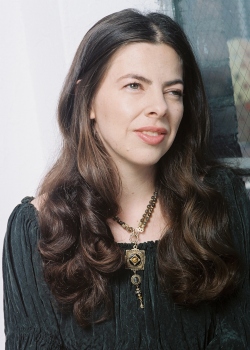
Carol P. Christ leads the life-transforming Goddess Pilgrimage to Crete (facebook and twitter).  Carol’s books include She Who Changes and and Rebirth of the Goddess; with Judith Plaskow, the widely-used anthologies Womanspirit Rising and Weaving the Visions and forthcoming in 2016 from Fortress Press, Goddess and God in the World: Conversations in Embodied Theology. Explore Carol’s writing. Photo of Carol by Shanti Jones. Photos of beach at Anaxos by Andrea Sarris.

No Longer Moved … by Symbols that Once Moved Me Profoundly by Carol P. Christ

Carol in Crete croppedThis week Judith Plaskow and I submitted the final version of our new book Goddess and God in the World to our publisher at Fortress Press. Just before completion, I added a shorter version of the following passage to my final chapter. In it I tried to describe the odd feeling of not being moved any longer by a religion that once moved me profoundly. Our book, which explores an embodied theological method, will be out in the summer of 2016.

I have never regretted my decision to leave Christianity. Although I have a sentimental attachment to Christmas trees, Christmas dinners, Christmas carols, and some hymns, I miss little else about Christianity. At a distance of several decades, I find that I quite simply have no feeling for the Christian edifice of doctrines and rituals based on the life and death of a single individual. Jesus was a visionary, but there have been many others like him—including Martin Luther King, Elizabeth Cady Stanton, and Gandhi, all of them flawed, as Jesus must have been as well.

A few years ago, I decided to participate in the Greek Orthodox Easter week services, because they are attended by so many of my neighbors. But while enjoying the company of the women who decorated the epitaphios (tomb for Jesus), the procession through the streets of our town on Friday night, and the lighting of candles at midnight on Saturday, I came to a clear understanding that the Easter drama is no longer my drama. During the Thursday night services, I realized that many of the women were openly grieving the death of Jesus. Though intellectually I could understand that the Easter drama allowed my friends to release pent-up and repressed feelings, I found their deeply emotional response to the re-enactment of the death of Jesus bizarre.

P6115475
Idean Cave

In leaving Christianity, I had gained the freedom to name the sacred in my own experience, confirmed my deep inner knowing about the human connection to nature, and found the power to create and participate in rituals that have meaning in my life. For me now, the rituals on the Goddess Pilgrimage to Crete are at the center of my spiritual life. To listen to Alice Walker’s words, “We have a beautiful/mother/Her green lap/immense/Her brown embrace/eternal/Her blue body/everything we know”* on a mountaintop or to repeat Ntozake Shange’s cry, “we need a god who bleeds now/whose wounds are not the end of anything”** at the mouth of a cave, moves me more than any passage from the Bible.

Singing “Light and Darkness” in the depths of caves is an embodied act of reclaiming the womb as a symbol of creation and the darkness as a place of transformation. I still enjoy singing the Doxology (Hymn of Praise)—and doing so connects me to my history. But I now sing it in front of altars laden with summer fruits or winter vegetables and with words that express my spirituality: “Praise Her from whom all blessings flow/Praise Her all creatures here below/Praise Her above in wings of flight/Praise Her in darkness and in light.”***

*Alice Walker, “We Have a Beautiful Mother,” Her Blue Body Everything We Know: Earthling Poems 1965-1990 (New York City and Orlando, FL: Harcourt Books, 1991), 459-460.
**Ntozake Shange, “we need a god who bleeds now,” A Daughter’s Geography (New York: St. Martin’s, 1983), 51.
***See Carol P. Christ, She Who Changes: Re-imagining God in the World (New York: Palgrave Macmillian, 2003), 238, for a discussion of the meaning of the new words.

Carol P. Christ leads the life-transforming Goddess Pilgrimage to Crete (facebook and twitter).  Carol’s books include She Who Changes and and Rebirth of the Goddess; with Judith Plaskow, the widely-used anthologies Womanspirit Rising and Weaving the Visions and forthcoming in 2016 from Fortress Press, Goddess and God in the World: Conversations in Embodied Theology. Explore Carol’s writing. Photo of Carol by Maureen Murphy. Photo of Idean Cave by PJ Livingstone.

ALTERNATIVE IMAGES OF GOD BY CAROL CHRIST AND EMMA TROUT

Carol P. Christ at Alverno College 1
Carol Christ at the Conference of Women Theologians

Today I am publishing an early work on female language for God that I wrote with Emma Trout at the first Conference of Women Theologians in 1971. Highly contested at the conference, this essay is a foreshadowing of my subsequent work on the need for female imagery for divinity.

Rereading this essay more than four decades later, I am gratified to see that though we began our essay with the image of God giving birth (which I still view as an important image), Emma and I were aware of the danger that female imagery for God could reinforce “a false sexual polarity.” We insisted then that female imagery for God must not repeat sex role stereotypes, but rather must shatter them. Continue reading “ALTERNATIVE IMAGES OF GOD BY CAROL CHRIST AND EMMA TROUT”

Barth and Woman at Yale by Carol P. Christ

Carol P. Christ at Alverno College 1
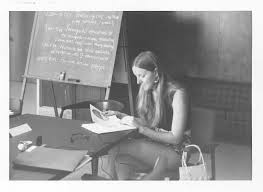
Carol P. Christ at the Conference of Women Theologians, Alverno College, 1971

I recently located a copy of an essay on Karl Barth and women that I wrote as a graduate student at Yale University in the Alverno College archives. Rereading it decades later, I am a-mazed at the brilliance and tenacity of my younger self. Had I been a male graduate student, I imagine that I would have been encouraged to publish this paper. Instead, though distributed by Alverno College after the Conference of Women Theologians, it was never published. I am correcting that oversight here. Read  A Question for Investigation (Barth and Women)-Carol P. Christ (1971) and view the original typescript Barth’s Theology and the Man-Woman Relationship by Carol P. Christ (1970). Please note that the essay does not restrict itself to Barth’s view of women, but rather uses Barth’s view of women to raise questions about his theology and theological method. Continue reading “Barth and Woman at Yale by Carol P. Christ”

Changing the American Story? by Carol P. Christ

Carol in Crete croppedIn a moving part of Goddess and God in the World, the book Judith Plaskow and I are writing together, Judith describes how the Sabra and Shatila massacre  forced her to confront the fact that “her people” are just as capable of perpetrating evil as any other group. Growing up in the shadow of the Holocaust and the pogroms that had scattered her people across the world, Judith was taught to think of the Jewish people as the victims of history rather than as the perpetrators of evil. The willingness of the Israeli army to countenance the outright massacre of up to 3500 people told another story: when in power, Jews too were capable of great evil.

I tell this story because I believe the lesson Judith learned is a lesson that Americans as a group still need to learn. I am thinking about this in the days following the heated debate that led to the removal of the Confederate flag from the Capitol of North Carolina.

In a brave and impassioned speech, Jenny Horne explained that though she is a descendant of Jefferson Davis, she was speaking against the display of the Confederate flag because it is a symbol of the harm that has been done and continues to be done to slaves and descendants of slaves in her state. Jenny Horne was rejecting the story she had been told about what it is to be an American in South Carolina. Continue reading “Changing the American Story? by Carol P. Christ”

Where are the Jewish Feminists? by Ivy Helman

10953174_10152933322533089_8073456879508513260_oLast month in my regular post, I suggested that a lesbian who passes as an Orthodox man subverts Jewish traditional gender roles and understandings of sexuality at the same time she is conveying something true about her own relationship to the Holy One.  Not a single comment challenged me on that proposition.  Not one.  Why?  I think I know the answer.

While I absolutely love this site and have been a regular blogger now for three and a half years, I must say there are whole worlds of ideas, insights and conversations that we are missing. Whenever I write a blog on this site related to Judaism, it is rare that I receive a comment from someone Jewish (at least recognizably so).  And, as the above example illustrates (especially if you were to read the comments of said post), no one even recognized the problematic nature of such a suggestion or challenged me as to how I think it would accomplish subverting gender roles and traditional views on sexuality.

The fact that I am the only regular Jewish contributor writing about Judaism in this blog doesn’t help. The last one left over two years ago. Also as far as I can tell from regular reading and a few searches, the last guest blogger who was both Jewish and wrote about something related to Judaism was about this time last year.  Where are the Jewish feminists?  Not here. Continue reading “Where are the Jewish Feminists? by Ivy Helman”

Painting Perpetua and Felicity: Patron Saints of Same-Sex Couples by Angela Yarber

angelaRecently, I realized the heart’s capacity to hold both extreme tragedy and utmost joy simultaneously. Surely this is something I’ve experienced in the past, but both personal and nation-wide events have served as poignant reminders. First, the racism that primarily persists in microaggressive forms—in the underbelly of a society that too often prides itself in the heinous sin of “colorblindness,” claiming that racism no longer exists in the United States—reared its violent head in the most blatant and painful ways in the slaughter of nine innocent people in Charleston. Because the shooting took place in a church, some media outlets have tried to claim that the shooter’s intentions were to attack persons of faith. It is clear, however, based on Dylann Roof’s words, photos, and history, that these killings were hate crimes targeted specifically at black people. Hearts broke. Lives ended. We, as a nation, were reminded, all too soon and yet again, that the lives of black people are valued less. Racism is present, evil, persistent, both blatant and hidden. It is more than hearts can hold.

Only days later SCOTUS ruled that same-sex marriage is now the law of the land. As my wife and I were packing to leave on a year-long journey throughout the country, we had already made copies of our marriage license (from Maryland before North Carolina recognized the legality of our love), two separate adoption decrees because our state did not recognize us as a family when my wife first adopted our child a brief 20 months ago, and all of the other legal paperwork that we could use to “prove” the legitimacy of our family in the case of an emergency (if medical staff wouldn’t permit us both to be in a hospital room with our child, for example). With those files copied and stored neatly in a suitcase, everything changed for us. Now, no matter what state we visit, our family is legally recognized. And while I’d like to think that our paperwork is no longer necessary, I know that the legality of the court’s decision doesn’t automatically change the hearts and minds of everyone in the country. Heteronormativity still reigns supreme. While we rejoiced at the ruling, we simultaneously acknowledged that marriage is only one small step in dismantling straight supremacy. Though countless couples can now marry, receiving all the legal rights and privileges therein, many may still live in states that allow LGBTQs to be fired for their sexual orientation or gender identity, where housing may be denied, where hate crime protections do not include sexual orientation or gender identity, and the list could continue. Still many queer people, myself included, found ourselves reveling in utter joy. Continue reading “Painting Perpetua and Felicity: Patron Saints of Same-Sex Couples by Angela Yarber”

A Christian Response to Racism, Sexism, & the Rise of American Terrorism by Trelawney Grenfell-Muir

Trelawney bio pictureAs our country reels in horror at the brutal massacre of nine worshipers at Emanuel African Methodist Episcopal Church, one particularly important detail has emerged: the young man who killed those nine people entered the world of white supremacism after the object of his romantic interest rejected him and dated a black man.

According to his cousin, the experience dramatically changed the young man, led to his obsession with racist hatred, and motivated him to commit the atrocity. In some ways, the event resembles the 2014 Santa Barbara massacre, in which a young white man with strong racist tendencies massacred young women because he felt angry that women generally did not respond favorably to his romantic advances. Other mass murderers have also exhibited violent misogyny. Moreover, our country has begun to notice that most mass shootings are carried out by white males, and to point out that white masculinity may lead young men into feeling like failures if they do not achieve all the trappings of their supposedly superior race and gender identity.

My questions are: how did we, as a society, fail these young men? And how have we, as a church, failed society? And, most important, how can we help heal these diseases that are killing us? Continue reading “A Christian Response to Racism, Sexism, & the Rise of American Terrorism by Trelawney Grenfell-Muir”

Who Sits at the Center of this Story? By Elise M. Edwards

Elise EdwardsHave you ever heard of the Vitruvian Man? It’s an image from 1490 inked by Leonardo da Vinci that came to symbolize the centrality of the individual in the Renaissance. It is quite clearly a depiction of a muscular, European male. His body is perfectly proportionate and thus simultaneously represents ideal humanity and a microcosm of the universe. The Vitruvian Man is so named after the ancient Roman architect Vitruvius who describes the proportions and symmetry of a temple as being analogous to the proportions of a man.

As an architect and scholar in the humanities, I’ve been acquainted with the Vitruvian Man for many years now. I even had a da Vinci theme on my PC’s Windows software about 15 years ago, meaning that the image of the Vitruvian Man appeared regularly on my desktop and screen saver. There was nothing problematic to me about his presence until a few days ago, when I took part in a discussion about teaching philosophies with some new friends and academic colleagues.

I was listening to Tamara Lewis, an assistant professor in religion whose research and teaching addresses the medieval and Renaissance periods. When she described a metaphor for her teaching philosophy, she discussed replacing the symbol of Vitruvian Man with the “woman at the well.” The woman at the well is a figure in Christian stories about Jesus and his teachings. Her narrative in the Bible is placed in chapter 4 of the Gospel according to John. Int eh story, Jesus encounters a Samaritan woman at a well. He asks her for a drink, which begins a meaningful exchange about spiritual teachings. Jesus’ male disciples and surprised to witness this exchange, presumably because she is a woman and a Samaritan, as the text tells us that Jews do not associate with Samaritans. The woman goes back to her town, tells people about her encounter with Jesus, whom she believes is the Messiah, which prompts many of them to come to him and also believe.

Dr. Lewis described how her presence in the historical study of medieval or Renaissance periods is sometimes questioned and how the woman at the well represents this presumed misplacement. Her metaphor caught my attention not just because of its profound coherence within her own career trajectory and narrative, but its coherence within mine. As a black feminist, religion scholar, and practicing Christian, I often wrestle with questions of belonging and being in or out of place.

This summer, I’m taking the time to think about broad questions and do some vision casting. This past December, Grace Kao wrote about using sabbatical time differently, and I’ve connected this to my own practice of Sabbath keeping as a ritual. I dedicate specific times to cease work.  I am engaging in some productive activity this summer, but I’m also honoring one of the truest blessings and privileges of full-time employment in my profession, which is break time to rest, reflect, and plan for the seasons ahead.  The metaphor of woman at the well who intentionally replaces the Vitruvian Man provokes these questions in my reflection:

Who is the default person around which the places we inhabit are constructed? Who sits at the center of our stories about the places we will go? 

As the little bio that follows my posts says, in my professional career I examine issues of civic engagement and how beliefs and commitments are expressed publicly through aesthetic and artistic practices. I’m currently writing a book-length project about theological ethics and architectural design. So these days I’m thinking a lot about the way public spaces and built environments communicate the values of those who build them and inhabit them. One of the questions I’m wrestling with is the way “common” spaces are defined by the narratives of only some people in the community. What does it mean to be literally “out of place”? What exists as a “safe space” in a public park for a man may not feel safe at all for me as a black woman. A public bench upon which I can rest in the middle of an afternoon jog may not be so uncontested for a homeless man at night.

As I think about my future, I have to ask who sits at the center of my story.   I’m approaching a milestone birthday, and I don’t want to fall victim to someone else’s vision of what a 40 year old woman should be. What does the story look like with me at the center? What happens when I replace an idealized image of perfection, vitality, and beauty with an imperfect but gloriously alive and wonderfully formed vision of who I already am?

As I plan for a new academic year, who do I imagine in my classes? As I engage students in discourse about the history of Christianity, the development of its theology, and the ethical issues of today’s world, who do I place at the center? As the US becomes enmeshed in presidential election politics and ongoing racial tensions, what image to we present as the archetypal American?

I’m so grateful that I was brought to see the woman at the well as a metaphor of intentional displacement. Even in a religion that places a male Savior (Jesus) at its center, there are women who sit with him. Although they confound some of Jesus’ other followers by their presence, they remain meaningful conversation partners and witnesses to their faith.

Elise M. Edwards, PhD is a Lecturer in Christian Ethics at Baylor University and a graduate of Claremont Graduate University. She is also a registered architect in the State of Florida. Her interdisciplinary work examines issues of civic engagement and how beliefs and commitments are expressed publicly. As a black feminist, she primarily focuses on cultural expressions by, for, and about women and marginalized communities. Follow her on twitter, google+ or academia.edu.

Referendum in Greece: One Small Victory for the 99% by Carol P. Christ

Yesterday the Greek people voted by an unexpectedly large margin of 6l.31% against the austerity programs insisted upon by the European creditors–despite threats from the creditors that Greece would be expelled from the European Union. This was a victory for democracy and for the 99% against the 1%. The blog I wrote on the eve of the referendum explains the situation.

Here in Greece, we are in a state of suspended animation and have been for the past 5 ½ months, since the new government of Alexis Tsipras began to negotiate with the European Commission, the European Central Bank, and the International Monetary Fund, popularly known as the Troika, regarding the Greek national debt. Each week we have heard: “a few days more and the crisis will be resolved.” We hold our breath and wait. Holding your breath for that long takes a toll on your health. Right now our banks are closed, and no one knows what the future will be.

Prime Minister Alexis Tsipras and Minister of Finance Yiannis Varoufakis have been negotiating on the assumption that representatives of the Troika are rational and moral actors—or can be convinced to be. Continue reading “Referendum in Greece: One Small Victory for the 99% by Carol P. Christ”