Legacy of Carol P. Christ: Visions of the Goddess: A White Horse

This was originally posted on May 4, 2020

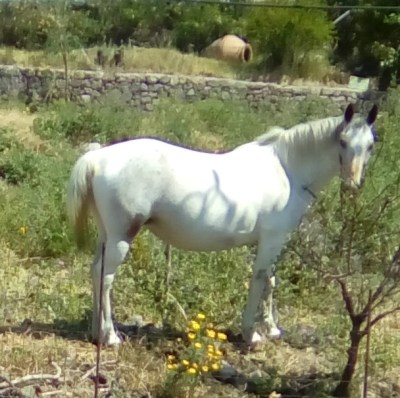
Imagine my surprise when, a few days ago, I looked out my window to see a dappled horse munching on flowers in the field across the street from my house. In the next days I got used to her being there. I would look for her in the mornings and at odd times during the day. Sometimes she was visible and sometimes she was not. When I could see her, I would open the window and call out, “Hello, white horse, you are very beautiful.” Once or twice she turned her head to look at me and seemed to respond, “Thank you for noticing.”

Many hundreds of years ago, Sappho must have had a similar vision in a field near a grove of trees where she and her students waited for the Goddess to appear, for she wrote: “In meadows where horses have grown sleek among spring flowers, dill scents the air.“ These lines are part of a longer poem addressed to Aphrodite that begins: “Leave Crete and come to us.” In this place, “incense smokes on the altar,” there is a stream, there are apple trees and rose bushes and horses in a field of flowers.

Continue reading “Legacy of Carol P. Christ: Visions of the Goddess: A White Horse”

The Legacy of Carol P. Christ: What if Divine Feminine and Divine Masculine Are Not Oppositional Categories?

Moderator’s Note: The blog was originally posted May 18, 2015

A friend who is a spiritual teacher speaks often “bringing back the values associated with the Divine Feminine.” For her this has to do with helping women to understand the beauty of our bodies and the importance of ways of being such as giving and caring for others that have been associated with the undervalued so-called “feminine” side of the masculine-feminine polarity. Though she also speaks about the Goddess, I think she prefers the term “the Divine Feminine” because of the implication that men too have their “Divine Masculine.”

This friend has a wonderful husband who is a teacher in his own right and who often ends up spending a lot of his time among powerful women who enjoy talking about the Goddess. In these conversations he sometimes speaks of the need for men to “recover the Divine Masculine” if they are to become whole.

Continue reading “The Legacy of Carol P. Christ: What if Divine Feminine and Divine Masculine Are Not Oppositional Categories?”

The Legacy of Carol P. Christ: Sappho Chose Love Not War, What Will You Choose?

This was originally posted on November 12, 2012

We have been taught to speak of war and the heroes of war in hushed tones. We have been told that evil Helen’s choice was the cause of the Trojan war.  2600 years ago Sappho, known as the greatest lyric poet of ancient Greece, spoke truth to power and unmasked the lies told at the beginning of western tradition.

*

In a poem addressed to Anactoria, Sappho writes:

            Some say a cavalry corps
            some say infantry, some, again,
            will maintain that the swift oars
            of our fleet are the finest
            sight on dark earth …

Here, Sappho invokes the heroic tradition celebrated in the epic poems of Homer that shaped the values of ancient Greek culture and all the cultures that followed it, including our own.  This tradition tells us that to serve in a war and to be remembered as a hero is the highest goal to which a man can aspire.  Sappho does not agree:

             …but I say
             that whatever one loves, is.

Continue reading “The Legacy of Carol P. Christ: Sappho Chose Love Not War, What Will You Choose?”

The Daughters of Zelophehad and the Five Feminine Powers of the Kabbalah by Rabbi Jill Hammer

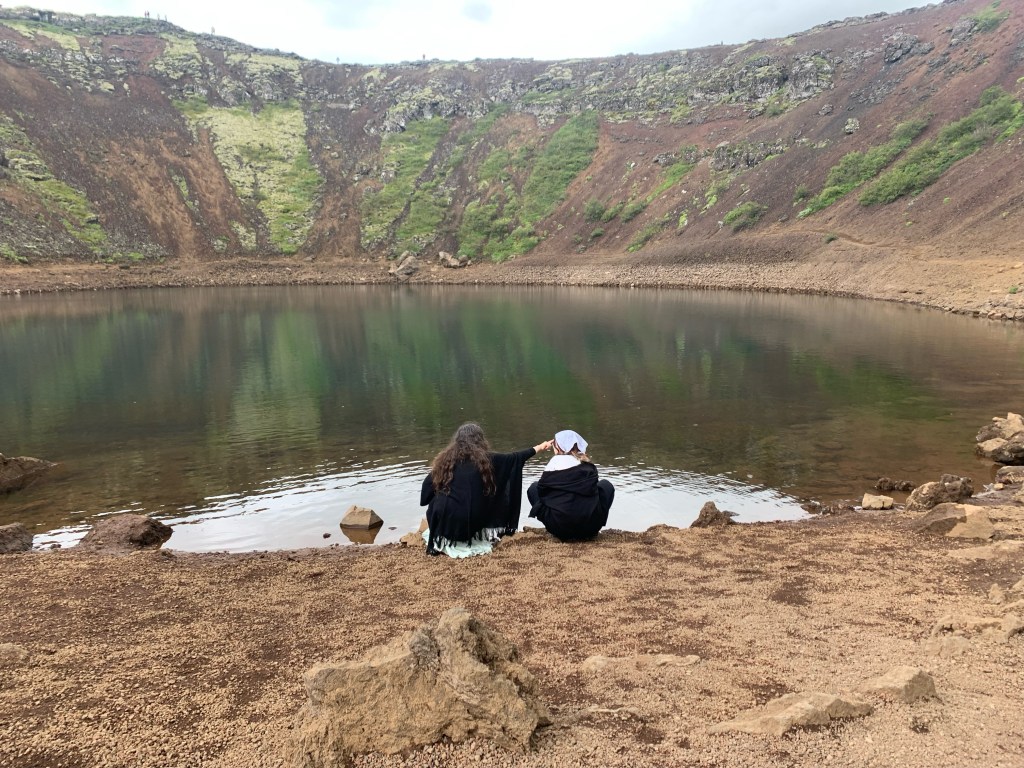
Jill anointing her daughter. photo by Shoshana Jedwab

This summer, I visited Iceland, a beautiful and magical land.  While I was there, I saw the Kerid Crater, which is a caldera: a volcanic crater with a lake inside.  My family and I hiked around the edge of the crater and then down close to the lake.  The perfect roundness of the crater-lake gave the impression of a circular container—a jewel-box shaped by some immense hand— or else a massive eye looking up from the earth.  My daughter and I sat by the lake’s waters and anointed one another, having the sense we were in a sacred place.

Later that summer, I grappled with a story that reminded me of the crater. In Numbers 27, five sisters—the daughters of a man named Tzelafchad—approach Moses with a question.  Their father had daughters, not sons, and it seems this means his family will receive no land allotment in Canaan.  The daughters ask that they be given land allotments: “Let our father’s name not be lost to his clan just because he had no son!” (Numbers 27:4).  Moses takes their complaint to God and brings back an answer: the daughters have spoken rightly, and will receive a land allotment as they request.  However, they must marry men of their own tribe so that the tribal land is not lost— if the women married men of another tribe, their heirs would belong to that other tribe and so the land would change its tribal designation.  Thus, patriarchy is mitigated but not ultimately contradicted—the women become heirs to their father, but primarily for their father’s sake, not their own. 

Continue reading “The Daughters of Zelophehad and the Five Feminine Powers of the Kabbalah by Rabbi Jill Hammer”

Remembering Rosemary Part 2 by Janice L. Poss and Theresa A. Yugar

Editor’s Note: A more formal memorial to Catholic Feminist Theologian Rosemary Radford Ruether was posted here at Feminism and Religion at the time of her passing. Now we are delighted to share these memories of her by two scholars, Theresa A Yugar and Janice L. Poss, who knew her well, especially in her last months. Therese’s reflection is below and Janice’s will appear tomorrow. As Janice notes in her post, “More than any deep theological concept, doctrinal exegesis, or other hyper-scholarly thought, she taught me simply by being who she was – a woman – and she gave me the ultimate gift, the gift of herself.” Through these posts, Theresa and Janice pass on some of Rosemary’s wise and caring gifts to our FAR readers. Part 1 was posted yesterday. You can read it here.

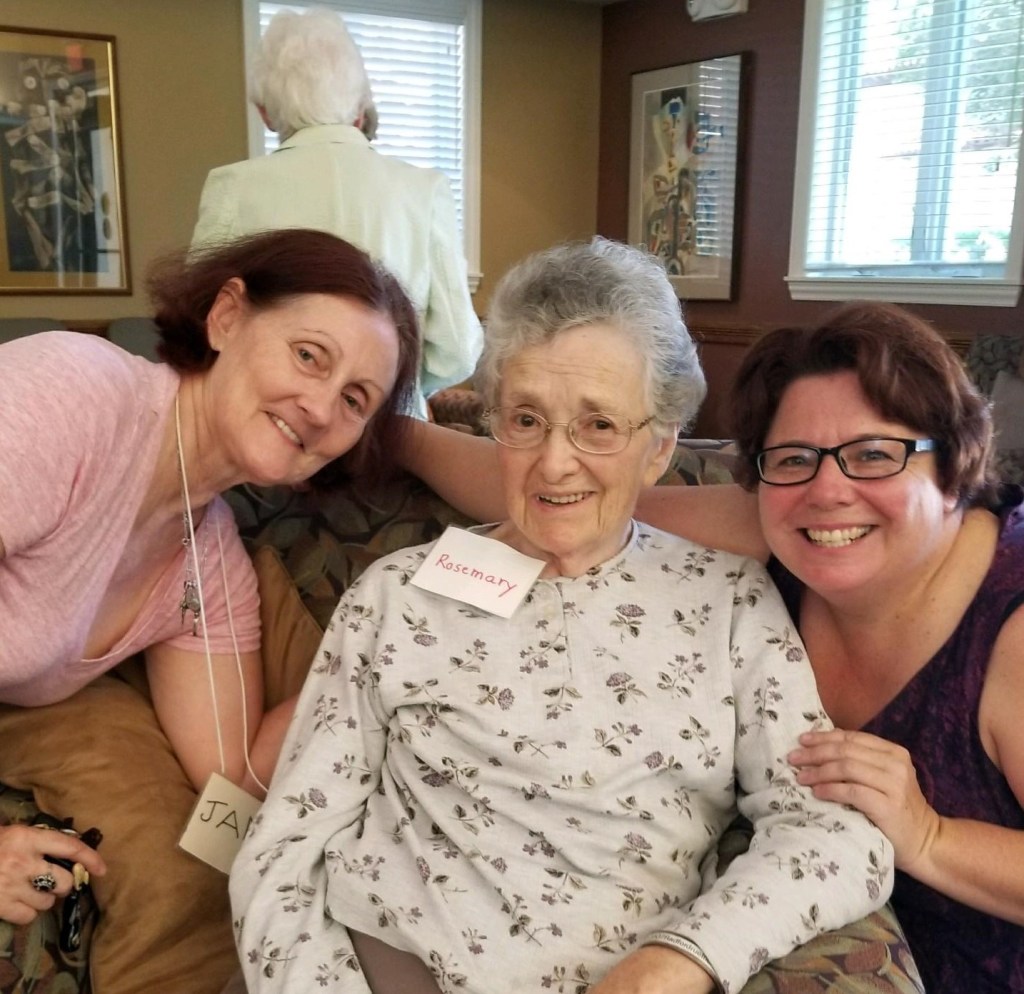
Janice, Theresa with Rosemary

Almost five years ago, Rosemary Radford Ruether suffered a devastating stroke that left her partially paralyzed and no longer able to speak or write, activities that were integral to her life as a writer, teacher, activist, and scholar. During her difficult last years Janice and I learned new ways of engaging her that were academically stimulating and fulfilling for her. We became advocates for her during her disability as she had been an advocate for us. Thus, out of pain grew blessings.

Janice and I dedicate and share with you these two short reflections that reflect our struggle to find our way without her. We know there will be many more reflections composed and shared by others whom she mentored, influenced and touched. Now—in the midst of our grief and sadness at her loss—we offer our personal memories of how she enriched our lives every day until she passed from our midst at 2pm, on Saturday, May 21, 2022.

Continue reading “Remembering Rosemary Part 2 by Janice L. Poss and Theresa A. Yugar”

Advancing Our Feminist and Womanist Theologies by Xochitl Alvizo

I recently completed a chapter for a book on Latinx theologies; it’s the second edition of the Wiley-Blackwell Companion to Latino/a Theology, edited by Orlando O. Espín, but this time with the slightly changed title of Companion to Latinoax Theology—aiming to be more inclusive in its umbrella term. The project has 35 contributors and covers everything from interreligious dialogue and care for creation, to race, racism and latinoax cultures, as well as chapters on such subjects as Christology, the bible, and ecclesiology. My particular chapter was about the intersection of gender, feminisms, and Latinoax theologies—not surprising. But what I loved in the process was a particular emphasis that emerged—decoloniality, like a thread woven throughout the chapter as it evolved; and this I now see as a necessity for Christian theologies. Let me explain.

Continue reading “Advancing Our Feminist and Womanist Theologies by Xochitl Alvizo”

Rosemary Radford Ruether, 1936-2022

Rosemary Radford Ruether, 1936-2022
Catholic Feminist Theologian

Pioneering Catholic feminist theologian Rosemary Radford Ruether,  accompanied by her daughters Mimi and Becky, died peacefully on Saturday, May 21, 2022 at 3 PM PDT in Pomona, California after a long illness. Arrangements are pending with more information to follow.

Dr. Ruether was a scholar activist par excellence. She was respected and beloved by students, colleagues, and collaborators around the world for her work on ecofeminist and liberation theologies, anti-racism, Middle East complexities, women-church, and many other topics.

Continue reading “Rosemary Radford Ruether, 1936-2022”

Legacy of Carol P. Christ: What Does Mother’s Day Mean in a Patriarchal and Matricidal Culture?

This was originally posted on May 9, 2016

When we seek immortality or spiritual “rebirth,” are we not saying that there is something wrong with the “birth” that was given to us through the body of our mothers? In She Who Changes and in “Reading Plato’s Allegory of the Cave as Matricide and Theacide,” I asserted that our culture is “matricidal” because it is based on the assumption that life in the body in this world “just isn’t good enough.”

What is so wrong with the life that our mothers gave us that we must reject it in the name of a “higher” spiritual life? The answer of course death.

Can we love life without accepting death?

Can we love our mothers if we do not accept a life that ends in death?

Jesus was said to have encouraged his disciples to leave their wives and families in order to follow him.  When he was told that his mother and brothers were outside and waiting to speak to him, he is said to have said:

“Who is my mother, and who are my brothers?” And stretching out his hand toward his disciples, he said, “Here are my mother and my brothers!  For whoever does the will of my Father in heaven is my brother, and sister, and mother. (Matt. 12:48-50)

Continue reading “Legacy of Carol P. Christ: What Does Mother’s Day Mean in a Patriarchal and Matricidal Culture?”

Carol P. Christ’s Legacy: Was There a “Golden Age” before Patriarchy and War? by Carol P. Christ

Marija Gimbutas coined the term “Old Europe” c.6500-3500 BCE to describe peaceful, sedentary, artistic, matrifocal, matrilineal and probably matrilocal agricultural societies that worshipped the Goddess as the power of birth, death, and regeneration in all of life. Gimbutas argued that Old Europe was overthrown by Indo-European speaking invaders who began to enter Europe from the steppes north of the Black Sea beginning about 4400 BCE.  The Indo-Europeans were patrilineal and patriarchal, mobile and warlike, having domesticated the horse, were not highly artistic and worshiped the shining Gods of the sky reflected in their bronze weapons.

In the fields of classics and archaeology, Gimbutas’s work is often dismissed as nothing more than a fantasy of a “golden age.” In contrast, scholars of Indo-European languages, Gimbutas’s original specialty, are much more likely to accept the general outlines of her hypothesis. The German linguist and cultural scientist Harald Haarmann is one of them.

Continue reading “Carol P. Christ’s Legacy: Was There a “Golden Age” before Patriarchy and War? by Carol P. Christ”

Carol P. Christ’s Legacy: Kassiani: Placing a Woman at the Center of the Easter Drama

This blog was originally posted on April 13, 2015. You can read the original comments here.

For many years I been told of the beautiful Hymn of Kassiani, sung only on Easter Tuesday night, but I had never heard it until this week. For many this song is the high point of Easter week.

Kassiani, also known as St. Kassia, was a Greek woman born into a wealthy family in Constantinople (now Istanbul) about 805 to 810 AD. According to three historians of the time, she was intelligent and beautiful and selected as a potential bride for the Emperor Theophilos. The chroniclers state that the Theophilos approached her and said: “Through woman, the worst,” referring to the sin of Eve. Clever Kassiani responded, “Through woman, the best,” referring to the birth of the Savior through Mary.

Apparently unable to accept being put in his place by a woman, Theophilos chose another bride. Kassiani founded a monastery in Constantinople becoming its first abbess. She was an outspoken theological advocate of icons during the iconoclastic crisis (for which she was flogged). One of only two women to publish under her own name during the Byzantine Middle Ages, Kassiani wrote both poetry and hymns. Up to 50 of her hymns are known today, with 23 of them being part of the Greek Orthodox liturgy

.

Continue reading “Carol P. Christ’s Legacy: Kassiani: Placing a Woman at the Center of the Easter Drama”