The following is a guest post written by Carol Christ, Ph.D., a pioneer and founding mother of the Goddess, women’s spirituality, and feminist theology movements, and director of the Ariadne Institute. She is also the author of multiple books including Rebirth of the Goddess.
Although there are some of us who disagree, the “party line” in the fields of Religious Studies and Archaeology—even among feminists– is that there never were any matriarchies and that claims about peaceful, matrifocal, sedentary, agricultural, Goddess-worshipping societies in Old Europe or elsewhere have been manufactured out of utopian longing.
I myself and most other English-speaking scholars defending Marija Gimbutas’s theories about Old Europe have studiously avoided the word “matriarchy” (speaking rather of “matrifocal, matrilineal, and matrilocal” societies) because the very word “matriarchy” conjures up the image of female-dominated societies where women ruled, waged wars, held men as slaves, and raped and abused men and boys. In fact, this fantasy tells us far more about patriarchy than about it does about matriarchy. Continue reading “Exciting New Research on Matriarchal Societies By Carol P. Christ”
Recently Gina Messina-Dysert, on this blog, wrote about rape culture and the church’s role in preserving it instead of challenging the norm of violence against women and victim blaming. And in my last post, after having just watched the last installment of the Harry Potter movies, I wrote about Lily’s love for Harry as being what saves Harry and not the sacrifice of Lily’s life; my point being that we need to give more credit to love as salvific and redemptive and not to sacrifice or suffering. For too long within Christianity, Jesus’ death and ‘sacrifice’ have been held up as the core, the essence, the heart of Christianity – wrongly giving it a necrophilic emphasis that I do not believe is actually faithful to the Christian tradition. All this reminds me of why feminism is critical to my ability to stay within Christianity and that without feminism I would not be able to be a Christian-identified woman.
Every day in both small and enormous ways I see the effects and embedded patterns that result from the long history and dominance of patriarchy/kyriarchy. Everything from sexism and racism, to capitalism and the destruction of our world, these destructive systems are part of our daily environment and affect the quality of all our lives in devastating ways. And perhaps it is because I am a woman and I am directly and existentially affected, but, sexism, misogyny and violence against women are the things that most crush my spirit and break my heart. As I see these insidiously at work in many aspects of our society, and see the effects these have on us, women and men alike, I am saddened and angered to a level for which I have yet to find words to express. I feel it, the insidious trauma of sexism, misogyny, and violence against women, I feel their effects on me and others, but do so usually in silence or in tears. Lump in my throat. No words to speak. All I can do is continue in my commitment to live in a way that is different from these – in a way that is biophilic and affirming of all people as sacred and divinely in-Spirited. Continue reading “Speaking of Sacrifice and Rape Culture…by Xochitl Alvizo”
Rape culture – a culture where violence against women and victim blaming is the norm – is alive and well in our society. Women are taught from a young age that rape is the worst thing that could possibly happen in our lives. As a patriarchal institution, the Church supports rape culture. Although texts, traditions, and teachings can be a resource for women who have been victimized, they can also serve as a roadblock and encourage further victimization.
There has been a long history of women and girls being taught by the Church that their lives are of little value once their hymens are broken. Citing the rape of Roman matron Lucretia, Church father Jerome stated that rape is the one exception for suicide. In fact, according to Jerome, “Although God is able to do all things, he cannot raise up a virgin after a fall.”* Although he argued that at the time of the resurrection of the body every affliction and mutilation would be healed, Jerome claimed that not even the power of God could repair a broken hymen. Likewise, Tertullian commended Lucretia for her suicide and claimed she was an example for Christian women.
Harmful ideas about women, rape, and victimization have been promoted by biblical rape texts and their interpretations. These “rape texts” of the Bible have been utilized to typify how “real” rape victims behave and suggest that women who claim rape are suspect. From the story of Ms. Potiphar (Genesis 39), that offers the image of a woman crying rape as one not to be trusted, to the story of Susanna (Daniel 13) that presents the notion that a rape victim should be silent, biblical texts set forth images of women and sexual violence that support rape culture. Continue reading “Rape Culture and the Church By Gina Messina-Dysert”
On April 21, 2011 Catherina Halkes, the founding mother of Feminist Theology in Europe, inspiration to me and countless others, prophet, mentor – and much else – died in her home city of Nijmegen, the Netherlands. She certainly changed my life: I arrived in Nijmegen desperately searching for books in Feminist Theology when writing my Ph.D. thesis. I had read everything that England had to offer, (not a lot in 1986!) I could not afford to go to America, so the Netherlands was my only option. Catherine Halkes, (or Tine, as we all called her), welcomed and encouraged me: later she would come to the public defence of my thesis in Louvain – after which I became her successor to the chair of Feminism and Christendom in Nijmegen, 1988. Life was never the same again!
Catherina Halkes
Tine blazed a trail for women’s role in theology in the Roman Catholic Church, as well as for all women in Feminist Theology in Europe in its key developing stages. She embodied the hopes and dreams of countless women – and men- beyond the boundaries of her small country. She influenced the development of Women Studies as an academic subject in the Universities of the Netherlands and wider. Her influence cannot be restricted to a single category. Rooted in the progressive theology of the Second Vatican Council, she developed a wide-ranging pastoral theological influence on theology. It could be said – although an evaluation is still too early- that her legacy will be seen as opening up different areas of theology and related disciplines to the feminist lens, and being at the forefront of developments in many fields, always with a critical eyes of a Christian faith that has never wavered, despite continuing disappointment and personal suffering at the unflinchingly repressive attitudes of the Roman Catholic Church, to which she remained consistently loyal. Continue reading “Catherina Halkes – In Memory and Appreciation By Mary Grey”
I went to the movies with a group of friends last Friday to watch the final Harry Potter movie, Harry Potter and the Deathly Hallows Part II. It was a great movie, fun and action-filled, and the energy of opening night only made it better. Afterward we all went out to eat and exchanged notes on our favorite scenes – talking about every little detail. At one point, one of my friends commented on the strong role women have in the Harry Potter movies/books. She said the story is carried by the women – that if it wasn’t for them Harry Potter would not exist. She made specific mention of Harry’s mom as having sacrificed her life for him. Lily dies so Harry can live.
This of course is when my brain comes to a screeching halt.
Women sacrificing their lives for others – I become suspicious and my defenses go up. Sacrifice = suffering. Suffering must not be glorified. Sacrifice must not be sacralized. I see red flags everywhere. Wait, though; haven’t those of us who are Christian-identified heard the opposite affirmed a million times? Jesus suffered and died – was sacrificed – for our sins. Further, Christians’ most sacred ritual, communion, includes reference to Jesus’ broken body and spilt blood. So, isn’t that what people do for love, sacrifice, as Harry’s mom did?
The gospel story of the crippled woman healed by Jesus of her ailment in the Gospel of St. Luke epitomizes for me the values of a Feminist Liberation theological perspective. For women, Feminist Theology as a discipline has enabled us to claim our dignity and rights as women and “stand up straight” as this woman in the gospel does. In the context of a larger church tradition which has not always affirmed women, Jesus models in his ministry both compassion and respect for the wellbeing of women. For eighteen years, this nameless woman, carried “a spirit that had crippled her,” so much that “she was bent over and was quite unable to stand up straight,” (13:11). Not only does Jesus heal her of her infirmities, but he also defends her dignity as a “daughter of Abraham.”
On a very intimate level I identify with this nameless woman who approached Jesus humbly seeking healing and liberation from the physical ailments that bound her. In my own life I have also experienced the same sense of bondage that this woman in the gospel is healed of. Like many women, I grew up struggling to affirm the dignity I had as a human being. Even though the church I love and grew up in stated that they value both men and women equally, in practice this was not the case. For me and the un-named woman, the relevance of this gospel in relation to Feminist Theology touches on the core of Jesus’ ministry, which was the liberation of all people from the oppressive structures that burdened them. Continue reading ““She stood up straight and began praising God”: Luke 13: 10-13 By Theresa A. Yugar”
The following is a guest post written by Kate Conmy, MA, Membership Coordinator for the Women’s Ordination Conference. Kate celebrates spiritual activism, feminism, and human rights. She currently works as the Membership Coordinator for the Women’s Ordination Conference and lives in Washington, DC. She can be contacted at Kconmy@womensordination.org.
In my last semester as a Religion student at Mount Holyoke College I sat in my Feminist Theology seminar with only one question for our guest speaker: “Why are you still a Catholic?” A question I rarely dared to ask myself as I spent most of my studies concentrating on Buddhism, traveling abroad to Dharamsala, India, interning with the Buddhist Peace Fellowship in Berkeley, even learning Tibetan; by most observable assessments I had swapped the pew I grew up in for a zafu. But Mary Hunt reminded me in such a simple and smart way that Catholicism is about community building and justice seeking. She said: “This is what a Catholic looks like. We have a responsibility to speak this language.”
In that moment I realized I had been resisting something that has always belonged to me. Raised in a Jesuit-educated Catholic family in Upstate, New York I felt less confirmed within the church, and more convinced that we were celebrating a god that was too small. One of the great mysteries for me growing up in a church-going family was the personal and religious reconciliation the Catholics I knew negotiated, sometimes weekly to make sense of their faith. The dissonance between what was practiced during Mass, and what Catholicism meant at the dinner table seemed an exhausting spiritual dance of ambivalence. It wasn’t until I began to identify as a feminist theologian that my spiritual worlds converged in a moment of satori: ambivalence is a virtue! The sisters and daughters of Mary Daly gave me permission to re-claim my Catholicism with all of my questions as an extraordinary action of faith. Ambivalence means courageously engaging the sacred to foster critique, conversation and innovation in the pursuit of knowing God. Just as Carter Heyward writes, “To love God is to un-do evil,” I so strongly believe that God must manifest as an expression of creative justice whereby inclusivity, “right-relation,” and the elimination of discrimination are central on the path toward a higher liberation. I graduated feeling empowered by women, activists, and radicals who claimed their faith and the responsibility to speak a language beyond the binary in order to celebrate the wisdom of all human and divine goodness. Continue reading “This is What a Catholic Looks Like By Kate Conmy”
I love art. I especially love certain women’s art – women such as Frida Kahlo, Cathy Ashworth, Sudie Rakusin, and Alma Lopez. To me, their art is a reflection of women’s strength, creativity, and beauty. Frida Kahlo, for example, expressed so many aspects of herself and her experience through her art. In it one can glimpse her passionate love for Diego Rivera, her continuous physical pain, her search for meaning, and the unending hopefulness she maintained throughout it all. Frida Kahlo’s art, like her person, was vibrant and full of life, colorful and yet broken. She expressed the wide spectrum of her experience not in words only but in color and images, texture, paint and print. As she put it, “I paint my own reality” – her own reality is what she knew and it is what she painted.
I rely on art to do what academics often cannot do well – what I cannot do well – which is to communicate the truths that rattle our being down to its deep core in ways that connect with others. There have been times in my academic life when I have encountered new insights that changed my life forever. Moments of being shaken and awakened at my very core by a truth that until then had eluded me. But such moments can be hard to share with others because they can be hard to translate to words, even if such moments have come to me by words. Learning about feminist theology and being shaken by the truths it spoke to me is one such encounter – and it was indeed an academic one that is often hard for me to put into words and explain to others. On the other hand, encountering Alma Lopez’s artwork was also a core rattling moment, but one which I can more easily share.
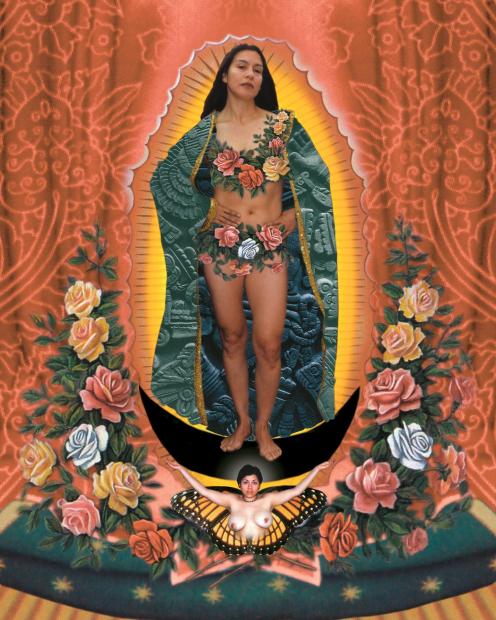
“Our Lady” by Alma Lopez (1999)
Alma Lopez’s Our Lady is a digital art piece in which Our Lady of Guadalupe is depicted (embodied, really) in a more obviously female form than is traditionally expected. For this, every time her piece is on exhibit, Lopez receives a barrage of protest and harassment – as does the sponsoring institution. Accusations of obscenity, profanity, and blasphemy come her way. But, why?
When I see Lopez’s Our Lady, I do not see blasphemy or obscenity, I see a celebration of the female and the sacred. I see the beauty of God’s queer incarnation – and I remember – I remember that the word became flesh and made her home among us. From the womb of a woman’s body, her life-giving body, the divine took human shape. Boundaries of sacred and profane forever blurred.
At a surprisingly early age, perhaps nine or ten, I became the author of my own spiritual narrative, meaning, I took it upon myself to initiate and pursue the deep mystery of my faith. Weekly Mass was an event, not an obligation, and something to which I attended without my family. The singleness of my worship at such a young age drew stares and whispers from those families who had arrived in tact. And while I was not unaware of their curiosity, I found it easier to lose myself in the absolute wonder of my environment. This was the world to which I belonged. I was at once home and alive in a devotion filled with sacramentals, those objects of religious piety that created a force field of God’s protection around me.
While the mystery of God’s love enveloped and graced my adolescence, a slow and creeping suspicion began to take hold of my faith. Because of my “girlishness,” I was barred as an alter server, and I began to absorb my otherness. I worried about my difference, and began to question the fairness of God. Telegraphic messages of inferiority caused me great confusion. The implicit reality that as female I was ontologically challenged, slowly sifted its way into my psyche and I would argue, my soul as well.
As a budding young feminist, what I found within the teachings of the church, either implicit or explicitly, did not coincide with what I felt to be the inner me. On the cusp of adulthood, the collision between self and Church [read as God] was inevitable. The catechetical formation of my youth, of coming forth equally male and female in the image and likeness of God seemed like a childish myth and certainly not the reality of the andocentric church to which I was now departing.
Fast forward twenty years, and I cautiously found myself back in the Catholic Church, only this time in the arms of feminist theologians. I was hooked. Their writings informed my life choices, directing me towards my current doctoral pursuit. Yet I have found the academic arena is able to shield and protect me from the pain I continue to feel within the institutional church. To demonstrate the interweaving of the challenges and nourishment I experience as a Catholic I addressed above, I would like to share with you the following story. Continue reading “Feminism, Ontology and the Priesthood of all Believers”


 The following is a guest post written by Carol Christ, Ph.D., a pioneer and founding mother of the Goddess, women’s spirituality, and feminist theology movements, and director of the Ariadne Institute. She is also the author of multiple books including Rebirth of the Goddess.