Toil and Trouble (Part 3) by Barbara Ardinger

Continued from Part 2

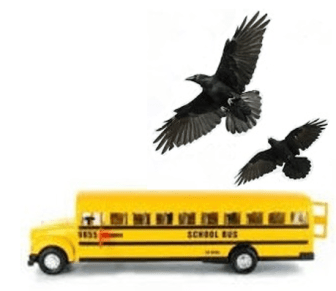
The magical school bus, carrying twenty-seven young women, drives across two or three states almost as quickly as the magic carpet flew a few days ago. The bus seems to fly, guided by Bunbury and Icarus as GPS and guards and Kahlil riding on the bus driver’s shoulder (well, not always; the driver keeps shrugging the heavy raven off, so Kahlil finally perches on the back of the first seat) and giving directions. (How the GPS ravens communicate with him is not to be disclosed.)

“So whaddaya think the magic’s for?” Kahlil asks the driver. “We’re guardin’ these here girls. Takin’ ’em somewheres safe.”

All the driver can do is keep driving. When the bus and its precious passengers arrive at the witch’s farm and the girls descend, everyone can see that the finery they’d been wearing to sit in El Presidente’s audience is no longer fine. Their silks and satins have turned into ragged T-shirts and crepe paper. Their priceless jewelry is now colored plastic straws strung together with string. Their exquisite hairdos are now lank and limp. And soon there are loud cries from the witch and her friends—these girls have black eyes and bruises all over their bodies. Some of them are missing chunks of hair or their front teeth. They are all barefoot, and their feet are filthy. And these twenty-seven former princesses—were they ever genuine princesses?—are scared. Continue reading “Toil and Trouble (Part 3) by Barbara Ardinger”

Toil and Trouble (Part 2) by Barbara Ardinger

Continued from Part 1.

“Mirror, mirror, on the table,
Show us all that you are able…”

The witch and her ad hoc coven and the ravens are leaning forward to see and hear more clearly what the mirror is showing them. The scarecrow wearing the human mask and his Gollumesque advisor are suddenly standing in a formal garden and addressing an audience that consists of a dozen rows of handsome but uncharming and self-important princes and (possibly) some princesses.

“Those girls are all captives,” Ella says. “Like I was until I started thinking for myself.” She gasps. “Oh, look—my sisters Annette and Darlene are there, too. When did they surrender?” As she begins weeping (she can’t help it), Mrs. Bezukhov pulls her into her arms. “Look, my Pierre is there, too,” she whispers. “He was always so kind, so smart…he spent his days helping other people. How could he stand among those, those—I don’t know what to call them.” Continue reading “Toil and Trouble (Part 2) by Barbara Ardinger”

Toil and Trouble (Part 1) by Barbara Ardinger

…and Ella can’t remember the last real meal she had. After supper with the refugees in the witch’s house, she and the witch put their heads together to begin making significant plans. She’s also been meeting all the refugees who now live on the witch’s farm. She knows first-hand why these people fled the capital and the other cities. “Oh, lordy, yes,” she says. “I used to know all the important people. My dear sisters and I went to all the big events, ate the finest cuisine—” suddenly remembering where she is, she looks down at the table “—oh, dear, but I don’t mean to criticize your cuisine.”

The ravens, all perched on the backs of chairs look straight at her. “Good food, this,” says Kahlil, “except these girls don’t serve eyeballs.” “Stop that,” Domina whispers (if ravens can be said to whisper). “Don’t be so picky. Everybody here gets enough to eat.”

Ella, who is more used to cats and dogs and the occasional parakeet than to ravens, blinks and continues. “I wish I knew where my sisters are now. Thanks to our ‘relationships’ with the princes, we were High Society and—”

Continue reading “Toil and Trouble (Part 1) by Barbara Ardinger”

Horse – Symbol of Power and Freedom by Judith Shaw

judith shaw photoThe horse was first depicted in art about 32,000 years ago on the cave walls of southern France and northern Spain. Though  archeologists disagree as to whether the paintings are realistic depictions or symbolic markings, many concur that they are both. Perhaps our ancestors applied a numinous meaning to the horses and the symbols painted on those ancient cave walls.

Continue reading “Horse – Symbol of Power and Freedom by Judith Shaw”

A Rescue Remedy, Part 2 by Barbara Ardinger

The handsome but uncharming prince having been magicked, the witch and her coconspirators know it’s time to focus on finding Ella. The witch looks around the table.

“Mrs. Janedoe and Mrs. Worthington,” she says, “you are two of our most highly experienced sauceresses…I mean sorceresses. Mrs. Bezukhov, you are also a woman of great, if temporarily diminished, power. Let us work together and see what we can do. Surely when people of good will work together they can raise energy that leads to positive results. Yes?” She looks around. “Please come up to my study.” The ravens of course know they are members of this ad hoc coven, and Mrs. Bezukhov goes out to her little room (actually a stall) in the barn to fetch her old scrying stone.

“Now,” says the witch, “we need to find out where Ella is and—”

“Before that,” says Kahlil, the prophetic raven, “we gotta fly that…er…sausage to the city ’n’ drop it on that lousy prince and hit ’im where it’ll do the most good. Make sure he got the message, doncha know. I got a new buddy who’ll fly with us.” He waves a wing at the window and another raven flies in. “This’s Icarus.” The new raven bows. “Despite his name, he’s a good flyer ’n’ he knows the safest routes to the capital and the bestest ways to get around the city.” Kahlil shows the bagged sausage to Icarus, who studies it and shakes his head like he’s just been attacked by a million fleas. “Okay,” says Kahlil, “youse girls just keep an eye on us in that there scrying stone.” He starts to rise from the table, but Mrs. Worthington stops him.

Continue reading “A Rescue Remedy, Part 2 by Barbara Ardinger”

Opening Our Hearts Through Armenian Dance by Laura Shannon

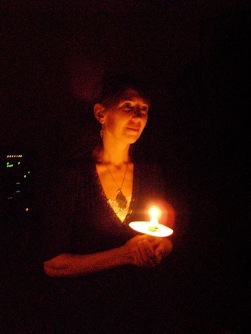
The candle represents the light of love, compassion and connection kindled in our hearts as we dance.
In these challenging times, one of the hardest things to do is to keep our hearts open. Grief and despair tend to shut them down. And even among close friends, colleagues, family members, and people with whom we share worship, when we clash over differing political opinions, trust can swiftly erode. These kinds of losses and sorrows can make us just want to close the doors to our hearts.
Yet hardened hearts and minds are not going to help us overcome conflicts and affirm connections. Only if we can open our hearts to one another, holding the fullness of our (and others’) feelings in a compassionate way, can we weather the storms which threaten to divide us further. And only if we are united can we find our way together through those storms.
One of the best ways I know to connect with others and to open my heart is through the joyful experience of traditional circle dance, particularly Armenian dances. I have written previously on this blog (The Dance of MemoryThe Wishing Tree) about Armenian dances and their ancient roots, their links to the pre-Christian Goddess, and how they affirm survival throughout the traumas of history. I have also written about my friend and colleague Shakeh Major Tchilingirian and her inspiring Circle of Life project, which brings Armenians, Turks, Kurds, Assyrians, and other survivors of atrocities and genocide to dance together for reconciliation.

Continue reading “Opening Our Hearts Through Armenian Dance by Laura Shannon”

Yemaya, Mother Whose Children are the Fish by Judith Shaw

judith shaw photoI spent the winter holidays in Rio de Janeiro with my sister. It was wonderful to experience the warmth of both the Brazilian people and summer in the Southern Hemisphere but a little odd to miss the quiet, dark time of winter back home. One huge bonus to the trip was to be in a place where the worship of Yemayá is alive and active. I was blessed to witness a ceremony to her on New Year’s Eve held by Afro-Brazilian practitioners of the Candomblé religion on the beach of Copacabana.

Continue reading “Yemaya, Mother Whose Children are the Fish by Judith Shaw”

A Rescue Remedy, Part I by Barbara Ardinger

A year, now. It has been a full year since the phony election that put El Presidente in the Golden Office. A year since people began leaving the capital and the nation’s other large cities. While some of the refugees emigrated to quasi-democratic nations, most of them settled in the small towns and on the farms across the countryside, where they began building new, rural lives. A year ago, it was a flood of refugees. Now fewer people are able to escape.

A year, now, and even though she has studied and practiced, the wicked witch is no wickeder than she ever was. Nowadays she even forgets to put on the wicked-witch mask that she used to think scared people. But it’s easy for everyone to see that, masked or not, she’s just an ordinary woman practicing an old-time religion. She’s never fooled anyone, not the sixty or so refugees who now live on her farm, especially not the various ravens who drop by regularly for snacks in exchange for gossip.

Continue reading “A Rescue Remedy, Part I by Barbara Ardinger”

SHEELA-NA-GIG by Carol P. Christ

On a trip to Ireland several years ago, I was fortunate to have been able to see the Sheela-na-gigs in the National Museum of Dublin.  Two of these Sheelas including the one removed from the Seir Kieran Church of County Offaly, pictured below, are currently on display.  They stand at the doorway of a room dedicated to items from the medieval period and easily missed.  As there was little interest in them and they are not in cases, I was able to silently commune without interruption.

Continue reading “SHEELA-NA-GIG by Carol P. Christ”

Honey: A Thousand Flowers by Mary Beth Moser

Today I am finishing the last bit of the honey I hand-carried home from my most recent trip to Trentino. Sun yellow in color, it is made from the nectar of mountain flowers. Its label tells its origin—di montagna, of the mountains, and its type — mille fiore, often translated as “wildflowers.” Literally, however, it means “a thousand flowers.”

The valley where my maternal grandmother was born, Val di Sole, is renowned for its honey. In Croviana, one of the villages in the valley, new honey is celebrated in July with a sagra, a communal food festival. There are more than a dozen different types of honey from Trentino, including apple, chestnut, and rhododendron. These are plants of place – nature’s gifts that appear in the folk stories and are present in everyday life. Continue reading “Honey: A Thousand Flowers by Mary Beth Moser”