On Bechukotai and the Valuing of Females

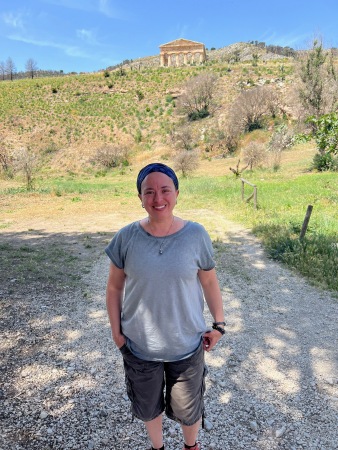
Bechukotai, Leviticus 26:3-27:34, was read in synagogues around the world on May 24, 2025.  As I have mentioned in past blogs, my timing is somewhat off in my attempt to finish my (eco)feminist commentary on all 54 of the parshot.  Bechukotai discusses the consequences of both following and ignoring the commandments.  For those of you who have been following along with these commentaries, you could probably already tell me how this parshah is going to go.  If you have guessed follow the rules and live and eat well in the land or don’t and be exiled, sick, starving, and so on, then you have guessed correctly.  As this is the case, this thinking betrays a certain logic, common to the ancient world and its understanding of flourishing or lack thereof.  I have written about this numerous times on this site (see here for what is perhaps my most thorough explanation).  Yet, Bechutokai also makes some rather interesting comments about women, and that will be my focus for today’s post.

Continue reading “On Bechukotai and the Valuing of Females”

From the Archives: Writing Through the Body: Betty Smith’s A TREE GROWS IN BROOKLYN by Joyce Zonana

This was originally posted on April 29, 2017

In her 1975 manifesto, “The Laugh of the Medusa,” French feminist Hélène Cixous urges women to write: “Writing is for you, you are for you; your body is yours, take it. . . . Women must write through their bodies, they must invent the impregnable language that will wreck partitions, classes, and rhetorics, regulations and codes . . .”

“The Laugh of the Medusa” remains a thrilling essay, challenging and inspiring women to “return to the body” and to language.  “Woman must write woman,” Cixous insists, “for, with a few rare exceptions there has not yet been any writing that inscribes femininity.”

Continue reading “From the Archives: Writing Through the Body: Betty Smith’s A TREE GROWS IN BROOKLYN by Joyce Zonana”

My Experience at the Parliament of the World’s Religions: Build the Bubble by Caryn MacGrandle

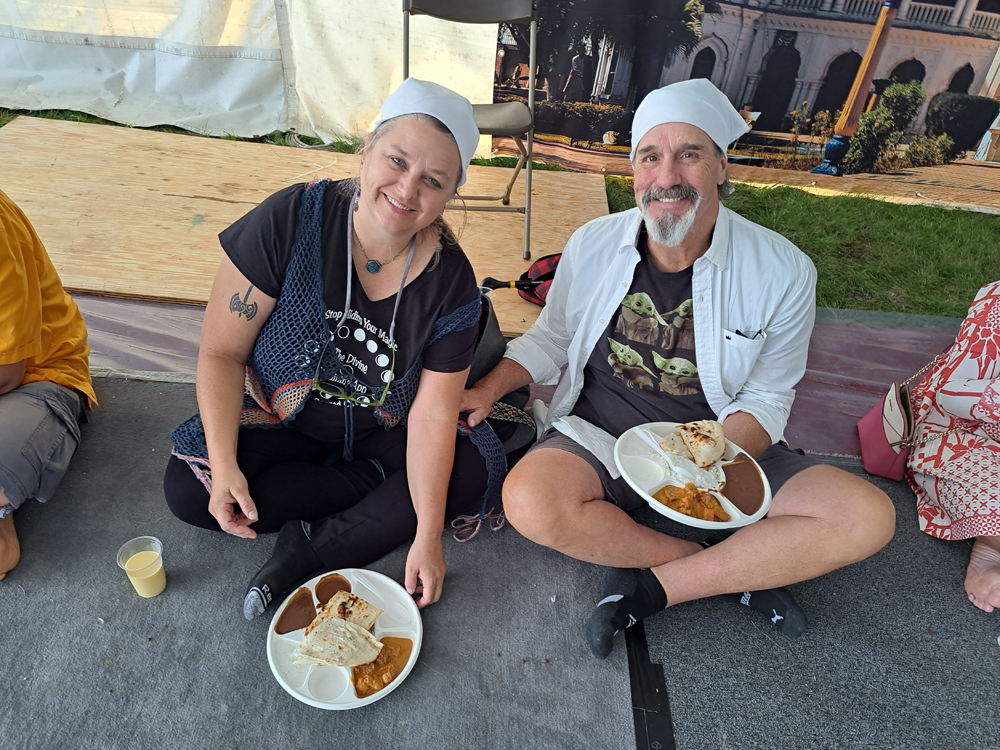
Mid August I went to the Parliament of World’s Religions.  It was one of the most amazing experiences of my life:  7,500 people from all over the world coming together in love.  Christians, Pagans, Sikhs, Jains, Hindus.  All different religions and cultures.  All with the same intention to find common ground and peace between us while respecting our individual rights, religions, preferences, etc.

Langar lunch

The Sikhs fed us with their Guru Ka Langar lunch.  ‘Langar’ started about 550 years ago with a simple, but gigantic act by Guru Nanak the founder of the Sikh faith.  He was given funds to start his business.  Instead, he bought food and served the hungry.  This tradition is carried on by Gurdwaras all around the world to this day.

Continue reading “My Experience at the Parliament of the World’s Religions: Build the Bubble by Caryn MacGrandle”

From the Archives: Rosh Hashanah and the Goddess by Joyce Zonana

Moderator’s Note: This was originally posted on Rosh Hashanah Sept 10, 2015. Rosh Hashanah this year begins on Sept. 15th but FAR will be taking a 16 day hiatus at that time so we are posting today.

When I was growing up in the 1950s in my Egyptian Jewish immigrant

My father, an Orthodox man who prayed each morning and went regularly to the local Sephardic synagogue in Brooklyn, privately followed the tenets of his faith.  But it was my mother, unconsciously devout, who brought the public rituals of our religion to life.  As a child, I longed to be at prayer with my father and was envious of the men and boys who studied and recited the sonorous ancient Hebrew; I did not want to be confined to polishing the silver and setting the table.  But today, as an adult, I am grateful for the silent teachings bequeathed to me by my mother.

Continue reading “From the Archives: Rosh Hashanah and the Goddess by Joyce Zonana”

HONEY SELLERS by Kapka Kassabova with Intro by Laura Shannon

Introduction to Kapka Kassabova’s ‘Honey Sellers‘, by Laura Shannon

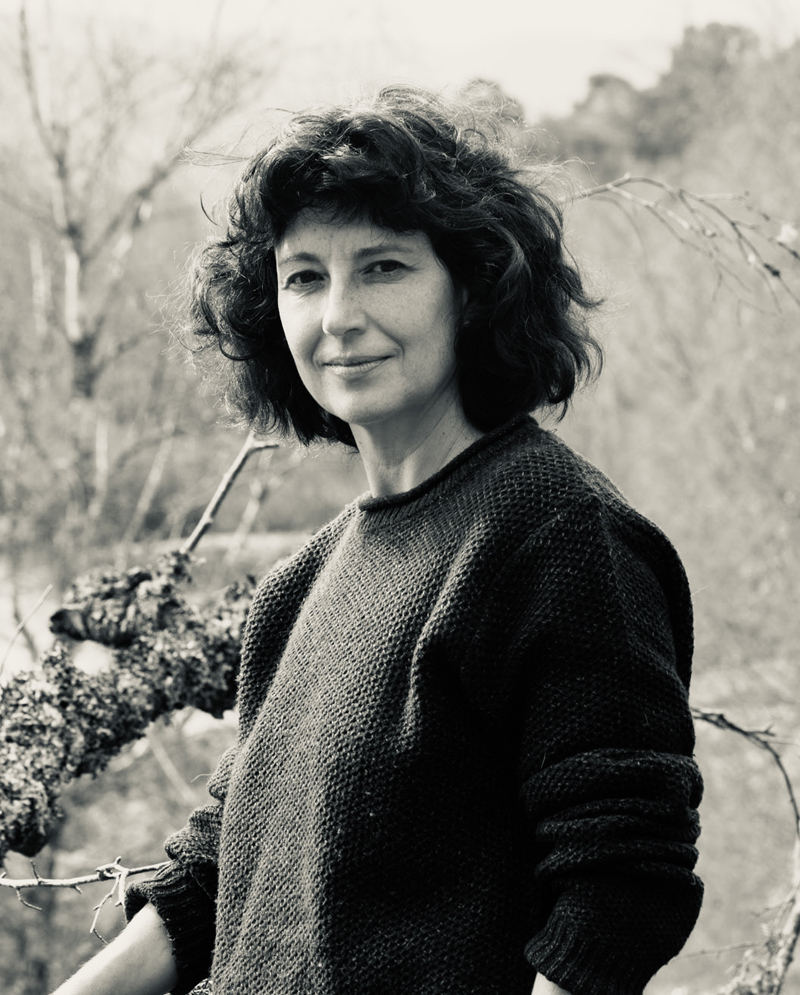
Kapka Kassabova. Author photo by Tony Davidson. Used by permission.

After my recent review of Kapka Kassabova’s latest book, Elixir: The Valley at the End of Time, I am delighted to share an excerpt from Elixir with FAR readers here, by kind permission of the author and the publisher.

Elixir is an astounding book, revealing a little-known world of foragers, healers, and mystics in a remote corner of Bulgaria. Here people live in profound connection to nature, with respect for herbs and the earth and older women, echoing the peaceful Neolithic civilisations which once flourished in the same valley Kassabova describes.

Continue reading “HONEY SELLERS by Kapka Kassabova with Intro by Laura Shannon”

From the Archives: The Found Goddesses of Good Eats by Barbara Ardinger

This was originally posted on August 1, 2013. We usually do Carol Christ’s legacy posts on Mondays. Given the closeness of Lughnasadh, it felt appropriate to share the work of one of our other long-time writers today. Carol’s legacy posts will be back next week.

Lughnasadh (pronounced LOON-us-uh) or Lammas—is the first of the three traditional harvest festivals of the traditional Celtic calendar that most pagans follow today. And what naturally follows harvest? Feasting, fairs, and festivals. To help us celebrate the season, here are two Found Goddesses of good eating. The term “found goddesses” was created in 1987 by Morgan Grey and Julia Penelope, authors of a hilarious book titled Found Goddesses. After reading this book and having never met a pun I didn’t instantly love and being of a naturally satirical state of mind, I started Finding—i.e., inventing—my own goddesses shortly before the turn of the century. After I found a hundred of them, they were published in 2003 in my book, Finding New Goddesses.

Continue reading “From the Archives: The Found Goddesses of Good Eats by Barbara Ardinger”

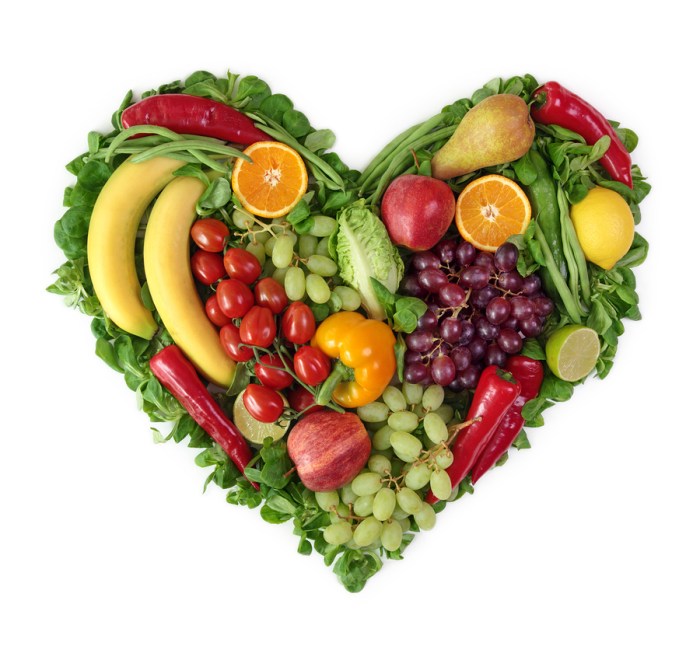
A Serving of Vegetables with Love: Plastic, Poison, and the Simple Salad Solution

Years ago, I remember looking around one day and realizing that I was surrounded by plastic bottles. Of course I already knew it on some level; I had bought them, after all. But it was one of those epiphanal moments – you know, where you kind of freeze, and time seems to slow down, and everything goes a little out of focus. And I realized – yet again – that I had been hoodwinked. That we all have.

Because I felt like I needed every single one of them. Yet somehow – and not that long ago, either – everyone used to get along fine without all these plastic bottles in their lives. Yes, it probably involved more domestic labor; but it also just stemmed from a local, circular economy based on common sense.

Continue reading “A Serving of Vegetables with Love: Plastic, Poison, and the Simple Salad Solution”

From the Archives: Sacred Food for Body and Soul by Carolyn Lee Boyd

This was originally posted on Jan 29, 2022.

Today is Wives’ Feast Day, a holiday celebrated in Ireland and northern England on February 2, the same day as Imbolc, Candlemas, and St. Bridget’s Feast Day. On this holiday, women (in Old English, “wife” meant simply woman) would gather together and enjoy making and sharing delicious foods with each other, honoring themselves and their work providing nourishment and other aspects of making a “home.”

When you think about it, this delightful tradition is quite remarkable. Feast days are generally associated with saints, so, in a way, this feast day recognizes the sacredness of all women and also their daily labor. This echoes to me Old European cultures that connected women’s baking and weaving to divinity by placing workshops in goddess temples and associating goddesses with these tasks. Today, women work in many jobs not directly associated with food production, but still labor to make our communities and planet better “homes” in many other ways. 

Continue reading “From the Archives: Sacred Food for Body and Soul by Carolyn Lee Boyd”

From the Archives: Thanksgiving and Service by Sara Frykenberg

This was originally posted on December 3, 2103

Growing up in an evangelical Christian church, I was taught that human beings should serve one another and put others before themselves.  These two different teachings, paired with patriarchal misogyny, have sometimes been very problematic for me.  I tend(ed) to give too much.  Too many demands with which I complied were self-negating (which after all, helped me to make other people more important than myself).  It took me a long time to learn how to appropriately prioritize my own needs, to stop mistaking self-esteem for the”‘sin of pride,” and how to say no when I needed to… Actually, I am still learning some of these lessons.

Conversely, my ritualized service to the church was sometimes confusing, awkward or embarrassing.  I clearly remember having the opportunity to serve as something like an usher during Thanksgiving at our family’s church as a child.  This involved wearing a pilgrim costume, which for me meant finding a Puritan style costume in the church’s closet that fit my overweight childhood frame.  This was not an easy task and left me feeling ashamed.  Later as an adolescent, my youth group asked us to wash one another’s feet as Jesus did for his disciples.  Now, don’t misunderstand me here— I do believe that this ritual has the potential to be very powerful and meaningful for those involved.  However, my teenage self could not identify with the symbolic gesture beyond realizing that:

1)    I thought touching other people’s feet was gross, as was having my dirty feet touched and,
2)    I knew I ‘should’ get something out of the ritual but did not, so I felt spiritually guilty or inadequate.

Overall, I often associated Christian service with guilt, inadequacy, my role as a daughter or woman or my sacrificial duty.

Despite these issues, I usually genuinely enjoy serving others and giving to other people.  I love to host people and care for them.  I like to help.  I even prefer to help.  Serving one another we can express and allow others to express love.  But this past week, one day before Thanksgiving, a dear friend of mine gently challenged me to allow myself to be served or, as she put it, “to give someone else the gift of giving to me.”  Specifically, she was referring to a pending holiday meal for which I expressed my anxiety and frustration with not being allowed to help—which somehow makes me feel like a child.  Even writing this phrase, “makes me feel like a child,” I know that I have touched deeper feelings of helplessness or vulnerability that at some point, I learned to battle with competence and over-achievement.  I do often feel like a child or guilty when other people do for me what I think I could or should do for myself; and my friend’s brief words encouraged me to explore this relationship to being served.

“Service” can sometimes feel uncomfortable for the reasons I mention above, but more so, for its connection to the coercive “servitude” required by existent hierarchies within andro-kyriarchal oppressive systems.  I have been subject to this coercive servitude, and also, its beneficiary.  As a white, middle class, Western woman I have far too much privilege that is contingent upon the forced labor and oppression of other people.  This kind of forced servitude is very wrong; and I am still learning how and where to choose other than to be complicit in this abuse.  But, there have also been many distinctive instances in my life where I have felt reciprocally and undeniably “served” by people around me, without abuse and without manipulation.

Driving to Colorado one summer to see the friend I mentioned above, my two companions and I served one another.  The individual in the back seat was responsible for cutting bagels and spreading cream cheese on them for the driver and navigator, while the navigator held the drink, food or whatever other item that the driver could not.  This may sound like a small thing, but it wasn’t.  I felt taken care of and loved in this small and traveling community.  We also had a safe word that meant, “leave me alone, I’m grumpy” on our long trip.  We made agreements to account for one another’s  discomfort and effort.  We respected one another and cared for each other.

Beginning my work as an adjunct professor, I encountered a great deal of stress and often long and awkward work hours.  Many times I felt like I needed help, but there was nothing I could ask for help with when it came to my job: I needed to grade my own papers, plan my own lectures, and yes, write my own blogs.  My husband has responded by taking care of me in other ways.  He makes me dinner, goes to the store and makes sure I take breaks.  We take turns taking care of one another, and I am grateful for him.

This past week after talking to my friend, I noticed how willing people were to touch me to soothe aching muscles.  I’m not sure how to describe what I felt, but it was like something invisible in certain spaces was suddenly visible.  I also realized that it had been a very long time since I had freely and openly received this touch.  Later during the weekend, a friend came to my house  and she made me dinner!  My husband rubbed my chest after a long night of coughing yesterday because I still haven’t completely rid myself of the smoldering in my lungs.  I was defensive for so long.  Shedding my defender allows me to rediscover all those things for which I am thankful.

Gratefulness is an action.  It can be found in those expressions that return, receive and allow for mutual loving.  I am learning new rituals that help me to remember that this kind of mutual serving and being served is sacred.  In a summer ritual, my friend and I washed one another’s hair instead of our feet.  I am still learning to ask for assistance from the goddess after freeing myself from an abusive omnipotent god, but I am starting to ask.

I am starting to pray again.

BIO: Sara Frykenberg, Ph.D.: Graduate of the women studies in religion program at Claremont Graduate University, Sara’s research considers the way in which process feminist theo/alogies reveal a kind transitory violence present in the liminal space between abusive paradigms and new non-abusive creations: a counter-necessary violence.  In addition to her feminist, theo/alogical and pedagogical pursuits, Sara is also an avid fan of science fiction and fantasy literature, and a level one Kundalini yoga teacher.

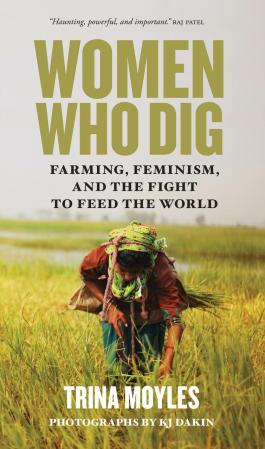
Women Who Dig by Trina Moyles – Book Review by Carolyn Lee Boyd

Here in the north, it is harvest time when the deep and ancient relationship between women and farming once again brings forth the food on which life depends. Women have been co-creating with the Earth to feed themselves and their families and communities for many  thousands of years. In fact, the world’s oldest agricultural tool may be a 300,000 year old stick possibly used by women to “harvest wild tubers for food and medicine” (p. xx) according to Women Who Dig: Farming, Feminism, and the Fight to Feed the World by Trina Moyles with photos by KJ Dakin. 

In her beautiful and enlightening book, Trina weaves together stories and stunning color photographs about the lives and work of women small farmers in Uganda, Guatemala, Nicaragua, the United States, Canada, India, the New Congo refugee settlement in Uganda, and Cuba. Together the profiles demonstrate that, despite sometimes overwhelming odds, women are feeding themselves, their families, and their communities through sustainable small farming practices that are good for both our nutrition and well being as well as the planet.

Continue reading “Women Who Dig by Trina Moyles – Book Review by Carolyn Lee Boyd”