
Lucy Pick’s Pilgrimage by Mary Sharratt

mary sharrattIn medieval Europe, religious devotion provided an alternate narrative for women’s lives in a male-dominated culture. Defiant women who stood up for themselves in the face of rape, incest, and murder were hailed as virgin martyrs. Religious vocations, such as becoming a nun or a beguine, provided a viable and esteemed alternative to forced marriage.
Even women who were married with children could escape their domestic entanglements and conjugal duties by taking an oath of celibacy as 15th century English mystic Margery Kempe did, leaving behind her husband and 14 children to go on pilgrimage to Santiago de Compostela, Rome, and Jerusalem. Her Book of Margery Kempe, the tale of her travels, reads like a kind of late medieval Eat, Pray, Love and is the first autobiography written in the English language.

Though it might seem surprising to us today, women of the European Middle Ages possessed more rights and freedoms than their descendants in the Renaissance, Early Modern, and Victorian ages. Women worked as craftspeople and artisans and were members of the guilds, alongside men. Monarchs such as Eleanor of Aquitaine were global power brokers while religious leaders such as Hildegard von Bingen devoted their lives to intellectual and artistic pursuits, composing music and writing weighty philosophical and theological books that are still being discussed today.

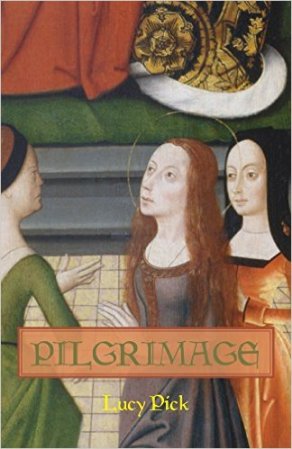
lucy pick pilgrimageThe cover of academic historian Lucy Pick’s novel Pilgrimage shows details from a painted altarpiece dedicated to Saint Godeleva. A victim of forced marriage who was strangled by order of her husband, this legendary saint was a patron of abused wives. Lucy Pick’s novel concerns the saint’s daughter, the blind Gebirga of Gistel in Flanders. What would it be like to be the daughter of a martyred saint whose miracles cured everyone except you?

Considered unmarriageable due to her blindness, Gebirga rejects life as a nun in an abbey dedicated to her sainted mother. Instead, in a bid for freedom, she embarks on a pilgrimage to Santiago de Compostela in faraway Iberia, an epic journey for that time. She serves as the companion to a highly strung teenage noblewoman and is charged with delivering the girl to the Spanish king she is contracted to marry. During their travels, Gebirga must use all her intelligence and resourcefulness to protect herself and her young charge from the considerable dangers and political intrigues they face on their way. Though they encounter hardship and heartbreak, this is a pilgrimage of miracles, healing, and redemption.

Lucy Pick, the Director of Undergraduate Studies and Senior Lecturer at the University of Chicago’s Divinity School, has infused her novel with impeccable research into the lives of medieval women. This novel is a medievalist’s delight and fans of the late Margaret Frazer will devour this book.

Mary Sharratt’s book Illuminations: A Novel of Hildegard von Bingen, won the 2013 Nautilus Gold Award, Better Books for a Better World. Her forthcoming novel, The Dark Lady’s Mask: A Novel of Shakespeare’s Muse, tells the tale of the groundbreaking Renaissance women poet Aemilia Bassano Lanier and will be published by Houghton Mifflin Harcourt in April 2016. Visit Mary’s website.


Was Mother Kalawati a Feminist? (Part 2) by Vibha Shetiya

VibahContinued from Part 1.

After leaving her home and her children in order to take refuge with her guru, in no time, Rukmabai won over hearts. Her guru, Siddharood Swami “with his divine sight” discerned that Rukmabai was no ordinary being. In fact, just before his death, upon realizing that his principle disciple had attained moksha (liberation from the cycle of death and rebirth), he left to her his mission of guiding others to salvation, directing his followers to now address her as Mother Kalawati.

And so it came to be that at the tender age of twenty-one, Rukmabai had a large following herself, and as an intense devotee of Krishna, she almost became synonymous with the god. As many like to point out, she had already internalized the attitude of non-attachment, whether towards individuals, possessions or food or drink; she was already enlightened.

Her disciples were both male and female, although she dedicated herself to the well-being of women. But while directing minds towards god, Kalawati Aai – a high class and high caste woman – also dedicated herself to uplifting the poor and backward Bohari community of Belgaum, Karnataka. It is said that the men used to wile away their time drinking and gambling leaving the womenfolk to run the household. Because of Kalawati Aai’s intervention, some order was brought to their lives; the men stopped drinking, which in turn put an end to the physical abuse they had heaped upon their wives, as well as the neglect their children had faced, who earlier had no choice but to turn to vagrancy. Stability in the homes through prayer and piety – in other words channeling their minds away from vice and towards god – in turn saw not just an economic change but also a change in the lives of these women and children, for the better.

But – and this is interesting – her message to women was not one of directing energy towards god in search of inner peace or salvation, but towards the family, of being a virtuous wife and mother. In fact, she urged women to put aside “just one hour a day of your life to the service of god”; the rest of the time should be aimed towards serving the family. And her advice to women unhappy on account of their domestic life would always be to look deep within themselves to remedy the situation, rather than to blame their husbands. Moreover, at no point should a woman ever neglect her duties towards family on account of her own well-being for that would be tantamount to selfishness. I find this most interesting because she herself broke norms in order to serve a personal calling. Continue reading “Was Mother Kalawati a Feminist? (Part 2) by Vibha Shetiya”

Reform? Progress? By Elise M. Edwards

Elise EdwardsIn my class yesterday (a survey of Christian thought and practices), I was lecturing about monastic life in the Middle Ages. Among other points, I mentioned that medieval religious orders provided settings where women could be educated and assume leadership roles (primarily among other women), thinking of Hildegard of Bingen (1098-1179) who was the Abbess of a monastic community in Rupertsberg. Other women medieval writers who developed influential writings, like Mechtild of Magdeburg (ca. 1210-1282) and Catherine of Siena (1347-80), belonged to tertiaries or third orders, which were monastic community for laypersons. This part of the lesson emphasized that monastic reforms around the 12th century opened religious orders more extensively to women and laity.

Still speaking of medieval reforms, I displayed a picture of Francis of Assisi on the screen at the front of the room. I mentioned that Francis was concerned about the poor and the animals and that he has inspired some contemporary Christians, including the current pope who took Francis as his name. We talked about how both St. Francis and Pope Francis are seen as reformers.

Because earlier in my lesson I’d made a point of speaking of women’s experience, when I spoke about the Pope’s name as a possible sign of renewal or reform, Gina Messina-Dysert’s question “What about the women?” came to mind. In her recent post, she responded to the Pope’s exclusion of many issues that concern women in his address to the US Catholic Bishops. Like Gina, I applaud many of the Pope’s reforms but I am confused about how rarely he is criticized for maintaining the long-held Catholic view that disallows women to be ordained as priests.

Let me provide an example: During the Pope’s visit to the US, one of my students described Pope Francis as “very liberal.” When I interjected that he has not supported the ordination of women, the student laughed and said the pope would be accused of heresy for supporting that! While that may be true, my more immediate concern was that in a classroom of students who are mostly supportive of women in ministry, the Catholic restrictions on the priesthood were seen as a part of the tradition not worth challenging. Why is it that preserving male leadership is excused as a part of the tradition while preserving exclusive marriage practices is something to be challenged? They are interrelated.

As we know from blogs and social media sites, many people who support LGBTQ rights were upset over news stories about the Pope meeting with Kim Davis, the county clerk who was jailed for refusing to issue marriage licenses to same-sex couples. Certainly such a meeting is disturbing to same-sex marriage advocates. But is it surprising? At least one womanist ethicist I know, Eboni Marshall Turman, pointed out in a Facebook discussion that the church has long since been public in its support of male privilege and heteronormativity. My intent is not to single out Catholicism for sexist practices. When recently asked about women’s ordination and leadership in Baptist churches in my own town of Waco Texas, I had to admit that even though ordination of women is permissible and practiced in many of the churches, the number of churches that have called women to the position of senior pastor is shockingly few.

My point is this: When we find teachings in particular religious traditions that justify the exclusion of one group, we should expect to find justifications for excluding other groups, too. In the same discussion I referenced above, Eboni Marshall Turman said, ”Oppressions are compounded and intersectional. If they come for me, it is just a matter of time before they come for you. This is basic theological ethics.”

The experiences of varied groups are not the same; our oppressions and marginalizations also differ. But practices of exclusion are constructed on the same logic that values some persons (the in-group) more than others (the outsiders). Therefore, feminists have a responsibility to advance the well-being and interests of other groups (besides women) who are being marginalized.

Another reason for this advocacy is that many women are included in other marginalized groups. To ignore the intersectionality of oppression is to deny its pervasiveness and the realities of women’s lives. This is why feminists of color are often critical of white feminism. (The recent debate over the photo shoot for the movie Suffragette is a new instance of a persistent critique of white or mainstream feminism. See Rebecca Carroll’s piece on “Suffragette’s Publicity Campaign and the Politics of Erasure”).

To counter the limitations of our own experiences and be consistent in our pursuit of equality, feminists should intentionally cultivate practices of solidarity and coalition-building in our work. I, like everyone else, am often unable to see the inconsistencies in my own practices and teachings without others’ experiences to expand my view. This is one reason I value this Feminism and Religion community. Thank you for the wisdom and practices you offer from your own religious traditions and your own experiences of marginalization. You make me a better feminist through your writings and comments.

Perhaps working together, we can bring about religious reforms that our descendants will recognize in the centuries to come.

Elise M. Edwards, PhD is a Lecturer in Christian Ethics at Baylor University and a graduate of Claremont Graduate University. She is also a registered architect in the State of Florida. Her interdisciplinary work examines issues of civic engagement and how beliefs and commitments are expressed publicly. As a black feminist, she primarily focuses on cultural expressions by, for, and about women and marginalized communities. Follow her on twitter, google+ or academia.edu.

Rosh Hashanah and the Goddess by Joyce Zonana

Joyce Zonana head shotWhen I was growing up in the 1950s in my Egyptian Jewish immigrant home, each of the High Holidays was imbued with sacredness, thanks largely to my mother’s commitment to a creating a harmonious and memorable gathering of family and friends.  Around a long table, covered with an embroidered white cloth and set with sparkling silver and delicately fluted china, she served at each season the festive meal that made manifest for us the presence of the Divine.

My father, an Orthodox man who prayed each morning and went regularly to the local Sephardic synagogue in Brooklyn, privately followed the tenets of his faith.  But it was my mother, unconsciously devout, who brought the public rituals of our religion to life.  As a child, I longed to be at prayer with my father and was envious of the men and boys who studied and recited the sonorous ancient Hebrew; I did not want to be confined to polishing the silver and setting the table.  But today, as an adult, I am grateful for the silent teachings bequeathed to me by my mother. Continue reading “Rosh Hashanah and the Goddess by Joyce Zonana”

Katharine Bushnell—The Most Important Christian Feminist You’ve (Probably) Never Heard Of by Kristin Kobes Du Mez

037 DuMez 2015 photo shootKatharine (Kate) Bushnell (1855-1946) was by any measure a remarkable figure in the history of Christian feminism. A global anti-trafficking activist and author of God’s Word to Women, a fascinating feminist theology that recasts the entire biblical narrative as a story of liberation for women, Bushnell was once widely known throughout the late-nineteenth-century Protestant world.

A Midwestern Methodist, Bushnell came of age in Evanston, IL. After a brief stint as a medical missionary to China, she helped launch the American “social purity” movement by leading a dramatic exposé of the trafficking of women in Wisconsin lumber camps. Drawing attention to the injustices women faced under the Victorian sexual double standard, Bushnell helped break the “conspiracy of silence” that inhibited discussion of sexuality among “respectable” women and men. She then took her activism overseas, where she exposed the abusive practices of the British army in colonial India, particularly when it came to the confinement and abuse of local women in military brothels. Continue reading “Katharine Bushnell—The Most Important Christian Feminist You’ve (Probably) Never Heard Of by Kristin Kobes Du Mez”

Guanyin Revisited: Queer, Pacifist, Vegan Icon by Angela Yarber

Each month, I delight in writing about a revolutionary woman. Whether she is from history or mythology, sharing the stories of my Holy Women Icons with a folk feminist twist is one of my favorite things to do as a feminist, artist, scholar, and clergywoman. Yet, no matter how much research I’ve done, or how many times I’ve taught about an icon, new discoveries are made, revelations within my own heart and mind cracked open, so that there is sometimes the need to revisit a particular holy woman afresh. Such is the case this month with Guanyin. Though I wrote about her nearly two years ago, published a book including her story, and have taught a course with one session focused on her compassion and mercy, I realized that much about her has gone unsaid. Namely, she is an icon for queers, pacifists, and vegans. Before explaining why, let’s have a quick review…

Guanyin is the Buddhist Goddess of Mercy and Compassion. In the Lotus Sutras, she originates from a bodhisattva named Avalokitesyara. Avalokitesyara is identified as male in the Lotus Sutras. Overtime, however, Avalokitesyara transitions from being identified as a male to becoming Guanyin, most often portrayed in feminine terms and referred to as “she.” Many scholars assert that Guanyin is androgynous and can take on the form of any sentient being. And this is how I’ve always written about Guanyin, as the divinely androgynous one who is most often portrayed in feminine form. Continue reading “Guanyin Revisited: Queer, Pacifist, Vegan Icon by Angela Yarber”

The Dance of Memory, Part 2: The Wishing Tree Laura Shannon

Laura Shannon square crop

Now is the time of Beltane, the great festival celebrating life and fertility.

Last week, on April 24th, in my post The Dance of Memory I wrote about the centennial of the Armenian Genocide, and invited everyone to join in this worldwide day of remembrance through prayer, meditation, music and dance. Subsequently I received testimony from students and colleagues all over the world about dance events they had organised in response to my call.

Dancing friends from Europe, North America, South America, and Australia told how moved they felt to be part of a larger whole, connected through the wordless beauty of music and dance, and by our compassion and caring for all those affected by genocide. Many, including my sister Leslie, thanked me for my ‘call to include Turkish and other dances in the Armenian commemoration activities’. She wrote from New Zealand, ‘The world needs more of this kind of inclusiveness!’

In Germany, Sybille Kolaric danced Armenian dances and a Turkish dance with her group, saying, “I really liked the idea to combine in the dance circle what is so separated in reality.”

A beautiful coming together of Turks and Armenians took place in Istanbul, where my dear friend and colleague Shakeh Major Tchilingirian went with her family, along with many Armenians from all over the world, for the April 24th commemorative ceremonies. A few days before, Shakeh had been leading Armenian dances with Turkish university students there as a ritual of reconciliation (you can see the film, Circle of Life, about a similar event she led in London). Shakeh wrote that they attended a very emotional service in the Armenian Church, and then went to Taksim Square to tie cloths to the Wishing Tree.

Shakeh wrote from Istanbul, “Last night I read some of the messages on The Wishing Tree, messages remembering ALL victims of atrocities and genocide as well as the displaced. There were thousands, possibly tens of thousands, of people sitting silently in Taksim Square, many Turks and Kurds amongst us. There is a lesson to be learned here: we are all victims of the situation we find ourselves in and the longer these wounds bleed the more difficult it becomes to heal.”

The Wishing Tree in Taksim Square was created by Turkish artist Hale Tenger, specifically to mark the centennial of the Genocide. She invited participants to tie pieces of cloth to its branches in homage to the victims and survivors of the Armenian Genocide. Armenian-American Nancy Kricorian brought with her from New York a strip of fabric from one of her grandmother’s aprons, saying, “My grandmother Mariam Kodjababian Kricorian was a survivor of the 1915 Genocide, and tying this cloth to the Wishing Tree in Istanbul will be a tribute to her life.”

HaleTengerWishingTree


Clouties_near_madron_wellArmenian wishing tree cropCoincidentally, my April 24 post on FAR included a photo of an Armenian grandmother tying an offering of cloth to just such a tree. The ancient folk custom of the wishing tree, where people (usually women) tie cloths with a special prayer for a loved one, can be found today in Armenia, Turkey, and Greece, in Asia and throughout Europe as far as the British Isles and in Asia as well. This ‘clootie tree’ by the ‘clootie well’ (cloth = clootie) in Madron, Cornwall, is almost identical to the Armenian one shown in my previous post.

Carol P. Christ’s comment on my last post described a similar tree on her Greek island of Lesvos which she tells me is near hot baths once sacred in antiquity. She also stated that brides in ancient Greece would leave articles of their unmarried clothing on a tree dedicated to the virgin Goddess Artemis, one of many tree-worshipping rituals which were well-known and widespread in the ancient world.

Women on Carol Christ’s Goddess Pilgrimage to Crete have all participated in such a practice, tying coloured ribbons onto the venerable myrtle tree already covered with ribbons and votive offerings called tamas, at the sacred monastery of Palianí. When I went there with Carol in 2012, my encounter with the tree led to a profound and lasting experience of healing, which Carol remembered in Giving Back to the Mother.

Paliani myrtle DSCN9080Paliani tamas DSCN9079

Tree emb Paliani DSCN9092Sisters on Carol’s pilgrimage also get to encircle the 2,000-year-old plane tree at Krasi. Even today village festivals are held under the canopy created by the ancient tree.  We know that tree worship on Crete has roots in Minoan times, as depicted in gold seal rings and other examples of Minoan art, and we know that tree worship is both ancient and widespread.  My life’s work researching the Goddess in traditional Balkan dance has shown that the Tree is often associated with the Goddess, for instance in many Balkan embroideries  This abstract but recognisable version comes from the curtains of the reception room in the Palianí monastery.

Maibaum_Ostfriesland967The sacred tree remains a living tradition in central, western and northern Europe in the form of the Maypole. I write this from Austria, where virtually every town and village honours May 1st (the ancient celebration of Beltane) with a May Tree, or Maibaum, a tall decorated pole with a wreath at the top. I love how this one from Germany resembles the Goddess.  Can you see her too?

Once-universal practices revering trees, nature, and the Goddess may have changed, but the act of praying for others’ well-being remains common to us all. The longing to keep our loved ones safe transcends all religious, political and ethnic boundaries. Love for others is one of the strongest bridges to common ground, and here is where we find our meeting place once again.

As I read through the messages sent in response to my invitation to dance on April 24th, I feel that each dancing circle is like a votive offering hung on a sacred tree. Each one is a gift of love for humanity, unique, yet part of a shared desire to end suffering, to bring healing, and to ensure the safety and survival of every single being in creation.

Laura Shannon has been researching and teaching traditional women’s ritual dances since 1987. She is considered one of the ‘grandmothers’ of the worldwide Sacred / Circle Dance movement and gives workshops regularly in over twenty countries worldwide. Laura holds an honours degree in Intercultural Studies (1986) and a diploma in Dance Movement Therapy (1990).  She has also dedicated much time to primary research in Balkan and Greek villages, learning songs, dances, rituals and textile patterns which have been passed down for many generations, and which embody an age-old worldview of sustainability, community, and reverence for the earth. Laura’s essay ‘Women’s Ritual Dances: An Ancient Source of Healing in Our Times’,  was published in Dancing on the Earth. Laura lives partly in Greece and partly in the Findhorn ecological community in Scotland.

Kassiani: Placing a Woman at the Center of the Easter Drama by Carol P. Christ

Carol in Crete croppedFor many years I been told of the beautiful Hymn of Kassiani, sung only on Easter Tuesday night, but I had never heard it until this week. For many this song is the high point of Easter week.

Kassiani, also known as St. Kassia, was a Greek woman born into a wealthy family in Constantinople (now Istanbul) about 805 to 810 AD. According to three historians of the time, she was intelligent and beautiful and selected as a potential bride for the Emperor Theophilos. The chroniclers state that the Theophilos approached her and said: “Through woman, the worst,” referring to the sin of Eve. Clever Kassiani responded, “Through woman, the best,” referring to the birth of the Savior through Mary.

Apparently unable to accept being put in his place by a woman, Theophilos chose another bride. Kassiani founded a monastery in Constantinople becoming its first abbess. She was an outspoken theological advocate of icons during the iconoclastic crisis (for which she was flogged). One of only two women to publish under her own name during the Byzantine Middle Ages, Kassiani wrote both poetry and hymns. Up to 50 of her hymns are known today, with 23 of them being part of the Greek Orthodox liturgy. Continue reading “Kassiani: Placing a Woman at the Center of the Easter Drama by Carol P. Christ”

Strong Female Role Models among Swedish Immigrant Ancestors in Kansas City by Carol P. Christ

carol p. christ photo michael bakasWhen I decided to become a career woman, I thought I had no role models in my family. My parents (who sometimes considered me the black sheep) would have agreed. Imagine my surprise to find a matriarchal family and three generations of businesswomen women among my Swedish family in Kansas City!

My great-aunt Edith who was a stenographer, secretary, and notary public was a fixture at family gatherings. When I knew her, she was living in California with her two brothers who also were not married. Until their father died, they had lived their whole lives in the family home in Kansas City. I sensed that though my family respected my uncles, they felt sorry for Aunt Edith. It certainly was never suggested to me that instead of getting married and being supported by a husband, I could become a self-supporting working woman like my aunt. Continue reading “Strong Female Role Models among Swedish Immigrant Ancestors in Kansas City by Carol P. Christ”

My Immortal Mother-in-Law by Elizabeth Cunningham

Elizabeth Cunningham headshot jpegBefore Olga Eunice Quintero Smyth died on December 4, 2014 at age 101 and 10 months, I was tempted to believe she was immortal, literally. I knew Olga for forty-five years (from age 16 to 61). For thirty-five of those years she was my mother-in-law. Our history began when I was kicked out of high school and went to work at her free-wheeling school, her utter lack of any interest in reforming me a blast of fresh air. It ended with me sitting beside her as she was dying, softly singing “Row, Row, Row Your Boat.”

Olga was named for a Russian princess her mother encountered when she was a babe in her arms en route to Trinidad from her native Venezuela. Olga took for granted her descent from Incan royalty as well. Her mother moved the family to New York when she was eleven. A few years later, she won a scholarship to Mount Holyoke College. She married a classmate’s brother, Julian Smyth, great grandson to Nathaniel Hawthorne. If that weren’t enough, Olga claimed for Julian’s line direct descent from the first century Celtic Queen Boadicea. As long as she could speak, she spun tales. “Where in Africa was she born?” one of her nurses asked me. “What kind of a dancer was she?” Continue reading “My Immortal Mother-in-Law by Elizabeth Cunningham”