Eve, Revisited by Jill Hammer

About six months ago I was hired to write a curriculum for a Jewish organization on biblical women in ancient and contemporary midrash.  Midrash—the ancient process of creative interpretation of sacred text that began two thousand years ago and continues to this day—has been one of my fields of expertise, and women in midrash is a particular specialty.  I knew the first lesson I wrote would be on Eve (Chava in Hebrew), the first woman of Genesis.  Yet as I began to write lessons, I started with Sarah and Hagar, then proceeded to Rebekah and Lot’s wife, Rachel and Leah, even Asnat (Joseph’s wife) and Naamah (Noah’s wife).  It became clear over the months that I was avoiding Eve.  Whenever I began to think about beginning “her” lesson, I grew anxious and immediately began to think of something else. Only when I had already written six of my ten lessons did I finally, reluctantly, begin to research ancient legends and modern feminist poems on the first foremother of the Bible.

Why was I avoiding Eve?  In part, because she seemed like such a huge topic.  Generations of Jews (and, of course, Christians) have had a great deal to say about Eve, her creation, the fruit of knowledge, the serpent, Eve’s relationship with Adam, and more.  How would I encapsulate it all?   And then there was Lilith, Eve’s alter ego, and all of the legends about her.  Choosing a handful of midrashim out of this vast corpus seemed impossible.  Plus, there was a whole literature about the relationship between Eve and ancient Near Eastern myth I wanted to allude to—Eve as a kind of human version of the Goddess with her Tree.  How to choose what to put in and what to leave out? Continue reading “Eve, Revisited by Jill Hammer”

Archy and Mehitabel by Barbara Ardinger

Archy the Cockroach and Mehitabel the Cat were introduced to the world in 1916 by Don Marquis, a columnist for the New York Evening Sun. Marquis was more than a mere columnist; he was a social commentator and satirist admired by nearly every famous writer of the first quarter of the 20th century. Franklin P. Adams, for example, said Marquis was “far closer to Mark Twain than anybody I know” (see note).

As the story goes, Marquis said he came into his office one morning to find a big cockroach jumping about on his typewriter keys. The cockroach kept climbing up the metal frame and hurling itself headfirst onto a key, one slow letter after another. He couldn’t use the shift lock (except one time when he hit it accidentally and produced an entire uppercase column), so his writing is lowercase. After about an hour, Marquis reported, the cockroach fell to the floor, exhausted after typing just one page. He never could manage punctuation, and he also had trouble with the carriage return—how many of us remember how those old typewriters worked?—but he somehow hit it every time. (My grandfather had an old typewriter like this. The keys were very stiff. I felt like my little fingers were gonna break when I tried to type.)


In his previous life, Archy was a free verse poet. As he explains to Marquis,

expression is the need of my soul

i was once a vers libre bard

but i died and my soul went into the body of a cockroach

it has given me a new outlook upon life

i see things from the under side now

Continue reading “Archy and Mehitabel by Barbara Ardinger”

What I Learn from Women in Southern Morocco by Laura Shannon

I feel deeply fortunate to be able to travel regularly to southern Morocco. In Taroudant in the Souss Valley, and further south in the Anti-Atlas Mountains, my groups of students have the chance to discover women’s cultural traditions including music and dance, weaving and embroidery, household and healing rituals. In the seven years I have been leading these tours, women have joined me from a dozen different countries and as many different faiths, and most of them end up feeling at home here just the way I do.
What makes southern Morocco so special? Many threads come together to create the extraordinary ambience which permeates this part of the country. First of all, there is the Berber influence: a large percentage of Moroccans in the South are Berbers, and many elements of ancient North African Berber culture, with roots in Neolithic times, remain percepible beneath the relatively recent overlays of Arabic culture and Islam.

Continue reading “What I Learn from Women in Southern Morocco by Laura Shannon”

Mother of All Fears by Trelawney Grenfell-Muir

This time of year, the general public tends to pay more attention than usual to witches. Much of it is lighthearted – halloween costumes and memes about where to park your broom. Some of it is spiritual – adherents of the modern religions of Wicca and neopaganism discussing symbolic and supernatural beliefs. And some of it is historical – analyzing the witch trials of past centuries and wondering how they apply, ethically, to modern day intolerance and violence.

Within all these discussions, usually unnamed and unexamined, is the framing metaquestion: what should we fear? And what should we do about that which we fear?

Historic witch trials (from a time when witches were believed to be evil agents of Satan) reveals how we humans always try to externalize badness and goodness, so we can exterminate badness and excuse ourselves for our lack of goodness. So we have heroes and villains, neither of them very human, but rather idols and symbols of our fears. I honestly think the patriarchy’s fear of females is as strong as it ever was. When the most popular videos on the most popular internet porn sites are of ****TRIGGER WARNING RAPE, INCEST**** raping a stepsister, or doctors raping a teenage girl in the hospital for cancer, or of border agents raping a pregnant young refugee, and these sites are visited by 98% of the men in our society, what does that say about us as a species? Or a culture? As Tallessyn Grenfell-Lee says, “Scary, scary vaginas!

Continue reading “Mother of All Fears by Trelawney Grenfell-Muir”

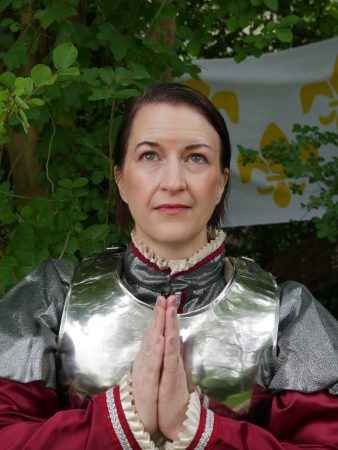
Joan of Arc from The Goddess Project: Made in Her Image by Colette Numajiri

“I’m not afraid. I was born to do this.” -Joan of Arc

Women are inherently valiant. In extreme situations we armor up and lead others through whatever we are battling at the time.

Joan of Arc was a human woman with otherworldly faith who, as a young teenager, listened to Divine voices and lead an army that eventually ended the 100 Years War.  “The real Joan of Arc is an uncomfortable fit as an icon of female solidarity or democratic rights. She achieved what should have been impossible for someone of her gender and class in 15th-century France.” wrote Helen Castor in her book Joan of Arc: A History. She was so respected and revered that 20 years AFTER Her death, 115 people testified on behalf of Joan of Arc (Jeanne d’Arc) and overturned the ruling.

Enbodying the Divine Feminine on Earth, women look to Joan as an inspiring example of a brave and active woman.  Joan inspired the Suffragettes, they held her banner and wore white (as Joan chose to wear white for purity when She was taken to the stake to be burned for the crime of cross-dressing) as they marched for women’s right to vote. Just as, a few months ago our newly elected Congresswomen all wore white in solidarity.

Continue reading “Joan of Arc from The Goddess Project: Made in Her Image by Colette Numajiri”

Sappho’s Poems as an Ethos for Women’s Ritual by Jill Hammer

Photo by: Zac Jaffe

For by my side you put on

many wreaths of roses

and garlands of flowers

around your soft neck


and with precious and royal perfume

you anointed yourself.


On soft beds you satisfied your passion.


And there was no dance

no holy place

from which we were absent.


–Sappho (trans. Julia Dubnoff)


Sappho, the poet from Lesbos (630-570 BCE), was considered one of the greatest poets of her time—one of her epithets was “the tenth Muse.” I discovered the poems of Sappho in my thirties and was utterly captivated.  I had newly embarked on a relationship with a woman and Sappho’s love poetry (though by no means exclusively lesbian) supported the expression of eros between women.  Yet even more than that, Sappho’s poems supported an erotic relationship between self and world—a relationship that included ritual as a form of intimacy.  I’m not a Greek scholar—I experience Sappho’s poems in translation. Yet the translations I read back then were a revelation: a world in which women lived in circle with one another.

Continue reading “Sappho’s Poems as an Ethos for Women’s Ritual by Jill Hammer”

Temple Magdalen by Elizabeth Cunningham

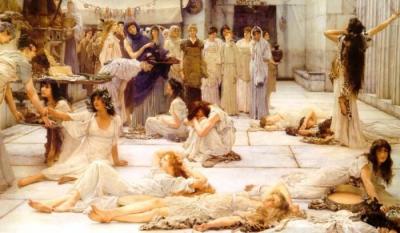
The Women of Amphissa, 1887, by Lawrence Alma-Tadema

Since I began writing for FAR in July 2012, I have written about Mary Magdalen, or excerpted a passage from one of my novels, near or on her July 22 Feast Day. For why I made the controversial choice to depict her as a prostitute, see last year’s post. The below excerpt is from The Passion of Mary Magdalen. I made this selection in remembrance of all the refugees in the world today. In this passage, Judith, a Jewish widow whose family was driven from the land by tax collectors, returns to the place where Maeve (my fictional Celtic Magdalen) and her friends have recently founded a Temple to Isis on the outskirts of Magdala. Maeve has just invited Judith to join them. (Edited for brevity.)

She stared at me, her eyes full of anger and longing.

“I will not be a slave and a whore where I was once a wife, the one who made the challah bread, who said the Sabbath prayers over it. This was our place, my husband’s and mine. We brought the best we had to the temple, the finest oil and wine, the unblemished kid—”

“Goats? You kept goats? You know how to make cheese?”

She sat quietly for a moment before she answered. “How can I live here with you?” she wondered. “I don’t understand.”

Continue reading “Temple Magdalen by Elizabeth Cunningham”

If Holly Near’s Simply Love Album Were a Musical by Elisabeth Schilling

For many of us, listening to women-loving-women songs is a spiritual experience. That is because somehow it makes us feel seen, puts a sense of hope into our world as well as daydreams of romance. We can understand the challenges and the regret or guilt that comes with disappointing others and ourselves, them for not being who they wanted us to be and for us, not being who we are for far too long. Holly Near’s Simply Love album narrates a story that I might envision as a musical theatre production, and I really wish someone would ask me to write it and then hold the casting call (yeah, I’d want to be in it too, so save me a part). I offer some of my thoughts on two central songs in the would-be musical in hopes of sacred liturgy on a potential stage.

Simply Love has 28 songs and was released (according to Spotify) in 2000. I think the synopsis would be surrounding Cassandra, in a loving relationship with her partner, reflecting on her journey to this place of authenticity. I can imagine how it might be living one’s live in an exploratory way and coming to new revelations later in life.

Continue reading “If Holly Near’s Simply Love Album Were a Musical by Elisabeth Schilling”

Re-Imaging Three Marys by Janet Sunderland

The recent #metoo movement, along with young women entering Congress, has pointed to an important question. Why, in this 21st Century, are these achievements remarkable? Why has it taken so long for women to be recognized as capable for these positions? One possible reason is the Christian mythology around women. However, to recreate the way women are viewed, we must re-imagine the women who have been standard-bearers for two thousand years.


Continue reading “Re-Imaging Three Marys by Janet Sunderland”

Kassiani’s Song: Woman at the Center of the Easter Drama by Carol P. Christ

Today I am reposting the song and story of Kassiani, the Byzantine composer, poet, and hymnographer, who is not well-known to western feminists or in western history in general. In Christian Orthodox tradition, Kassiani’s most famous song will be sung this week on Easter Tuesday night or very early Easter Wednesday morning, placing a woman’s love for Jesus at the heart of the Easter drama.

For many this song is the high point of Easter week.

Kassiani, also known as St. Kassia, was a Greek woman born into a wealthy family in Constantinople (now Istanbul) about 805 to 810 AD. According to three historians of the time, she was intelligent and beautiful and selected as a potential bride for the Emperor Theophilos. The chroniclers state that the Theophilos approached her and said: “Through woman, the worst,” referring to the sin of Eve. Clever Kassiani responded, “Through woman, the best,” referring to the birth of the Savior through Mary.

Apparently unable to accept being put in his place by a woman, Theophilos chose another bride. Perhaps relieved, Kassiani founded a monastery in Constantinople becoming its first abbess. She was an outspoken theological advocate of icons during the iconoclastic crisis (for which she was flogged). One of only two women to publish under her own name during the Byzantine Middle Ages, Kassiani wrote both poetry and hymns. Up to 50 of her hymns are known today, with 23 of them being part of the Greek Orthodox liturgy. Continue reading “Kassiani’s Song: Woman at the Center of the Easter Drama by Carol P. Christ”