Moderator’s Note: We here at FAR have been so fortunate to work along side Carol Christ for many years. She died from cancer in July, 2021. Her work continues through her non-profit foundation, the Ariadne Institute for the Study of Myth and Ritual and the Goddess Pilgrimage to Crete. To honor her legacy, as well as allow as many people as possible to read her thought-provoking and important blogs, we are pleased to offer this new column to highlight her work. We will be picking out special blogs for reposting. This blog was originally posted February 10, 2014. You can read it long with its original comments here.
Mary, Mary, quite contrary, how does your garden grow? With silver bells and cockle shells, and pretty little maids all in a row.
From the beginning of horticulture about 8000 BCE or earlier to the present day, weeding has been women’s work. Women, who were the gatherers and preparers of food in traditional nomadic societies, no doubt were the first to discover that seeds dropped at a campsite one year sometimes sprung up as plants the next year. When this discovery was systematized, agriculture was invented, and human beings began to settle down in the first villages and towns.
Moderator’s note: Today’s post has been paired deliberately with yesterday’s archivalpost by Mary Sharratt. Both pay homage to Margaret Fell in very different yet complementary ways.
In the conservative evangelical church world—a world I was deeply invested in for most of my twenties—people often spoke of Christian feminism as if it appeared for the first time in our generation, or maybe one generation prior. I’m not totally sure why I accepted this as true—but I did, for a long time. It wasn’t until seminary that I learned otherwise.
It turns out that the dream of full, real, felt equality for women within Christianity is a very, very old dream. The history of women in church is a great deal more complex than I had assumed, or been led to believe. Over the course of two thousand years of Christian history, women have fought for, and sometimes experienced, freedom to lead and minister and be fully human.
This week’s Torah portion is Vayechi, or Genesis 47:28-50:26. It is the last part of the Joseph saga (For my thoughts on two other parshot relating to Joseph, see Mikeitz and Vayigash). While there is much that could be said, there are three aspects of the parshah which I would like to concentrate on for this post: blessings being associated with fertility; verses 50:19-20’s troubling theodicy; and its women.
Let us begin with the last topic: women. Women are mentioned four times in Vayechi. Jacob recalls the burial of Rachel in verse 48:7. Joseph’s beauty is such that women often look at him (49:22). The blessing that Jacob gives to Joseph includes the blessings of both mother and father (49:25-26). At present, I will focus my commentary on Jacob’s request for burial, the fourth mention of women in this parshah.
, elders are people who have illuminated my path, inspired me to see my own potential. To open my eyes, all my senses, even those I did not know I had. Elders show bravery and model for us how to be strong.
What is an Elder?
The word elder comes from an Old English word which also meant ancestor or chief. A lot can change in a thousand years and many of us no longer honor older people or seek out them out for advice.
In my experience, elders are people who have illuminated my path, inspired me to see my own potential. To open my eyes, all my senses, even those I did not know I had. Elders show bravery and model for us how to be strong.
My first wise woman teachings came from my family. My mother, and her mother, taught me to be myself, to love being outdoors and the importance of having a garden. Feeling the joy of flowers, cooking with fresh herbs, planting a tree to honor the dead. These are a few ancient traditions of my ancestors that have survived even in a modernized and urban setting.
As I rediscover my connection with the earth, my eco-consciousness inspires me to transform. As I go back to nature, I re-awaken my ancient cellular memories of living in harmony with the earth. I feel called to dance barefoot, play drums, make offerings, bathe in moonlight, harvest with my own hands. As I move forward on a path which is both new and old, it is my beloved elders who have shown me how to find my way.
What is an Elder?
The word elder comes from an Old English word which also meant ancestor or chief. A lot can change in a thousand years and many of us no longer honor older people or seek out them out for advice.
In my experience, elders are people who have illuminated my path, inspired me to see my own potential. To open my eyes, all my senses, even those I did not know I had. Elders show bravery and model for us how to be strong.
My first wise woman teachings came from my family. My mother, and her mother, taught me to be myself, to love being outdoors and the importance of having a garden. Feeling the joy of flowers, cooking with fresh herbs, planting a tree to honor the dead. These are a few ancient traditions of my ancestors that have survived even in a modernized and urban setting.
On a hilltop between the horned peak of Mount Psiloritis and the wide blue expanse of the Libyan Sea, Ellen Boneparth, Tina Nevans and I prepare to enter the Kamilari tholos tomb. This round vaulted structure served as a communal and egalitarian burial site for thousands of years, from Neolithic through late Minoan times, and Carol brought more than 40 groups of Goddess Pilgrims here to honour those who have gone before. This is where Carol asked the three of us to perform a farewell ritual for her; she wanted no other ceremony. We each don a scarf and necklace which belonged to Carol and enter the sacred space. Kostantis stays behind to guard the gate, in case any other visitors arrive during our ritual.
2. Invocation
On this spot, hundreds of women have honoured thousands of ancestors. We ask for the benevolent presence and the blessing of all those who knew and loved Carol, living and dead. We ask permission of the spirits of the place to enter for this ceremony. We ask Carol’s own ancestors, and the Minoan ancestors of this place, to bless and welcome Carol as a beloved daughter and granddaughter of both lineages.
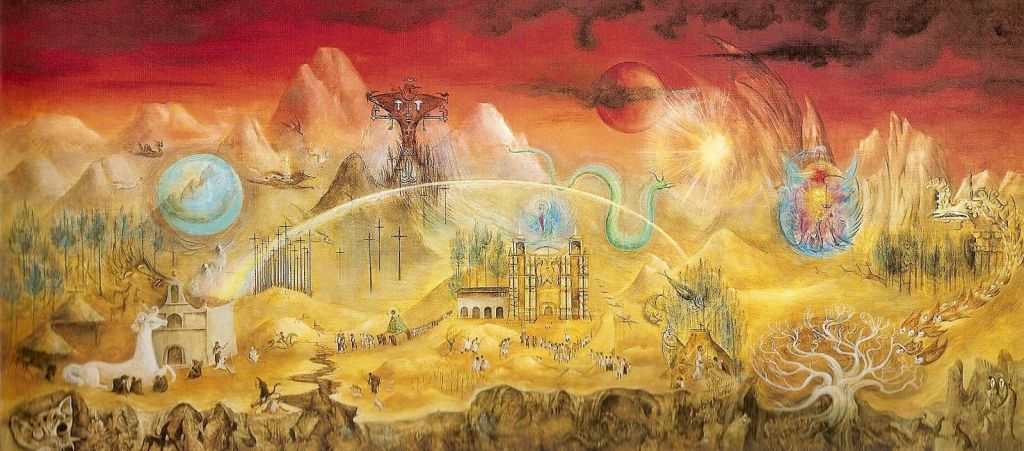
Long a fan of Surrealist artist Leonora Carrington, I was initially hesitant when the New York Review of Books reissued her 1974 novel, The Hearing Trumpet. I didn’t know what to expect when this extraordinary painter picked up a pen.
To my delight and surprise, Carrington shows the same artistry and whimsy in her writing that she does in her painting. She also reveals herself to be an astute feminist and aficionado of the Goddess, well-versed in arcane lore, with which she accents her fantastical world. The Hearing Trumpet is full of British humor and eccentricity, set in a finely spun, other-worldly landscape.
The World of the Maya
Her heroine Marian Leatherby is a 92-year-old, who lacks teeth, is hard of hearing, and sports a beard–a whimsical, endearing character who loves cats. She has been given a hearing trumpet by her great friend Carmella, and thereby learns that her son and his wife plan to send her away to an old folks’ home run by a Dr. Gambit and the Well of Light Brotherhood.
Recently, facing the reality that I do not have definitive or perhaps, static “answers” for my little one when she asks me about death, I find comfort in Carol’s words—in the idea that I don’t have to “answer” my daughter with one, forever “truth.” Because I have to ability to give her “enough,” at least for now.
As I sit down to write, I am reminded of a post I wrote many years ago entitled “Where Do Cat’s Go,” about my mother’s cat, Mimi, who passed away at the age of twenty-four. At that time, I was struggling with what death meant outside of an Evangelical Christian ideology. I had rejected the doctrine of heaven (and hell) itself; but doubt lingered. Fear still held sway over my emotions. I wanted to “believe in,” something else. Whether to regain control or simply for comfort, I hoped for new belief.
Carol Christ, who has touched so many of us, who was my teacher and whom I miss, replied to that post (paraphrasing here), “Why does [Mimi] have to go anywhere? Isn’t it enough that she is a loved and remembered part of life?”
At the time it was not enough. But recently, facing the reality that I do not have definitive or perhaps, static “answers” for my little one when she asks me about death, I find comfort in Carol’s words—in the idea that I don’t have to “answer” my daughter with one, forever “truth.” Because I have to ability to give her “enough,” at least for now.
As a feminist mom, I frequently think about what will give my daughter strength and a sense of her value outside of hetero-patriarchal standards. I am also an ex-vangelical agnostic married to an atheist. He and I want our daughter to have choice in her spirituality and freedom to explore her own directions. I think this is a good commitment, though it is frequently a little more difficult in practice. My partner wants to protect our daughter from all religion and Christianity in particular. I tend to take an educational approach, answering her questions about spiritual matters with, “well, people believe all sorts of things about that,” then listing several beliefs or mythologies that might give her some information on the matter.
This week’s Torah portion is Chukat. It covers a lot of ground. There are the mitzvot concerning purification with a red cow, the deaths of important individuals, and the continued wanderings in the desert, which are rife with complaining Israelites, plagues of snakes and destructions of enemies. It would be impossible to cover all of these events well in the length of this post, so instead I will am going to concentrate on a theme: water. I also want to explain some of the ways Jewish feminists have enriched our connection to water.
Water is first associated with the prophetess Miriam. Miriam is first called a prophetess in Exodus 15, when she takes the women of the community out to sing about their deliverance from Egypt by way of the Re(e)d Sea. Her “Song of the Sea” is thought to be, by many scholars, one of the oldest written texts of the Torah. Yet, the connection between Miriam and water starts earlier in the Torah. Miriam is Moses’ and Aaron’s sister and the one who watches over Moses when his mother, Joheved, hides him in a reed basket on the edge of the Nile (Exodus 2:4). She approaches the Pharaoh’s daughter to secure a milkmaid for her brother (Exodus 4:7).
Those of us in the Northern Hemisphere are coming out of a long pandemic winter and entering a new season of waxing light, hope, and growth. Yet these continue to be turbulent times. Even with the progress of the Covid vaccine, none of us truly knows when life will ever return to “normal.”
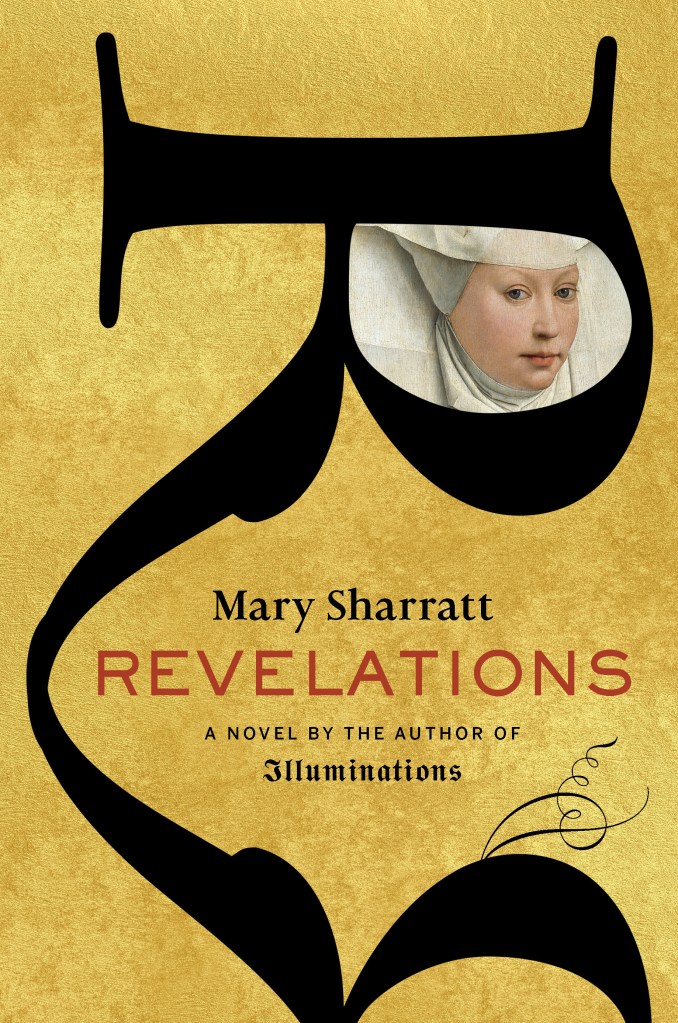
Like us today, the medieval mystics Julian of Norwich and Margery Kempe, the heroines of my new novel REVELATIONS, which will be published on April 27, lived in a time of pandemic and social upheaval, yet both women bore witness to the divine promise that ultimately all shall be well.
During a near-death experience, Julian received a series of divine visions and spent the next forty years unpacking them in her luminous theology of an unconditionally loving God who is both Mother and Father. Julian offered radical counsel to Margery Kempe, a failed businesswoman and mother of fourteen, who was haunted by her own visceral mystic experience. With Julian’s blessing, Margery walked away from a soul-destroying marriage and became a globe-trotting pilgrim-preacher and rabble rouser. Though these two women might seem like polar opposites—Julian, the enclosed anchoress, and free-roving Margery experiencing her visions in the full stream of worldly life—they complement each other. Together their lives and work form a Via Feminina, a distinctly female path to the divine.
The women mystics have always fascinated me. I identify very powerfully with Hildegard of Bingen, the heroine of my previous novel ILLUMINATIONS, as well as with Margery and Julian as spiritual women facing the roadblock of an institutional, male-dominated religion that side-lined them precisely because they were women. But instead of letting this beat them down, they found within their own hearts a vision of the divine that mirrored their female experience. I believe it’s no mere coincidence that both Hildegard and Julian dared to create a theology of the Feminine Divine, of God the Mother. All three women seized their power and their voice to write about their encounters with the sacred, preserving their revelations to inspire us today.
In our modern world, when many traditional religious institutions are crumbling, we can follow in these women’s footsteps and seek the divine—however we perceive the divine—within the sanctuary of our own hearts. This is the birthright no one can take from us, our eternal refuge. This is the Way of the Mystic.
Learn more about Margery and Julian as I discuss these mystics in a series of free virtual events.
My virtual tour kicks off with a very special Literature Lover’s event, sponsored by Valley Bookseller and Excelsior Bay Books in Minnesota. You can watch the video above. I am in conversation with acclaimed author, Elissa Elliot .
For a deep dive into Julian of Norwich’s spirituality, I am teaming up with Christine Valters Paintner of Abbey of the Arts to offer a Virtual Mini-Retreat on May 13, Julian’s Feast Day. You can learn more and register here.
Mary Sharratt is on a mission to write women back into history. Her acclaimed novel Illuminations, drawn from the dramatic life of Hildegard von Bingen, is published by Mariner.Her new novelRevelations, about the globe-trotting mystic and rabble-rouser, Margery Kempe, will be published on April 27. Visit her website.
My Aunt Sophie passed into another realm last week. Not from COVID, but, from a life well-lived.
At 98, she lived a remarkable life. She wasn’t famous, nor did she ever strive to be, but what she was, was what love should be, can be, and is.
In her 98 years she played trumpet in the high school marching band, she had a mean left hook, and she was a Rosie the Riveter, where she actually worked as a welder on ships being built for WWII in Richmond, CA. More, she was a devoted wife, she was a sister and caretaker, she was an incredible grandmother, and, she was a mother. Not just to her seven children, but to her grandchildren, her great-grandchildren, neighborhood kids, and to my sister and me, her nieces. Continue reading “The Legacy of Wisdom by Karen Leslie Hernandez”




 My Aunt Sophie passed into another realm last week. Not from COVID, but, from a life well-lived.
