Do Women Really Need the Goddess? by Collie Collier

It’s been several years now since I first read ecofeminist thealogian Carol P. Christ’s revelatory prose regarding the necessity of the Goddess in a woman’s life:

A symbol’s effect does not depend on rational assent, for a symbol also functions on levels of the psyche other than the rational… The symbols associated with … important rituals cannot fail to affect the deep or unconscious structures of the mind of even a person who has rejected these symbolisms on a conscious level—especially if the person is under stress… Symbol systems cannot be simply rejected, they must be replaced. Where there is not any replacement, the mind will revert to familiar structures at times of crisis, bafflement, [celebration,][1] or defeat.[2]

Reading those words was an unexpected shock—I felt like a previously unknown weight was abruptly lifted off my shoulders! As a young tween, I’d consciously refused Christianity for a somewhat naïve equality-based form of feminism—but I’d still unwittingly internalized the organized religion’s misogynistic teachings. Since then, I’ve worked to encourage the Goddess, in all Her multiplicity of forms, in both my life and the lives of women and genderfluid persons all around me.

Continue reading “Do Women Really Need the Goddess? by Collie Collier”

NOT POSITIVE MASCULINITY, BUT FULL HUMANITY by Esther Nelson

The following New York Times article titled “We Can Do Better than ‘Positive Masculinity’” by Ruth Whippman was published on October 9, 2024.  Whippman is also the author of the book, REIMAGINING BOYHOOD IN THE AGE OF IMPOSSIBLE MASCULINITIES. Whippman’s New York Times article grabbed my attention.

Decades ago while taking undergraduate courses in the discipline that was then called Women’s Studies (now known as Gender, Sexuality, and Women’s Studies), most of the authors I remember reading insisted that both masculinity and femininity (human ways of being in the world) were cultural constructs, not something innate in humans we refer to as women and men. Throughout the world, societies have shown a lot of variety in ways that women and men express themselves and are expected to behave.

Continue reading “NOT POSITIVE MASCULINITY, BUT FULL HUMANITY by Esther Nelson”

3 Taoist Secrets for Embodying your Life

Taoism is an ancient Chinese philosophy and spiritual tradition that offers a unique perspective on life, existence, and human experience. Where many religious practices aim to transcend and sometimes even punish the body, Taoism cultivates a deep connection with our physical self in ongoing relationship with nature around us. 

This resonates with my own experience, in which I see the body as starting point and place of return for everything we do in life. Leaving the body in order to meet spirit or the divine has never made any sense to me. 

In this article I’ll highlight a few elements of Taoism as an embodied philosophy, specifically zooming in on principles and practices that promote holistic wellbeing and inner peace.

Continue reading “3 Taoist Secrets for Embodying your Life”

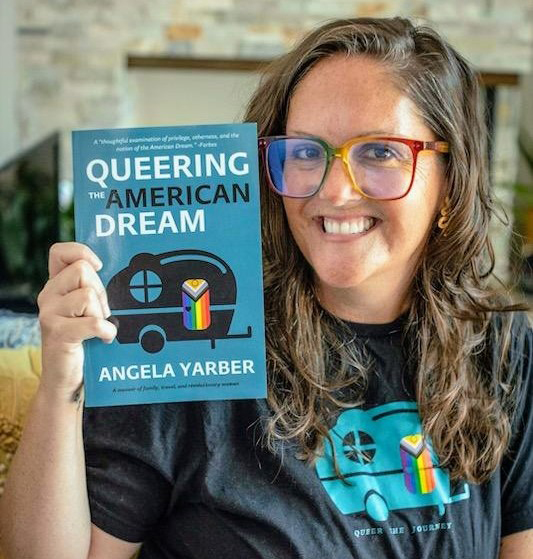
Why I Wrote Queering the American Dream by Rev. Dr. Angela Yarber

Like most authors, I had grand plans for Queering the American Dream. Heeding the wisdom of the venerable black, queer writer, Pauli Murray—“One person plus one typewriter constitutes a movement”—I committed, not simply to writing and publishing a book, but creating a movement. With my modern-day typewriter (laptop) in hand, I dreamed of readers throwing off the shackles of an ill-suited dream, galvanizing retreats, coaching to help other marginalized creatives queer their own iterations of the so-called American dream.

I tried learning about book marketing and pitching companion essays and creating a launch team and all those things small-time authors without expensive publicists on retainer do. I tried so hard.

Continue reading “Why I Wrote Queering the American Dream by Rev. Dr. Angela Yarber”

The Pain and Struggle of Gender by Michele Bodle

In the April 2024 issue of Christianity Today, Fellipe Do Vale wrote, “Gender on Earth as in Heaven: Will Our Gender be Removed or Renewed in the Resurrection?”

            The entire issue was dedicated to a conversation between egalitarian and complementarian beliefs regarding gender, which I am not here to argue. However, I will wholeheartedly and fully engage with a quote in the article where Do Vale states the following.

                        There is a long and impressive lineage in Christian history and
contemporary theology that says the best way to envision the
redemption of our gender is to picture its removal….
They say that gender was an attribute given to us only
because God knew humanity would sin. It was meant
to sustain us only until the restoration of creation. Therefore, 
attributes like gender, race, and disability, which they believe
cause the most pain and struggle in this life, will not remain
in the resurrection. 
(Do Vale, “Gender on Earth as in Heaven,” Christianity Today (Aril 2024), p. 24-25.)

Continue reading “The Pain and Struggle of Gender by Michele Bodle”

Getting at the Roots: An Earth Day Reflection by Xochitl Alvizo

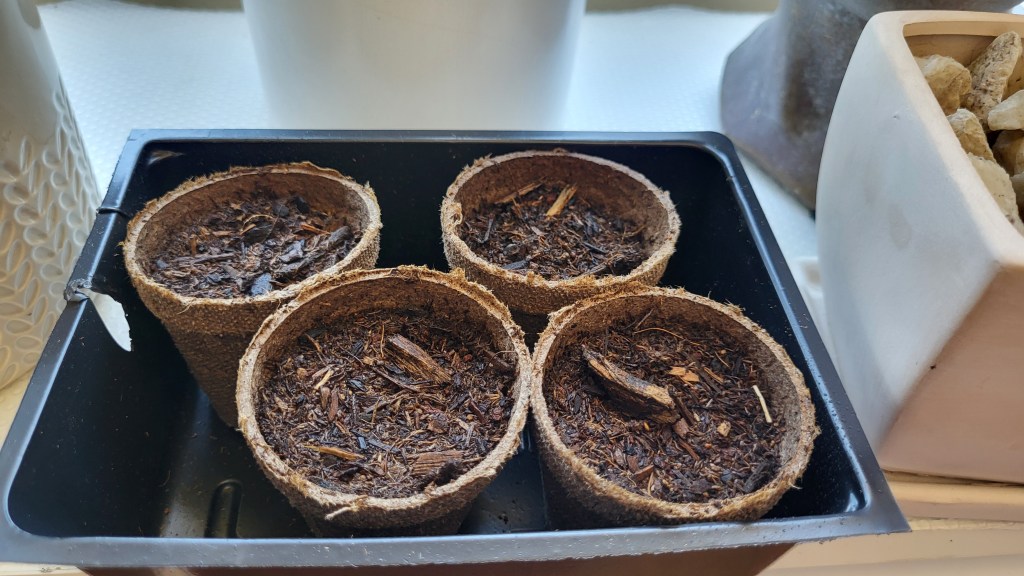
Last Monday on Earth Day I planted my little seeds (though I acknowledge Sara Wright’s point in her las post that every day is earth day!). I’m in a new apartment and don’t have the outdoor space I used to in my previous home. I live in a courtyard-facing apartment complex with a beautiful desert garden in the middle, but no outdoor space that the tenants are allowed to work in. I do, however, have a big, beautiful living room window that gets a lot of direct sunlight. For Earth Day, then, I started my little potted-plant garden. As I put together the tiny pots, pressed in the place for and placed the seeds, covered and watered them, I inevitably reflected on the magic of it all. The pots look empty except for the soil, and yet, I’m to expect lettuce from them in some weeks or months. A seeming impossibility, but it will happen—slow, but nonetheless, steady growth happens.

The little seeds now in place.
The apartment complex desert garden I see through my window.
Continue reading “Getting at the Roots: An Earth Day Reflection by Xochitl Alvizo”

Sh’mini: An Egalitarian Argument for Women and Girls

The parshah for April 6, 2024 is Sh’mini (Shemini), Leviticus 9:1-11:47 and since it is also Shabbat Hachodesh, we read Exodus 12:1-20 in addition to Sh’mini.  Sh’mini contains commandments regarding animal sacrifice, the death of two of Aaron’s sons, lists of which animals are kosher and which are not, and distinctions between clean/unclean and holy/profane.  The excerpt from Exodus, read as the maftir, describes the last plague before the Jews were freed from slavery in Egypt, the establishment of Pesach, and the eating of unleavened bread or cakes.  In today’s commentary, I’m focusing on the only mention of femaleness in Sh’mini and by doing so I hope to find more room for women and girls within contemporary Judaism.

Continue reading “Sh’mini: An Egalitarian Argument for Women and Girls”

Human, Just Human by Xochitl Alvizo

Mary Daly and other feminist scholars of her time knew that taking away the power of naming, whether oneself or the world, is one of the primary ways to take a people’s power away, to subjugate them to a world they do not help form or create.[1] Control over their bodies, their sexuality, and their relationships, is another. It has happened throughout history that not all people are allowed the same level of sovereignty over their bodies. Women, children, black people, indigenous and enslaved people, and whoever is deemed a threat to the social, economic, and cultural status quo being advanced (enforced) at a given place and time, have been forcibly and violently legislated against and policed into submission through varying implicit, explicit, informal, and institutionally sanctioned ways.

Continue reading “Human, Just Human by Xochitl Alvizo”

From the Archives: The Three Mothers: Feminine Elements and the Early Kabbalah by Jill Hammer

This was originally posted May 22, 2108

For over ten years, I’ve been teaching a work of early Jewish mysticism known as Sefer Yetzirah, or the Book of Creation.  There are widely differing opinions on the book’s origin and dating, but many scholars date it to the sixth century.  Its core concept can be described simply: the Divine used the Hebrew letters as metaphysical channels to create the different aspects of reality: the directions, the elements, the planets, the months of the year, and so forth.  Each letter is a channel by which God creates a unique form or entity, and meditating on the letters provides us with a connection to divine creative power. In its discussion of the letters, Sefer Yetzirah shows a strong connection to feminine imagery, and thus helps the later kabbalah develop its own link to the feminine.

Continue reading “From the Archives: The Three Mothers: Feminine Elements and the Early Kabbalah by Jill Hammer”

Bathsheba: From Survivor of Sexual Abuse to Queen Mother by Linda Cooper Costelloe

Bathsheba by Artemisia Gentileschi, wikimedia commons, public domain

The image we have of Bathsheba is that of a scheming temptress. That’s the way she’s been portrayed in media, such as the 1951 movie, David and Bathsheba, and Leonard Cohen’s song, Hallelujah. She deliberately bathed on a rooftop in sight of King David. She caught his eye and he was helpless to withstand her charms. The Bible does not support that image of Bathsheba, however. It says that Bathsheba was used and abused by David, and God was displeased.

The Bible says that David was on his rooftop. It does not say where Bathsheba was, only that she was bathing to purify herself after her period (2 Samuel 11:2-4). She was probably in an inner courtyard. In their book, Flawed Families of the Bible. How God’s Grace Works Through Imperfect Relationships, David E. Garland and Diana R. Garland write: “The laws required ritual washing at the conclusion of her menstrual period. A woman would be highly unlikely to conduct such a cleansing from her menstrual period as a come-on. If she were in public view, she would have washed without disrobing. There is no reason even to assume that she was naked. Public nudity was not acceptable in this ancient Jewish culture but instead was considered shameful. There is no foundation for assuming she was some kind of exhibitionist.”i

Continue reading “Bathsheba: From Survivor of Sexual Abuse to Queen Mother by Linda Cooper Costelloe”