Fifty years ago, California and elsewhere in the US and around the globe were roiling, creative, hopeful, and passionately dynamic places where many of those currently active in feminism and feminist religion and spirituality found their voices and lives’ work. To offer a taste of that historical moment through the eyes of one young woman, you are invited to enter the world of the novel Miami in Virgo.
Set in California’s Central Valley in the mid-seventies, Miami in Virgo is a coming-of-age novel narrated by seventeen year-old Miami Montague. Insecure and fatherless, Miami struggles to hammer out an identity through her photography and the practice of feminist Wiccan ritual with her friends. She is short-circuited and ambushed, however, by emotional rivalries, sexual insecurity, and family drama. Her early years spent with her fundamentalist grandmother in east Texas cast a long shadow.
Disappointments in love coupled with exposure to the nascent gay pride movement in San Francisco lead her to question her own sexuality. Her confidence in free fall, Miami enters into a reckless one night stand at a Halloween party that has disastrous consequences for her move into a household full of teenage stepbrothers when her mother unexpectedly remarries and they move across county. Her peccadilloes take on a spiritual dimension and she goes through a soul searing scrutiny which eventually leads to the resolution of her conflicts through the deepening of her character.
This blog was originally posted on December 1, 2014
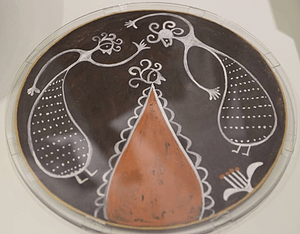
The image from an ancient Cretan bowl (c.1700 BCE) from the Sacred Center of Phaistos pictured here has often been interpreted as an early depiction of Persephone’s descent or rising. But are clues from later Greek mythology pointing in the right direction in this case?
Recently, my colleague Mika Scott posted the Phaistos bowl image on our Goddess Pilgrimage Facebook site in conjunction with the bee pendant from Mallia. This juxtaposition led me to think again about the importance of bees and pollination in agricultural societies and to offer an alternative reading of the symbolism on the bowl.
The Torah portion for July 16, 2022 is Balak (Numbers 22:2 -25:9). Some of what happens in Balak is familiar: idolatry, divinely-sanctioned death penalties, and a plague. But, did you know that this parshah has a talking female donkey who stands up to abusive behavior? Perhaps not. That talking donkey and the larger story of Balak’s attempt to curse the Israelites raises questions about gender, how we treat animals, choices, free will, violence, courage, and having one’s eyes open to what is really happening around one’s self. All of which is what we will be looking at today.
Balak begins with this story about Balaam. The Moabite king, Balak, wishes to curse the Israelites because he is worried about their size and their impact on the land and its current inhabitants (22:3-4). He sends representatives to bring Balaam, a powerful man whose curses and blessings have tangible effects on their recipients (22:6), to him. Balaam meets with those representatives and tells them to wait; he has to talk to the deity in order to know what to do. The deity commands Balaam to stay put and to not curse the Israelites, for they are blessed (22:12). Indeed, a first in quite a while.
Editor’s Note: A more formal memorial to Catholic Feminist Theologian Rosemary Radford Ruether was posted here at Feminism and Religion at the time of her passing. Now we are delighted to share these memories of her by two scholars, Theresa A Yugar and Janice L. Poss, who knew her well, especially in her last months. Therese’s reflection is below and Janice’s will appear tomorrow. As Janice notes in her post, “More than any deep theological concept, doctrinal exegesis, or other hyper-scholarly thought, she taught me simply by being who she was – a woman – and she gave me the ultimate gift, the gift of herself.” Through these posts, Theresa and Janice pass on some of Rosemary’s wise and caring gifts to our FAR readers.Part 1 was posted yesterday.You can read it here.
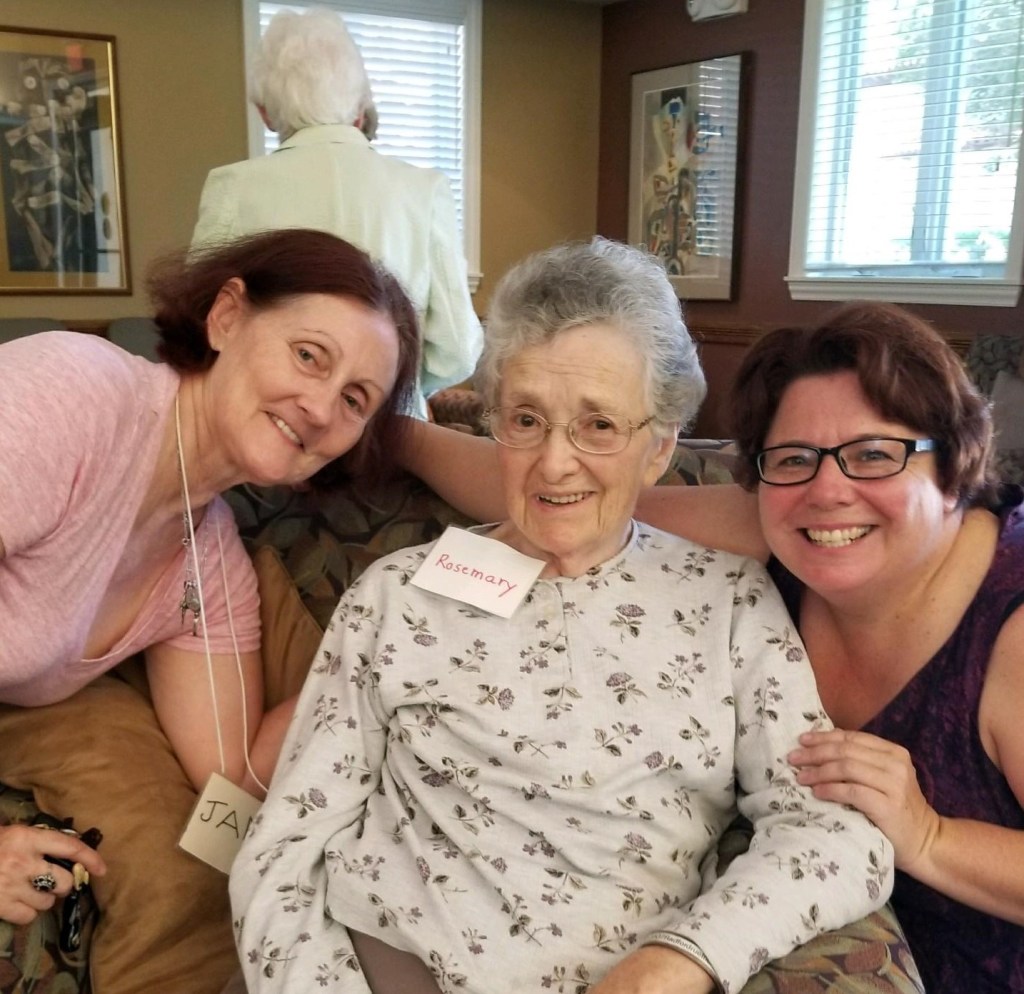
Janice, Theresa with Rosemary
Almost five years ago, Rosemary Radford Ruether suffered a devastating stroke that left her partially paralyzed and no longer able to speak or write, activities that were integral to her life as a writer, teacher, activist, and scholar. During her difficult last years Janice and I learned new ways of engaging her that were academically stimulating and fulfilling for her. We became advocates for her during her disability as she had been an advocate for us. Thus, out of pain grew blessings.
Janice and I dedicate and share with you these two short reflections that reflect our struggle to find our way without her. We know there will be many more reflections composed and shared by others whom she mentored, influenced and touched. Now—in the midst of our grief and sadness at her loss—we offer our personal memories of how she enriched our lives every day until she passed from our midst at 2pm, on Saturday, May 21, 2022.
Editor’s Note: A more formal memorial to Catholic Feminist Theologian Rosemary Radford Ruether was posted here at Feminism and Religion at the time of her passing. Now we are delighted to share these memories of her by two scholars, Theresa A Yugar and Janice L. Poss, who knew her well, especially in her last months. Therese’s reflection was posted yesterday and Janice’s is below. As Janice notes in her post, “More than any deep theological concept, doctrinal exegesis, or other hyper-scholarly thought, she taught me simply by being who she was – a woman – and she gave me the ultimate gift, the gift of herself.” Through these posts, Theresa and Janice pass on some of Rosemary’s wise and caring gifts to our FAR readers.
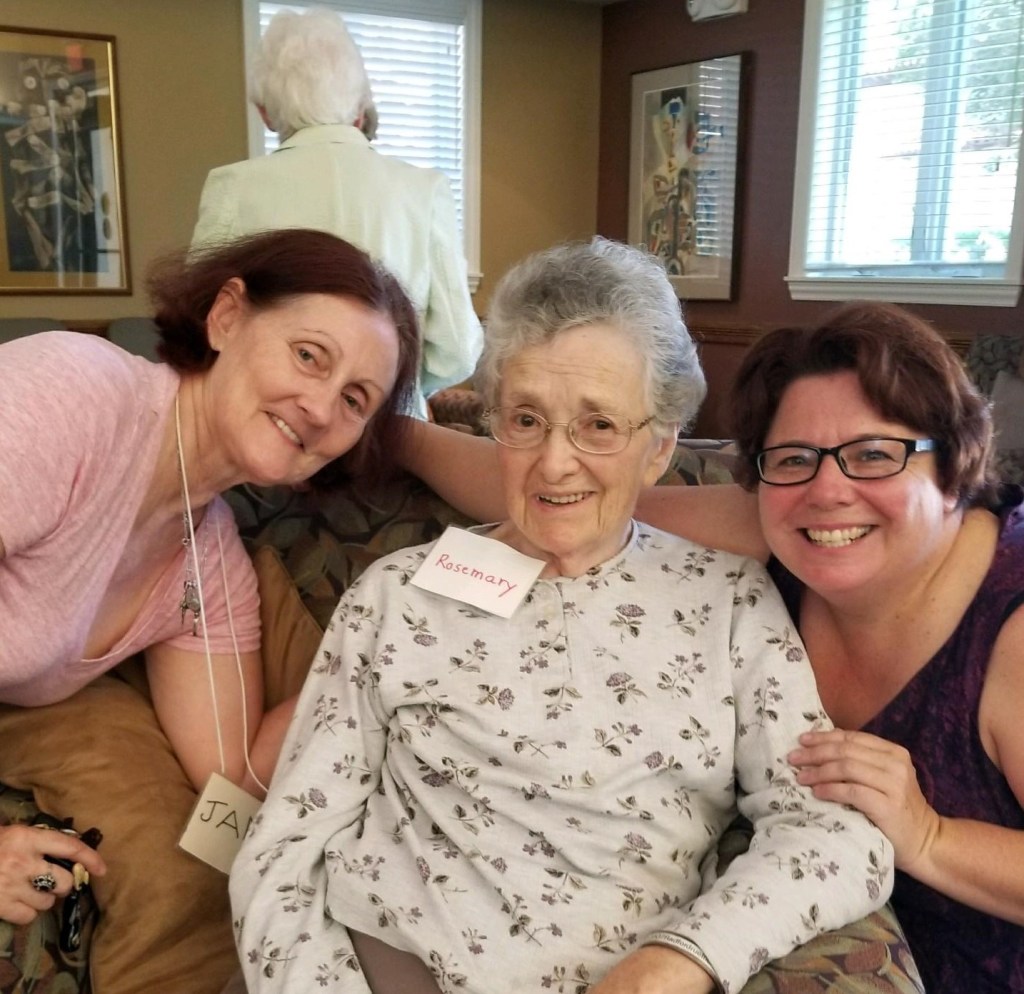
Janice L. Poss, Rosemary and Theresa A. Yuger
She’s gone, but not forgotten. She is there, presence felt. The Spirit, as they say, works in mysterious ways. I knew about Rosemary for several years after attending two presentations on feminist topics that she gave at Loyola Marymount University in 2005 and 2008. In 2006, I also recall hearing about her while organizing the first Roman Catholic Women Priests (RCWP) Mass in Los Angeles. Once I entered Claremont Graduate University as a Ph.D. student I heard quite a bit about her because my colleague and friend, Theresa Yugar, mentored me through orientation until she graduated. Occasionally I would see Theresa and Rosemary at Pilgrim Place when I attended Women Church Services. Although Rosemary was still teaching one class a semester, I could never attend because I was working full-time.
I recently completed a chapter for a book on Latinx theologies; it’s the second edition of the Wiley-Blackwell Companion to Latino/a Theology, edited by Orlando O. Espín, but this time with the slightly changed title of Companion to Latinoax Theology—aiming to be more inclusive in its umbrella term. The project has 35 contributors and covers everything from interreligious dialogue and care for creation, to race, racism and latinoax cultures, as well as chapters on such subjects as Christology, the bible, and ecclesiology. My particular chapter was about the intersection of gender, feminisms, and Latinoax theologies—not surprising. But what I loved in the process was a particular emphasis that emerged—decoloniality, like a thread woven throughout the chapter as it evolved; and this I now see as a necessity for Christian theologies. Let me explain.
Waxing moon pierces fringed Hemlocks Starbursts blink in and out Owls converse from Needled Crowns bathed in Air and Light. Refuge Tree soothed by Familiar calls sighs deeply, soaking In the Night.
Refuge incarnates as Aphrodite…
In the forest I slip into a lime green skin with the help of one hemlock, under whose feathery wings this transformation takes place. I breathe her sweet scent through my supple membrane. Standing beneath Refuge, whose roots claw the edge of a steep slope that bows to the river, I can barely see the crown of the tree, maybe 150 feet in the air. This hemlock towers over the rest. Moss and lichen adorn her limbs and the tree’s deeply ribbed reddish brown bark is an invitation to touch that I can never resist. Scrambling down the slope with care I lean against the tree and listen, always hoping… sometimes I think I hear a low hum if the wind is still. Perhaps I’m imagining.
Moderator’s Note: This was originally posted on September 19, 2016
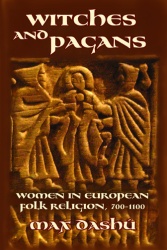
Max Dashu’s Witches and Pagans: Women in European Folk Religion 700-1000challenges the assumption that Europe was fully Christianized within a few short centuries as traditional historians tell us. Most of us were taught not only that Europe became Christian very rapidly, but also that Europeans were more than willing to adopt a new religion that was “superior” to “paganism” in every way. Careful readers of Dashu’s important new work will be challenged to revise their views. When the full 15 volumes of the projected series are in print, historians may be forced to hang their heads in shame. This of course assumes that scholars will read Dashu’s work. More likely they will ignore or dismiss it, but sooner or later–I dare to hope–the truth will out.
History has been written by the victors—in the case of Europe by elite Christian men. These men may have wanted to believe that their views were widely held, but Dashu suggests that they were not. Combing artistic and archaeological records, Dashu finds (to give one example) that images of Mother Earth nursing a snake are far from uncommon and can even be found as illustrations in Christian documents and on Christian monuments. Clerics rage against people—particularly women–who continue to visit holy wells and sacred trees and to practice divination and healing rituals invoking pagan powers. To paraphrase Shakespeare: “Methinks the cleric doth protest too much.” Were these things not happening and happening often, there would have been no need to condemn them. Using these clues, Dashu provides intriguing new readings of the Poetic Edda and Norse sagas.






 Feminism and Religion