Soulful Art in New York City by Judith Shaw

judith shaw photoThough temperatures outside were sizzling during the July heatwave in New York, I was cool inside the Frick Museum. Nearing the end of my visit I was standing by a rope that blocked entry to a curved stone staircase – I looked to my right, a stunning Renoir; I looked to my left, a resplendent Vermeer. Each expresses the essence, the sublime – one with misty intensity – the other with focused clarity. 

Continue reading “Soulful Art in New York City by Judith Shaw”

We Are Not Alone: Embodying and Re-enacting Ancient Wisdom by Carol P. Christ

A few nights ago, on the way to dinner, two friends and I passed by a small church near the old fortress in Ierapetra, Crete. The liturgy was broadcast via microphone and a crowd of people gathered outside the church. “Must be some kind of name day,” one of my friends commented, but I could not think of a saint celebrated on August 1.

We decided to light candles and make our prayers. I asked one of the Greek women the reason for the ceremony. “This is the first night of our celebrations for the Panagia,” she responded, referring to the Assumption of Mary that would occur on August 15. I looked around and saw that indeed many of the women were wearing black. “Of course,” I thought to myself. Continue reading “We Are Not Alone: Embodying and Re-enacting Ancient Wisdom by Carol P. Christ”

Eye of Newt, a Binding Spell by Barbara Ardinger

I first wrote this spell in 1994 when a certain Member of Congress from Marietta, Georgia, took out his Contract On America. I sent the spell out on the internet and know that it was used. I rewrote it to put in my book, Finding New Goddesses, but decided that it’s much too serious a spell to put in a book of humor, so the spell stands alone again. I have used it successfully, though carefully, on several occasions, and so have other people. The purpose of this spell is to bind, not to do harm. It’s neither “black magic” nor “white magic,” but simply useful magic.

Now, in mid-2019, I’m giving serious consideration to renaming the spell: Eye of Donald. But no—if I did that, we’d lose the reference to Macbeth, Act IV, scene 1. If you’ve read or seen “The Scottish Play,” you know that Macbeth is, among other things, filled with hubris. So was the fellow from Georgia, and he’s since fallen on the sword of his hubris. The current occupant of the White House? I think he’s hubris personified. So we need the reference to Macbeth. Continue reading “Eye of Newt, a Binding Spell by Barbara Ardinger”

Art That Lifts the Soul by Judith Shaw

judith shaw photoArt that seeks the essence. Such art comes in many forms and styles.

Some art is political, some is decorative. Some art is conceptual, some is commercial. But the art that draws me in, that makes me feel deeply, and that compels me to truly be with it, is art that expresses the mysterious essence of life, the unfathomable depths of infinity, the indescribable nature of existence.

Continue reading “Art That Lifts the Soul by Judith Shaw”

Gentle Moments in a Violent World by Marcia Mount Shoop

mms headshot 2015“Be gentle with yourself.”

It may be some of the most redemptive guidance I have ever received.  And I share that invitation daily with people in painful situations.

“Be gentle with yourself.”

In a world seemingly hell bent on self-destruction, being gentle even for a moment is a radical act of resistance. A moment of tenderness. A moment of trust. A moment of attentiveness to need.

But really, what good does gentleness do in a world as brutal as ours can be?  How does being gentle provide any kind of answer to the assault of being commodified or objectified or betrayed or assaulted or oppressed or erased or abused or discarded or exploited? Continue reading “Gentle Moments in a Violent World by Marcia Mount Shoop”

Plant Trees, Trees, and More Trees by Carol P. Christ

I dream that all of us who are suffering burn-out because of national and world politics come together to plant and nurture trees. Scientists say that planting ONE TRILLION TREES would neutralize two-thirds of carbon emissions and reverse climate change. Yes, we need to march, to organize, and to vote. But it is also important to embody our commitment to life and the living. Putting our hands in the soil, tenderly teasing the roots of the trees we plant as we nestle them into the earth, we move from our heads to our bodies, re-membering the interdependence of life.

This has already begun to happen in India—a country where what Vandana Shiva named “maldevelopment” has produced massive deforestation. At the Paris climate change conference India pledged to “make India green again” by reforesting 235 million acres of land. The government allotted 6.2 billion dollars to support the plan. What was not expected was the overwhelming enthusiasm of those who volunteered to plant trees. Continue reading “Plant Trees, Trees, and More Trees by Carol P. Christ”

What to Do About Bullies by Deanne Quarrie

I could probably go on and on about this topic, so in the interest of education I offer the following information gathered in my own recovery. Why would I write about bullying at all?  Are we not Goddess lovers, one and all?  How would such behavior ever come into a spiritual path that believes all life is sacred?

Well, we all come to this path with all our old baggage. That baggage may include jealousy, fear, and a desire for the wrong kind of power, that which attempts to control others.

Bullying is not merely, as many believe, an occasional stinging comment made by a significant other at the breakfast table, a bad day with the boss, or children wrestling on the playground.

Bullying is cruelty deliberately aimed at others with the intent of gaining power by inflicting psychological and/or physical pain.

Bullying behaviors are varied: name calling, humiliation, spreading rumors, gossiping, public ridicule, scape-goating or blaming, isolating, assigning poor work conditions and job assignments, or denying holiday and vacation time in the workplace, or more obvious punching, hitting, kicking, taunting, ostracizing, sexualizing, or making ethnic or gender slurs, etc.

Continue reading “What to Do About Bullies by Deanne Quarrie”

Sappho’s Poems as an Ethos for Women’s Ritual by Jill Hammer

Photo by: Zac Jaffe

For by my side you put on

many wreaths of roses

and garlands of flowers

around your soft neck


and with precious and royal perfume

you anointed yourself.


On soft beds you satisfied your passion.


And there was no dance

no holy place

from which we were absent.


–Sappho (trans. Julia Dubnoff)


Sappho, the poet from Lesbos (630-570 BCE), was considered one of the greatest poets of her time—one of her epithets was “the tenth Muse.” I discovered the poems of Sappho in my thirties and was utterly captivated.  I had newly embarked on a relationship with a woman and Sappho’s love poetry (though by no means exclusively lesbian) supported the expression of eros between women.  Yet even more than that, Sappho’s poems supported an erotic relationship between self and world—a relationship that included ritual as a form of intimacy.  I’m not a Greek scholar—I experience Sappho’s poems in translation. Yet the translations I read back then were a revelation: a world in which women lived in circle with one another.

Continue reading “Sappho’s Poems as an Ethos for Women’s Ritual by Jill Hammer”

Temple Magdalen by Elizabeth Cunningham

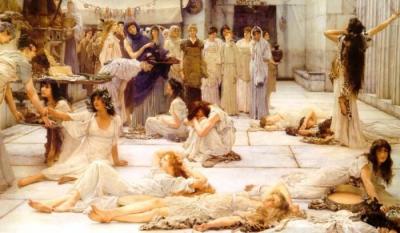
The Women of Amphissa, 1887, by Lawrence Alma-Tadema

Since I began writing for FAR in July 2012, I have written about Mary Magdalen, or excerpted a passage from one of my novels, near or on her July 22 Feast Day. For why I made the controversial choice to depict her as a prostitute, see last year’s post. The below excerpt is from The Passion of Mary Magdalen. I made this selection in remembrance of all the refugees in the world today. In this passage, Judith, a Jewish widow whose family was driven from the land by tax collectors, returns to the place where Maeve (my fictional Celtic Magdalen) and her friends have recently founded a Temple to Isis on the outskirts of Magdala. Maeve has just invited Judith to join them. (Edited for brevity.)

She stared at me, her eyes full of anger and longing.

“I will not be a slave and a whore where I was once a wife, the one who made the challah bread, who said the Sabbath prayers over it. This was our place, my husband’s and mine. We brought the best we had to the temple, the finest oil and wine, the unblemished kid—”

“Goats? You kept goats? You know how to make cheese?”

She sat quietly for a moment before she answered. “How can I live here with you?” she wondered. “I don’t understand.”

Continue reading “Temple Magdalen by Elizabeth Cunningham”

Beaches and Books by Esther Nelson

Even though I’ve traveled and lived throughout much of the world, I’ve never thought of any one place or geographic location as home.  I have always felt a little envious of people who claim to have a strong, visceral connection to a particular house, garden, village, landscape, or city in a specific, geographic area.

We often use the word home to indicate a space where we feel accepted, safe, nurtured, loved, and at peace.  Although I’ve never sunk deep roots anywhere I’ve lived—or even visited—I feel most grounded when standing on a sandy beach anywhere in the world, overlooking an expansive view of the ocean.  Perhaps the cowboys in American folklore and legend felt “home, home on the range where the deer and the antelope play,” but I don’t.  I am much more at ease with home, home on the beach where the wind swirls the water and sand.

I often hear the beach calling me.  Sometimes I listen and allow myself to fall under her spell and into her fluid embrace.

Continue reading “Beaches and Books by Esther Nelson”