
“What I want to do is live in as much silence as is possible at this point in our history.” – Sara Maitland, A Book of Silence
Scottish author Sara Maitland is an intriguing amalgamation of diverse and seemingly contradictory personas. Active in the 1970s Women’s Movement, she is regarded as one of the UK’s pioneering feminist novelists and attempted to create a new mode of narrative inclusive to female experience. She is at once a Roman Catholic convert, a divorcee, a mother, and an unrepentant cigarette smoker. But most uniquely of all, she is a modern-day mystic and hermit, a seeker of silence, solitude, and seclusion, all of which are rare commodities in our crowded, noisy, hyper-connected world.
Her fascinating and beautifully written memoir, A Book of Silence, describes how Maitland, born into a large, gregarious family, came to chose this life. She wasn’t always a hermit, but loved being a mother and wife and adored spirited dinner party conversation. Her “conversion” to silence began gradually, at menopause, after her marriage ended and her adult children moved away. Left on her own, she discovered that, far from being lonely, there was deep happiness and freedom in solitude. Trying to evoke an even deeper experience of this solitary life, she moved to a rural house in Weardale, Yorkshire, where she fell in love with the wild countryside and devoted more and more time to spiritual contemplation. In a most daring experiment, she rented an isolated cottage on the Isle of Skye where she spent a 40 day retreat all on her own, in the depths of winter, not speaking to another soul. Her description of this time makes for riveting reading as she reveals how deeply the solitude effected her psyche. She experienced a certain disinhibition–losing the desire to shower or groom herself because she had no human Other to keep up appearances for. She also experienced auditory hallucinations that intrigued rather than frightened her, including hearing a men’s choir singing plainchant in her bedroom. Though she experienced some negative side effects, what mattered to her far more was the deep bliss and peace that solitude brought her. Only in this kind of silence could she feel the deep spiritual connection to the Divine that she was seeking. Later Maitland made a another retreat deep into the silence of the Sinai desert.

But one thing Maitland discovered was that silence didn’t enhance her creative output as a writer in the way she hoped it would. Her self-chosen spiritual silence also silenced her voice as a novelist, although she reinvented herself as an author of nonfiction. She theorizes that there are two distinct modes of solitude and silence: that of spiritual seekers and that of artists and writers. This latter version she refers to as romanticism, as it evolved from the philosophy of Rousseau and the Romantic poets, such as Wordsworth, who sought romantic seclusion and splendid isolation in nature in order to write:
Religious or eremitc silence, not just in the Christian tradition but in Buddhism as well, is about inner emptiness–emptying the mind and the body of desires, being purged and therefore pure: a kind of blank, a tabula rasa, on which the divine can inscribe itself. It is a discipline of self-emptying, or, to use a theological term, of kenosis, self-outpouring. Whereas romanticism uses silence to exactly the opposite ends: to shore up and strengthen the boundaries of the self; to make a person less permeable to the Other; to assert the ego against the construction and expectations of society; to enable an individual to establish autonomous freedom and an authentic voice. Rather than self-emptying, it seeks full-fill-ment.
Maitland compares her own journey into silence to those of the early Christian desert hermits, to modern day Buddhist nuns who live in silent retreat. She compares and contrasts the experiences of those who seek silence and solitude for spiritual and creative reasons to those who stumble into silence as an occupational hazard–ie Arctic explorers or mountain climbers who become stranded in the wilderness. She also makes a crucial distinction between silence as a choice versus the brutal silencing of oppressed peoples and political prisoners.
For Maitland, after embracing silence, there was no way back. It became her vocation. She now lives alone in a self-built house on a remote farm in Galloway, Scotland, one of the least populated areas in Britain. She lives without television, radio, or close human neighbors, but does have internet and earns her living teaching creative writing via an online distance learning program for Lancaster University. In a 2014 interview with The Guardian, Maitland admits she sometimes struggles to control her time on the internet and that she is not quite alone, as she lives with her dog. But according to her book, she has never owned a mobile phone.
A Book of Silence was published in 2008, before smart phones became so ubiquitous. How much more challenging would it be to follow Maitland’s path into silence now? These days noise is everywhere. Even churches, temples, and libraries are no longer quiet places of contemplation. In the rare instances we are alone, we distract ourselves with our phones and headphones. With our exploding global human population, we live in a world where it’s increasingly difficult to find silence or even personal space. To claim a hermit’s seclusion might appear to many as self-indulgent or elitist escapism. Precisely for these reasons, I found Maitland’s book so radical and compelling.
“In the Middle Ages Christian scholastics argues that the devil’s basic strategy was to bring human beings to a point where they are never alone with their God, nor even attentively face to face with another human being,” Maitland writes. She also observes that “the overstimulation, of which noise is a major factor, of modern society has an addictive quality–the more stimulation and novelty you get, the more you feel you need.”
Although the reader may not necessarily identify with Maitland’s deeply Christian focus, this is an illuminating book that deserves to be regarded as a twenty-first century classic in Women’s Spirituality.

Mary Sharratt is on a mission to write overlooked women back into history. Her novel, Ecstasy, about composer and life artist Alma Mahler is new from Houghton Mifflin Harcourt. Visit her website.



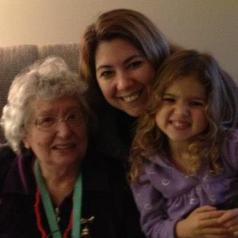 I often share that what I’ve learned about strength, perseverance, and responsibility, I learned from my grandmother and namesake, Gina. In November we celebrated her life and said goodbye to the pioneering woman who overcame the greatest of obstacles to lead a life of dissent.
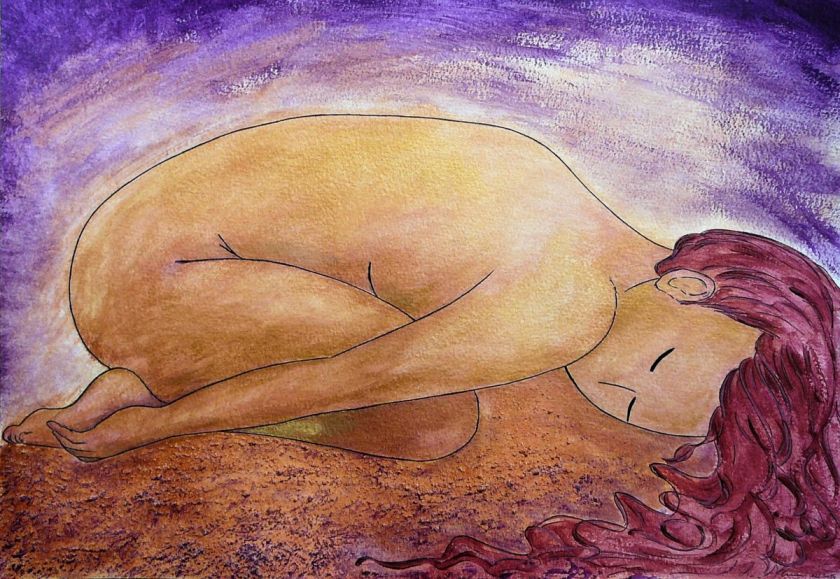
  I can’t even save myself. I make bad decisions just like the ones in the world – bombs and wars and the industrial revolution with chains of greed. But then I go on and, without even knowing any part of the story, want to save others.
 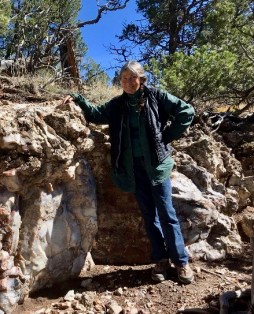 Just that one word dreamed the night of January 1st.
 The parshah for next week is Beshalach (Exodus 13:17 – 17:16). There are a lot of very important events happening in just four chapters. In fact, one could write a blog on any one of the following topics: the Israelite escape from Egypt; the parting of the Red Sea (literally the sea of Reeds); the Israelites being pursued by the Pharaoh and his army; the death of Pharaoh and his army in the sea; the incessant complaints of the Israelites in the desert; and the first descriptions of Shabbat observance.
 When European scholars began to study Sanskrit they were surprised to discover linguistic similarities between Sanskrit and Greek and Latin. Old Persian was found to be even closer to Sanskrit. Scholars thus began to speak of related groups of Indo-European languages stemming from an earlier language they called Proto-Indo-European.
 Feminism and Religion