Just Show Up by Katie M. Deaver

Happy Midterm Election Day 2018!!

The first article I ever wrote for Feminism and Religion, (“I Never Thought That I Would Need to Be a Part of History,”) ran just a couple of weeks after the inauguration of the current President.  As I sat writing this Monday afternoon, I kept trying to find some new or more exciting way to talk about voting in today’s election, I couldn’t help but go back and take a look at that first article.

As I wrote in that article, I never really imagined that I would need to be a part of history.  As a scholar of theology and feminism I certainly understand that we are a long way from being a truly inclusive society. We still need to fight oppression and push for the acceptance of all those who are othered in our society, but somehow our current issues and “battles” seem so much larger than they did only a couple of years ago.
Continue reading “Just Show Up by Katie M. Deaver”

When the Gods Retire by Barbara Ardinger

Come with me in your imagination to an old land, a Demi-Olympus, a fabled and possibly invented land to the north of Mount Olympus, home and throne of the fabled Olympian gods. It is to this Other Olympus that the gods have retired. Now they reside in the Divine Rest Home whose proprietor is a black goddess. Not African black, She is as black as space, and if we look closely at Her, we can see galaxies and constellations and comets in Her. She is the Ur-Goddess, the Divine Creatrix, eldest of all, and She answers to the name Mama. (Note: many years ago, I actually saw this goddess after an all-day asthma attack that nearly killed me. She was in the ER with me.)

Helping Mama run the Divine Rest Home are Gaea, the mother of all life, and the Titans and Titanesses, who are older than all the gods who have come to the Divine Rest Home to…well…rest. The Titans and Titanesses held numerous important stations in the primeval universe and should probably retire, too, but they just keep going. That’s probably a good thing, as most of the retired gods need a great deal of attention.

Continue reading “When the Gods Retire by Barbara Ardinger”

Women’s Ritual Dances and the Nine Touchstones of Goddess Spirituality-Part One by by Laura Shannon

In Rebirth of the Goddess, feminist theologian Carol P Christ offered a list of ‘Nine Touchstones of Goddess Spirituality’.[1] She revisited the Nine Touchstones in an interview with Karen Tate on Voices of the Sacred Feminine titled ‘Gratitude and Sharing: Principles of Goddess Spirituality‘, and in an inspiring series of blogs on this site recently exploring each touchstone in depth.

In her incisive analysis of the ethics of Goddess religion, Christ argues that Goddess spirituality can offer the ‘ethical guidance that we need to combat the forces of evil in our world’, and that this ethic is not imposed from a set of rational principles nor from a transcendent God known through the prophetic traditions of the Bible, as suggested by Rosemary Radford Ruether.[2] Rather, the ethics of Goddess spirituality are discerned through intuition and reflection on the world of which human beings are a part.[3]

Continue reading “Women’s Ritual Dances and the Nine Touchstones of Goddess Spirituality-Part One by by Laura Shannon”

I Was Brainwashed to Believe I Wasn’t Human. Now I’m on a Mission Against that Cult-Part 3

Trigger warning: rape, sexual assault, domestic abuse, graphic sexual content

In Part 1 of this story, I introduced a discussion of Johan Galtung’s theory of cultural violence as it relates to my experience as a young woman in an abusive relationship. To recap:

Cultural violence is: “…any aspect of a culture that can be used to legitimize violence in its direct or structural form. Symbolic violence built into a culture does not kill or maim like direct violence or the violence built into the structure. However, it is used to legitimize either or both.”

Cultural violence against women is: Normalization and promotion of pornography, prostitution, degradation, and sexual objectification of females in media, predominantly male language in civic, business, and religious institutions, gender roles and stereotypes, misogynist humor, gaslighting, minimizing or denying any of these forms of violence.

Continue reading “I Was Brainwashed to Believe I Wasn’t Human. Now I’m on a Mission Against that Cult-Part 3”

Hear Me by Winifred Nathan

image1.png

I found the confirmation hearings of now Justice Kavanaugh deeply disturbing. I have ideas for preventing a replay.

First, secret keeping doesn’t work. For too long girls/women have suffered in silence with their secret while boys/men move along often without any sense of guilt about  their “fun”. When the victim/survivor keeps her secret, the perpetrator remains in control.  An important  step for the victim to regain control is to tell her story.  Then the next step … she needs to be heard.   Dr. Blasey Ford spoke, but her distracters did not hear her.  They questioned her credibility. She was criticized for her years of silence, and her lack of memory of details.  What I learned from this is that the victim/survivor must be prepared to speak, and that this preparation must start well before it occurs.

Continue reading “Hear Me by Winifred Nathan”

Lifting the Veil – #WontBeErased by Joyce Zonana

Samhain is upon us. Halloween. The Day of the Dead. All Saints’ Day. All Souls’ Day. That liminal time of year when the doorways to what the Celts called the Otherworld, Annwn in Welsh, are open. In New York City, we have the 45th annual Village Halloween Parade, a queer extravaganza of puppetry, masquerade, and cross-dressing that draws some 60,000 participants and over 2 million onlookers. Elsewhere, we have children in costume and lawns covered with plastic skeletons and illuminated ghouls. Everywhere, if we’re lucky, we might catch a glimpse of  “the piper at the gates of dawn,” the vision granted Rat and Mole in Kenneth Grahame’s The Wind in the Willows: “something very surprising and splendid and beautiful”—Pan the goat-god, boundary-crosser, Friend and Helper, trans-being.

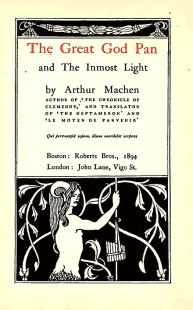
jz-headshotJust last week—a few days after the New York Times reported on the Trump administration’s efforts to define transgender out of existence—I read for the first time Welsh writer Arthur Machen’s 1894 novella, The Great God Pan, today considered a classic of horror fiction. Condemned as “morbid” and “abominable” by most critics when it was first published, the tale was hailed as “un succès fou” by Oscar Wilde, recuperated in the 1920s by H. P. Lovecraft, and particularly praised more recently by Stephen King, who called it “maybe the best” horror story “in the English language.”
440px-Title_page--The_great_god_Pan
Original edition with cover illustration by Aubrey Beardsley

The “queer” tale (the word “queer” recurs frequently throughout) is told by a series of straight-laced Victorian men, each of whom is horrified by the unspecified behavior and bearing of a mysterious woman, Helen Vaughan. Readers are led to suspect that Helen is guilty of some sort of sexual excess or transgression, but nothing is specified until after her suicide, when the medical examiner reports that he was “privileged or accursed” to see the “skin, and the flesh, and the muscles, and the bones, and the firm structure of the human body that I had thought to be unchangeable, and permanent as adamant, beg[i]n to melt and dissolve”: Continue reading “Lifting the Veil – #WontBeErased by Joyce Zonana”

Not Yet the Death Rattle by Marcia Mount Shoop

Marcia Mount ShoopI have had the honor of sitting vigil with dying people. And I have prayed through the coming of the death rattle. It can be painful to witness, especially for those witnessing death for the first time. Sometimes the person can hang on, seemingly fighting the inevitable final step of their transition into death.

In those times, I have encouraged families to share affirming words with their loved one, to tell them that it’s ok for them to go, that they are going to miss them, but that they will be ok.

I have listened as wives tell husbands thank you for all the years, for all the love, for the life they have lived together. I have been there with parents forcing themselves to say the excruciating goodbye to a child passing too soon, so the child won’t have to suffer anymore—telling them it is ok to rest, it’s ok to stop fighting. And I have listened as adult children find the courage to release the parent who has so deeply formed them.  “I love you, dad. You have taken good care of me. Thank you for loving me. It’s ok for you to go now.”

It is a sacred passage. These are Holy moments.

Continue reading “Not Yet the Death Rattle by Marcia Mount Shoop”

Goddess Pilgrimage: A Sacred Journey for Women by Carol P. Christ

A pilgrim leaves home and sets off on a journey, seeking healing, revelation, and direction in her life. She finds companions along the way whose stories reflect her own, validating her quest and shedding light on her journey. According to anthropologists Victor Turner and Edith Turner, pilgrimages have common structural elements. A pilgrim separates from family and friends, work and obligations. She steps across a threshold into “liminal space” in which daily routines are suspended, opening herself to discovering new ways of being and living.
For spiritual pilgrims, the goal is a place or places said by others to be a “sacred” because healing or revelation have occurred there through the intervention of a deity, a saint, or spirits. The place is often on a mountain, in a cave, or near a spring. Along the way, pilgrims meet and share stories as in the Canterbury Tales. Some pilgrims say that the experience of sharing community with other seekers is as important as the revelation gained at the destination. When the pilgrim returns home, she must re-integrate into the community she left behind or find a new one. Continue reading “Goddess Pilgrimage: A Sacred Journey for Women by Carol P. Christ”

The Hershee Bar: Saving A Lesbian Sacred Place (While there is still one left) by Marie Cartier (Part II)

(l to r) Bartender Burt, Marie Cartier, and owner Annette Stone

Why is this bar still important? (Read Part I)

For the gender queer, marginalized community who are testing the waters of gender difference by frequenting this bar, many for the first time, for the pool leagues, and yes, the college folks, but also the working class people, and the tentative younger folks, this may be “the only place.” For the democracy of a gay bar creates a conversational cauldron for marginalized people to “hear themselves into speech” to quote the theological Nelle  Morton.

I am quoted in an article done by Virginia Pilot report Amy Poulter saying that “LGBTQ bars are also tasked with filling in the gaps as religious spaces, support groups and the go-to location to celebrate milestones and mourn losses. Bars like Hershee are often the only place LGBTQ people feel at ease and comfortable in their own skin.”

And I added, “And the council, they need to realize what they have before they destroy it.” Continue reading “The Hershee Bar: Saving A Lesbian Sacred Place (While there is still one left) by Marie Cartier (Part II)”

…and The Pub Church, Boston was Born by Xochitl Alvizo

Incarnation, Goddess spirituality, Xochitl Alvizo, god became fleshSee Part I of Pub Church series here

The question arising among a group of friends gathering for fish and chips on Fridays – why can’t church be more like this? – was the clarion call that sparked the birth of The Pub Church, Boston. This was the fumbling out of which pub church began: the reality that church had been the opposite of embodied Good News in many people’s lives, and the glimpse, the experience, that it could be otherwise.

Birth: Some of how pub church was formed was in direct response to people’s past negative experiences with church and Christianity, but much was also shaped by the “good news” people experienced at the weekly Friday gathering for fish and chips at the local pub. There, people experienced a weekly gathering in which all were invited to gather around the table, express themselves without fear of judgement, and, perhaps more importantly, experience the merry sharing of food and drink!

This, the sharing of food and drink, became the foundation for what pub church would become. Food made it possible to feel more at home, to create a relaxed environment, inspire conversation, and satisfy a need. Being at the pub with access to food and drink created an organic way to share and make new connections with one another. It facilitated the act of inviting and treating someone to a beer or to share fish and chips or a slice of pizza, often with a newly met friend. People got to know one another. Over a beer, new friends would end up sharing about the rough week they had, their past or current sorrows, or sharing a good laugh about something mundane and fun. Continue reading “…and The Pub Church, Boston was Born by Xochitl Alvizo”