Mr. Big Man by Jameelah Medina

Jameelah Medina

This past week, I have discussed with college students the time I was wrongly arrested and harassed by an Islamophobic Sheriff Deputy several years ago, which led to a successful court case against my county spearheaded by the ACLU. I opened up the discussion with the following religiously feminist spoken word piece I wrote:


Mr. Big Man

You told me what to write, word for word for word for word in my statement,

To get me caught up in your trickery is what you meant,
Acting like you were my friend,
Just so that you could win,

Me over and dictate the stroke of my pen,

But then Continue reading “Mr. Big Man by Jameelah Medina”

It is a Matter of Focus by Deanne Quarrie

deanne_2011_B_smMany of the young women I meet tell me that they think feminism is not what they are about, that they prefer to work for the good of all. I understand that and certainly we can all choose where we wish to place our focus. However, it does make me wonder how effective we can be with our focus placed on so broad a scope. Certainly, we want equal rights for all and some call that “feminism” these days but is it?

In my 73 years, I have lived through quite a few years of women working for equal rights. I have seen many successes as well as the failures. I am incredibly proud of those successes. When I was in the early stages of my career and had just entered management, I was able to implement leadership methods, which now have become models for employers such as team building and servant leadership. Then however, there were no names for them. I led my teams based simply on how I wished my employers to treat me. Continue reading “It is a Matter of Focus by Deanne Quarrie”

The Dance of Memory: Commemorating the Centennial of the Armenian Genocide

Laura Shannon square crop

Friday, April 24, 2015 marks one hundred years since the start of the Armenian Genocide of 1915.

In my dance workshop last Sunday in Somerset, England, we lit candles to the exquisite voice of the great Armenian soprano Lusine Zakarian, and danced beautiful Armenian dances in a ritual of solidarity with this occasion.

I have been encouraging all my students to dance Armenian dances with their groups this week, most especially on Friday, to align with the commemorations happening around the world. Even if you do not dance, you could simply light a candle and listen to some Armenian music (see my list of recommendations at the end of this post). I feel that every act of compassionate witnessing, however small, helps heal the wounds of history.

Continue reading “The Dance of Memory: Commemorating the Centennial of the Armenian Genocide”

Gay Marriage: “Tell me why I shouldn’t hate you…?” asks the straight Christian to the lesbian by Marie Cartier

MarieCartierforKCETa-thumb-300x448-72405This is the third of a series exploring gay marriage as a game changer within religion and politics. I have explored the topic as political animus and earlier as almost fairy tale come to life. Today I am examining it from a very person view.

Consider a gay woman (myself) being asked by a straight attempting to understand the “right” for gay marriage, “What does it matter if I know you’re ‘gay’ if I’m not attracted to you?”[1]

Then consider that another right of “marriage” –or being known as “gay”—is the right to be admitted into the hospital room of a loved one, who is considered one’s primary partner, or “spouse.” Yes, one wants to say to the questioning woman in the above scenario, the rights for marriage include the crucial family relationships which allow one person to be able to take sick leave to care for a partner, or a partner’s child; being able to make critical medical decisions, and the right to be together in crisis situations (such as a hospital emergency room).[2]

Imagine the gay woman speaking to the straight woman and saying, “Because I am more than someone you might or might not be attracted to. I am my own person with my own life. I want to among other things, get into the hospital room of my partner, my loved one, the one I am actually attracted to.” Continue reading “Gay Marriage: “Tell me why I shouldn’t hate you…?” asks the straight Christian to the lesbian by Marie Cartier”

Gender, Friendship, Collaboration, and Unacknowledged Authorship by Carol P. Christ

Carol in Crete croppedIn recent weeks Judith Plaskow and I have been revising the manuscript of our new book Goddess and God in the World in preparation for sending it to the publisher. Yes, we have a publisher. We signed a contract with Fortress Press a short time ago. The book should be out in 2016.

We have been hard—and I mean very hard—at work revising the four chapters in the book that are jointly written. The versions have been going back and forth and forth and back as we revision what we want to say and revise each other’s revisions of the drafts we have. We both want the final manuscript to say things just right and it is very hard not to make one more set of (alleged) improvements.

In the process we have realized that while we often disagree on words and wording, we have come to think alike on a wide variety of issues to the point that it becomes hard to say who had the ideas first. In addition we have both become so familiar with each other’s positions that we can each easily articulate both sides of our dialogue on the issues on which we disagree.

All of this has gotten me to thinking again about authorship and co-authorship and original and shared ideas. This train of thought led me back to the subject of Judith’s and my first essay together originally titled “Against My Wife” but published as “For the Advancement of My Career: A Form Critical Study in the Art of Acknowledgement.”  We discussed 5 formulaic tropes used in acknowledgements to wives in academic books, ending with “the wife as unacknowledged co-author.” Continue reading “Gender, Friendship, Collaboration, and Unacknowledged Authorship by Carol P. Christ”

My Tribute to Joy and Vera by Esther Nelson

esther-nelson

My daughter Joy, in so many ways, is like my mother Vera–competent, feisty, determined, smart, no-nonsense, generous, gracious, and loving.  Many of her mannerisms mimic Vera’s as well, yet Joy barely knew my mother.  She died soon after Joy’s fifth birthday.  Unlike both my mother and me, though, Joy came into the world wired with a feminist vision.  Comfortable in her own skin from the “get-go,” she did not shrink from asserting her right (quietly–she’s an introvert) to participate in whatever caught her fancy “out there.”  She always had a strong sense of autonomy and resists, along with other feminists, when men (or to be more accurate–the patriarchal social system that informs us) attempt to shape public policy based on (primarily) men’s experiences and political agendas.

It took some time for me to understand the structured (and toxic) nature of gender inequality within our society, and even more time to learn to “speak that truth to power.”  During Joy’s formative years, I tried my best to instill into her what I had been taught–women were created primarily to be “help-meets” for their husbands and by extension, men.  Joy never bought into that “truth.”  I could tell by the way she lived.  For example, Joy liked to cook.  When she prepared a dish, she balked if (when) family members just helped themselves to the fruits of her labor.  She insisted they first ask to partake of the food she prepared.  She would not be taken for granted. Continue reading “My Tribute to Joy and Vera by Esther Nelson”

The Importance of Rituals by Elise M. Edwards

elise-edwardsMy sister once said about me, “One thing you have to understand about Elise—she takes the ritual of whole thing very seriously.” My sister was right and her words helped me see this quality about myself. What ritual was she talking about me taking so seriously? Happy hour on Fridays.

It was a different season of my life when she said this. I don’t have Friday happy hours regularly anymore, although I did gather with my friends nearly every week for food and drinks for many years throughout my 20s and 30s. It was often on Fridays, but at one point it was Wednesdays and then, for about a year, it was Thursday nights after a late shift at work.

More recently, I would meet a friend for crepes at the farmers’ market on Saturday mornings. Although the day and the time and specifics of these gatherings would vary, the act of setting aside a weekly time to connect with people dear to me and relax as we indulged in good food or drink was a ritual to me.

Continue reading “The Importance of Rituals by Elise M. Edwards”

Who “Gets” to be a Feminist? by Sara Frykenberg

Sara FrykenbergLast year a friend of mine who is also a professor, a professor of Philosophy, initiated an email conversation with me to casually dialogue and ask some questions about feminism, a topic about which he had only limited knowledge. During this conversation, he asked a particularly pointed question which I will paraphrase here:

“Sara, do you think that ‘popular feminism’ or the kind of feminism we see in social media, particular political organizations or popular culture ends up getting to define feminism for larger society (and isn’t this representation a bit limited or behind what feminism has actually become)?”

His question stayed with me for quite some time and was echoed by members of the Women’s Caucus at the 2014 meeting of the American Academy of Religion, Western Religion (AAR/WR). Who defines feminism for society today? Who is defining what feminism is becoming? Who wants to be a feminist? Who ‘gets’ to be a feminist now?

Reflecting on these questions personally last year, I found myself a little lost… My daily exposure to feminism via social media sometimes felt like I was watching a constant battle between those who identified as feminists and those who found feminism wanting, inadequate, harmful or even hateful. Yet, much of my professional experience working with feminism, at the same time, also involved the opposite: purposeful coalition building, training and discussions about allied relationships, and efforts to create inclusive, if agonistic community.

Teaming up to address this issue of representation, power, naming and justice-making, the Queer Caucus and the Women’s Caucus of the AAR/WR co-hosted a panel and groups discussion at the 2015 regional conference this year in March. We asked the panelists to consider the question: “Who ‘gets’ to be a feminist,” encouraging each panelist to directly engage her, his or their own social location, institution and activism when addressing the workshop theme.

Continue reading “Who “Gets” to be a Feminist? by Sara Frykenberg”

Spring in the Era of Pesticides, Global Climate Change, and War by Carol P. Christ

Carol in Crete croppedThis was not a normal winter. It rained and rained and rained. It was grey, grey, grey. Gale force winds blew in from the ocean, not once but many times. Several of my shutters were shattered. An olive tree fell in my garden. I pruned the dead leaves from its branches and had it hauled away. I am still in the process of pulling out a large number of plants that did not survive an unusual number of very cold days.

The soil is so saturated that streams are running where they have never been seen before, the land gives way, and boulders come crashing down the mountainsides. I have decided to remove all of my traditional shutters rather than repair them–as it is becoming clear that no shutters will survive the winds that will blow over our island in the coming years.

They say that we used to have strong gale winds of about 50 miles per hour once a year. Now we have hurricane force winds of 70 miles per hour several times each winter. I once read that Lesbos has the largest number of sunny days of all the Greek islands. We often sit out of doors wearing light jackets in the middle of winter. This year we did not.

My response to the long winter that has only just begun to give way was to stay inside. Though I said I was mildly depressed, I think deep down I was sad and angry.

Changes in the weather are normal and natural phenomena. But it is becoming increasingly evident that the changes we now experiencing are not. Climate experts tell us that because of the carbon we have released into the atmosphere of our planet, we will experience more and more extreme weather conditions.

I have noticed a decline in bees and butterflies in my garden in recent years. So far this spring there are almost none. This is not the result of global climate change, but of our failure to heed the warnings of Rachel Carson to stop poisoning the environment with pesticides.

house martin in flightThe house martins have returned. I hear their liquid chatter as they fly above me. Freesias and irises are about to come into bloom. Pale pink, almost white petaled flowers are opening on the quince tree. Red leaves are budding on the pomegranate trees. The Judas tree burst into deep pink blossom overnight. Spring is a time of rebirth and renewal. This year is no exception.

Spring has also brought an increase in the arrival of refugees fleeing war in Syria and Afghanistan to our island. People discuss what will happen to them, but no one is talking about ending war.

Although spring is coming, it is hard for me to rejoice today. Human beings seem to be hell bent on destroying life. Right now I am holding back tears and screams because I fear that if I let them out, they will not stop.

Postscript: I will find the strength to rejoice in the regeneration of life and to redouble my commitment to save what can be saved–because we must.

Carol leads the life-transforming Goddess Pilgrimage to Crete (facebook and twitter)–space available on the spring and fall 2015 tours.  Carol’s books include She Who Changes and and Rebirth of the Goddess; with Judith Plaskow, the widely-used anthologies Womanspirit Rising and Weaving the Visions; and forthcoming next year, Goddess and God in the World: Conversations in Embodied Theology. Photo of Carol by Maureen Murdock.

Popeye as Deity by Barbara Ardinger

Barbara Ardinger

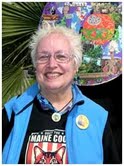
If you’ve read any of my posts here (or my books), you know that I’m not a friend of the fellow I call the standard-brand god. This is the “man upstairs” who goes by such names (in alphabetical order) as Allah, El Shaddai, Jehovah, and Yahweh. He’s the guy who’s snoopier than Santa Claus—he knows when we’re sleeping, when we’re awake, when we’ve been bad or good, and what we’re doing in any state of consciousness. At least that’s what his priests and preachers tell us. His holy books were written by men and his stories are told from the male point of view. (But how did Ruth and Esther get in the canon?) He has priests, but no priestesses that I know of, and even the named angels are male. I mean no disrespect to people who honor this god, but he’s just not my kind of deity.

But hark! There is a charming fellow. We all know him. Continue reading “Popeye as Deity by Barbara Ardinger”