Recently, I saw the following line in a promotion for a book to which I contributed: “This volume includes voices from Christianity, Judaism, goddess religion, the Black church, and indigenous religions.” The editors of this book are to be strongly commended for expanding the dialogue in feminism and religion beyond the confines of the Christian hegemony in which it is still all too often framed. Nonetheless, I felt hurt and offended. I immediately wrote to the editors asking how they would feel if a book were promoted using the words: “This volume includes voices from Goddess religion and god traditions such as judaism and christianity.”
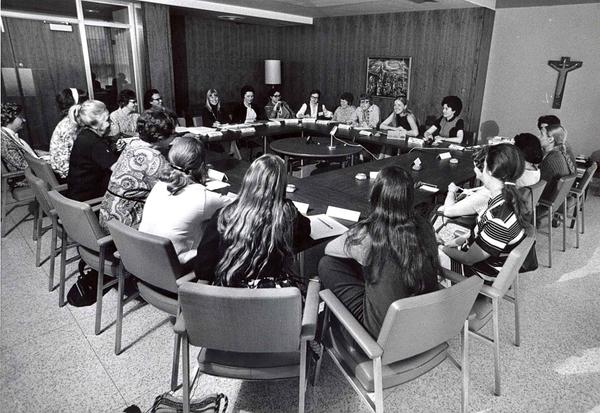
Carol Christ at the Conference of Women Theologians
Today I am publishing an early work on female language for God that I wrote with Emma Trout at the first Conference of Women Theologians in 1971. Highly contested at the conference, this essay is a foreshadowing of my subsequent work on the need for female imagery for divinity.
Rereading this essay more than four decades later, I am gratified to see that though we began our essay with the image of God giving birth (which I still view as an important image), Emma and I were aware of the danger that female imagery for God could reinforce “a false sexual polarity.” We insisted then that female imagery for God must not repeat sex role stereotypes, but rather must shatter them.
I am surprised that we also mentioned the need for a new non-static or process metaphysic, a theme I did pursue until I wrote Rebirth of the Goddessand then She Who Changesseveral decades later.
While the references in the essay are dated, the issues it raises are not. Though many mainline Christian and Jewish communities have adopted inclusive language, active experimentation with female language for God is relegated to the fringes of these groups. And while Goddess feminists resist gender stereotypes, some New Age teachers and Neo-Pagan groups perpetuate the idea that the Divine Feminine is receptive, loving, and giving, while the Divine Masculine is active, assertive, and aggressive.
Conference of Women Theologians 1971
ALTERNATIVE IMAGES OF GOD: COMMUNAL THEOLOGY BY CAROL CHRIST AND EMMA TROUT
How much better for theology to conceive of God the Creator as pregnant with the world, giving birth to it and nourishing it, than of God the divine Watchmaker who set the machine ticking millions of years ago. — Penelope Washbourne Chen in “Rediscovering the Feminine in God” The Tower alumni magazine
Even though we know that God Himself is not really a male, we have made use of no other images in talking about Him. As Mary Daly has pointed out, images have a way of perpetuating themselves even though we conceptually know better. (“After the Death of God the Father”) The image of God as a male authority figure serves to legitimize the structures of subordination (oppression) of women to (by) men. The problem is to conceive God in such a way that God’s masculinity does not function as a legitimation system for the oppression of women.
The imaging of God as male has two aspects: 1) the poverty of our language, and 2) the impoverishing of our vision of God by exclusive use of characteristics which our culture has attributed to and limited to the male in conceptualizing and imaging God. In the first of these two aspects we find images of God as Father, King, Lord; our language has no pronoun which is able to embrace and/or transcend both sexes. Our language forces us to think of God as male; we need words like “she-he,” “father-mother,” “daughter-son,” “brother-sister.” Regarding the second aspect: in the Western tradition, particularly the Christian theological tradition our ideas and images have been impoverished by almost exclusive use of “male” characteristics in conceptualizing and imaging God.
For example, initiative, transcendence, authority, primacy, leadership, control and order have all been conceived in static, self-sufficient, abstractly rational terms, in correspondence with masculine stereotypes. An alternative image of God suggested by Penelope Washbourne Chen, imaging God as pregnant, giving birth to, and nurturing the world, presents us with a more dynamic way of conceiving God. Philosophically, this image of God would find expression in the neo-classical metaphysics or process view of reality of Whitehead and Hartshorne, rather than the static ontology of the Greek tradition.
. . .
Let us now turn to the alternatives. Underlying the problem of choosing among the alternative conceptions/images of God is the problem of the evaluation of sexual differences. If, for example, one believes sexual differences are a fundamental polarity in human experience, she will find it appropriate to see this polarity reflected in the deity. If, on the other hand, one does not see sexual differences as a fundamental polarity, she will be wary of correcting a false male image/concept of God by introducing a “female” element which may serve to further legitimize a false sexual polarity.
If one is open to the possibility that sexual differences may not be fundamental, the real question is how to shatter the idol of a male deity without either 1) substituting a reverse idol of a female deity, or 2) legitimizing a false sexual polarity.
Photos of Carol speaking at the Conference of Women Theologians and of the Conference Participants from the Alverno College archives. Thanks to Sarah Shutkin for providing a copy of the essay from the Alverno College Library Archives.
When I first began to think about female language and images for God I imagined that changing God-He to God-She and speaking of God as Mother some of the time would be a widespread practice in churches and synagogues by now. I was more worried about whether or not images of God as a dominating Other would remain intact. Would God-She be imaged as a Queen or a Woman of War who at Her whim or will could wreak havoc on Her own people?
Forty years later, very little progress has been made on the question of female imagery for God. I suspect that most people in the pews today have never even had to confront prayers to Sophia, God the Mother, or God-She. Most people consider the issue of female language in the churches to have been resolved with inclusive language liturgies and translations of the Bible that use gender neutral rather than female inclusive language.
Grounded in an ancient theodicy, Ki Tavo (Deutoronomy 26:1-29:8), the Torah portion for September 17th, is an emotional rollercoaster. In it, the Israelites find their lot in life directly linked to their own behavior. Follow the commandments to gain blessing; ignore them at your own peril. While the commandments listed here are laudable from a feminist perspective, the deity’s response to non-concompliance is problematic. It is full of victim-blaming and empty of compassion. Furthermore, Ki Tavo’s portrayal of divine expectations leaves no room for human nature to actually be anything other than complete perfection. This is unacceptable.
As should sound familiar to the reader by now, Ki Tavo speaks to a specific historical context: the Babylonian exile. As we are aware, the typical theodicy of the Babylonian exile places blame for the Israelites’ lot in life on the Israelites themselves, specifically on how their behavior (or their ancestors’ behavior) has warranted divine punishment. In other words, the Isrealites have not observed the commandments and thus deserve what is happening to them. This justifies an understanding of the divine as vengeful, spiteful, jealous, and victim-blaming.
That being said, what exactly happens in Ki Tavo? Ki Tavo, also like many Torah portions, discusses commandment observance. From a feminist perspective, the portion rightly focuses its description of the commandments on justice and fairness within the community (27:16-25) as well as care for the widow, stranger, orphan, the poor, and the disenfranchised (26:12-13, 27:18-19). Its interpretation of the commandments seem to be truly about how, according to its time, a community, that puts the downtrodden and outcast first, should function. These are generally good principles.
Taken by author.
Ki Tavo then lists, in varying degrees of specificity, what happens to the Israelites when and if they observe the commandments. If they heed the commandments, they receive abundant blessings. These blessings focus on material, this-worldly rewards (28:3-13). Most offer abundant crops, flowing, deep rivers, good bread, fertility of human and animal, and rain, while, unfortunately, there are a few which mention blessings in terms of gaining power-over and, thus, influence. (Here it is impossible to give specific verse references as many verses have a combination of material blessings and less tangible, power-focused ones.)
When the Isrealites fail to heed the commandments, they incur divine wrath. This is depicted in Ki Tavo as curses or cursing. The curses are sometimes quite mundane and other times absolutely disturbing. There are the typical droughts (28:22, 24), plagues (28:22, 38-39, 42), diseases (28:22, 27-28, 35, 59-61), wars (28:49-53) and so on.
And, then, there are some not-so-common curses. One intriguing curse is exile, which forces the Israelites to practice idolatry (28:36). Interestingly, here idolatry is not a breaking of the commandments, but a punishment for doing so (28:36). Exile signifies the physical breakdown of the group, while idolatry distances that same group from their covenantal relationship with their chosen deity (28:64). They are not a people any longer as they live in foreign lands and worship different gods.
The uncommon curses go one step further and remove any semblance of the Israelites’ humanity through cannibalism. In Ki Tavo, this is a result of war. The deity wages a vicious war against the disobeying Israelites, using other humans (28:57). Their cities are so mercilessly besieged to the point that the people completely run out of food. With nowhere else to turn, they are forced to resort to cannibalism (28:53). Even the most gentle and well-behaved man and woman becomes, when this happens, cannibals (28:53-55), eating their own children to survive.
Yet, who is to blame for the death of their community and their own inhumanity? The deity who punishes? No. Ki Tavo makes it clear that it is the Isrealites themselves. By punishing the Israelites’ non-observance, the deity is only being faithful to the established covenant to which both parties freely agreed. This victim-blaming might have made sense of the Babylonian exile for those who were living through it, but it is also clearly a product of patriarchy. Back then victim-blaming justified war and disease. Now, it condones such practices as domestic violence, rape, and various manifestations of power-over. It is problematic because it does not acknowledge who is most often truly at fault: other, more powerful, humans.
Ki Tavo also paints a one-sided picture of divine understanding when it comes to good and evil. There is either goodness (in Ki Tavo, observance) and blessings or evil (non-observance) and curses. There is no middle ground, no explanation, and certainly no compassion.
This lack of divine compassion is what bothers me the most in Ki Tavo. Even though humans are divine creations, the writers of the Torah have depicted the Creator as so disconnected from creation that there is no compassion and no understanding of humanity, only sheer anger and divine wrath. According to Ki Tavo, our Creator is more than willing to shattered the community, our relationship with the divine, and even our own humanity than practice forgiveness and mercy.
Thank goodness that the Jewish tradition’s understanding of the divine does not stop at Ki Tavo. Rather, Jewish tradition teaches us that we, in the covenant, have partnered with the divine who understands us, showers us with compassion and mercy, and does indeed forgive us (when we don’t always behave as we should). We have a faithful deity who is abundant in goodness and rarely upset or disappointed. We can put our hope and our faith in the goodness of the Holy.
As we enter the High Holy Days, may Ki Tavo’s understanding of the divine as wrathful, angry, destructive, and vindictive stay in the past where it belongs. In this new year, may Compassion embrace us, gifting us with a sacred empathy for others and also for ourselves. May mercy and goodness be with us this year and all the days of our lives. And, may the world and our hearts be at peace.
L’shana tova umetukah! (For good and sweet year!)
Ivy Helman, Ph.D.:A feminist scholar and faculty member at Charles University in Prague, Czech Republic where she teaches a variety of Jewish Studies, Feminist and Ecofeminist courses.
In my last blog I wrote that the image of God as a dominating other who enforces his will through violence–found in the Bible and in the Christian tradition up to the present day–is one of the reasons I do not choose to work within the Christian tradition. To be fair, there is another image of God in Christian tradition that I continue to embrace. “Love divine, all loves excelling” is the opening line of a well-known hymn by Charles Wesley. Charles Hartshorne invoked these words and by implication the melody with which they are sung as expressing the feelings at the heart of the understanding of God that he wrote about in The Divine Relativity.
Love divine, all loves excelling also expresses my understanding of Goddess or as I sometimes write Goddess/God. Though I am no longer a Christian, but rather an earth-based Goddess feminist, I freely admit that I learned about the love of God while singing in Christian churches. Hartshorne wrote that he knew the love of God best through the love of his own mother, and I can say that this is true for me as well. My mother was not perfect, and she did not understand why I wanted to go to graduate school, my feminism, or my adult political views, but I never doubted her love or my grandmothers’ love for me. (I count myself lucky. I know others did not have this experience.) Like Hartshorne, I also learned about the love of God through the world that I always understood to be God’s body. Running in fields and hills, swimming in the sea, standing under redwood trees, and encountering peacocks in my grandmother’s garden, I felt connected to a power greater than myself.
This week’s Torah portion is Ki Tisa, Exodus 30:11-34:35. Its events revolve around the theme of creation, destruction, and recreation. From a feminist perspective, it is quite clear that this cyclical process is a result of a patriarchal understanding of the divine as jealous, distant, and rage-filled.
Ki Tisa begins soon after the Israelites have been delivered from Egyptain slavery. This delivery creates a new people devoted to this divine liberator. Yet, Ki Tisa starts with both that deity and their leader, Moses, nowhere to be found. So, what do the Israelites do being in such a vulnerable spot? They create a golden calf in order to have a spiritual connection to something.
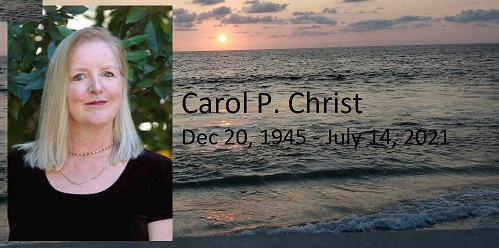
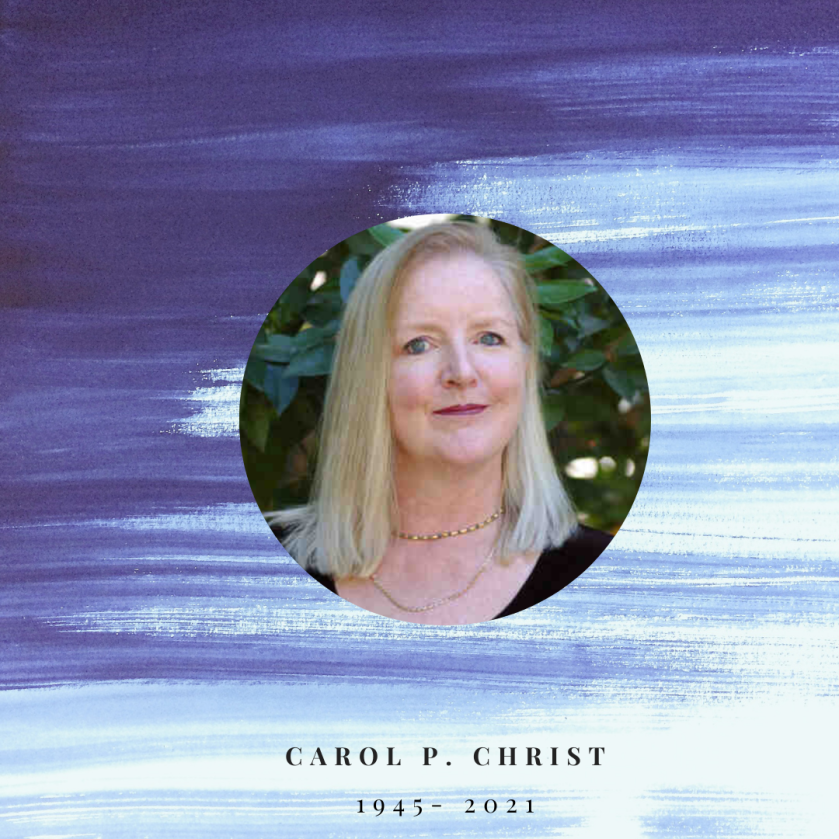
Moderator’s Note: We here at FAR have been so fortunate to work along side Carol Christ for many years. She died from cancer in July, 2021. Her work continues through her non-profit foundation, the Ariadne Institute for the Study of Myth and Ritual and the Goddess Pilgrimage to Crete. To honor her legacy, as well as allow as many people as possible to read her thought-provoking and important blogs, we are pleased to offer this new column to highlight her work. We will be picking out special blogs for reposting. This blog was originally posted July 9, 2012. You can read it long with its original commentshere.
My relationship to God changed when I accused “Him” of everything I thought “He” had done or let be done to women—from allowing us to be beaten and raped and sold into slavery, to not sending us female prophets and saviors, to allowing “Himself” to be portrayed as a “man of war.”
In the silence that followed my outpouring of anger, I heard a still small voice within me say: In God is a woman like yourself. She too has been silenced and had her history stolen from her. Until that moment God had been an “Other” to me. “He” sometimes appeared as a dominating and judgmental Other, and at other times as a loving and supportive Other, but “He” was always an “Other.” I as a woman in my female mind-body definitely was not in “His” image.
This month’s blog post marks my 10-year anniversary writing for feminismandreligion.com (FAR) and my 122nd post. I would just like to take a moment to acknowledge this milestone and thank the community for both its dialogue with me and support over these years. I look forward to writing for FAR for years to come.
Speaking of dialogue and support, this post is structured in the form of an answer to Barbara Ardinger’s question on my last post. She asked in what language I read Torah. I found that intriguing. To me, what I do is obvious. Yet, for the reader, I have never explicitly walked through the steps of how I create these Torah commentaries. In this walk-through, the reader is getting a rather unedited look into my process.
This week’s Torah parshah, as you can tell from the title, is Ha’azinu, or Deuteronomy 32:1-52. This is Moses’ final speech to the Israelites before he ascends Mount Nebo to die. It is traditionally associated with Yom Kippur and read somewhere very close to it (when exactly depends on the year). The reasons for this association should become obvious as we continue.
In the parshah, Moses describes how, even in the Promised Land, the Israelites will continue to be idolatrous, thus disobeying their deity and bringing divine wrath upon themselves. From what I have already discussed in past blogs about the history of the Torah’s composition, clearly the exiled Israelites in Babylonian sought reasons for that exile; in traditional Isrealite fashion, they made sense of their current circumstances by reasoning whose disobedience was to blame.











 I am an annoying feminist. I annoy pretty much everyone about it, because I’m never NOT applying a feminist lens to every aspect of life: science (looking at you,
  Feminism and Religion