Winter Lessons, by Molly M. Remer

Yes, it is December
already and again.
Let yourself notice the milkweed pods,
how they have split their sides
and are sending silky white seed fluffs
into the waiting air.
Witness the trees,
bare and gray and patient.

Yes, it is December
already and again.
Let yourself notice the milkweed pods,
how they have split their sides
and are sending silky white seed fluffs
into the waiting air.
Witness the trees,
bare and gray and patient.
Watch the squirrels,
tails puffed against the chill,
stored nuts in their cheeks.
Listen to the wind
how it whispers and rattles
through the empty branches.
Watch the clouds,
slow-moving white billows
in a pale blue sky.
Be patient with yourself.
Grant yourself grace.
Remember the three invitations
of the solstice season:
to listen,
to wonder,
to be content.
Remember your promise
to keep company with joy.
Remember your vow
to be in devotion
to your own life.
Think about everything
there is to do.
Open your hands.
Feel that thin, whispering
winter wind
skim over your palms.
Take a deep breath.
Allow yourself to marvel
at all this year
has held.
Bless it.
Thank it.
Cup your hands
around your own face.
Say: thank you.
Here you are in the center
of your own life’s unfolding.
There is nowhere else to be.
Be gentle with yourself.
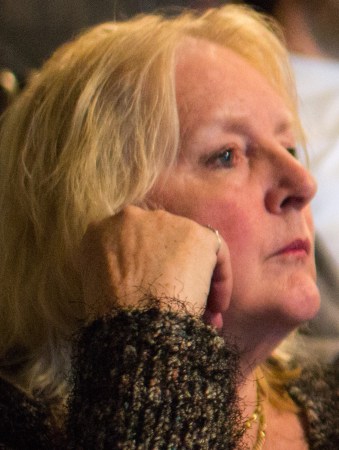
Invite the winter crone to tea.
Look into her eyes.
See yourself reflected there,
your own winter eyes open
to the possibility
of both clarity and delight.

I have been writing for Feminism and Religion for 13 years. In the summer, I compiled a post with 13 summer lessons from 13 years of posts here at FAR. I decided to bookend that post with a Winter Lessons post as well. Here are thirteen lessons to share from past winter posts:

Continue reading “Winter Lessons, by Molly M. Remer”

Of Resistance and Risk, Community and Kin: A Thanksgiving Reflection by Beth Bartlett

Ricky DeFoe

At the No Kings rally on October 18th, Anishinaabe elder Ricky DeFoe affirmed to the gathered crowd that “the natural response to oppression, ignorance, evil, and mystification is wide-awake resistance.” Such resistance, he claimed, calls for an “ethic of risk.”  I was immediately struck by his use of the term, paralleling feminist theologian Susan Welch’s A Feminist Ethic of Risk.[i]Returning home, I picked up my copy and found many of the same points DeFoe had articulated.[ii] Both asserted that an ethic of risk recognizes that “to stop resisting, even when success is unimaginable, is to die,” and by this they meant not only the threat of physical death, but also “the death of the imagination, the death of the ability to care.”[iii]

Continue reading “Of Resistance and Risk, Community and Kin: A Thanksgiving Reflection by Beth Bartlett”

Legacy of Carol P. Christ: MATRIARCHY: DARING TO USE THE “M” WORD

carol-christ

This post was originally published on Feb. 17th, 2014.

For me the word “matriarchy” expresses the certainty that “another world” can exist—a world not based in domination and hierarchy or violence and war. 

The word “matriarchy” makes people’s hair stand on end as they imagine the mirror-image of patriarchy: societies in which women dominate men, beat men, rape men, hold men as slaves, and demand obedience from men.  Some who do not protest very loudly or at all against patriarchy are horrified by the very idea of matriarchy. To be fair, most feminists have also been schooled not to use the “m” word.

Early in my academic career, I read “The Myth of Matriarchy” by Joan Bamberger and learned that the idea of matriarchy gone wrong has been used by men to justify patriarchy. From other academics I learned that in matrilineal societies, uncles have a great deal of power—so therefore there never was a matriarchy.  I was also aware that Jungian and other proponents of a “matriarchal stage” in the development of culture have argued that matriarchy had to be succeeded by patriarchy in order for societies to evolve to a “higher” stage. Unlike many of my colleagues I stubbornly held onto the belief that there must have been “a better way” prior to patriarchy. Continue reading “Legacy of Carol P. Christ: MATRIARCHY: DARING TO USE THE “M” WORD”

Legacy of Carol P. Christ: IS GODDESS “WITH US” OR “IN CONTROL” OF EVERYTHING? THE “THEOLOGICAL MISTAKE” OF DIVINE OMNIPOTENCE

carol-christ

This post was originally published on Feb. 24th, 2014.

How do we make sense of loss, great loss, and everyday disappointment? Some would tell us that “everything has a purpose” or that whatever happens “must be the will of God.”  I have found that these answers to questions raised by life as we know it often do more harm than good.  Yet they have a sticking power–we hear them all the time, sometimes even from other feminist seekers.

From the beginning feminists in religion rejected “the God out there” who rules the world from a throne in heaven. Most of us have insisted that “God” is more “in” the world than “beyond” or “outside it.” However we have not always been consistent in our convictions. When feminists are confronted with untimely death or great evil or just not getting what we think we want, we can sometimes be overheard to wonder, “Why did God (or Goddess) let that happen?” This question is based in the assumption that God or Goddess is omnipotent and rules the world from outside it. This is the theological idea I intend to question today.

The “zero fallacy” is a term philosopher Charles Hartshorne used to explain the “theological mistake” known as divine omnipotence.  Hartshorne pointed out that if God is omnipotent, then God has “all” or “100%” of the power. If this is so, then human beings and all other beings have “zero” power.  But if we have zero power, then do we even exist?  Continue reading “Legacy of Carol P. Christ: IS GODDESS “WITH US” OR “IN CONTROL” OF EVERYTHING? THE “THEOLOGICAL MISTAKE” OF DIVINE OMNIPOTENCE”

Legacy of Carol P. Christ: “Immanent Inclusive Monotheism” with a Multiplicity of Symbols Affirming All the Diversity and Difference in the World

carol-christ

This post was originally published on March 10th, 2014.

In recent years monotheism has been attacked as a “totalizing discourse” that justifies the domination of others in the name of a universal truth. In addition, from the Bible to the present day some have used their own definitions of “exclusive monotheism” to disparage the religions of others. Moreover, feminists have come to recognize that monotheism as we know it has been a “male monotheism” that for the most part excludes female symbols and metaphors for God.  With all of this going against monotheism, who would want to affirm it?

In response to some or all of the above critiques, many modern pagans define themselves as polytheists, affirming at minimum, the Goddess and the God, and at maximum a vast pantheon of individual deities, both female and male, from a single culture or from many, including divinities with animal characteristics.  Other pagans define themselves as animists, affirming a plurality of spirits in the natural world. A group of Christian feminists have argued that the Christian Trinity, the notion of God Three-in-One, provides a multiple and relational understanding of divinity.

While also rejecting exclusive monotheism and male monotheism, Jewish poet, ritualist, and theologian Marcia Falk provided a definition of inclusive monotheism that I find compelling.

Monotheism means that, with all our differences, I am more like you than unlike you. It means that we all share the same source, and that one principle of justice must govern us equally.  . . Continue reading “Legacy of Carol P. Christ: “Immanent Inclusive Monotheism” with a Multiplicity of Symbols Affirming All the Diversity and Difference in the World”

Legacy Of Carol P. Christ: The Great Commandment for Women: Love and Care for Yourself as You Love and Care for Others

carol-christ

This post was originally published on Feb. 3rd, 2014.

A rabbi known as Jesus of Nazareth taught that you should  “love God with all your heart and your neighbor as yourself.”  Charles Hartshorne, philosopher of relationship and a twentieth century advocate of the “two great commandments,” added that it should be understood that this means that God wants you to love yourself too.

I quote Hartshorne’s midrash on the great teaching often because, sadly, too many women—and some men too–have been taught to love their neighbors at the expense of themselves, to care for others, but not to care as much for themselves.  Continue reading “Legacy Of Carol P. Christ: The Great Commandment for Women: Love and Care for Yourself as You Love and Care for Others”

The ‘Current’ of Patriarchy: Feminization of Rivers in Indian Mythology by Dhruv Kabra

The Ganga, Yamuna, Saraswati, Kaveri, and Godavari are all goddesses. In contrast, the mountains- Meru, Kailasa, Himalaya are male gods or their celestial abodes. Perhaps this is not just a coincidence but a deliberate gendered imagination that reveals how patriarchal structures flow through the very geography of the sacred.

Indian rivers are predominantly personified as women, with the lone masculine river, Brahmaputra serving as a subversive exception that divulges the somewhat gendered logic of sacred geography.

The Containment of Divine Power

Ganga, the most revered river goddess in India, is born in the heavens, but her descent to earth is mediated by Shiva. His matted locks absorb her torrent, lest her power shatter the earth. Ganga’s sacredness is based on her containment. Feminine energy is revered, but only if domesticated by a male god.

Continue reading “The ‘Current’ of Patriarchy: Feminization of Rivers in Indian Mythology by Dhruv Kabra”

Legacy of Carol P. Christ: Is the Spirit of Great Generosity in Crete a Survival of Ancient Matriarchal Values?

This was originally posted on October 28, 2013

carol-christAt a coffee shop in Agios Thomas, Crete last month a perfect stranger offered to pay for the coffees and sodas of the 16 women on the Goddess Pilgrimage to Crete. This spirit of great generosity is rarely experienced in the United States or other parts of Europe, but it is still common in rural Crete and some parts of Greece.

 In fact our group was in Agios Thomas because our bus driver Babis, also in a spirit of great generosity, insisted on stopping to show us his village when we were passing nearby. He guided us to see Roman rock cut tombs and arranged for the early Byzantine church to be opened. At the end of the our pilgrimage, Babis stopped the bus at a wooded glen beside a small church where he offered us his own homemake raki, wine, and olives, accompanied by local sheep cheese he had purchased while we were climbing a mountain. After every meal that we ate in local tavernas, we were offered bottles of cold raki, fruit, and sweets.

crete fruitsThis spirit of great generosity has long been commented on by travelers in Greece, who often speak of it as unexpected (for them) hospitality to the stranger or traveler. That it is, of course. Through the work of Heidi Goettner-Abendroth, I now understand that the famous Greek hospitality to the stranger has deep roots in matriarchal cultures. According to Goettner-Abendroth, equality of wealth is assured through the widely-practiced custom of gift-giving in matriarchal cultures. Continue reading “Legacy of Carol P. Christ: Is the Spirit of Great Generosity in Crete a Survival of Ancient Matriarchal Values?”

The Cauldron of Life: Destruction and Creation in Celtic Myth, Part 2 by Judith Shaw

Branwen’s Story

Branwen, sister of King Bran the Blessed, was cherished for her gentleness, compassion, and beauty. As the mother of the future king in the tradition of the Old Tribes of the British Isles, she embodies Sovereignty. She is the source of all life, ruling over both the spirit and the land.

Branwen, Celtic Goddess painting my Judith Shaw
Branwen: Celtic Goddess of Love and Compassion by Judith Shaw

We first meet Branwen when the Irish King Matholuch arrives, his fleet signaling peace with a great shield pointing outwards. He asks for Branwen’s hand in marriage—a significant event, as no woman of the old tribes had ever left her people for a foreigner, much less she who would give birth to the next king. Nonetheless, Matholuch is welcomed ashore, and Branwen is summoned.

Continue reading “The Cauldron of Life: Destruction and Creation in Celtic Myth, Part 2 by Judith Shaw”

Legacy of Carol P. Christ: IS THE SPIRIT OF GREAT GENEROSITY IN CRETE A SURVIVAL OF ANCIENT MATRIARCHAL VALUES?

carol-christ

This post was originally published on Oct. 28th, 2013

At a coffee shop in Agios Thomas, Crete last month a perfect stranger offered to pay for the coffees and sodas of the 16 women on the Goddess Pilgrimage to Crete. This spirit of great generosity is rarely experienced in the United States or other parts of Europe, but it is still common in rural Crete and some parts of Greece.

 In fact our group was in Agios Thomas because our bus driver Babis, also in a spirit of great generosity, insisted on stopping to show us his village when we were passing nearby. He guided us to see Roman rock cut tombs and arranged for the early Byzantine church to be opened. At the end of the our pilgrimage, Babis stopped the bus at a wooded glen beside a small church where he offered us his own homemake raki, wine, and olives, accompanied by local sheep cheese he had purchased while we were climbing a mountain. After every meal that we ate in local tavernas, we were offered bottles of cold raki, fruit, and sweets.

crete fruitsThis spirit of great generosity has long been commented on by travelers in Greece, who often speak of it as unexpected (for them) hospitality to the stranger or traveler. That it is, of course. Through the work of Heidi Goettner-Abendroth, I now understand that the famous Greek hospitality to the stranger has deep roots in matriarchal cultures. According to Goettner-Abendroth, equality of wealth is assured through the widely-practiced custom of gift-giving in matriarchal cultures. Continue reading “Legacy of Carol P. Christ: IS THE SPIRIT OF GREAT GENEROSITY IN CRETE A SURVIVAL OF ANCIENT MATRIARCHAL VALUES?”