Straight from the Horse’s Mouth: Celebrating Epona by Mary Sharratt


epona-of-kastel

The following is a guest post by Mary Sharratt’s Welsh mare, Miss Boo aka Queen Boudicca


The ancient Romans and Gauls knew something that many modern day humans have forgotten. Mares are divine.

The worship of Epona was popular throughout the Roman Empire. Epona was a Gaulish deity whose name means “divine mare” or “she who is like a mare.” Epona was the the only Celtic divinity to receive her own official feast day in the Roman Calendar: Eponalia, December 18, was celebrated on the second day of Saturnalia, the Roman midwinter celebration (December 17 to December 23). But as far as we horses are concerned, every day is Epona’s Day! Go out and hug a horse right now!

The patron deity of horses, ponies, donkeys, and mules, Epona also protected those who looked after equines or worked with them. Thus she was beloved of the Roman cavalry. Epona’s worship stretched from Roman Britain, across Gaul and Germania to Spain, Rome, and Eastern Europe. Not only did she have a temple in Rome and her own holiday, but there were shrines to her in almost every stable. Her altars were adorned with fresh roses. Horses and donkeys were adorned with roses for her processions.

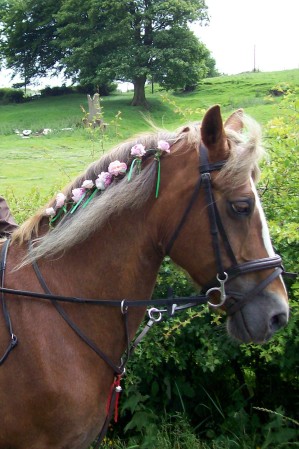
Some modern humans are inspired by these ancient traditions. At midsummer, my human ties roses in my beautiful mane when we ride out together.
midsummer-boo-4

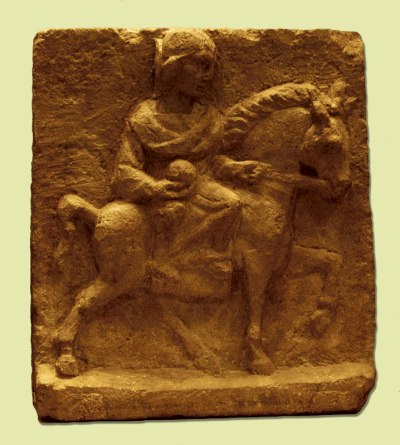
In her iconography, Epona is often depicted as a majestic woman riding side saddle, always travelling from left to right. In the image at the top of the page, “Epona from Kastel,” she is riding and carrying a round fruit or loaf. Epona is associated with abundance, fertility, and sovereignty.

A votive image from Budapest shows Epona as a great sovereign lady seated between two horses who feed from her lap.
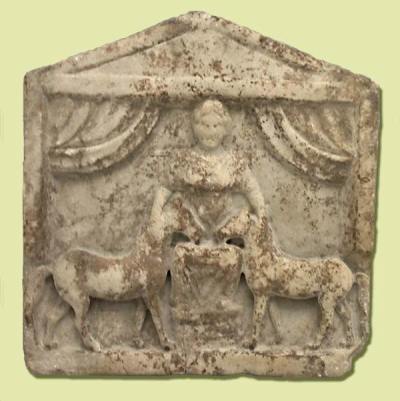
epona-of-budapest

In the Middle Ages, Epona’s archetype lived on in literary figures such as Rhiannon in the Mabinogian.

Epona was a nurturing mother figure, a giver of abundance and plenty. But what does this mean for us today? Anyone who has spent any time around us horses knows that we are capable of great empathy. Any person who is sad or depressed should spend some time just quietly grooming horses and being with them, and the healing will unfold. When my human is upset, I know right away and I’m especially gentle with her and give her lots of tender snuffles. I also love children and am extra careful around them. Here’s a picture of me with one of my little human friends.
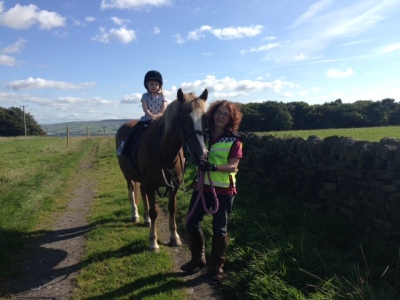
boo-saffron


People have reported great success using horses to treat autistic children and adults. Even people suffering from eating disorders can heal if they spend time with equines. Horses have huge hearts. Especially mares! We’re hard-wired to nurture.

Heartland Girls’ Ranch in Minnesota offers equine therapy to help heal sex-trafficked girls. Each girl is matched with a horse that she cares for and this partnership helps build back her sense of trust and self-worth.

The Romans celebrated Eponalia by giving every horse, donkey, and mule a day of rest. Modern humans who keep horses can observe this by giving their horses a day off and by offering them apples, which are sacred to Epona. Humans can also honour Epona by donating to equine charities, to Heartland Ranch, or your local horse rescue centre.

What would human civilization look like had there not been a millennia-long partnership between humans and equines? Have a heart for the horses who have carried their humans so far and so faithfully.

Links: Epona.net

Epona’s Day: The Gifts of Midwinter by Caitlin Matthews

Heartland Girls’ Ranch

Miss Boo aka Queen Boudicca is a Welsh mare who lives in the Pendle region of Lancashire. A hereditary Welsh trad witch in the most archetypal sense of the word, Miss Boo lives in deep communion with the Earth and is a keeper of ancestral wisdom. Miss Boo is a committed feminist, and she and her herd preserve an ancient matriarchal social structure unchanged since the dawn of their species. Don’t mess with chestnut mares! She is the proud owner of the author, Mary Sharratt. All royalties from Mary’s book sales will go to keeping Miss Boo in the style to which she has become accustomed. Visit her human’s website.
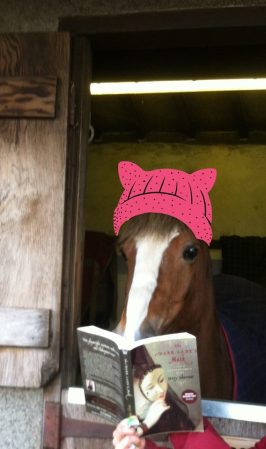
boo-pussy-hat

It’s a Small Thing in Relation to Everything Else: Or Is It? by Carol P. Christ

carol-p-christ-photo-michael-bakasYesterday morning when I learned about the Open Letter to Attorney General Sessions: Join Us In Selma On the Right Side of History, I paused Joy Reid’s interview with William Barber II in order to search for the petition site. The letter’s authors invited the Attorney General to join them in Selma to commemorate the 52nd anniversary of “Bloody Sunday” when peaceful marchers demanding the right to vote were attacked with billy clubs and tear gas. The Letter also asks the Attorney General, who was born in Selma, to join them in a non-partisan commitment to ensure the right to vote for all Americans. The letter calls upon the Justice Department to restore the protections against voter suppression enshrined in the Voting Rights Act.
I was pleased to sign the Open Letter because I have been thinking about how those who came together in the Women’s March and other marches can channel their energy into registering voters, helping them get the identification required by “voter suppression laws” enacted with the purpose of disenfranchising voters of color and elderly voters in nearly half of all US states. I believe it is imperative to focus a part of our energy on helping people to get the necessary ID’s while at the same time working to throw out every single rascal who voted for these laws. We must take back the state legislatures that have the power to enact voting laws. And we must do what we can to make sure that everyone who wants to vote is able to vote.

While I was adding my name to the petition, I was asked to check if I am a faith leader. Continue reading “It’s a Small Thing in Relation to Everything Else: Or Is It? by Carol P. Christ”

Reflections on Death, Evil, and Divinity by Carol P. Christ

carol-p-christ-photo-michael-bakasIn our book Goddess and God in the World, Judith Plaskow and I discuss and debate our contrasting and conflicting views of the nature of divinity and the cause of evil. In the passage that follows, I respond to Judith’s questions.

This brings us to the major philosophical issue that divides us: the nature of divine power and the relation of divine power to the world. It is fair to say that our major difference in this regard is whether the divine power is personal, conscious, intelligent, loving, and good. You ask, “If all we know of that exists is a mixture of the good and the bad . . . , if our creativity and the creative power that births and sustains the world brings forth both good and evil, then how can the Goddess be less than ambiguous? How can the Goddess be ‘the ground of all being’ if she does not ‘form light and create darkness, make weal and create woe’ (Isa. 45:7)? This question lies at the heart of our differences.

. . .

You ask whether “evil finally has less metaphysical warrant or reality than good” in my worldview. Continue reading “Reflections on Death, Evil, and Divinity by Carol P. Christ”

She is Here by Mary Petiet

Mary Petiet photoOn the morning of January 20, 2017, the world watched Donald J. Trump stand on Capitol Hill for inauguration as the 45th president of the United States. He did not stand alone. Timothy Michael Dolan, Catholic cardinal and archbishop of New York, also stood, and he invoked the divine feminine as he opened the inaugural ceremony with a recitation of King Solomon’s prayer from the Book of Wisdom.
As Dolan stood before the capitol building, which houses the US congress, he called upon the divine feminine with the words:  “Now with you is wisdom, who knows your will and was there when you made the world, who understands what is pleasing in your eyes, what is conformable with your commands, send her forth from your holy heavens. From your glorious throne, dispatch her that she may be with us and work with us, that we may grasp what is pleasing to you. For she knows and understands all things and will guide us prudently in our affairs and safeguard us by her glory.”

She is here. Continue reading “She is Here by Mary Petiet”

Boldly and Outrageously Envisioning Our Way Through the Maelstrom by Carolyn Lee Boyd

carolynlboydAs we wander together through the maelstrom of our world today, trying to keep our eyes open, our voices firm and truthful, our feet bravely taking one step and then another, may we reclaim our gift of future-envisioning boldly, outrageously, and together as a global community. In perilous times we may think that envisioning a future that may never be is a waste of time and energy. When we look into the future and see only uncertainty, we may no longer be sure that the kind of world we have been working towards for decades could ever exist.

However, it is precisely when we think we are too weary or that all attempts at progress are futile that our visions are the most important because the stakes are highest. If we have no guide towards where we want to go and do not even start on the journey, we are guaranteed to never get there. Continue reading “Boldly and Outrageously Envisioning Our Way Through the Maelstrom by Carolyn Lee Boyd”

Making Our Stand by Molly Remer

“You may not remember, may-2016-103
but let me tell you this,
someone in some future time

will think of us.”

Sappho

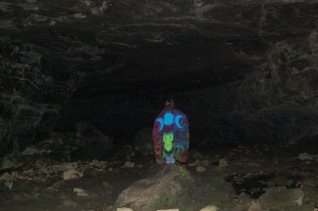
I put on my boots and jeans, grab my priestess robe, pack a basket of ritual supplies, and meet four close friends in a nearby cave. We feel a little nervous about holding ritual on unfamiliar land, but we decide to push our boundaries and do it anyway. The land needs us, says my friend. The other people who come here are meth-heads and vandals.

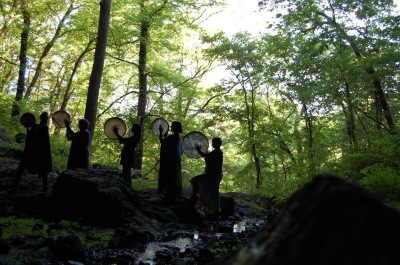
We take our drums and climb to the top of the cave, singing as we find our way up the steep hillside. On top, looking out across the country, we sing: cauldron of changes, feather on the bone, arc of eternity, ring around the stone. We laugh and practice some more songs, some hearty, some tentative and new. We tie up small bundles of our symbolic burdens with stones and let them down over the edge
may-2016-051using handspun wool yarn until the yarn releases, taking our burdens with them. Suddenly, we hear the sound of tires on the gravel. Slamming doors. The sound of loud men’s voices. The smell of cigarette smoke. A ripple of uncertainty passes through us. We are once again tentative and we feel a current of unease. What should we do? we whisper to one another. The voices draw nearer, there are calls and hoots. My friend looks at me and says: this is where we make our standWe hold hands in a line at the edge of the cave roof, gazing out into the horizon. A hawk wheels overhead. We sing. The approaching voices quiet. We sing louder.
I am a strong woman, I am a story woman, I am a healer, my soul will never die.

We project our voices and yell: we are the witches, back from the dead!

The voices stop. We wait. We hear doors slamming. The sound of tires on gravel. We are alone once more.

We descend into the cave singing a song composed on the spot: Deeper, deeper. We’re going deeper. Deeper, deeper. Deeper still.

We strike a pose based on the carvings described in the classic book, When the Drummers were Women. Archaeologists described may-2016-099carvings of priestesses carrying drums as, “women carrying cakes to their husbands.”
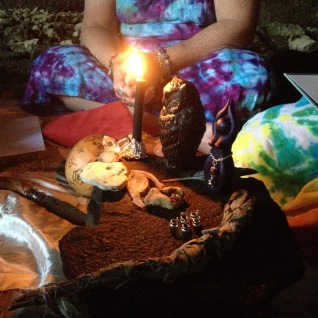
We shout: “we’re not carrying cakes!”

I stand on a rock in the center of the cave and sing: she’s been waiting, waiting, she’s been waiting so long, she’s been waiting for her children to remember to return. My friends join the song and we move deep into the darkness where we face the “birth canal” at the back of the cave, listening to the small stream within trickle, laugh, and bubble as it emerges from the dark spaces deep within the heart of the earth. We begin to sing:

Ancient mother we hear you calling. Ancient mother, we hear your song. Ancient mother, we hear your laughter…

Just as we sing the words, ancient mother, we taste your tears, droplets of cave water fall on our faces, splashing our eyelids.

It might seem simple on the surface, but gathering the women and calling the circle is a radical and subversive act. A revolutionary act. In my work with women’s circles and priestessing, I am repeatedly reminded that gathering with other women in a circle for ritual and ceremony is deeply important even though it might just look like people having fun or even being frivolous, it is actually a microcosm of the macrocosm—a miniature version of the world we’d like to see and that we want to make possible.

In the book, Casting the Circle, Diane Stein observes that women’s rituals, “…create a microcosm, a ‘little universe’ may-2016-062within which women try out what they want the macrocosm, the ‘big universe’ or real world to be. Within the safety and protected space of the cast circle, women create their idea of what the world would be like to live in under matriarchal/Goddess women’s values…The woman who in the safety of the cast circle designs the world as she would like it to be takes that memory of creation and success out into daily life…By empowering women through the microcosm of the ritual’s cast circle, change becomes possible in the macrocosm real world.” (p. 2-3)
It starts with these private ritual and personal connections and then, as Stein explains, “A group of five such like-minded women will then set out to clean up a stream bed or park in their neighborhood; a group of twenty-five will join a protest march for women’s reproductive rights; a group of a hundred will set up a peace encampment. The numbers grow, the women elect officials to government who speak for their values and concerns. Apartheid crumbles and totalitarian regimes in Eastern Europe end, disarmament begins, and laws to control polluters are enforced. Homes, foods, and jobs are opened to the world’s homeless, and often begins in the microcosm of the Women’s Spirituality ritual circle” (p. 3)

“Feminism catches fire when it draws upon its inherent spirituality. When it does not, it is just one more form of politics, and politics never fed our deepest hungers.”

–Carol Lee Flinders (in The Millionth Circle)

january-2017-038Molly has been “gathering the women” to circle, sing, celebrate, and share since 2008. She plans and facilitates
women’s circles, seasonal retreats and rituals, mother-daughter circles, family ceremonies, and red tent circles in rural Missouri and teaches online courses in
Red Tent facilitation and Practical Priestessing. She is a priestess who holds MSW, M.Div, and D.Min degrees and finished her dissertation about contemporary priestessing in the U.S. Molly and her husband Mark co-create Story Goddesses, original goddess sculptures, ceremony kits, and jewelry at Brigid’s Grove. Molly is the author of Womanrunes, Earthprayer, and The Red Tent Resource Kit and she writes about thealogy, nature, practical priestessing, and the goddess at Brigid’s Grove

Happy New Year by Barbara Ardinger

Here we are, beginning a new year. Let’s hope it’s a good new year. I grew up in a working-class family in St. Louis. We were Calvinist and Republican. I’ve escaped from the last two, but I still claim my working class background. My father was a lithographer, my mother, a housewife. And I will never forget the advice given every year (actually, more than once every year) by my Dutch grandmother: Whenever you start something new, start clean. Take a bath, brush your teeth, wash your hair. More than that, she meant clean your house. Wash dishes. Dust. Vacuum. Pick up stray books and pet toys. Gramma put the fear of god in me, at least about cleaning. Every time she took the bus down to visit me while I was in graduate school, I spent two days cleaning my apartment.

It’s thanks to Gramma that when I wrote a daybook titled Pagan Every Day, I started the year writing about home. Here’s the page for January 1:

Usually, we invoke Janus on this first day of the year. He was the Roman two-faced god of the doorway (ianus), the transition point between the safe indoors and the outside world, where anything could happen. Roman weren’t alone in believing that this opening needed to be protected. The mezuzah, which holds verses from Deuteronomy, is affixed to doors of Jewish houses, the façade around the doorway of a medieval cathedral is as elaborate as the altar, and nearly every pagan is taught to cut a “doorway” into the energy of the circle. As the doorway stands between inside and outside, so does the turning year stand between an old year we knew and a new year we don’t yet know. Janus gave his name to January and the Romans honored him all month. Before he came to the city, however, he was Dioanus, an Italian oak god whose consort was the woodland goddess, Diana. Continue reading “Happy New Year by Barbara Ardinger”

This Time by Joyce Zonana

jz-headshot

And the new sun rose bringing the new year.

Alfred, Lord Tennyson, “The Passing of Arthur,” Idylls of the King

It’s arbitrary, of course, this designation of January 1st as New Year’s Day on the Gregorian Calendar, but it’s also unavoidable.  Everywhere around us, people are gathering, celebrating, making resolutions, ringing out the old, ringing in the new.

The Jewish calendar’s Rosh Hashanah, near the Autumnal Equinox, always feels like the real New Year to me, with its time-honored rituals of renewal and return.  The ancient Persian New Year, observed at the Vernal Equinox and recalled in in the Jewish and Christian celebrations of Purim and Mardi Gras, also moves me.  And, like so many of my brother and sister pagans, I experience the Winter Solstice as a truly numinous moment, a time to release the past and welcome the future as the sun dies and is reborn.

This year, it’s especially meaningful to find Chanukah so close to the solstice, filling the week between Christmas and New Year’s.  I’ve been lighting my candles each night with particular pleasure.  Yet I’m happy, too, to join the rituals associated with the secular, popular New Year.  In my view, there can never be too many moments of renewal and return.

Continue reading “This Time by Joyce Zonana”

FAR Press Publishes A Serpentine Path: Mysteries of the Goddess by Carol P. Christ

carol-p-christ-photo-michael-bakasThis is a great day for me as I announce the publication of A Serpentine Path: Mysteries of the Goddess. It is the first —but certainly not the last—book from the new FAR Press, directed by Gina Messina and Xochitl Alvizo, two of the founders of www.feminismandreligion.com. The release of my book is the fruit of friendship and collaboration that has been nourished in the blog community. I hope you will join with us in celebrating our joint venture by ordering the book, telling your friends about it, sharing it Facebook and Twitter (links below), reviewing it on Amazon, and letting Gina and Xochitl know if you can review in a magazine, journal, or blog.
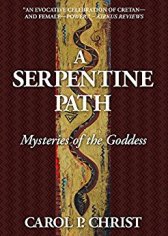
Here is an excerpt from the preface to whet your appetite.

*

A Serpentine Path is a story that begins in despair and ends in rebirth and regeneration. It depicts a turning point in my life, a psychological and spiritual breakthrough that opened me to living the rest of my life in grace and joy. Though I am tempted to say it was a journey from darkness to light, that would be inaccurate, for mine was a journey into the darkness and out again. The path of life is never straight or narrow, and the circle of light and darkness is never-ending.

When I began the journey described in A Serpentine Path, I did not feel loved, I did not want to live, I could not write, and I believed the Goddess had betrayed my faith. As I completed the book, I knew I was loved, I wanted to live, I was writing, and I understood that the Goddess had never abandoned me. Though my life has had its ups and downs since then—as all lives do—I have never forgotten that I am loved, I have wanted to live, I have not stopped writing, and I feel the Goddess ever-present in my body, in my breath, and in my connections with the living and the dead. Though my story is deeply personal, my struggles with love and death, trust and control, are widely shared.

A story of finding the Goddess, A Serpentine Path is part of a growing genre that is developing as women explain to themselves and others why they left the patriarchal religions of their origins for a more nourishing spiritual vision that affirms both women and the earth. A Serpentine Path documents the first of the Goddess Pilgrimages to Crete I have been leading twice a year since then. For the women who have traveled with me, it will evoke many memories. For those who have dreamed of a pilgrimage to the Goddess, it offers an opportunity to imagine the journey. I now know a great deal more about ancient Crete, the folklore and customs of traditional Crete, and the rocks, trees and plants of Crete, than I did when I began. But I learned the mystery on my first pilgrimage. Because we are all deeply connected to each other, I know that the path to the mystery I discovered is not mine alone.


a-serpentine-path-amazon-coverBe among the first to order A Serpentine Path, Carol P. Christ’s moving memoir of transformation. Carol’s other new book written with Judith Plaskow is Goddess and God in the World: Conversations in Embodied Theology. Carol also wrote the first Goddess feminist theology, Rebirth of the Goddess.

Join Carol on a Goddess Pilgrimage to Crete in 2017. Save $200.

Read two of the chapters in the book: Mysteries and Dionysian Rites.

Thanks to Judith Shaw for the cover art “Downward Serpent”

The Halcyon Days by Deanne Quarrie

Deanne QuarrieThere is a Greek myth that tells there were fourteen “halcyon days” in every year, seven of which fell before the winter solstice, seven after; peaceful days when the sea was smooth as a pond and the hen-halcyon built a floating nest and hatched out for her young.

The halcyon is also known as the kingfisher. The kingfisher is associated in Greek myth with the Winter Solstice. She also had another habit, that of carrying her dead mate on her back over the sea and mourning him with a plaintive cry. Pliny reported that the halcyon was rarely seen and then only at the winter and summer solstices and at the setting of the Pleiades. She was therefore, a manifestation of the Moon-Goddess who was worshipped at the two solstices as the Goddess of Life in Death and Death in Life and, when the Pleiades set, she sent the sacred king his summons for death. Continue reading “The Halcyon Days by Deanne Quarrie”