In a previous post on FAR I explored Greek Easter customs which interweave Christian and pre-Christian beliefs. Today I would like to take a closer look at one of these customs, the women’s ritual dance known as Tráta, ceremonially performed on ‘Bright Tuesday,’ the Tuesday after Easter. Versions of Tráta survive in the towns of Mégara and Elefsina just west of Athens, on the island of Salamína directly across from them, and in the surrounding area as far as Thebes.
Elefsina, of course, is Eleusis, where for over 2,000 years the Eleusinian Mysteries enacted the story of Demeter and her daughter Persephone’s descent to the Underworld. Choral dance was a central part of the ceremonies at Eleusis – as at other sacred sites including Delphi, Knossos, Athens, and Vravrona – and the ‘Well of the Beautiful Dances’ can still be seen at the archaeological site. It is a a visible reminder of the circle dancing which was a part of the initiatory experience, bringing cosmic order – symbolised by the circle – into the human world. This is still one of the functions of the Tráta as performed today.
As I mentioned in my January 30, 2016 post, Grace Jantzen in Foundations of Violence makes a compelling case that Diotima is a fictional figure. She does not, however, adequately distinguish her from the poetizing female figures Parmenides and Boethius portray as instructing them in their respective works. If nothing else, the quality of the poetry of Parmenides and Boethius betrays the influence of a very real woman: Sappho.
By contrast, Plato essentially portrays Diotima as the personification of his philosophy–his metaphysics–and it is hard to believe there was such an ancient Greek woman. Although the term ‘metaphysics’ derives from a neologism coined in Greek centuries after Plato and Aristotle lived, its meaning (‘beyond’ (meta) the ‘natural,’ or ‘embodied’ world (physics)) appropriately characterizes what Diotima and hence Plato’s philosophy is all about. A key passage is where she characterizes the most intense love as “gazing at and being with” the beloved, without even the need to “eat or drink.” That leads her to ask rhetorically whether it would not be best to gaze at what is not “infected” by flesh and blood (Symposium (211 d-e)).
Niamh (meaning ‘bright’ or ‘radiant’) of the Golden Hair, one of the Tuatha de Danann and daughter of Mannanan mac Lir, Celtic God of the Sea, was Queen in the land of Tír na nÓg (pronounced Tear na Noge), the most famous of the Celtic Otherworlds.
A friend once laughed to hear me describe picking wild raspberries as a “holy task,” but it is. A task earthy, embodied, mundane, and miraculous at once. Each year, I sweat and struggle, am scratched and stung, but I return home once again with my bounty.
As I returned, red-faced, sweating, and after having yelled much more than I should and having said several things I instantly regretted, I was reminded of something that I manage to forget every year: one definition of insanity is picking wild berries with a toddler. In fact, the closest I ever came to spanking one of my kids was during one of these idyllic romps through the brambles when my second son was three. While still involving some suffering, this ramble was easier since I had a nine and a half year old as well as the toddler. This time, my oldest son took my toddler daughter back inside and gave her a bath and put her in new clothes while I was still outside crawling under the deck in an effort to retrieve the shoes and the tiny antique ceramic bluebird that my girl tossed over the railing and into the thorns “for mama.”
While under the deck, I successfully fished out the shoes (could not find the tiny bird) and I found one more small handful of raspberries. Since the kids were all safely indoors, I took my sweaty and scratched up and irritable self and ran down to my sacred sanctuary in the woods. I was thinking about how I was hot, tired, sweaty, sore, scratched, bloody, worn, and stained from what “should” have been a simple, fun little outing with my children and the above prayer came to my lips. I felt inspired by the idea that parenting involves uncountable numbers of small, wild adventures. I was no longer “just” a mom trying to find raspberries with her kids, I was a raspberry warrior. I braved brambles, swallowed irritations, battled bugs, sweated, swore, argued, struggled, crawled into scary spaces and over rough terrain, lost possessions and let go of the need to find them, and served as a rescuer of others. I gave my blood and body over to the task.
Like Inanna, I faced thorny gates and descended into darkness, crawled on my knees, and gave up things that I cherished, and in the process discovering things about myself, and then returned with a renewed sense of purpose and an awareness of my own strengths.
Now this year, I set out to make homemade marshmallow fondant icing for our daughter’s fifth birthday party. My goal: to make little fondant pandas for her birthday cake. I began with my two pounds of powdered sugar, my melted marshmallows, and my all-natural $12 jar of black food pigment. As I kneaded and kneaded the stiff and difficult dough, my journey became more arduous. I ended up yelling at my lovely children who were leaning over my shoulders to watch the adventure unfold. I said, “just get out of the kitchen!” to the birthday girl herself and I hollered for my now 12 year old to come peel the one year old away from my legs as he attempted to scale my body and reach my arms while my hands were covered with black-icing cement. I ranted and raved briefly about how this is an example of my own life-long tendency to overdo and overperform. Making these pandas wasn’t necessary. I do it to myself. Why do this to myself, I lamented over and over. What is the point? What am I teaching my kids—the cost of having fun and doing something nice and neat for each other is yelling and feel strained and tense? What didn’t I just buy lard-frosting, I lamented (meaning slimy hydrogenated oil frosting from the store). Why aren’t we eating Chicken McNuggets and a cake from Wal-Mart right now? Wouldn’t that be better than yelling at my kids and forcing myself to spend hours kneading panda dough? Shouldn’t we just eat frozen taquitos and watch TV all day and never, ever invite anyone to come to a birthday party ever again?
Then, I fell into a rhythm with the fondant. The sugar started to incorporate. The black started to knead in. I could see it coming together. This is a Hero’s Journey, I thought, this is an Inanna’s Descent. I heard the call to adventure, or fondant, as it were, and I answered. I set forth with my tools and my optimism. I was challenged on my journey. I came face to face with my own shadows. My fingernails became stained with effort. I cast away expectations and judgments. And, then I started to emerge, coming back from my trek, bearing my prize, carrying my treasure, offering my sweet elixir to my people. When I realized it was actually going to work, I started to feel a sense of exhilaration and glee. It is empowering to make your own dang fondant. I called out to my husband with a slightly manic bark of laughter, this is another one of those small adventures! Parenting involves hero’s journeys and Inanna’s Descents every day. What if I’d given up when the fondant got tough? Doesn’t that teach my kids to quit, to not bother, to not learn, experiment, do, and try? I thought about giving birth to my children—how the going gets difficult, how you feel like giving up, and then you emerge, tender and strong, a new human in your arms. I did that! I can do anything! My parenting is stronger, richer, and deeper from knowing that I can face difficult tasks and do them anyway, from knowing that I can draw upon my own strength, my own body wisdom, my own power, and succeed. I am a better person, a better mother, for having hit my own limit and then, incredibly, realized I could go beyond it, that I actually still had the will and courage left in me to do it. Those pandas, while less earth-shaking and life-changing than giving birth to children, were birthed from my own love and effort into my black-icing hands, and my willingness to do it myself, for the ones I love.
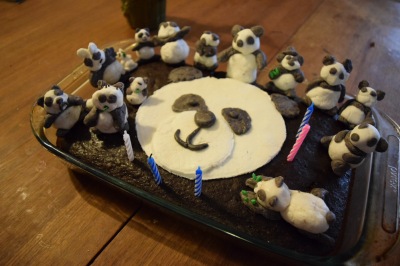
I’ve said before that I’d rather be the mom that does cool and fun stuff with her kids and sometimes yells while doing it than a mom who doesn’t yell, but who doesn’t do cool stuff because she’s afraid she might yell or worse yet, because she doesn’t have any fun ideas. (Of course, an awesomer option, would be to be the mom who does cool stuff and also doesn’t yell, but I’m not holding my breath on that one!) After I constructed the first tiny panda and seeing how cute it was and how excited my daughter was about her cake, I felt such a sense of thrill and triumph. I thought that if I hadn’t decided to do it and make it easier on myself, sure, I wouldn’t have yelled, but I also wouldn’t have felt the empowering sense of having done exactly what I imagined doing. When you do hard things and encounter shadows and keep going and come out the other side, you are strengthened. You learn something about yourself. You realize your own capacities and power. If you are unwilling to embark, you stay safer, and maybe even are a nicer person, but you do not experience the overwhelming satisfaction of accomplishment. The pairing—the difficultywith the triumph—is what makes the journey worth it. This is it, I told my husband, this is The Return. I have returned to my people and I come bearing bears. It feels good to be home.
Each child at her party made a panda to add to the cake.
Molly has been “gathering the women” to circle, sing, celebrate, and share since 2008. She plans and facilitates women’s circles, seasonal retreats and rituals, mother-daughter circles, family ceremonies, and red tent circles in rural Missouri and teaches online courses in Red Tent facilitation and Practical Priestessing. She is a priestess who holds MSW and M.Div degrees and recently finished her dissertation about contemporary priestessing in the U.S. Molly and her husband Mark co-create original goddess sculptures, ceremony kits, and jewelry at Brigid’s Grove. Molly is the author of Womanrunes, Earthprayer, and The Red Tent Resource Kit.She writes about thealogy, nature, practical priestessing, and the goddess at her Woodspriestess blog.
Western Easter has come and gone, and I missed it this year, by design. I went to Athens for the weekend, where Easter this year won’t come until May 1. In the Greek Orthodox Church, Easter is reckoned differently, so that sometimes (like next year) Easter falls on the same date in both faiths and sometimes (like now) the celebrations are several weeks apart.
In contrast to the UK, where Easter now seems to be mostly about chocolate, Easter in Greece is the main festival of the Christian year, much more important than Christmas. Throughout the Lenten period, fasting foods – ‘nistisimo’ – are available everywhere (heaven for vegan visitors).
Caroline Schelling (‘Caroline’) wrote the fourth letter of hers that survives (the ‘4th Letter’) on October 7, 1778, shortly after she had turned 15, to a girl she met at boarding school who was to become her lifelong friend (Luise). The intensity of her friendship with Luise is evident already in the 4th Letter, for she tells Luise that in writing to her she “portrays her entire soul.” What prompted such depth of feeling for this letter relates not just to a significant moment in Caroline’s life but in every person’s life. In the second paragraph she refers to what was most likely her first sexual relationship. Given that context, Caroline demonstrates remarkable emotional maturity and intellectual sophistication in how she expresses herself.
She begins by referring to the “sensations of my heart,” telling Luise how she struggles to find “adequate words” to express them. She is not, she proudly insists, an “enthusiast” who simply gives into feelings, insisting instead on the importance of “going over” (Überlegung) them herself. Though Caroline was not taught Latin, it seems as if she had been taught the relevance to German of aLatin treatise from the 4th century CE on the method for defining words. Caroline’s ‘going over’ her feelings before writing Luise is consistent with its methodology: first, to confront the question of whether something even exists (an sit, Existenz) and then determining, to the extent possible, what it is (quid sit, Wesen) and what its qualities are (quale sit, Eigenschaften)–i.e., its relationship to other words (grammar) and hence how it can be communicated.
This methodology, which is applicable to a wide range of disciplines (e.g., legal argumentation, psychiatric diagnosis), is also analogous to a language theory Charles Segal argued is implicit in what remains of the writings of the 5th century BCE Sicilian Gorgias, a theory Segal related to Sappho’s poetry. That is relevant, because given the failed sexual relationship about which Caroline writes to Luise, the 4th Letter bears comparison to two poems by Sappho (S. 31 andS. 1) that Caroline surely then knew in translation. Caroline’s “sensations of my heart” is directly comparable to the palpitations of the heart Sappho refers to in the second stanza of S. 31. The immediate effects are comparable; Sappho cannot speak and Caroline cannot find “adequate words.” Though S. 31 appears to break off, S. 1 can be read as a continuation of it. There Sappho prays for divine intervention (Aphrodite) to deal with a failed sexual relationship; the closing prayer of its final stanza is analogous to the last sentence of the 4th Letter’s first paragraph: “Lord, you who know my heart . . . fulfill no wishes that are not pleasing to you, I am depending on you!”
In each case it would seem the answer is anticipated to be one that is not heard or read but rather felt in the heart, intuitively understood as the center point of all bodily feelings. That would be not an abstraction from the senses but an inward intensification of them. Such intensification becomes the basis for its outward expression not just in words, but in all forms of art.
Caroline grew up during a time of renewed interest in ancient Greek art and particularly nude sculpture, which rightly can be taken to symbolize the belief in the sacredness of the entire human body (a belief that correlates with heart centeredness). It is notable that the floruit of such sculpture predates Plato by almost a century and quite literally embodies principles utterly antithetical to his philosophy. It is also analogous to another art form that predates him and that he disparaged: reciting poetry (whether or not incorporated into a theatrical production). Poetic recitation requires fully identifying with the poet and poem to such a degree that it can be thought of as internalized sculpting.
The principles underlying sculpture and recitation are thus similar and of general applicability. Caroline, who enjoyed (and was appreciated for) reciting poetry, makes the point in a review she wrote of a book of essays on artistic appreciation (the “Review”). To judge art, she says, it is necessary to penetrate “deeply into the meaning and sensibility of both it and its initiator . . . surrendering oneself in quiet reflection to a disposition of loving, receptive observation . . . [to be] transpose[d] . . . into the world of the poet or artist.” She defends the book’s use of a fictional friar to voice religious reverence for art, effectively equating artistic appreciation with religious devotion, since it is only from feeling the divine within (i.e., internalizing god as the artist) that the divine outside is to be understood.
This was not something new for Caroline, as is evident from the 4th Letter that was written nearly twenty years before the Review. Not only does she seem to have internalized Sappho, but the opening line of S. 31 (a man, “equal to the gods”) and the closing line of S. 1 (“my comrade,” the goddess) arguably encouraged her transition in the 4th Letter’s first paragraph from describing her feelings to Luise (psychology) to praying to God (theology). That transition anticipates the identification of psychology with theology Caroline articulates in the Review.
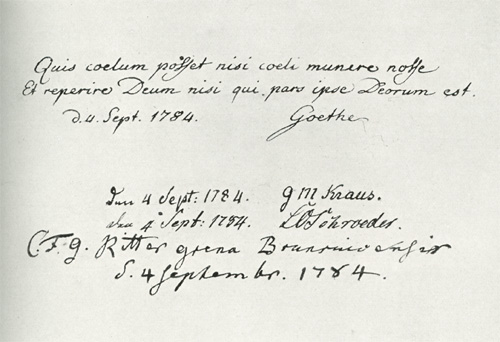
The remote antiquity of this identification and its association with goddess worship to which Sappho attests, as well as the recognition of it by Caroline at such a young age deserve attention, for it has quite a history, especially in German culture. Goethe quoted two lines of a 1st century CE Latin poem on astrology that essentially echo it in theguestbook atop Mount Brocken on September 4, 1784: who is able to know heaven except by a gift from heaven, who finds god unless a part of the godsis within them. It is not known when Caroline met Goethe; it has been speculated that he was the father of her first daughter, Auguste, born April 28, 1785. In August 1784 Caroline was living in a mining town not far from Brocken.
The opening paragraph of an essay published by Caroline’s third husband in 1809, only months before her death, contains a reference to the principle of knowing the god outside from the god within, correctly noting that its connection with Empedocles proves it predates Plato. In 1936 Heidegger characterized that essay as “one of the most profound works” of Western philosophy. In my next post(s) I hope to show that its profundity relates to a critique of Plato (and other philosophers) that derives from Caroline and her appreciation of ancient Greek female spirituality, and not to glorifying supermen.
Stuart Dean has a B.A. (Tulane, 1976) and J.D. (Cornell, 1995) and is currently an independent researcher and writer living in New York City. He has studied, practiced and taught Tai Chi, Yoga and related disciplines for over forty years. Stuart has a blog on Sappho and the implications of her poetry for understanding the past, present and future: http://studysappho.blogspot.com/
Many years ago, in the group of women I work with, we all had a marvelous epiphany. It was spontaneous combustion that fueled our collective desire to learn about the “Nine Maidens.” It was as though some unknown force was driving all of us to seek out and to know.
I would like to share what we collected:
“… My poetry, from the cauldron it was uttered. From the breath of nine maidens it was kindled….”
“… ygkynneir or peir pan leferit. O anadylnawmorwyngochyneuit.”
(Preiddeu Annwn or The Spoils of Annwyn from ‘Llyfr Taliesin’ 9th to 12th c. CE.)
Anadyl = breath
Naw= nine
Morwen= maiden
These lines are from the poem, the Spoils of Annwyn, where Arthur and seven knights raid the rotating island fortress of Caer Sidi in the Otherworld for possession of the Cauldron of the Head. Continue reading “The Nine Maidens by Deanne Quarrie”
Arduinna, Gaulish Goddess of Forests and Hunting is one of the many Celtic Goddesses who is associated with a particular region or body of water. She was worshipped in the heavily forested regions of the Ardennes, located in what is current day Belgium and Luxembourg with small portions found in France and Germany. She was also associated with the Forest of Arden in England. Her name has its roots in the Gaulish word “arduo” meaning “height”.
If you ever eavesdrop on a conversation between my husband and me around the clamor of our four children’s voices, you will probably hear me making a tired lament: “All I want is a broad swath of uninterrupted time.” In listening to Elizabeth Gilbert’s newest book, Big Magic, on audio book I was interested by her mention that many creative people lament not having long stretches of uninterrupted time available in which to work. She quotes a letter from Herman Melville to Nathaniel Hawthorne, lamenting his lack of time and how he is always pulled “hither and thither by circumstances.” Melville said that he longed for a wide-open stretch of time in which to write. She says he called it, “the calm, the coolness, the silent grass-growing mood in which a man ought always to compose.”
…I do not know of any artist (successful or unsuccessful, amateur or pro) who does not long for that kind of time. I do not know of any creative soul who does not dream of calm, cool, grass-growing days in which to work with- out interruption. Somehow, though, nobody ever seems to achieve it. Or if they do achieve it (through a grant, for in- stance, or a friend’s generosity, or an artist’s residency), that idyll is just temporary—and then life will inevitably rush back in. Even the most successful creative people I know complain that they never seem to get all the hours they need in order to engage in dreamy, pressure-free, creative exploration. Reality’s demands are constantly pounding on the door and disturbing them. On some other planet, in some other lifetime, perhaps that sort of peaceful Edenic work environment does exist, but it rarely exists here on earth. Melville never got that kind of environment, for instance. But he still somehow managed to write Moby-Dick, anyhow.
When I create a new sculpture, I am most often creating something that I need to remember or want to learn. The original figures for my Centered Mama sculpture and my Meditation Goddess sculpture were both created while at a friend’s house for a weekend work exchange as my baby toddled around. While I love making figures of mothers and babies, I was feeling a strong urge to make a goddess representation complete unto herself. It felt like a reclaiming of my non-maternal identity and a declaration of self-sovereignty. She turned out a little bigger than some of my other figures, strong and secure and independent. Then, the baby crawled over and knocked off one of her breasts, knocked her over on the tray, smashing the side of her head. I came close to crying. I felt annoyed with my husband who’d “let” him come over and destroy my work rather than noticing him doing it and stopping him. I was frustrated, dismayed, and my feelings felt hurt in a sense. First I felt like, Argh! This is a metaphor for life! And, then I realized it was not just a metaphor for life, it is my actual life! I pouted a bit and said I was just going to smash her and give up and I made some bitter faces at my husband and some long-suffering huffs and signs, but then the baby fell asleep in the Ergo, held close against my chest. I kissed his soft hair and I took my clay and started again. I reclaimed her from the smashed parts and she sat stronger and taller than ever.
She reminds me not to give up and that beautiful work can come from struggle, but also of interdependence (not just the independence I was going for!), co-creation, and tenacity. When the finished version of her, cast from the original sculpt, sits by my bed at night or overlooks my dinner preparations, she reminds me that I am strong and that persistence is worthwhile. She also tries to remind me to be calm and steady, centered and Zen, even though I more often feel like a whirlwind.
That same Saturday at my friend’s house, as my baby tentatively toddled around the kitchen, chewed on a piece of watermelon, and snoozed on my chest, I felt moved to begin creating a new Centered Mama sculpture. I had been going through an emotional rough patch, feeling buffeted by variable emotions and erratic and unpredictable in my enthusiasm and confidence. I was also feeling impatient, snappy, and irritable.
“I will be gentle with myself. I will be tender with my heart. I will hold my heart like a newborn baby child.”
This song by Karen Drucker replayed in my mind as I sculpted. The baby woke, the watermelon got dragged along the floor collecting dust, and it was time for our collaborative dinner, so I had to put her away unfinished. When we got back to our own home, I was compelled to finish her, working feverishly as the baby pulled on my legs and I said, “just a few more minutes!” to the older kids who were trying to play with him to let me work. Again and again I re-rolled the clay baby’s head, trying to make it “perfect,” and worked to lay down the strands of her hair, against of the backdrop of this often-chaotic, noisy, home-based life we’ve consciously and intentionally created together. She was created to represent holding my own center in the midst of motherhood. I will be tender with my heart. I don’t create sculptures like this because I AM so “Zen” and have life all figured out, I make them to remind me what is possible if I listen to my soul.
As I do extensive rearranging, construction, and reconstruction on my slowly ongoing dissertation project, I typed out a quote from the book Priestess: Woman as Sacred Celebrant by Pamela Eakins about her past life memories of making clay goddess figures as a temple priestess:
…to me it brought a continuation of the energy of the sacred objects of the grandmothers. I contained this energy in a new form in the dolls that would be placed upon the altars and in the graves of the daughters living now and the daughters to come…
I felt this process made my own clay stronger, too. Some of the pieces cracked in the fire because of the added ‘impurities’…but, in this case, I felt the impurities were the purest of pure and I worshipped each crack knowing the crack contained the wisdom of the priestesses who had occupied the doll-making table for more moons than I could even imagine. It contained too, the devotional energy of every grandmother who had held it in her hands or placed it on her altar. Sometimes ‘impurities’ sanctify further that which is holy to begin with.
While I tend to have a knee-jerk skepticism about past-life memories, there is something in Eakins’ words that I know at a bone-deep level as I do my own work with goddesscraft:
…Each goddess was imprinted with the sound of sacred life coursing through the Universe. I changed with the priestesses as the figures came through my hands. Each doll received the sacred vibration of life…For seventy-seven moons I made the dolls at the long table with the young Sisters of Nun. My hands were so fast. I made thousands of figures: beautiful little faces, etched collars of gold plates, pubic hair swirled into tiny rows of connecting spirals. They were so precious. At the end of the day, my baked clay shelves were covered with little women.
The clay goddesses healed…
This is how I apprenticed. I learned, in this manner, the art of healing. I learned that to heal means to make whole, and that becoming whole involves learning many levels of purification, balance, and reformation” (p. 32-33).
In Anne Key’s marvelous priestess memoir, Desert Priestess, she makes this important point: “It is of course no small wonder why graven images are so tightly controlled by religious traditions.” (p. 52) Sometimes I feel like this is what I’m tapping into when I make my own goddess sculptures—a resistance to tight control over graven images and over personalization of divinity as male.
I occasionally get requests to make bigger goddesses–-people ask about figures that are large altar pieces 12-18 inches tall or taller. The goddesses I make are all about three inches tall and there’s a reason for that: they fit in the palm of my hand. When I create them, I feel as if I’m part of an unbroken lineage stretching back 30,000 years to the person who carved the Goddess of Willendorf. I feel connected to the priestesses of the Mesopotamian temples who sculpted hundreds upon hundreds of tiny clay goddesses. Someone commented on my sculptures once saying, “echoes of Mesopotamia.” And, I said, “exactly.” I feel the connection between the clay in my hand and the clay in their hands, running through the ripples and eddies of time.
I’ve been inspired recently to re-read Starhawk’s The Spiral Dance, finding new bits of wisdom from it that speak to something different in me than they did the first time I read it. She writes of the attempts to discredit Goddess religion by invalidating the historical narratives or archaeological evidence: “The idea seems to be that if they can disprove our origin story, they can invalidate our spirituality…Is Buddhism invalid if we cannot find archaeological evidence of Buddha’s existence? Are Christ’s teachings unimportant if we cannot find his birth certificate or death warrant?…the truth of our experience is valid whether it has roots thousands of years old or thirty minutes old…a mythic truth whose proof is shown not through references and footnotes but in the way it engages strong emotions, mobilizes deep life energies, and gives us a sense of history, purpose, and place in the world. What gives the Goddess tradition validity is how it works for us now, in the moment, not whether or not someone else worshipped this particular image in the past” (p. 4).
The ancestry of my goddess sculptures may not be the same energy that raised temples and built monuments (or walls), it is the energy that carried a baby on one hip and a basket of supplies on the other and needed a goddess just the right size to tuck down the front of a shirt…
Sometimes I describe my life in the woods as being held in the hand of the goddess. And, I make goddesses that I hold in my hand. Am I in the palm of her hand or is she in the palm of mine? The answer is both.
(One of my all-time favorite fan photos–a rainy day traveling goddess picture, taken by my friend/SIL (this one is only an inch tall, but look how she calls in the waters of the world!)
Molly has been “gathering the women” to circle, sing, celebrate, and share since 2008. She plans and facilitates women’s circles, seasonal retreats and rituals, mother-daughter circles, family ceremonies, and red tent circles in rural Missouri. She is an priestess who holds MSW and M.Div degrees and she is finishing her dissertation about contemporary priestessing in the U.S. Molly’s roots are in birth work and in domestic violence activism. She has worked with groups of women since 1996 and teaches college courses in group dynamics and human services. Molly is the author of Womanrunes: a guide to their use and interpretation, Earthprayer, Birthprayer, Lifeprayer, Womanprayer, and The Red Tent Resource Kit, as well as three social service oriented booklets and a miscarriage memoir. She has maintained her Talk Birth blog since 2007 and writes about thealogy, nature, practical priestessing, and the goddess at her Woodspriestess blog. Molly and her husband Mark co-create original birth art, goddess sculptures, ceremony kits, and pendants at Brigid’s Grove.
I started this post just after getting back from an India trip, always very challenging because of memories that haunt me not only through their high negative recall value, but also in that I often find myself reverting to the diffident, fearful person I used to be while living there. In fact, palpitation is the first to greet me at Bombay airport even now after nearly seventeen years of being an expat. But with every trip, I also find myself evolving as a person, as a woman. And of course, it is always fun to meet up with family and old friends, all of whom I hold very dear. But the highlight of this trip was Queen.
Queen is a Bollywood movie unlike any other I’ve seen. As mentioned in a previous post, B-wood cinema if you can call it that, is made mostly of predictable, formulaic themes centering on impossible flights of fancy, not-so-subtle patriarchy, and gendered stereotypes. The good news is that in recent years, film makers have been trying to push boundaries in their own small ways, no doubt a laudable attempt in an industry where success still depends on mass consumption; box office success over critical acclaim. Queen, however, stands out in its portrayal of the protagonist Rani Mehra, a middle class young lady from Delhi (“rani” is “queen” in Hindi). Even more remarkable is that it portrays Rani’s female friends – “scantily” dressed women and prostitutes – without judgment, as human beings who are far from detrimental to Rani or the plot. Continue reading “I Am Queen by Vibha Shetiya”


 In a previous post on FAR I explored Greek Easter customs which interweave Christian and pre-Christian beliefs. Today I would like to take a closer look at one of these customs, the women’s ritual dance known as Tráta, ceremonially performed on ‘Bright Tuesday,’ the Tuesday after Easter. Versions of Tráta survive in the towns of Mégara and Elefsina just west of Athens, on the island of Salamína directly across from them, and in the surrounding area as far as Thebes.

 As I mentioned in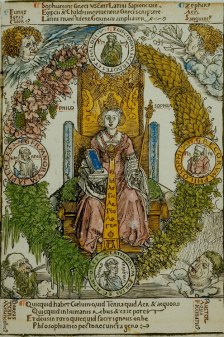
 Niamh (meaning ‘bright’ or ‘radiant’) of the Golden Hair, one of the Tuatha de Danann and daughter of Mannanan mac Lir, Celtic God of the Sea, was Queen in the land of Tír na nÓg (pronounced Tear na Noge), the most famous of the Celtic Otherworlds.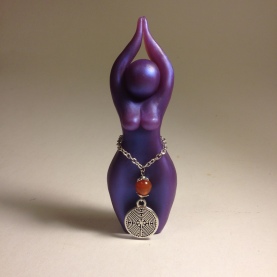
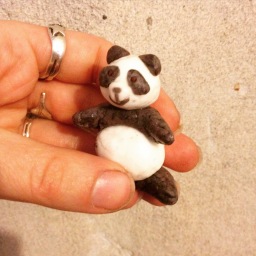 goal: to make little fondant pandas for her birthday cake. I began with my two pounds of powdered sugar, my melted marshmallows, and my all-natural $12 jar of black food pigment. As I kneaded and kneaded the stiff and difficult dough, my journey became more arduous. I ended up yelling at my lovely children who were leaning over my shoulders to watch the adventure unfold. I said, “just get out of the kitchen!” to the birthday girl herself and I hollered for my now 12 year old to come peel the one year old away from my legs as he attempted to scale my body and reach my arms while my hands were covered with black-icing cement. I ranted and raved briefly about how this is an example of my own life-long tendency to overdo and overperform. Making these pandas wasn’t necessary. I do it to myself. Why do this to myself, I lamented over and over. What is the point? What am I teaching my kids—the cost of having fun and doing something nice and neat for each other is yelling and feel strained and tense? What didn’t I just buy lard-frosting, I lamented (meaning slimy hydrogenated oil frosting from the store). Why aren’t we eating Chicken McNuggets and a cake from Wal-Mart right now? Wouldn’t that be better than yelling at my kids and forcing myself to spend hours kneading panda dough? Shouldn’t we just eat frozen taquitos and watch TV all day and never, ever invite anyone to come to a birthday party ever again?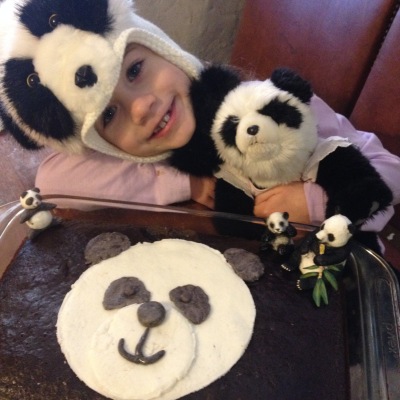

 Western Easter has come and gone, and I missed it this year, by design. I went to Athens for the weekend, where Easter this year won’t come until May 1. In the Greek Orthodox Church, Easter is reckoned differently, so that sometimes (like next year) Easter falls on the same date in both faiths and sometimes (like now) the celebrations are several weeks apart.
 Stuart Dean has a B.A. (Tulane, 1976) and J.D. (Cornell, 1995) and is currently an independent researcher and writer living in New York City. He has studied, practiced and taught Tai Chi, Yoga and related disciplines for over forty years. Stuart has a blog on Sappho and the implications of her poetry for understanding the past, present and future:
 “If there is one chant in the universe it is to create.”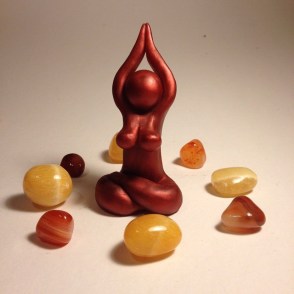
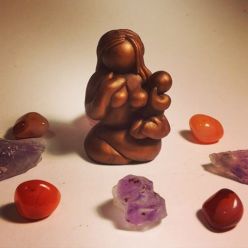
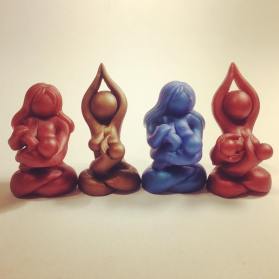
 inches tall or taller. The goddesses I make are all about three inches tall and there’s a reason for that: they fit in the palm of my hand. When I create them, I feel as if I’m part of an unbroken lineage stretching back 30,000 years to the person who carved the Goddess of Willendorf. I feel connected to the priestesses of the Mesopotamian temples who sculpted hundreds upon hundreds of tiny clay goddesses. Someone commented on my sculptures once saying, “
 I started this post just after getting back from an India trip, always very challenging because of memories that haunt me not only through their high negative recall value, but also in that I often find myself reverting to the diffident, fearful person I used to be while living there. In fact, palpitation is the first to greet me at Bombay airport even now after nearly seventeen years of being an expat. But with every trip, I also find myself evolving as a person, as a woman. And of course, it is always fun to meet up with family and old friends, all of whom I hold very dear. But the highlight of this trip was Queen.
 Feminism and Religion