“You may not remember, 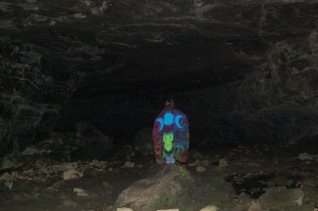
but let me tell you this,
someone in some future time
will think of us.”
—Sappho
I put on my boots and jeans, grab my priestess robe, pack a basket of ritual supplies, and meet four close friends in a nearby cave. We feel a little nervous about holding ritual on unfamiliar land, but we decide to push our boundaries and do it anyway. The land needs us, says my friend. The other people who come here are meth-heads and vandals.
We take our drums and climb to the top of the cave, singing as we find our way up the steep hillside. On top, looking out across the country, we sing: cauldron of changes, feather on the bone, arc of eternity, ring around the stone. We laugh and practice some more songs, some hearty, some tentative and new. We tie up small bundles of our symbolic burdens with stones and let them down over the edge
 using handspun wool yarn until the yarn releases, taking our burdens with them. Suddenly, we hear the sound of tires on the gravel. Slamming doors. The sound of loud men’s voices. The smell of cigarette smoke. A ripple of uncertainty passes through us. We are once again tentative and we feel a current of unease. What should we do? we whisper to one another. The voices draw nearer, there are calls and hoots. My friend looks at me and says: this is where we make our stand. We hold hands in a line at the edge of the cave roof, gazing out into the horizon. A hawk wheels overhead. We sing. The approaching voices quiet. We sing louder.
I am a strong woman, I am a story woman, I am a healer, my soul will never die.
We project our voices and yell: we are the witches, back from the dead!
The voices stop. We wait. We hear doors slamming. The sound of tires on gravel. We are alone once more.
We descend into the cave singing a song composed on the spot: Deeper, deeper. We’re going deeper. Deeper, deeper. Deeper still.
We strike a pose based on the carvings described in the classic book, When the Drummers were Women. Archaeologists described 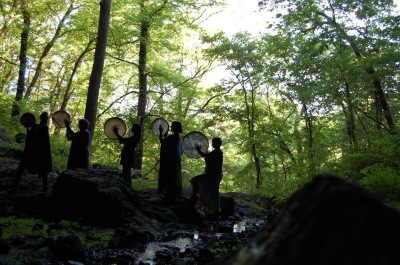 carvings of priestesses carrying drums as, “women carrying cakes to their husbands.”
We shout: “we’re not carrying cakes!”
I stand on a rock in the center of the cave and sing: she’s been waiting, waiting, she’s been waiting so long, she’s been waiting for her children to remember to return. My friends join the song and we move deep into the darkness where we face the “birth canal” at the back of the cave, listening to the small stream within trickle, laugh, and bubble as it emerges from the dark spaces deep within the heart of the earth. We begin to sing:
Ancient mother we hear you calling. Ancient mother, we hear your song. Ancient mother, we hear your laughter…
Just as we sing the words, ancient mother, we taste your tears, droplets of cave water fall on our faces, splashing our eyelids.
It might seem simple on the surface, but gathering the women and calling the circle is a radical and subversive act. A revolutionary act. In my work with women’s circles and priestessing, I am repeatedly reminded that gathering with other women in a circle for ritual and ceremony is deeply important even though it might just look like people having fun or even being frivolous, it is actually a microcosm of the macrocosm—a miniature version of the world we’d like to see and that we want to make possible.
In the book, Casting the Circle, Diane Stein observes that women’s rituals, “…create a microcosm, a ‘little universe’ 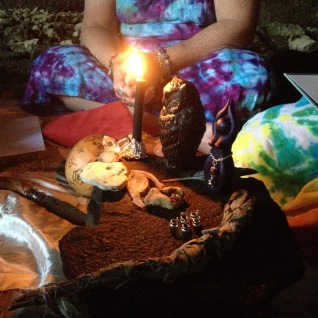 within which women try out what they want the macrocosm, the ‘big universe’ or real world to be. Within the safety and protected space of the cast circle, women create their idea of what the world would be like to live in under matriarchal/Goddess women’s values…The woman who in the safety of the cast circle designs the world as she would like it to be takes that memory of creation and success out into daily life…By empowering women through the microcosm of the ritual’s cast circle, change becomes possible in the macrocosm real world.” (p. 2-3)
It starts with these private ritual and personal connections and then, as Stein explains, “A group of five such like-minded women will then set out to clean up a stream bed or park in their neighborhood; a group of twenty-five will join a protest march for women’s reproductive rights; a group of a hundred will set up a peace encampment. The numbers grow, the women elect officials to government who speak for their values and concerns. Apartheid crumbles and totalitarian regimes in Eastern Europe end, disarmament begins, and laws to control polluters are enforced. Homes, foods, and jobs are opened to the world’s homeless, and often begins in the microcosm of the Women’s Spirituality ritual circle” (p. 3)
“Feminism catches fire when it draws upon its inherent spirituality. When it does not, it is just one more form of politics, and politics never fed our deepest hungers.”
–Carol Lee Flinders (in The Millionth Circle)
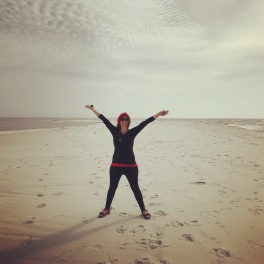 Molly has been “gathering the women” to circle, sing, celebrate, and share since 2008. She plans and facilitates
women’s circles, seasonal retreats and rituals, mother-daughter circles, family ceremonies, and red tent circles in rural Missouri and teaches online courses in Red Tent facilitation and Practical Priestessing. She is a priestess who holds MSW, M.Div, and D.Min degrees and finished her dissertation about contemporary priestessing in the U.S. Molly and her husband Mark co-create Story Goddesses, original goddess sculptures, ceremony kits, and jewelry at Brigid’s Grove. Molly is the author of Womanrunes, Earthprayer, and The Red Tent Resource Kit and she writes about thealogy, nature, practical priestessing, and the goddess at Brigid’s Grove.


 On the morning of January 20, 2017, the world watched Donald J. Trump stand on Capitol Hill for inauguration as the 45th president of the United States. He did not stand alone. Timothy Michael Dolan, Catholic cardinal and archbishop of New York, also stood, and he invoked the divine feminine as he opened the inaugural ceremony with a recitation of King Solomon’s prayer from the Book of Wisdom.
 As we wander together through the maelstrom of our world today, trying to keep our eyes open, our voices firm and truthful, our feet bravely taking one step and then another, may we reclaim our gift of future-envisioning boldly, outrageously, and together as a global community. In perilous times we may think that envisioning a future that may never be is a waste of time and energy. When we look into the future and see only uncertainty, we may no longer be sure that the kind of world we have been working towards for decades could ever exist.
 This is a great day for me as I announce the publication of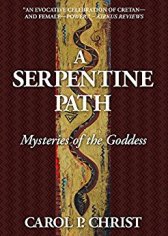
 There is a Greek myth that tells there were fourteen “halcyon days” in every year, seven of which fell before the winter solstice, seven after; peaceful days when the sea was smooth as a pond and the hen-halcyon built a floating nest and hatched out for her young.
 living with your feelings, touching the earth, and embracing the fullness of your humanity.”
 In this building I write, work, create, and hold small rituals with a circle of friends. I call it my Tiny Temple and it is the proverbial, “room of one’s own” described by Virginia Woolf in 1929. Having a dedicated work and ceremony space in the midst of a home-based life, which includes a home business shared with my husband, and four homeschooled children, has changed my life profoundly. In the tiny temple, I feel most wholly myself: connected, powerful, free, authentic, and completely alive.
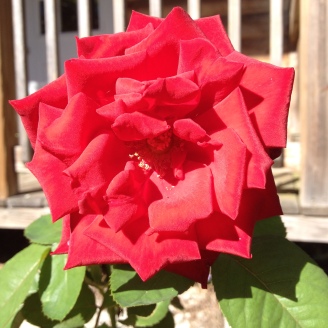 “We may need to be cured by flowers.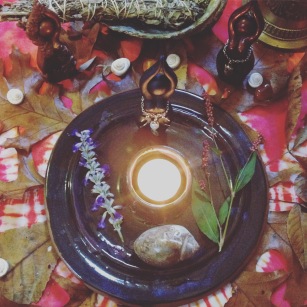
 The Celts were fascinated by the number three – triple designs, images and triadic ideas. The Goddesses and Gods who related to the mysterious rather than the mundane nature of life were always worshiped in threes. Unlike the Greek triple goddesses who represent the maiden, mother and crone, the Celtic triadic deities reveal the mysterious, unexplainable aspect of nature and human existence. These triple Goddesses are doorways into the unknown and unknowable.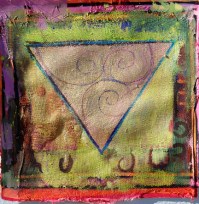
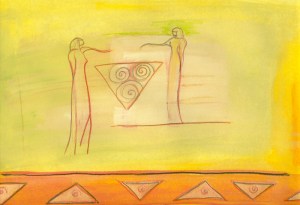
 cycle of birth, death and rebirth. Anu is the source, Danu is the movement and Tailtiu is the endurance inherent in this cycle.
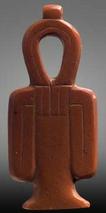 Friday night, I served as co-priestess in the opening rite which amazingly elevated every woman there. We called the Quarters, invoked the Elements and tied the Knot of Isis, with nine-foot-long, red sashes, on to bamboo poles cut with a cross bar, made to resemble ankhs. Each woman invoked her Element and the Power and Magic of Isis to guard and protect the space where we were gathered. We then called to Isis to join us. With doumbeks playing, Isis – yes, a real live Isis – walked into our Circle. She had two escorts who assisted Her up onto a platform where She spoke to everyone present.
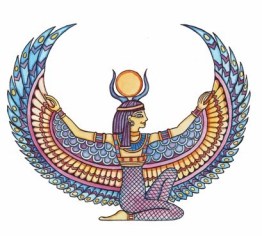 She was dressed, as you can imagine, in Egyptian robes with Her regal crown of horns and sun. On Her arms were Her beautiful wings. They were made by sewing men’s ties together with the small ends flapping in the breeze at the back. They stretched from Her shoulders to Her finger tips. Every woman and maiden there was able to come forward to receive a blessing from Isis. Many were enfolded in Her wings. Our Isis was a beautiful African American woman with long black hair, braided in knots. She completely embodied the spirit of Isis. This was her first time to ever come to a Goddess festival and I am sure when she agreed to her role in the ritual she thought it was going to be like a theatrical performance but she truly aspected Isis. It was amazing. I talked to her later and she told me that she never anticipated the intense emotional experience she had.
 My own part, in addition to what I did on-site, was to take all incoming email messages with questions and respond with answers. I organized the first Crone Camp ever. We offered a tent already in place as well as cots to sleep on. It was the first time since we moved from Stonehaven that beds were offered. Our Crone Guardians helped by erecting and taking down our large tent. They were also there to help when needed. I also got to be the one who took care of all the women seeking scholarships. I told everyone that I definitely had the best job in the Planning Circle as I got to speak to so many marvelous women! I came home with new friends and a happy glow from being surrounded by so much love.
