Every year when the cherries, pears, plums, and apple trees begin to bloom, I go out walking. I look for every spot in my vicinity where white and pink blossoms are blooming in exquisite profusion like foam on an ocean. Every year I take photographs, even though I already have so many. I walk at every hour of the day because, as the light changes, the colors change. I have albums and albums of pictures of my beloveds, the trees.
For me, the apple and cherry trees are a manifestation of Goddess. Of course, everything is a manifestation of Goddess, but these, for me, have an extra measure of that life-giving beauty and abundance I associate with the indwelling Presence in the cosmos. My enjoyment of the blossoms is both a sensual appreciation of the gorgeousness of Being and a poignant awareness that they will not last forever. Sometimes these glories manifest for me as feminine, sometimes as masculine, and sometimes just as Life itself.
Image of Arawello. Since there is no known portrait of Arawello, this is an artist’s interpretation.
I did not intend to find her. In fact I wasn’t even looking. But there she was, soaring before me, on my last night in Baidoa. This majestic Somali woman reached high into the heavens, engulfed in a glorious wraparound garment that reflected the hues of the world around her: the azure of the Indian Ocean, white sparks of the splendiferous Milky Way, the orange of the clay soil beneath her feet.
The golden snake wrapped around her arm identified her immediately. This was Arawello, the Somali Goddess.
I had only heard hints of this treasured goddess. She was born of her people in the first century. She took the beatings, the whips that scarred her as a child, and escaped to the aromatic fields of myrrh in the northern Somali mountains. Female torture was rampant at that time, an outgrowth of the centuries-old clan wars.
In the fields of myrrh Arawello found many women like herself, women who ran to save their own lives, women who wanted to help their sisters, mothers, aunts and friends left behind.
Let me share with you the Goddess most honored as the Goddess of liminal time and space. It is our beloved Hekate, Great Goddess of the Three Ways, bridging Earth, Sea and Sky as we travel between worlds.
In modern times, She is seen by many as a “hag” or old witch stirring the cauldron. This idea was popularized by Roberts Graves’ book, The White Goddess. In early writings, however, she is portrayed as a beautiful and powerful maiden goddess.
“I come, a virgin of varied forms, wandering through the heavens, bull-faced, three-headed, ruthless, with golden arrows; chaste Phoebe bringing light to mortals, Eileithyia; bearing the three synthemata [sacred signs] of a triple nature. In the Aether I appear in fiery forms and in the air, I sit in a silver chariot.” (Chaldean Oracles)
She was the only one of the ancient Titans that Zeus allowed to retain her power after the Olympians seized control. She shared with Zeus, the awesome power of granting all wishes to humanity (or withholding, if she chose).
In March, my husband drove our daughter into town to work at her Girl Scout cookie booth and released me to prepare for an all-day Red Tent retreat for my local women’s circle. After I packed my supplies for ritual, I set off on a walk in the deepening, rain-dark twilight. As I walked, I sang a song of sanctuary over and over, until I felt transported into a different type of consciousness, my feet steady on muddy gravel, the leafless branches stark against grey sky, moss and stones gleaming with sharp color against the roadside. A fallen tree absolutely carpeted with enchanting mushrooms caught my eye and invited me off the road and into its arms. As I stood there, feeling as if I had stepped out of ordinary reality and into a “backyard journey,” the spring peepers in the ephemeral pool in our field began their evening chorus. It has been so cold out with below freezing temperatures, snow, and ice for days since first hearing them in early March that I actually wondered if they would survive to continue their song.
Yesterday I dreamed that I discovered a bird’s nest that was hidden in the center of an evergreen tree. This little dream moved me deeply because this is the time of year I celebrate my love and gratitude for all trees, but especially evergreens, and the dream felt like an important message. For me in winter, the “Tree of Life” is an evergreen.
Outdoors, I recently placed a glass star in the center of my newly adopted Juniper here in New Mexico, repeating a pattern that began in Maine years ago with my Guardian Juniper in whose center I also placed a star…Inside the house an open circle created out of a completely decayed tree trunk sits at the center of my Norfolk pine; around the room spruce, juniper and pinion boughs are twinkling with miniature lights. The tree has a festival of lights at her feet. The point of making these gestures is to keep me mindful that tree bodies are sacred in their wholeness and each tree explicates the immanence of divinity. Another way of saying this is to say that Natural Power lives in trees. This goddess is steadfast. Continue reading “For Love of Trees by Sara Wright”
We’re nearly a week into the new year. I almost wish I were a prophet and could predict with assurance that 2019 will be better than 2018—less filled with hate, name-calling, lies, and all-round trumpery (pun intended: “trumpery” is “worthless nonsense”).
When I wrote my daybook, Pagan Every Day, here’s how I began today’s essay:
The Saxons of northern Europe called the first Monday after January 6 Plough Day and honored Freya, “the Venus of the North.” As a goddess who engages in indiscriminate sex, Freya is the spirit of the earth’s fertility. Like Persephone, she is in the underworld during the winter, but early in January we already see hints that she might be rising. We’ll soon set our ploughs into the earth and plant our crops.
Yeager Empress
We can think of planting our crops in both literal and metaphorical ways, but my best guess is that we’d best think of them metaphorically, at least in the so-called developed world, because our part of the world is mostly urban now and if there’s literal planting, it seems to be mostly done by agribusiness. If we’re not farmers literally broadcasting seeds, how do we plant metaphorical crops for 2019?
We can start with numerology, which I studied back in the early 1980s about the same time I was reading books on metaphysical and occult topics, learning the tarot, and reading every book about the Goddess I could find. (There were already lots of them.) As you no doubt know, numerology is based on the meaning of numbers. Whether we’re working with a name, a birth date, or a situation, we use a chart (which you can find online) to convert letters to numbers, then we add the numbers and reduce them to one number that becomes a kind of prediction. It’s important to remember, of course, that true divination does not forecast a fixed and permanent future. Instead, it notes what is likely to happen if things keep going along the path they’re on.
According to my numerology teacher, 1 means creation and individualization; 2 means love, gentleness, service, harmony; and 3 means self-expression, personal creation, optimism, inspiration. One is also the beginning of a new cycle (year, life, experience, adventure), and 9 is “complete expression,” or the end of a cycle, life, experience, or adventure. It’s interesting that 9 + 1 = 10 = 1. The end always leads to what we call a new beginning.
So let’s do some numerology with 2019. We add the numbers and reduce them to one number that will characterize the year: 2019 = 2 + 1 = 3 + 9 = 12 = 1 + 2 = 3. This means that 2019 is a “3 year,” which can (and may) lead to self-expression, optimism, inspiration, talent, sociability, friendliness, and kindness. (Note that there are two 3’s in the calculation; maybe they reinforce the idea of 3-ness.)
Self-expression, optimism, etc. are good crops to be planting this month! These are crops that need to be growing here. If we think politically, as so many of us have been doing for two years, we can hope that the new diverse and Democratic majority in the House of Representatives will grow and harvest these crops and bring an end to trumpery. What do you think might happen this year? Where are these metaphorical crops best planted? How will we feed and fertilize them? How and where will they grow?
Motherpeace Empress
Several years ago, I moved into what I call tarot numerology. Our new year’s 3 corresponds to Card III of the major arcana: The Empress. You know of course that there’s a nearly infinite number of decks with their own illustrations, but most of them show Card III as The Empress. She is the Earth Mother, Mother Nature, the Great Goddess. My tarot teacher said The Empress advises, among other things, “as above, so below,” and when we get The Empress in a reading, she’s usually telling us that new things will be born, there will be productivity and creativity, there will be good crops.
Gaian Tarot Gardener
Our reading of 2019, therefore, is that we are possibly entering a new year of good crops—those metaphorical ones I listed earlier: self-expression, optimism, inspiration, talent, sociability, friendliness, and kindness. A couple months ago, we elected 100 women to a U.S. Congress that is more diverse than any Congress has ever been before. Can these women, perhaps individually, more likely collectively, embody the Goddess?
Rider-Waite-Smith Empress
I’m going to stop writing now because I want you all to finish this post for me. Give me—give us—your ideas and plans for planting new crops in 2019. How can we bring self-expression, optimism, inspiration, talent, sociability, friendliness, and kindness into our weary society? We can keep voting, of course, but what else? Organizing? Marching? Writing? Please think about this new year and then tell us what you’re thinking. What’s gonna happen??
Note: The cards are from the Tarot of Meditation, drawn by Marty Yeager; the Motherpeace Tarot, created by Karen Vogel and Vicki Noble; the Gaian Tarot, drawn by Joanne Powell Colbert; and the Rider-Waite-Smith Tarot, drawn by Pamela Coleman Smith (who did not receive any credit for her work for nearly a century. Oh, look—it’s the patriarchy in action again).
Barbara Ardinger, Ph.D. (www.barbaraardinger.com), is a published author and freelance editor. Her newest book is Secret Lives, a novel about grandmothers who do magic. Her earlier nonfiction books include the daybook Pagan Every Day, Finding New Goddesses (a pun-filled parody of goddess encyclopedias), and Goddess Meditations. When she can get away from the computer, she goes to the theater as often as possible—she loves musical theater and movies in which people sing and dance. She is also an active CERT (Community Emergency Rescue Team) volunteer and a member (and occasional secretary pro-tem) of a neighborhood organization that focuses on code enforcement and safety for citizens. She has been an AIDS emotional support volunteer and a literacy volunteer. She is an active member of the Neopagan community and is well known for the rituals she creates and leads.
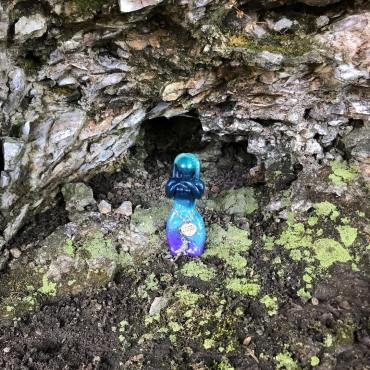
Since I wrote “Claiming the Power to Choose to Our Lovers” and “Choosing to End Love” in the spring, my beloved and I came back together and parted again, not once, but twice. At the end of the summer, believing our separation to be final, I decided to drop a miniature copy of the Minoan bee pendant, symbol of my desire to “let go of a beautiful dream,” into a crevice in the Skoteino Cave while on the Goddess Pilgrimage to Crete.
I don’t believe in divine intervention, but something happened to stop me. The day before the ritual, the pendant disappeared. It was not in my jewelry case, not in my handbag, not anywhere in my suitcase or my hotel room: it was nowhere to be found. That same day I received a gift of a large jar of honey from a local shopkeeper. In the end, I dropped a sugar-coated almond into the crevice and poured every bit of the honey onto the altar of the cave, asking for transformation and love. Continue reading “The Lost Is Found by Carol P. Christ”
Once I became a mother I found the demands as well as my own expectations for holiday gifting, decor and celebrations to be SO taxing that I quickly felt a bit of resentment toward Santa Claus for getting all of the credit. Now I tell my children that Santa Goddess is posing as homekeeping MRS. CLAUSE and that SHE and the elves do all of the work, and that “Santa” is merely their courier. Engulfed in modern society, I don’t think my young children hear me as they still dance with glee at any mention of Santa Claus.
Even though Jesus was born during the reign of Augustus, first Roman emperor, the empire didn’t celebrate that birth until three centuries later when his birth date was moved to mid-winter to match the birth date of the sun god Mithra. The Romans already had a long tradition of celebrating the winter solstice. This celebration was called the Saturnalia. Here are three days in December, taken from my daybook, Pagan Every Day. (When I wrote this book in 2003, I wrote longer days. The publisher demanded that I reduce every day to 300 words. I edited them all down to 301 words.)
December 17: Saturnalia begins
Saturn, who was conflated with the Greek Titan, Cronus, was an ancient Latin agricultural god whose name may derive from satur, “stuffed,” or sator, “a sower”; in either case he stands for abundance. He was a working god who oversaw viniculture and farming, the king of Italy during the golden age. When Jupiter conquered him, he hid himself (latuit) in the region that came to be called Latium. The Romans said Saturn’s body lay beneath the Capitol in Rome. Because his reign brought prosperity to the city, the state treasury and the standards of the Roman legions were kept in his temple when the army was at home. Saturn’s statue was bound in woolen strips to keep him from leaving Rome.
In the earliest of times, I believe humans did not see themselves as separate from all that was around them. All of life was interdependent. I see this in my own practice today. When we are born, we are born to a mother. Our lives are solely dependent on her for survival. We are birthed by her, nourished by her, protected by her, and sometimes forced out to experience on our own, by her. She is at first, our own Original Uncultured Mother. Once we move from her shelter, we begin to experience our world in the same way, looking not only for what nourishes, what protects and what shelters, but also for what we need to be mindful of for our own safety, those forces far out of our control. Those forces, which were uncontrollable, the ancients held in high esteem, and honored with reverence.


 Every year when the cherries, pears, plums, and apple trees begin to bloom, I go out walking. I look for every spot in my vicinity where white and pink blossoms are blooming in exquisite profusion like foam on an ocean. Every year I take photographs, even though I already have so many. I walk at every hour of the day because, as the light changes, the colors change. I have albums and albums of pictures of my beloveds, the trees.

 “Please prepare me
 Yesterday I dreamed that I discovered a bird’s nest that was hidden in the center of an evergreen tree. This little dream moved me deeply because this is the time of year I celebrate my love and gratitude for all trees, but especially evergreens, and the dream felt like an important message. For me in winter, the “Tree of Life” is an evergreen.
 We’re nearly a week into the new year. I almost wish I were a prophet and could predict with assurance that 2019 will be better than 2018—less filled with hate, name-calling, lies, and all-round trumpery (pun intended: “trumpery” is “worthless nonsense”).


 Since I wrote
 Feminism and Religion