Hope: What is a heart transplant if not hope? In granting the possibility of new life out of death, it is the essence of hope. Yet, hopefulness is also knowing death is imminent and finding a way to live well into that knowledge. The impulse of hope encourages us to go on despite the odds. Hope indeed seems to spring eternal. In my darkest days, something would come along and lift me up. Hope is a testimony of the human spirit, lifting us up, refusing to refuse us. This new heart brought hope to me, and I believe that in our going on together, we carry the hopes of my donor’s loved ones as well.
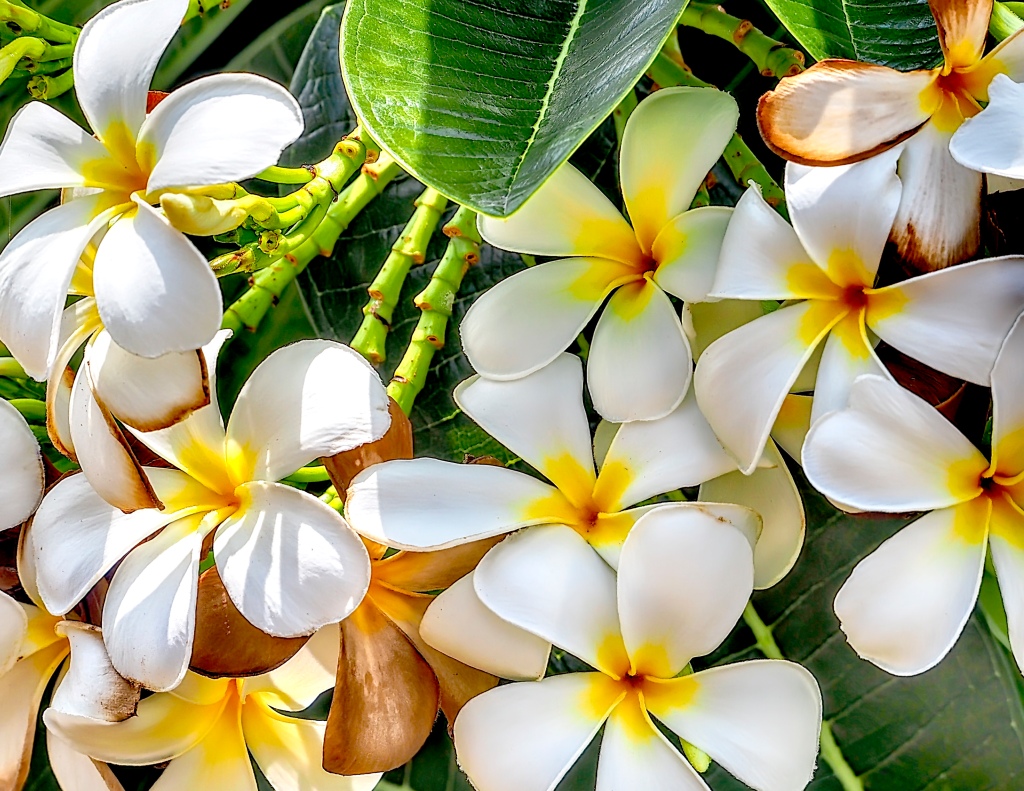
Plumeria, one of the fragrant flowers often used in leis.
While my experience of Hawaiian spirituality isn’t explicitly feminist, I am attracted to it because of its loving and gentle nature. It doesn’t feed the patriarchy. It is a philosophy that doesn’t use dogma but rather principles. It doesn’t work as a top-down power system but rather as an internal power extending to the external world. This is reflected in one of our principles: “all power comes from within.”
I was ordained as an alaka’i (spiritual guide) in October 2016 by Serge Kahili King the founder of Aloha International. He teaches Hawaiian Adventure Shamanism or Huna for short. Huna means secret. It isn’t a secret in the sense of something that can’t be shared but rather something that is esoteric or hard to see. You can think of it like the mists of the sea, hard to distinguish and even harder to hold on to. But all real nevertheless.
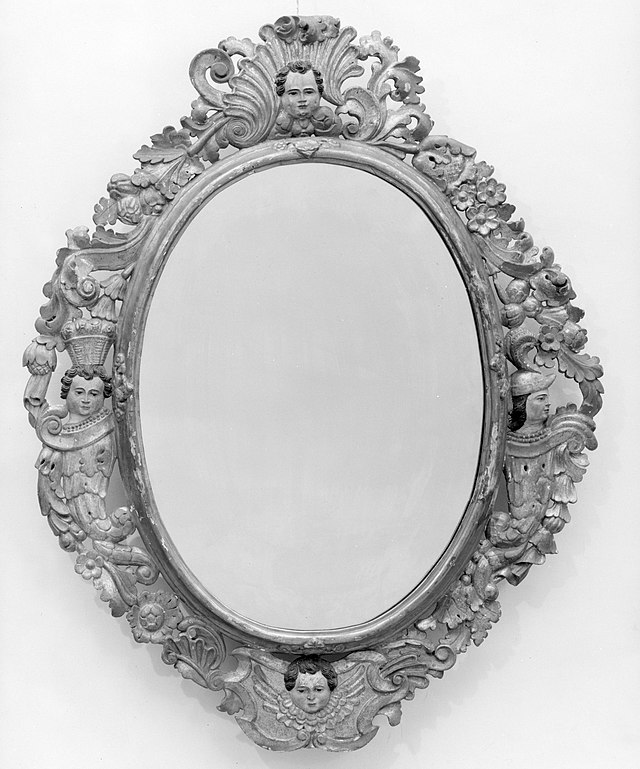
Once upon a time there was a person who only saw themselves in the mirror—even if someone else was passing by in the background, and they certainly never saw the shadows of all the people who had helped them in their life swimming in their eyes. That’s the way it is sometimes—we just don’t see what we don’t want to see.
And every day this person would look into the mirror, adjust their hair or their jewelry or their collar and then go off to work—never seeing anyone besides themselves.
Until one day they fell. The fell hard over a “stupid, goddamn tree trunk root that some goddam someone should have cut or shaved or done something with –goddamn it.” They said a version of this over and over on their way to the hospital.
And because of that they had to be fed by a nurse. And they had to have their bandages changed. And they had to have a cast put on—several. And they had to have a lot of things happen because it had been a nasty fall and they broke both wrists and their right leg.
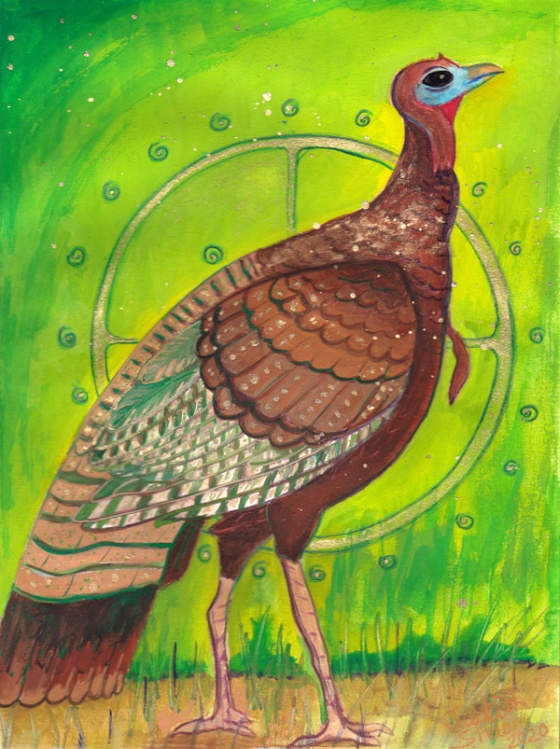
In the United States turkeys are equated with Thanksgiving. But there is so much more to Turkey – a gentle creature who forms strong attachments. Reputed to be dumb, Turkey is in fact quite intelligent and curious, with the ability to solve problems. Turkeys have an excellent understanding of the details of their location which makes them so successful at feeding themselves. They also love to play and to cluck along with music.
photo by Tony Castro
Turkeys, indigenous to North America, evolved over 20 million years ago and share a common ancestor with grouse, pheasants and other fowl. Two species of wild turkey exist today – the wild turkey of eastern and central North America of which there are 5 sub-species and the ocellated wild turkey of the Yucatan.
Yet why is turkey named turkey? Strangely enough it was a mistake. English colonial settlers thought turkeys were a type of guinea fowl which England imported from Turkey – thus the name. The Spanish word for turkey is guajolote which is derived from the Nahuatl (Aztec) name huexolotl.
The forest is bursting with berries, blue lily beads are just one of a multitude of seeds…Astonishing pearl bells adorn mounds of shining wintergreen that shimmer across the forest floor. Soon those berries will blush, bead up, cry scarlet. Three leaved trillium wear peaked red caps. Deep orange bunchberry clusters surprise the unwary -who is expecting this bountiful feast on a woodland floor? Partridgeberry beads are lime green except for those from last year. Soon too these will be adorned in flaming berries that will last all winter… I’m waiting for the cucumber plants to show their colors. Lemon lime whirls catch the slightest breeze. Cattails, and milkweed pods are sending puffs of cotton on the wings of the slightest breeze. Bull frogs call from the rushes; fish intent on the next meal, break the surface of the beaver pond creating a ripple that spreads across the still waters circles upon circles widening into blue glass. Blue headed vireos, red eyed vireos and the hermit thrush sing from green bowers hidden from sight. Hemlock cones have dropped their black microscopic eyes under each parent carrying the knowledge that kin will look after their own. Acorns are dropping a bit too early; their caps still green, but some creature will have a feast, or the microbes will devour these seeds enriching the soil for next year’s sprouting.
Seeding up…. Thousands of years ago women began gathering forest bounty – always asking for permission they took only what they needed. That the forest will return the favor is a given – gratitude the exchange – Seed Saving is an ancient practice that women originally learned from dreams, animals, and the trees that were their neighbors. At that time all were kin….
This year I collect hemlock seeds, the beaked hazelnuts that edge the forest are ripening – almost ready to split…I rattle wild columbine spires releasing the seeds, collect salmon rose hips for a nourishing tea… scatter wild poppy seeds. I am still waiting for elderberry to grace the ditches with deep purple berries. The birds and I keep an eye on ripening clusters and share the bounty between us.
My cultivated garden takes care of itself these days…. Planting vegetables gives me no pleasure – too many years of work, giving to others – too much work that restricted my freedom to come and go. The forest floor is medicine now. Appreciation of every gift grieved or given never goes unnoticed…but it is the joy of watching each plant offer its prayer for the future that keeps me returning … home.
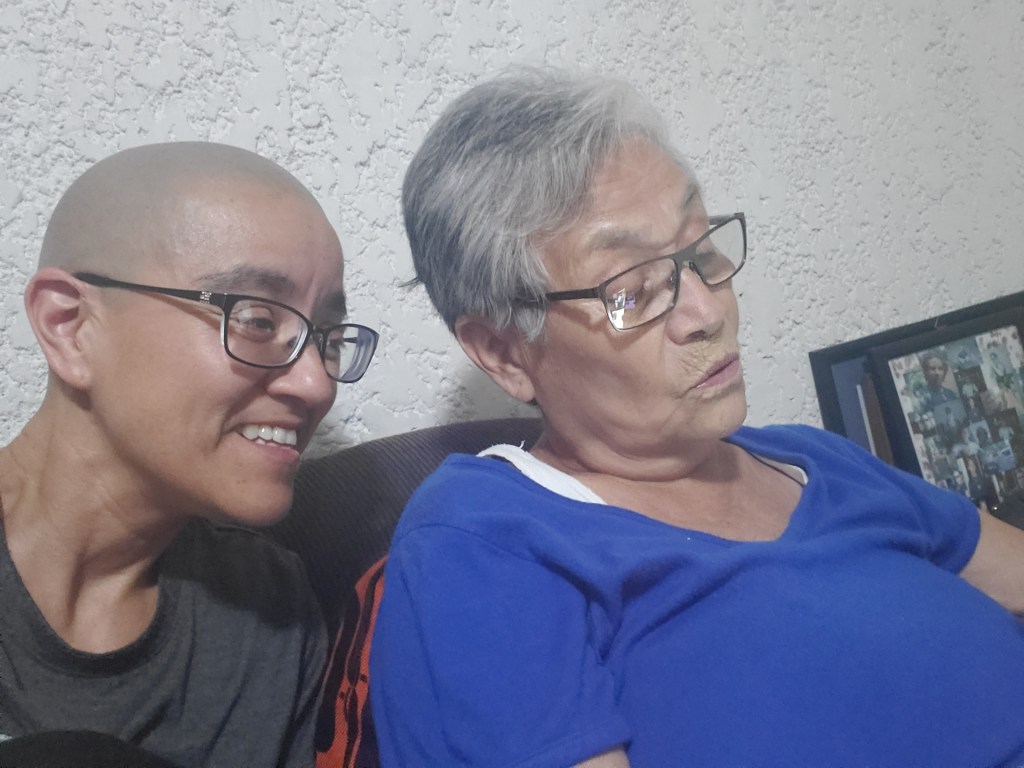
I was sometimes told I look like my grandmother on my dad’s side, and although it wasn’t meant as a compliment, I always welcomed it as such. I wanted to be like my grandma. She was a tough, no-nonsense woman who was light-hearted and spunky to the very end of her life. She had a serious expression on her face most of the time but would playfully and unexpectedly stick out her tongue at neighbor-friends when they passed by her house. She had well-developed patterns of good-natured banter with most people in her neighborhood. She was well-known and well-liked, and people also knew not to mess with her. So, if I could be thought to be anything like her, I was good with that.
She lived in Mexico and my family in the United States. In Mexico, even as a younger kid, we were allowed to move around town on the bus if my older cousin was with us. We always landed and stayed with my mom’s side of the family and usually only went to visit my dad’s side for an afternoon or two during the course of our time in Guadalajara, where my parents were from. I couldn’t wait to surprise visit my dad’s side of the family – my grandma, aunt, and grandpa who all lived together. We never announced our visit in advance; so it was fun for me to get to walk into the patio of their apartment complex and find my grandma, as usual, standing in the doorway of her front door, smoking. She was a businesswoman, always running a small business, selling basic grocery items from home, so her door was always open. And she was almost always right there, standing just outside her door, a serious expression on her face, and a smoke in hand.
We take a slice of honey cake and a pottery cup of grape juice and leave it by the rose bush as an offering, arrayed on a bed of petals and topped with a single daisy and a ring of wild raspberries. We make some wishes in the dusty air, kneel down with our palms upon the warm earth and sing for rain. We walk under a half-moon sky beside a blood-red sun, the sound of coyotes rising into the night as a silent deer watches us, head a triangle of alertness, black eyes staring across the heat-weary field. We catch fireflies, winking above the wildflowers sparks of yellow-green, and find a plump brown toad waiting in the path. Then, we stand quietly together, mosquitoes beginning to cluster around our legs, our heads tilted back watching carefully for fairy silhouettes against the deepening gray of the midsummer sky.
It is summer here in the Northern Hemisphere. Deep summer. Dusty summer. Thirsty summer. Humid summer. In central Missouri, it is the type of thick, wet heat that soaks into you and saps your strength and enthusiasm about life. Life can feel faded, dull, and magic hard to see. The woods, where I find such solace, renewal, and enchantment, become closed to me as poison ivy, thorns, ticks and chiggers, resolutely bar my way. So, I walk on the road these days, in the mornings and at sunset, seeing what I can see from my vantage point on a dusty gravel road. Deep summer I find offers an opportunity to look around to see what flourishes of its own accord, to see what grows without tending, to see what rises wild and unfettered from the natural conditions in which they thrive.
Sometimes as humans we become used to controlling as much of the world as we can control and as much of ourselves as we can control. Sometimes we get focused on what we can cultivate and grow and intentionally tend. So focused on this conscious tending may we be, that we may even rip up or destroy or change what is naturally growing in our own little ecosystem, our own little biome, what is growing right where we are. We may even pull it up and put something else in its place that we think is prettier, or nicer, or even more beneficial or useful. I encourage us to consider summer as a time in which to pause with, appreciate and look at, savor and explore, learn about and discover, what really grows right where you are, what thrives right where you stand, without the need for you to manipulate or control or change it. And, I invite you to also consider how this might apply to the growing and thriving in your own personal life? How or what are you perhaps trying to manipulate or change or control in yourself or with the people in your life? Perhaps it is time to take a step back, to sit back, and to see what is already growing. What is already there? What is thriving in your world? What is thriving for you that doesn’t require wrestling with or changing or trying to make it fit in a certain way? I encourage you to soften and see. Perhaps the mulberry trees are green and spreading in your world. Perhaps the clover is in bloom. Perhaps there are daisies. Perhaps there are monarch butterflies still bravely persistent on the milkweed in the field. Perhaps there are wild onion scapes, with their little purple heads. Perhaps there is yarrow, white, and waiting, and interwoven in its own curious way with the health of your own blood and body. Perhaps that book you want to write is bubbling right behind your fingertips, waiting for your pen to be set against the page. Perhaps that project that sings your name is waiting for you to pause to see it.
We doubt sometimes our place in the natural world. And, yet these plants that surround us, that spring up around us, that grow right where we are, are here and growing, just like we, ourselves, are growing where we are. These plants are intertwined with the health of our own bodies. That is amazing and enchanting and wondrous to me.
My youngest son, Tanner, is six and we are working together on an earth science class, studying planets and the earth and geology and the universe. He came to me saying: “Mom, did you know, there’s real iron in us! There’s real ironin us.” And I replied, “there’s real iron at the core of the Earth too. Isn’t that amazing? The earth has iron in it and so do we.” He looked at me and asked then, “is magic real?” And I replied, “yes, honey, we walk around inside of it every day.” I pause here in the hot exhaustion of summer to marvel that so it is. In truth, it is not only that we walk around inside of it every day. We walk on top of it every day. We walk with it every day. It beats in our veins every day. We live with it every day. If we carry an awareness of this embodied magic with us, then every day becomes enchantment. Every day becomes sacred space in motion. Every day becomes the opportunity to fully inhabit our own living magic as we literally walk around within it each and every day.
So, what is growing for you? What is blooming for you? What is flourishing and healthy, just of its own accord, asking nothing else from you, but witnessing?
The earth is made of days beyond count and roots beyond question. The fire in your belly is that which whirls worlds into being. There is iron in your blood, iron at the planet’s core, iron in the stars, iron in beak of hawk and eye of crow, and iron in the red rocks beneath your feet. This air you breathe is river woven, lightning laced, tear salted, iron eyed, earth kissed, raven winged. Wait, let this breath expand your chest and know: here you are, today, in-dependence with all things.
Molly Remer, MSW, D.Min, is a priestess, writer, and teacher facilitating ritual, making art, and weaving words together in central Missouri. Molly and her husband Mark co-create Story Goddesses at Brigid’s Grove. Molly is the author of nine books, including Walking with Persephone, Whole and Holy, Womanrunes, and the Goddess Devotional. She is the creator of the devotional experience #30DaysofGoddess and she loves savoring small magic and everyday enchantment.
I offered up morning prayers at dawn this July morning to the song of cardinals, rose breasted grosbeaks, and just barely rippling waters. The air was sweetened by water. Peace filtered through the green – seedlings, lichens, mosses, grasses, ferns, trees, clear mountain waters. Silence, except for the birds’ benediction.
I honored my body with a poem. I also repeated my hope that my house will get the necessary structural help she needs, that the work will be completed. At the brook I experienced my body rooting into forested soil… I am loved here; I belong here – at least for now.
The drought drones on, although today at least we have light rain falling, for which I am profoundly grateful, especially because the dreaded 4th of July weekend is ahead – if only the rain will continue the deafening explosions might be tempered. In case this does not happen the dogs and I are going to retreat to the silence and peace of the woodlands to spend our nights in the car, the back of which has been turned into a comfortable bed.
Like so many others, I learned this jingle, actually the opening of a lovely poem by Joseph Parry, during a brief stint in the Girl Scouts when I was nine or ten. I’m not sure I understood it then—what was wine, after all? what did it mean for it to “mellow and refine”?—but the words stayed with me, echoing unbidden through the years and shaping many of my choices.
Make new friends, but keep the old;
Those are silver, these are gold.
New-made friendships, like new wine,
Age will mellow and refine.
Like so many others, I learned this little jingle, actually the opening of a lovely poem by Joseph Parry, during a brief stint in the Girl Scouts when I was nine or ten. I’m not sure I understood it then—what was wine, after all? what did it mean for it to “mellow and refine”?—but the words stayed with me, echoing unbidden through the years and shaping many of my choices.
I’m sure it was thanks to these words that, three years ago, I found myself dancing at the wedding of my childhood best friend. Deb lives in Southern California; I live in New York. Yet I never had the slightest hesitation about saying “yes,” I’d attend. This was to be her second marriage, after a painfully failed first. For years she’d sworn she would never remarry; the wonderful man she’d been living with for two decades finally persuaded her. Clearly, a moment to celebrate. And although we’d missed all the other milestones in each other’s lives, I knew I had to be there for this one.
At Deb’s San Diego wedding, 2018
I’ve known Deb since we were seven; we’re now both in our seventies. For nearly forty years we had no contact—different cities, different lifestyles, different choices. But when Deb sought me out after Hurricane Katrina (I’d been living in New Orleans and somehow she knew that); when she came to see me in New York and we revisited our childhood haunts; when she took to phoning me regularly on Jewish holidays—I was irresistibly drawn back into this relationship that linked me not only with her but with my own self over time. (“For ’mid old friends, tried and true / Once more we our youth renew.”)
May you witness a growing trust in the guidance around you. May you allow magic to find you where you are.
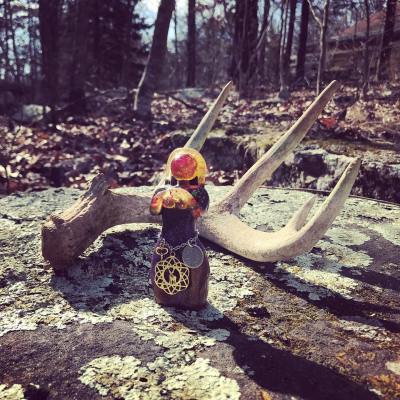
Seven years ago, I did a drum-guided meditation in which I journeyed deep into the forest. On my head as I walked, antlers grew, curving above me. As I followed the sound of drums and the glimmer of firelight, I kept raising my hand to check to see if they were still there, firm beneath my hand. I reached the fire and met the Goddess there, she reached up and took the antlers off my head and cast them into the flames, where they twisted and glowed until they became a golden ring, which she removed and placed on my finger, antlers now wrapped around my index finger. In waking life, I scoured etsy and two years later located a bronze antler ring extremely similar to my vision, which I bought and placed on my own finger in the woods as a symbol of my earth based path, my priestess vows, and some kind of unspoken dedication, felt within but not able to be fully verbalized at the time.






 Feminism and Religion