Even Now: Creativity, Possibility and the Renewal of the World by Rabbi Adina Allen

October 3, 2024 // 1 Tishre, 5785

“Rosh Hashanah is the anniversary of the creation of the world,” wrote the Eish Kodesh, Rabbi Kalonymous Kalman Shapira, Rebbe of the Warsaw Ghetto. Writing at a time of unimaginable suffering, even against the backdrop of impossible circumstances, he knew this moment, the day in which we inhabit right now, to be one of creativity, possibility and renewal. 

This theme of creativity and Rosh Hashanah is perhaps expressed nowhere more poignantly than in the phrase Hayom Harat Olam. One of the many names by which Rosh Hashanah is known, these words come from one of the holiday’s most ancient piyyutim, recited in the sacred center of the Rosh Hashanah service, the haunting, evocative Musaf Amidah. To conclude each of the three special sections for Rosh Hashanah: Malchuyot (Sovereignty), Zichronot (Remembrances), and Shofarot (marking the appearances and meanings of shofar across Torah), the shofar is sounded in the proscribed pattern — wholeness, breakage, shattering, wholeness, followed by Hayom Harat Olam.

Continue reading “Even Now: Creativity, Possibility and the Renewal of the World by Rabbi Adina Allen”

Incredibly! The Inquisitional Cultural Mechanism Rears its Hydra Head by by Elisabeth Sikie

As a young witch hungry for feminist sisterhood and spiritual wisdom in the 90s, before the blooming of the internet, I discovered a mag called The Beltane Papers. I remember devouring an article featuring channeled material of women killed during the European witch hunts. This transmission revealed past voices of everyday people living their lives until they were snagged by the slow creep of an increasingly oppressive cultural trajectory. What struck me was the normalcy of their voices, the deceased echoes of regular women trying to make sense of events beyond their control until they were taken by a system that destroyed them. What stayed with me is the author’s observation that even at their violent end these women’s voices remained “incredulous”. 

Decades, and seemingly lifetimes later, I completed my dissertation for my PhD in Religion and Philosophy in which I excavated some of the subaltern history of my European Ancestors and their female shamanic practices. At one inevitable point in my research – kicking and screaming – I reluctantly faced the inquisitions and witch trials. After waving a sage wand and cracking a sacred beer, I cracked open the Malleus Maleficarum, the infamous “Hammer of the Witches”.[1] This notorious guidebook, a how-to for career Christian Inquisitors written by two Dominican Friars[2] during the Middle Ages, details moral arguments supporting the legalized suppression, interrogation, and eradication of women designated by the church-state as heretics.

Continue reading “Incredibly! The Inquisitional Cultural Mechanism Rears its Hydra Head by by Elisabeth Sikie”

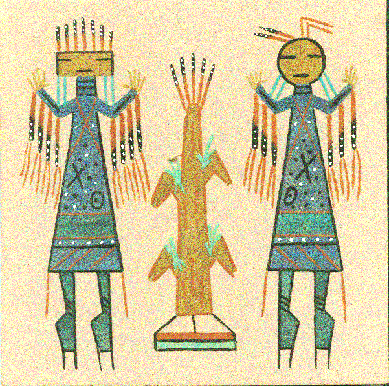
Elderberrying with the Yei by Sara Wright

Every year at the end of August I celebrate the Wild Harvest by gathering elderberries to make a medicinal tincture that I use all year long and share with close friends.

This gathering is a process that begins in the spring as I search for new bushes and then later blossoming elderberry flowers in old and new places. As the summer progresses, I continue to monitor the bushes searching for those with berries. Beginning in early August I am on alert for ripening. I am especially mindful because our weather is changing rapidly. If the trend of bad air, fog, and too many deluges continues unabated it’s probable that the times for harvesting berries may shift. In addition, many of the wild places that once supported elderberry bushes have been manicured to get rid of the wild plants by mowing them down, bulldozing the soil to remove all greenery, etc. The rape of wild nature has escalated with time. 

This year I have been especially fortunate because I found new clusters bursting out in places they weren’t before. I think the Elder – Berry Woman is helping me. Destroying these precious wild plants and their habitat means that a once common ancient Native plant remedy may be disappearing. Despite horticultural advertising our elderberry bushes do not do well in cultivation, if they survive at all.

Continue reading “Elderberrying with the Yei by Sara Wright”

Queering Herstory Profiles by Anjeanette LeBoeuf

We are back with a new volume of uncovering and focusing on extraordinary persons. We start our first post of Volume II with 4 figures who in many ways throw history, narrative, and the status quo off their axis. All 4, if alive in 2024, would find solidarity and kinship with the Queer Community. So let us being.

Hatshepsut (1508-1458 BCE) Egyptian Pharaoh.

Hatshepsut was the daughter of Thutmose I, wife to Thutmose II, and stepmother to Thutmose III. Her husband died while his heir was too young to ascend the throne. Hatshepsut became not only the acting regent but full fledge ruler. She would reign for 21 years as the 5th Ruler of the 18th Dynasty of Egypt. Her reign was prosperous including funding for art, statues, and monuments that have stood the test of time and active destruction. Deir –el-Bahari became a significant temple for Hatshepsut.

Continue reading “Queering Herstory Profiles by Anjeanette LeBoeuf”

The Purpose of Women by Beth Bartlett

Thomas Aquinas, Wikimedia Commons

12th century theologian Thomas Aquinas didn’t think much of women.  He’d known less than a handful during his lifetime – his mother, who sent him off to a Benedictine monastery when he was five, as was the custom at the time, and later abducted and imprisoned him, with the help of her other sons, seeking to “rescue” him from his choice of becoming a Dominican priest; his two sisters who were sent to him while imprisoned to dissuade him from his choice; and the prostitute his brothers sent into his prison cell to try to tempt him to sin and break his vows – unsuccessfully. So perhaps it is no wonder that Question 92 of his Summa Theologica asks, “Should woman have been made in the original creation?” Though more likely his question was prompted by the milieu of misogyny in which he was raised and lived, having been educated in the theological tradition of Augustine who believed women to be the “lesser” sex and necessarily subject to men, and highly schooled in and known for reviving the thought of Aristotle, who said of women, “a woman is a misbegotten man.”[i]

Continue reading “The Purpose of Women by Beth Bartlett”

By Song, All Was Created by Janet Maika’i Rudolph

This blogpost is part of an on-going collaborative project between myself and my dear friend Ecuadorian elder and medicine woman, Susana Tapia Leon. The purpose of the project is to illuminate in word and images the underlying pagan meanings of biblical verses. There are many rich verses that got hidden within translations. This has had the effect of erasing their original meanings or at least making them very difficult to uncover. I have come to call these hidden gems because they were not erased completely. In this post, I am offering alternative translations of 3 verses that focus on song.  

Susana Tapia Léon, Cantadora 1
“She came alive after a month of work
She was always inside waiting to be revealed.”
Continue reading “By Song, All Was Created by Janet Maika’i Rudolph”

Why Ritual in Turbulent Times? by Terry Folks

Nick Fewings, Unsplash

It is Autumnal Equinox. Five women gather equidistant apart beneath a giant avocado tree in the garden at Evi’s place near the village of Zaros. This little hamlet is under the watchful loving eye of Psiloritis (Mount Idi) on the Island of Crete in Greece. We leave the solitude of our individual cottages where we have been quarantined to co-create an Autumnal Equinox ritual I have initiated for this occasion. Since we are still testing positive for COVID, we maintain our distance. I have a nasty strain as I’m exhausted, foggy, my nose bleeds, and I’m coughing so much my head hurts. Still … this ritual is important as our morale seriously needs a boost. We are dubbed the five “Corona Sisters” or the “COVID Girls” whose Goddess Pilgrimage on Crete was cut short when we contracted the virus somewhere between our homes in Australia, Canada and the United States, and our arrival in Heraklion a few short days ago. We have renamed ourselves the “Avocado Sisterhood” to acknowledge the blessing of our togetherness, and we represent a quarter of the women participating in Carol Christ’s Goddess Pilgrimage to Crete in 2023.

Continue reading “Why Ritual in Turbulent Times? by Terry Folks”

Seeds of Life by Sara Wright

Seeds from Jack in the Pulpit

 I have been involved with plants since I was a toddler. My first word was ‘fower’ for bright yellow buttercups, a nickname I was given by my grandfather that stuck.

I guess it’s no surprise that I started out with gardening as a three-year-old under my grandmother’s tutelage. Her large vegetable plot fed us for most of the year. I seeded my first yellow summer squash into rich moist earth and watched with wonder as the seed emerged with two emerald ears.

In college when students were decorating their rooms with drapes and bedspreads, I bought a pepper plant to brighten my cement surroundings and soon had a windowsill full of plants.

As a young adult I grew many house plants and often talked to them, noting that we seemed to have an uncanny personal relationship, a childhood reality that I had been educated out of. I also gardened with herbs outside my back door, because I loved to cook and needed tasty condiments. Soon I moved on to planting a full – fledged vegetable plot. I canned what I could like my grandmother still longing for the bountiful flower gardens of my dreams. I come from a lineage of female flower gardeners and farmers that stretched back three generations (that I know of) but as a young single mother who worked and one who was frozen from loss, I didn’t make the time.

Continue reading “Seeds of Life by Sara Wright”

Legacy of Carol P. Christ: A New Glossary for Crete: The Power of Naming and the Study of History

This was originally posted on Sept. 2, 2013

The words we use affect our thinking. In the case of ancient Crete the repetition of the terms “Palace,” “Palace of Knossos,” “King Minos,” “Minoan,” “Priest-King,” and “Prince of the Lilies” shape the way we understand history–even when we ourselves know these terms are incorrect. We must engage in “new naming.”

Ariadne. May have been a name of the Goddess of pre-patriarchal Crete. The ending “ne” signifies that Ariadne is not of Greek or Indo-European origin and thus predates the later Greek myths.

Ariadnian. The name I have given to the Old European pre-patriarchal culture of Crete, from arrival of the Neolithic settlers from Anatolia c.7000 BCE to the Mycenaean invasion c.1450 BCE. Arthur Evans named the Bronze Age (c.3000-1450 BCE) culture of Crete “Minoan” after King Minos of Greek mythology, son of Zeus and Europa, husband of Pasiphae, father of Ariadne, whose gift of the secret of the labyrinth to Theseus led to the downfall of her culture. Evans assumed that Minoan Crete was ruled by a King.

This image I call “Ariadne Dancing” could become the new “icon” of Ariadnian Crete.

minoan woman dancing
Continue reading “Legacy of Carol P. Christ: A New Glossary for Crete: The Power of Naming and the Study of History”

The Place of All Possibility: Cultivating Creativity Through Ancient Jewish Wisdom by Rabbi Adina Allen

In her book Pentimento, author and playwright Lillian Hellman describes a phenomenon that often occurs when we return to a piece of art we once worked on after much time has passed: “Old paint on a canvas, as it ages, sometimes becomes transparent. When that happens it is possible, in some pictures, to see the original lines: a tree will show through a woman’s dress, a child makes way for a dog, a large boat is no longer on an open sea.” Hellman speaks of the way the aging paint allows for older layers to show through, offering an opportunity to see, in her words, “what was there for me once, what is there for me now.”

Like the painting Hellman describes, Torah, too, is a work in process. Layers and layers of interpretation have been added to it over time, according to the needs, desires, fears, and longings of those who devoted their lives to making meaning out of these sacred words. Some layers add to the beauty and power of the overall piece, strokes and shapes that bring the picture more clearly and compellingly into focus. And some accrue like varnish, making the painting hard and impenetrable. Each one of us is invited into this process of excavation, of peeling back layers of what we have been taught or what we think we know, and seeing, as Hellman writes, what is there for us now. And each of us is called to our creativity — to bring our brush back to the canvas anew, reencountering and reworking the stories, ideas, and images that lie at the very foundation of who we are and who we could be.

Continue reading “The Place of All Possibility: Cultivating Creativity Through Ancient Jewish Wisdom by Rabbi Adina Allen”