Eve, Revisited by Jill Hammer

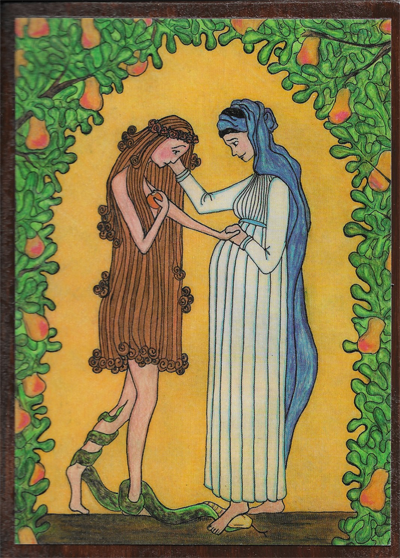
About six months ago I was hired to write a curriculum for a Jewish organization on biblical women in ancient and contemporary midrash.  Midrash—the ancient process of creative interpretation of sacred text that began two thousand years ago and continues to this day—has been one of my fields of expertise, and women in midrash is a particular specialty.  I knew the first lesson I wrote would be on Eve (Chava in Hebrew), the first woman of Genesis.  Yet as I began to write lessons, I started with Sarah and Hagar, then proceeded to Rebekah and Lot’s wife, Rachel and Leah, even Asnat (Joseph’s wife) and Naamah (Noah’s wife).  It became clear over the months that I was avoiding Eve.  Whenever I began to think about beginning “her” lesson, I grew anxious and immediately began to think of something else. Only when I had already written six of my ten lessons did I finally, reluctantly, begin to research ancient legends and modern feminist poems on the first foremother of the Bible.

Why was I avoiding Eve?  In part, because she seemed like such a huge topic.  Generations of Jews (and, of course, Christians) have had a great deal to say about Eve, her creation, the fruit of knowledge, the serpent, Eve’s relationship with Adam, and more.  How would I encapsulate it all?   And then there was Lilith, Eve’s alter ego, and all of the legends about her.  Choosing a handful of midrashim out of this vast corpus seemed impossible.  Plus, there was a whole literature about the relationship between Eve and ancient Near Eastern myth I wanted to allude to—Eve as a kind of human version of the Goddess with her Tree.  How to choose what to put in and what to leave out? Continue reading “Eve, Revisited by Jill Hammer”

Teaching After the Getty Fire by Sara Frykenberg

This is the third year in a row that I will be writing about wildfires in California and their impact on me and my community.

This year, I don’t have any poetry.
This year, I’m not afraid.
This year, I’m angry. I am very angry. And again, I am awash in the (not so?) mundane concerns that surface in the wake of devastation. I am continually struck by this: the strangeness of the everyday next to the blackened hillside, the restricted access, and soot covered floors—the persistence and tremendous regularity, even normality of the everyday. Continue reading “Teaching After the Getty Fire by Sara Frykenberg”

Temple Magdalen by Elizabeth Cunningham

The Women of Amphissa, 1887, by Lawrence Alma-Tadema

Since I began writing for FAR in July 2012, I have written about Mary Magdalen, or excerpted a passage from one of my novels, near or on her July 22 Feast Day. For why I made the controversial choice to depict her as a prostitute, see last year’s post. The below excerpt is from The Passion of Mary Magdalen. I made this selection in remembrance of all the refugees in the world today. In this passage, Judith, a Jewish widow whose family was driven from the land by tax collectors, returns to the place where Maeve (my fictional Celtic Magdalen) and her friends have recently founded a Temple to Isis on the outskirts of Magdala. Maeve has just invited Judith to join them. (Edited for brevity.)

She stared at me, her eyes full of anger and longing.

“I will not be a slave and a whore where I was once a wife, the one who made the challah bread, who said the Sabbath prayers over it. This was our place, my husband’s and mine. We brought the best we had to the temple, the finest oil and wine, the unblemished kid—”

“Goats? You kept goats? You know how to make cheese?”

She sat quietly for a moment before she answered. “How can I live here with you?” she wondered. “I don’t understand.”

Continue reading “Temple Magdalen by Elizabeth Cunningham”

We Won’t Go Back by John Erickson

Bottom line: abortion is healthcare. Nearly a fourth of women in America will have an abortion by age 45. Every day, people across the United States make deeply personal decisions about their pregnancies. Those decisions deserve respect.

Someone once asked me: John, why are you a feminist?  It is always a jarring question because I believe all people should be feminists and we should all fight for gender equality no matter what.  I’ve been drawn to Martin Niemöller’s prolific quote:

First they came for the socialists, and I did not speak out—because I was not a socialist.
Then they came for the trade unionists, and I did not speak out— because I was not a trade unionist.
Then they came for the Jews, and I did not speak out—because I was not a Jew.
Then they came for me—and there was no one left to speak for me.

Right now, it seems like a full on frontal assault against all of us.  No matter what community you’re in, you can draw back to an instance of discrimination you’ve faced both pre-2016 as well as after the election of President Trump. Continue reading “We Won’t Go Back by John Erickson”

If Holly Near’s Simply Love Album Were a Musical by Elisabeth Schilling

For many of us, listening to women-loving-women songs is a spiritual experience. That is because somehow it makes us feel seen, puts a sense of hope into our world as well as daydreams of romance. We can understand the challenges and the regret or guilt that comes with disappointing others and ourselves, them for not being who they wanted us to be and for us, not being who we are for far too long. Holly Near’s Simply Love album narrates a story that I might envision as a musical theatre production, and I really wish someone would ask me to write it and then hold the casting call (yeah, I’d want to be in it too, so save me a part). I offer some of my thoughts on two central songs in the would-be musical in hopes of sacred liturgy on a potential stage.

Simply Love has 28 songs and was released (according to Spotify) in 2000. I think the synopsis would be surrounding Cassandra, in a loving relationship with her partner, reflecting on her journey to this place of authenticity. I can imagine how it might be living one’s live in an exploratory way and coming to new revelations later in life.

Continue reading “If Holly Near’s Simply Love Album Were a Musical by Elisabeth Schilling”

I am in Peace: The Ministry of Margaret Fell by Mary Sharratt

margaret fell

This linoprint of Margaret Fell can be ordered here.

Pendle Hill will forever be associated to the Pendle Witches of 1612 who live on in the undying soul of the landscape and its folklore and who inspired my 2010 novel, Daughters of the Witching Hill. Pendle Hill also gave birth to the Quaker movement.

In 1652, George Fox, a simple weaver’s son and cobbler’s apprentice turned dissenting preacher, wandered across England on a spiritual quest. When he climbed Pendle Hill, his revelation came to him—an event that would change both Fox and the world forever. He envisioned a “great multitude waiting to be gathered.”

As we travelled, we came near a very great hill, called Pendle Hill, and I was moved of the Lord to go up to the top of it; which I did with difficulty, it was so very steep and high. When I was come to the top, I saw the sea bordering upon Lancashire. From the top of this hill the Lord let me see in what places he had a great people to be gathered.

George Fox: An Autobiography, Chapter 6 Continue reading “I am in Peace: The Ministry of Margaret Fell by Mary Sharratt”

I’m [Not] Batman by Sara Frykenberg

A little tongue-in-cheek, somewhat punchy, somewhat angry reflection for your consideration. Thank you for reading.

Ever have trouble speaking your mind? I do. I do, particularly in situations where I was taught (in all sorts of ways, violent and nonviolent alike, religious, patriarchal) to be “a good girl.” The “good girl” training I received is so deeply ingrained in me that I often don’t realize when I’m doing it. I catch myself being agreeable with people when I want to be arguing. I use extra exclamation points in communications with my online classes to appear more likable, friendly or non-threatening. I also have a peculiar habit of, unconsciously, changing my clothes repeatedly until I ‘match’ someone around me, usually in color. I honestly don’t mean to do this, and only became aware of the habit in the last decade because my husband started pointing it out to me ALL THE TIME.

But I’m working on it. “Be authentic, Sara.” “Be yourself.” That’s got to be different than being good, right? I probe my habits and relationships for the tell-tale signs of this “good girl.” Continue reading “I’m [Not] Batman by Sara Frykenberg”

Creatrix Mundi: Speculating The Godma by Isabella Ides

Photo Credit: KTYarbrough

What does it mean to approach the idea of a Godma, a mother-of-all, as an act of the imagination, as a pure act of speculation? I particularly love the word speculator: one who is mining for the diamond, one who is going off the map, a voyager, a voyeur, a seer. A spiritual adventurer. A gambler, a trader in divine currencies.

I am a writer of fictions—speculative fictions. I am a poet-philosopher. Acts of the imagination and divine currencies are my trade.

I like this phrase: In the beginning was an of the imagination, a movement of mind. Or better—an act of procreation, a giving of birth. I love how words lead an idea deeper into the woods. A chance to get lost in variations and find new places to hide and seek. Perchance to meet an angel. Or a wolf. Or yourself in disguise. Continue reading “Creatrix Mundi: Speculating The Godma by Isabella Ides”

Coming Home to the Sacred by Carolyn Lee Boyd

My grandparents and mother at their home in 1929.In 1929, my grandmother wrote the word “HOME” in resounding letters across the bottom of a photo of a herself and my grandfather, smiling lovingly and confidently, with my infant mother propped in between them on a rattan chair.  Within a few years the Great Depression stole that house, rendering them desolate and homeless, cutting a psychic wound so deep that it never healed.

I recently found the photo and thought of our family’s ancestors who, millennia ago in Old Europe, worshipped the Goddess in peaceful, egalitarian societies.  Then and there, as in so many cultures outside modern western societies, “home” was a sacred place. As discovered by Marija Gimbutas and others, small statues of the Goddess were frequently found by the ovens inside family dwellings, and temples included rooms for both sanctuaries and workshops for making bread and weaving cloth. Houses and temples were extensions of one another. 

Continue reading “Coming Home to the Sacred by Carolyn Lee Boyd”

Three More Herstorical Divas to Die For by Mary Sharratt

Last month I blogged about Three Herstorical Divas to Die For. But since herstory is teeming with heroines whose praise needs to be sung and whose legacies deserve to be remembered, I now present three more Herstorical Divas to inspire us.

The Urban Dictionary defines a diva as a woman who exudes great style and confidence and expresses her unique personality without letting others define who she should be. In my mind, a diva is a woman who stands in her sovereignty and blazes a trail for other women. We all need to claim our inner diva to truly dance in our power.

Continue reading “Three More Herstorical Divas to Die For by Mary Sharratt”