From the Archives: Is Baptism a Male Birthing Ritual? By Michele Stopera Freyhauf

This was originally posted on March 22, 2012

Quite a number of years ago I had a conversation with one of my professors, a feminist theologian, who posed the question “Why do I need a man to purify my baby with the waters of baptism?  Is there something wrong or impure about the blood and water from a mother’s womb – my womb?”  Before you jump and shout the words Sacrament or removal of original sin, this question bears merit in exploring, especially in today’s world where women are taking a serious beating religiously, politically, and socially.  In today’s world, violations and rants are causing women to stand up and say STOP!  This is MY Body.  This outcry was provoked by chants of ethical slurs against women– Slut! Prostitute! Whore!  The cry got even louder when the issue of religion and government was raised in the fight of healthcare coverage of contraception. The cry got even louder with the enactment of the laws in Virginia and Texas (and many other states to follow suit) that forces women to undergo transvaginal ultrasounds in early stage abortions.  The mandatory insertion of a wand into a woman’s vagina (mandated by the government, mind you), is a violation and has women crying RAPE!

Continue reading “From the Archives: Is Baptism a Male Birthing Ritual? By Michele Stopera Freyhauf”

A Story About Forgiveness by Sara Wright

Every morning I write a little meditation with attached images that in some way reflects what’s going on in my life. I do this for three reasons. To experience gratitude for something I have learned, to share my thoughts with others and to consciously align myself with LIFE while participating, albeit unwillingly, in a death destroying culture.

As a naturalist my focus is usually on some gift received resulting from my reciprocal relationship with nature. But I wrote this meditation to articulate one of the most important aspects of relating to other humans – perhaps the most important. Forgiveness. And I wrote it after experiencing the freedom and gratitude that followed a powerful act of forgiveness associated with a long-term friendship.

Continue reading “A Story About Forgiveness by Sara Wright”

HOPE, PAIN, DESPAIR, AND JESUS by Esther Nelson

Despite halting attempts to live my life with hope, I’ve failed. My experience is not unique. We suffer. The recent pandemic, including its side effects of loss and displacement, is but one example. Suffering can leave a sense of hopelessness in its wake. One place I look for balm is in poetry.

As with most poetry, Emily Dickinson’s (1830-1886) work requires me to pause and ponder. What is being said? Not easy to tell, nonetheless, I often do find meaning in her poems. If I understand her thrust at all, much of the meaning I glean disorients me.

Continue reading “HOPE, PAIN, DESPAIR, AND JESUS by Esther Nelson”

From the Archives: The Hunger Games, Holy Week, and Re-imaging Ritual by Xochitl Alvizo

This was originally posted on April 3, 2012 and serves as a nice follow up to my recent posts, and to the Christian holy days being celebrated this week.

Being passive spectators of violence and injustice, even if mournfully so, is not just a thing of Panem, it is our everyday reality.

In The Hunger Games Suzanne Collins takes the reality of an unjust society and gives it an imaginative makeover. In Panem, most people are kept at such extreme levels of hunger that even when they do eat they cannot fill the hollowness that has settled in their stomachs, while others are deciding on the next cosmetic alteration they will undertake – whiskers, jewel implants, or green-tone skin color? The disparate conditions between the rich and the poor, the few and the many are absurdly and starkly portrayed but done so in a way that we can still recognize our world in theirs. And at the center of this world is the state imposed ritual of punishment and control, the yearly Hunger Games – a nationally televised competition that all the people of Panem are required to watch. The 12 districts watch mournfully as two kids from each of their districts compete to the death, and the wealthy watch gleefully, for the games are the height of their excesses and entertainment. The yearly Games conclude when one kid, the lone ‘victor’, is left standing. All while the nation watches.

Continue reading “From the Archives: The Hunger Games, Holy Week, and Re-imaging Ritual by Xochitl Alvizo”

Boundaries: A Poem Drawn from the Well of Jacob by Marcia Mount Shoop

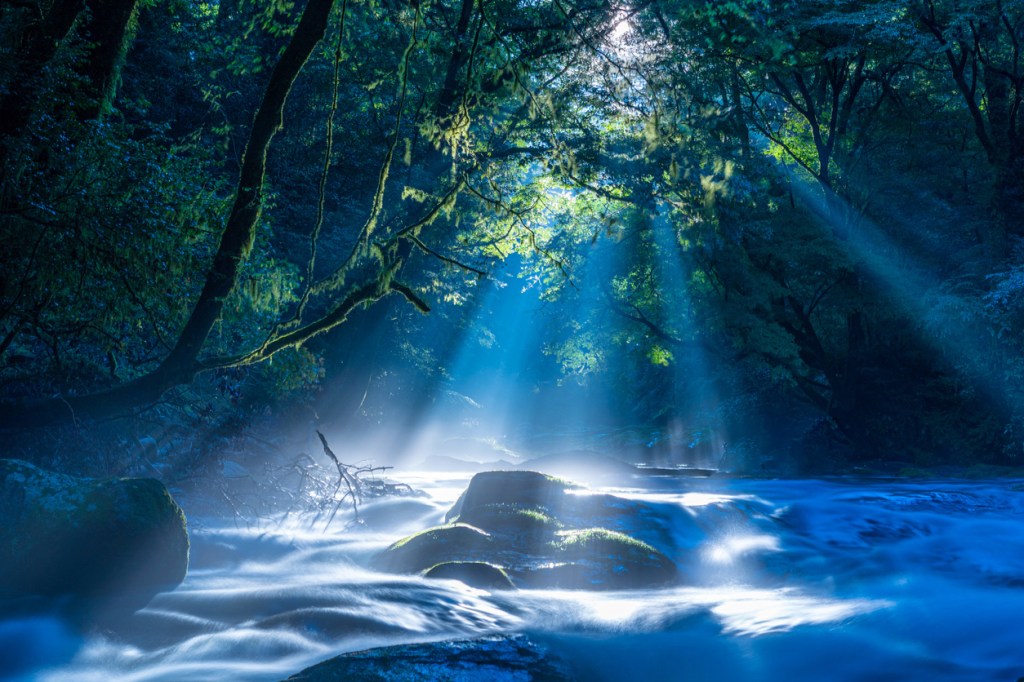
kikuchi valley, waterfall and light lay in the forest, kikuchi, kumamoto, japan

Today is the day in the Christian church year that we remember Jesus’ last supper with his friends/chosen family before he was betrayed by some of those same friends/chosen family. He talked to his beloved circle that night about many things, including betrayal and their capacity to embody Divine Love in a broken world after his death. Just a few days later he was executed by the Roman government because his prophetic and compassionate life was a threat to the powers that be of his day–both governmental and religious. In honor of this day in my faith tradition, I share a poem I wrote about one of the women in Jesus’ life before he was executed by Empire. Since Jesus’ death, he was kidnapped again by multiple Empires who have used him to put an ecclesial and even divine seal of approval on systems of oppression and genocide. The woman at the well gives us a window into Jesus the liberator. May we have space to remember him today as another Easter Sunday approaches for Christians around the world.

Continue reading “Boundaries: A Poem Drawn from the Well of Jacob by Marcia Mount Shoop”

On My Invitation as a Jew to Participate in Advent and Christmas by Ivy Helman.

imageI attend Czech classes twice a week.  This time of year the courses focus on Christmas.  I’ve attended three different schools over the last five years, and all handle Christmas similarly.  Even though the Czech Republic is only marginally Christian, for many Czechs being Czech and observing Christmas seem to go hand-in-hand.  In fact, Czech customs around Christmas even figure into the citizenship exam.

In last Tuesday’s class, my teacher asked me how I celebrate Christmas here.  She knows I’m Jewish.  When I said that I don’t observe Christmas traditions in my home, she responded, “you don’t have to be a believer to do Advent-related and Christmasy things.  Only 20% of Czechs are, and yet we all participate in Advent and Christmas.” It was part invitation, part assimilation request.  However, the excited in-class discussion felt more like an attempt at conversion. Don’t you want to be a part of this amazingly joyful time?   Continue reading “On My Invitation as a Jew to Participate in Advent and Christmas by Ivy Helman.”

The Bodies of Christ, Broken for You by Tallessyn Zawn Grenfell-Lee

Years ago, I learned of a small Christian sect that has an unusual sexual practice due to an interpretation of each Christian as the literal ‘bride of Christ.’ Every member of this religion is instructed from the age of 12 to imagine their sexuality always in relation to the (male) person of Jesus; men are encouraged to imagine they are women during intercourse and masturbation, to avoid a homoerotic relationship with Jesus; and they basically imagine their wives are Jesus.

I admit that I find this idea both bizarre and alarming. Yet, ironically, this sexual practice does accomplish one interesting goal: men imagine women as the literal Body of Christ.

Huh. Continue reading “The Bodies of Christ, Broken for You by Tallessyn Zawn Grenfell-Lee”

Desierto Divino: Messages from the Earth by Elisabeth Schilling

image1-1I have been thinking about deserts lately, what places are desired, which ones are deserted, and by whom. Cabo de Gata of Andalusia is one of the four deserts in Spain. In 2010, it became public knowledge that the Ministry of Development planned to locate a nuclear waste dump there. The last I have heard was that they had ordered a feasibility survey with nuclear scientists, but I can find no other updates. Why would the government and academic institutions penetrate a protected region, sacred for its ecological richness and beauty? The dump would be created 1,000 meters below the surface where the radiation would be dissolved (so they said) and then carried into the sea. Whether we hide waste inside the earth or shoot it up into space or keep it in someone else’s backyard, when will we pause?

The earth never runs out of messages. But humans as a species have lost touch with this reality. The majority of the human population lives in urban areas where we consume and live processed lives. It is no wonder too few of us make grand changes in our lives concerning excessive consumerism and waste. How can we think of what we do not encounter? Milk is disassociated from its bovine origins for many, and trash is dropped off at the curb for someone else to deal with.

Even many of the items we own were made in factories in lands far off, where people have to deal with the waste to the detriment of their own environments. But who cares? That air will never reach us. The vegetation most city-dwellers (and so most humans) are familiar with is the plants and trees used to ornament lawns and landscaped neighborhood streets (when we are that lucky). This is why the desert, and any rural area, might be our saving grace.

Etymologically, the term “desert” connotes with “abandonment”: it refers to a place that was deserted. Perhaps thankfully so. The harsh conditions of the areas we modernly refer to as deserts have been inhospitable to profit and capitalism. One only needs take a road trip down I-40 in the U.S. to see vast expanses of desert, empty (from only one perspective) land. Even gas stations are few and far between.

Yet here is the paradox: in the isolation of the desert, perhaps we can learn how to become closer to one another, to heal our relationships, all of them. We can only see each other, notice the sky. When we are no longer distracted and disillusioned, looking down at our shoes and swallowed by our navel-gazing minds, nature reflects our own goodness to us, the sacredness that we have forgotten. In the city, we have broken almost all the mirrors and muted all the echoes. Continue reading “Desierto Divino: Messages from the Earth by Elisabeth Schilling”

Moving Forward and into a New Season by Elise M. Edwards

elise-edwardsIt’s only been a month and I am still reeling from the US presidential election.  I feel like I’m just beginning to emerge from the sense of loss and futility that has cloaked me.  But I am beginning to move forward.

I don’t feel better.  I’m still confused and discouraged about why people voted for Donald Trump.  I’m very concerned about his cabinet picks and his proposed policies.  But I am actively seeking a path forward and a path of resistance.  I’m finding support in my spiritual practices and communities.

In the Christian calendar, we are in the season of Advent.  Advent carries profound symbolism, and this year it is especially poignant for me.  The word advent bears meanings of arrival, birth, and emergence.  It’s the beginning of the Christian year, which is patterned on the life of Christ, but the year does not begin Jesus’ birth.  That celebration is observed at Christmas, four weeks into the church year.  The weeks preceding Christmas are a time of preparation and reflection on the need for the Incarnation.  The Incarnation of God in the Christ Child may be a distinctly Christian doctrine, but I believe the need for it–even the idea of it–is found in other spiritual and religious teachings.

Continue reading “Moving Forward and into a New Season by Elise M. Edwards”

Jesus Films Have Risen, They Have Risen Indeed By Anjeanette LeBoeuf

AnjeanetteThe creation of cinema brought a new medium to which art and representation were transmitted. This new visual tool allowed people to bring to life favorite stories. Deemed in 1947 as ‘the greatest story ever told,’ the four Gospels found in the New Testament, have been ripe for cinema. Over fifty movies have been made which depict the life story of Jesus. Some have found lasting popularity and influence. Franco Zeffifrelli’s Jesus of Nazareth became the template for successful Jesus films. Mel Gibson’s The Passion of the Christ was another turning point for Jesus cinema. Each new Jesus film becomes a window to study how the story is reimagined. Continue reading “Jesus Films Have Risen, They Have Risen Indeed By Anjeanette LeBoeuf”