Remembering to Be Thankful by John Erickson

Remembering to be thankful may just be a privileged illusion that individuals in positions of power get to write about in the December of each year to self-congratulate themselves about being actually able to be able to be thankful. It may just seem like people who write about being thankful are complaining or pontificating that being thankful is in itself a chore.

WEHO CA (June 7, 2015)©2015 Rebecca Dru Photography All Rights Reserved    www.rebeccadru.com
WEHO CA (June 7, 2015)©2015 Rebecca Dru Photography All Rights Reserved
http://www.rebeccadru.com

With the holidays just around the corner and the frazzled, crisp ping of anxiety, rush, and panic take over the air around us, it is easy to forget to stop and “smell the roses.”  In times where teaching positions continue to shrink and more universities switch to adjunct labor, fees and class costs continue to rise, or just simply life becomes a little more complicated, due to the nature of balancing life, activism, work, friendships, or relationships, remembering to remind myself to be thankful is another task, I find adding to the never-ending list of stuff I always seem I have to do.

However, remembering to be thankful, scheduling it into one’s daily schedule are vital to our success as new and emerging faculty or activists or just in general because being thankful reminds us that we have aspects of our lives that are worth being thankful for.  Remembering to be thankful proves that we are in some way, connected to a larger sense of life that, at times, grants our wishes, wants, or desires, brings us despair, and then allows us to get through it, or even makes us feel alive.

As I sit back and look at the personal and professional landscape around me I understand that I have a lot to be thankful for both consciously and unconsciously.  Most recently at AAR, I participated on a panel in response to Bernadette Barton’s Pray the Gay Away.  During the course of our panel, the conversation of chosen vs. biological families came up.   Most recently, my mentor and panel moderator, Dr. Marie Cartier, talked about the same topic here on FAR and the difficulties many of us experience in regards to our chosen families vs. our biological families.   With the holiday season all around us, and regardless of what or if, you celebrate it or not, it is quite hard to get away from it all without realizing who your “family” is and whether or not you’re close or connected with them can be traumatizing during these times where we’re taught or expected to be with them.

After our discussion on the panel and then at the hotel bar, people discussed the pains and traumas in relation to not having a biological family to go home to during the holidays.  Sitting there and listening to the conversations, I realized that, for once in my life, I had nothing to say. Continue reading “Remembering to Be Thankful by John Erickson”

Truth in Storytelling by Elise M. Edwards

“[ShakespElise Edwardseare] was an alright writer.  I did not always understand him, but some things he said were beautiful and he made some things so clear the way he explained people.  But one thing he was wrong about.  That ‘To be or not to be?’  is not the first question. ‘What is the truth?’ – that is the question!  Then ‘To be or not to be?’  is the second question.”

-from “Feeling for Life “ in Some Soul to Keep by J. California Cooper

This past weekend, I taught a lesson for an adult church group about Christian imagination in the short stories of J. California Cooper. The quote above comes from one of her stories. I was invited to teach a lesson as part of a series on exploring God through literature. It was a delight to participate for several reasons.

Continue reading “Truth in Storytelling by Elise M. Edwards”

Invisible Giants: On Women, Mosques, and Radical Activism by Juliane Hammer

hammerAt times, being ignored, erased, and made invisible, is more hurtful than open debate and disagreement. Such silencing and marginalization render the energy, activism, and work of so many people mute and, ultimately, they do not serve the communities and society we are attempting to change. In what follows I insist on uplifting and naming some of the radical Muslim activists and advocates for gender justice I saw ignored in a recent Muslim community event.

On Labor Day weekend, the Islamic Society of North America (ISNA) met for its annual convention in Chicago. On Friday evening, in a well-attended panel, ISNA unveiled (pun intended) its latest statement and campaign on “the inclusion of women in masjids” (places of worship) and issued a call and invitation to sign the statement and implement its central demands in mosques and community centers across the United States and Canada. Panelists at the launch included Hind Makki, the creator of Side Entrance, a tumblr collecting pictures of the various (good, bad and in between) accommodations for women in mosques, and member of the ISNA task force on the issue; Dr. Ingrid Mattson, professor of Islamic studies and former president of ISNA; Imam Mohamed Magid, also a former president of ISNA; Dr. Sarah Syeed, chair of the ISNA task force and Dr. Ihsan Bagy, another member of the task force. Continue reading “Invisible Giants: On Women, Mosques, and Radical Activism by Juliane Hammer”

Reform? Progress? By Elise M. Edwards

Elise EdwardsIn my class yesterday (a survey of Christian thought and practices), I was lecturing about monastic life in the Middle Ages. Among other points, I mentioned that medieval religious orders provided settings where women could be educated and assume leadership roles (primarily among other women), thinking of Hildegard of Bingen (1098-1179) who was the Abbess of a monastic community in Rupertsberg. Other women medieval writers who developed influential writings, like Mechtild of Magdeburg (ca. 1210-1282) and Catherine of Siena (1347-80), belonged to tertiaries or third orders, which were monastic community for laypersons. This part of the lesson emphasized that monastic reforms around the 12th century opened religious orders more extensively to women and laity.

Still speaking of medieval reforms, I displayed a picture of Francis of Assisi on the screen at the front of the room. I mentioned that Francis was concerned about the poor and the animals and that he has inspired some contemporary Christians, including the current pope who took Francis as his name. We talked about how both St. Francis and Pope Francis are seen as reformers.

Because earlier in my lesson I’d made a point of speaking of women’s experience, when I spoke about the Pope’s name as a possible sign of renewal or reform, Gina Messina-Dysert’s question “What about the women?” came to mind. In her recent post, she responded to the Pope’s exclusion of many issues that concern women in his address to the US Catholic Bishops. Like Gina, I applaud many of the Pope’s reforms but I am confused about how rarely he is criticized for maintaining the long-held Catholic view that disallows women to be ordained as priests.

Let me provide an example: During the Pope’s visit to the US, one of my students described Pope Francis as “very liberal.” When I interjected that he has not supported the ordination of women, the student laughed and said the pope would be accused of heresy for supporting that! While that may be true, my more immediate concern was that in a classroom of students who are mostly supportive of women in ministry, the Catholic restrictions on the priesthood were seen as a part of the tradition not worth challenging. Why is it that preserving male leadership is excused as a part of the tradition while preserving exclusive marriage practices is something to be challenged? They are interrelated.

As we know from blogs and social media sites, many people who support LGBTQ rights were upset over news stories about the Pope meeting with Kim Davis, the county clerk who was jailed for refusing to issue marriage licenses to same-sex couples. Certainly such a meeting is disturbing to same-sex marriage advocates. But is it surprising? At least one womanist ethicist I know, Eboni Marshall Turman, pointed out in a Facebook discussion that the church has long since been public in its support of male privilege and heteronormativity. My intent is not to single out Catholicism for sexist practices. When recently asked about women’s ordination and leadership in Baptist churches in my own town of Waco Texas, I had to admit that even though ordination of women is permissible and practiced in many of the churches, the number of churches that have called women to the position of senior pastor is shockingly few.

My point is this: When we find teachings in particular religious traditions that justify the exclusion of one group, we should expect to find justifications for excluding other groups, too. In the same discussion I referenced above, Eboni Marshall Turman said, ”Oppressions are compounded and intersectional. If they come for me, it is just a matter of time before they come for you. This is basic theological ethics.”

The experiences of varied groups are not the same; our oppressions and marginalizations also differ. But practices of exclusion are constructed on the same logic that values some persons (the in-group) more than others (the outsiders). Therefore, feminists have a responsibility to advance the well-being and interests of other groups (besides women) who are being marginalized.

Another reason for this advocacy is that many women are included in other marginalized groups. To ignore the intersectionality of oppression is to deny its pervasiveness and the realities of women’s lives. This is why feminists of color are often critical of white feminism. (The recent debate over the photo shoot for the movie Suffragette is a new instance of a persistent critique of white or mainstream feminism. See Rebecca Carroll’s piece on “Suffragette’s Publicity Campaign and the Politics of Erasure”).

To counter the limitations of our own experiences and be consistent in our pursuit of equality, feminists should intentionally cultivate practices of solidarity and coalition-building in our work. I, like everyone else, am often unable to see the inconsistencies in my own practices and teachings without others’ experiences to expand my view. This is one reason I value this Feminism and Religion community. Thank you for the wisdom and practices you offer from your own religious traditions and your own experiences of marginalization. You make me a better feminist through your writings and comments.

Perhaps working together, we can bring about religious reforms that our descendants will recognize in the centuries to come.

Elise M. Edwards, PhD is a Lecturer in Christian Ethics at Baylor University and a graduate of Claremont Graduate University. She is also a registered architect in the State of Florida. Her interdisciplinary work examines issues of civic engagement and how beliefs and commitments are expressed publicly. As a black feminist, she primarily focuses on cultural expressions by, for, and about women and marginalized communities. Follow her on twitter, google+ or academia.edu.

Feminist Interpretations by Elise Edwards

Elise EdwardsI’ve written a few posts recently referencing biblical themes or stories. I’m not a biblical studies scholar; I’m an ethicist and theologian. So I know that ways I use the texts disturb some people who study them from a historical or biblical studies perspective. To say I don’t use the Bible as those scholars do, though, doesn’t mean I don’t have a disciplined approach. I aim to apply a consistent approach to scripture and to encourage my students to do the same.

I get really annoyed when someone proclaims a variation of “The Bible says it; I believe it; that settles it!” in moral debates. Obviously, people within a religious tradition are going to believe there is truth in the scriptures of their tradition. That’s simply how scripture functions. So I’m okay with “I believe it.” I have a problem with the two other parts of the statement – the Bible says it, and that settles it. The assertion that “the Bible says it” masks the task of interpretation that anyone encountering a text takes on. The statement “that settles it,” when adopted in moral debate, rejects the accountability and humility in sharing our interpretations with others. Continue reading “Feminist Interpretations by Elise Edwards”

Covenanting Justice. Covenanting Joy. by Margot Van Sluytman

MargotJustice as a lived and living experience is a poem. Is a song. And as a song it is filled with all manner of rhythm, of texture, and of sound via melody and lyric which affects us in an infinity of ways. The voice of poetry is the voice of The Song of Songs. It is a voice of invitation. Chapter Two of The Song of Songs is an invitation to strangers to Scripture. Strangers who want to feel a rhythm of joy, of loving embrace of tender and generous welcome. The gravity of the language is its graceful invitation to be seen, to be gazed at, to be heard.
My own vocation as a Sawbonna/Restorative Justice practitioner and a Therapeutic Writing facilitator, has blessed me with the opportunity to share words, via Word, in many different places and spaces around the Globe. The word that I use for justice as a lived and living experience is: Sawbonna. Sawbonna is a Zulu greeting that means I see you. You see me. I hear you. You hear me. Sawbonna contextualizes Restorative Justice in the crucible of our connectedness. Sawbonna, which is the essence of Chapter Two of The Song of Songs, clears the way for engagement, via words, with Word. Continue reading “Covenanting Justice. Covenanting Joy. by Margot Van Sluytman”

What Would Durga Do? by Barbara Ardinger

durga1_4inIt’s one of my favorite T-shirts. Every time I wear it, people who know who Durga is comment. So do some people who don’t know who the Hindu goddess is.
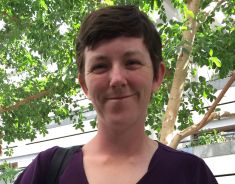
 

“What would Durga do?” is of course an echo of the question What would Jesus Do?

I’ve just done a bit of research and learned that this phrase may come from the Middle Ages, that it was famously used in a sermon in about 1891, and that it became very popular among evangelical Christians during the 1990s. What would Jesus do? I think he’d remind us to pay closer attention to the Sermon on the Mount (Matthew 5, 6, 7), especially the Beatitudes and the Golden Rule: “So whatever you wish that others would do to you, do also to them” (Matt.: 7:12). The Golden Rule is of course given in the other major religions, too. WWJD has also been turned into WWBD—“What would Buddha do?” I think the Buddha would tell us to live more mindfully.

But who, you may be asking, is Durga? Why does she have all those arms? Why is she carrying all those weapons? Why is she riding on a tiger? I’ll answer with reference to Patricia Monaghan’s New Book of Goddesses and Heroines (Llewellyn, 1997). While all the Hindu goddesses are ultimately one goddess with the collective name Devi (“goddess”), Monaghan writes, the goddess appears in different forms. “One of the fiercest of Devi’s forms is Durga … [who is] also the eldest.” She appeared during the “primordial war between gods and antigods” and is the “first manifestation of goddess energy” (p. 106). Continue reading “What Would Durga Do? by Barbara Ardinger”

Satirists as Public Theologians by Melissa James

Melissa James Profile photo

Why satirists have become our public theologians (or why I am doubling down on feminist theological ethics as public theology)…

Did you see the Daily Show last night? I’m sure it was all over your Facebook feed and Twitter. The show just nailed the response to. . .fill in the blank. From Ferguson to pay inequality, from racism to culture wars the satirists have had quite the run lately. From political cartoons to the Onion to late night cable “news” shows, satire plays an important role in society. What satirists are excellent at is holding up a magnifying mirror to our society to show us areas of absurdity, oppression, and hypocrisy. The mix of political commentary and humor allows satirists to push further than many other interlocutors in public discourse.

Part of their success stems from our deep need and longing for collective moral reflection and humor allows us to do so in a way that feels safe enough to engage. What makes good satirists effective is their ability to do deep, critical analysis of society. They use sociology. The better they employ their analysis the better their satire. The better the satire the more they reflect to us what we need to hear. And many satirists have played that role really well. Continue reading “Satirists as Public Theologians by Melissa James”

Mr. Big Man by Jameelah Medina

Jameelah Medina

This past week, I have discussed with college students the time I was wrongly arrested and harassed by an Islamophobic Sheriff Deputy several years ago, which led to a successful court case against my county spearheaded by the ACLU. I opened up the discussion with the following religiously feminist spoken word piece I wrote:


Mr. Big Man

You told me what to write, word for word for word for word in my statement,

To get me caught up in your trickery is what you meant,
Acting like you were my friend,
Just so that you could win,

Me over and dictate the stroke of my pen,

But then Continue reading “Mr. Big Man by Jameelah Medina”

Liberation Lessons for Pesach by Ivy Helman

Each year we read the story of our exodus from Egypt during the Pesach seder. The story is one of human liberation from oppression. Yet, most of the imagery we encounter, the drama of the story so to speak, involves nature: a river that saves a baby, a burning bush, the plagues, the re(e)d sea, the wilderness, lack of food and water and the promised land itself. What does this mean?

In general, it means that human liberation is intimately connected to the liberation of all of creation.  In particular, the exodus story can teach us many lessons about environmental justice.  I’m going to explore five of them here: do not manipulate nature, use water wisely, form a connection to the land, imagine G-d differently and treat humans, animals and the land well.

Continue reading “Liberation Lessons for Pesach by Ivy Helman”