
Covenanting Justice. Covenanting Joy. by Margot Van Sluytman

MargotJustice as a lived and living experience is a poem. Is a song. And as a song it is filled with all manner of rhythm, of texture, and of sound via melody and lyric which affects us in an infinity of ways. The voice of poetry is the voice of The Song of Songs. It is a voice of invitation. Chapter Two of The Song of Songs is an invitation to strangers to Scripture. Strangers who want to feel a rhythm of joy, of loving embrace of tender and generous welcome. The gravity of the language is its graceful invitation to be seen, to be gazed at, to be heard.
My own vocation as a Sawbonna/Restorative Justice practitioner and a Therapeutic Writing facilitator, has blessed me with the opportunity to share words, via Word, in many different places and spaces around the Globe. The word that I use for justice as a lived and living experience is: Sawbonna. Sawbonna is a Zulu greeting that means I see you. You see me. I hear you. You hear me. Sawbonna contextualizes Restorative Justice in the crucible of our connectedness. Sawbonna, which is the essence of Chapter Two of The Song of Songs, clears the way for engagement, via words, with Word. Continue reading “Covenanting Justice. Covenanting Joy. by Margot Van Sluytman”

What Would Durga Do? by Barbara Ardinger

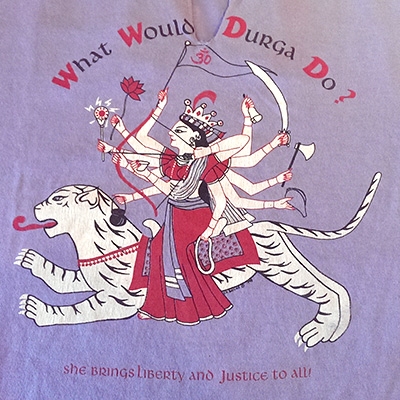
durga1_4inIt’s one of my favorite T-shirts. Every time I wear it, people who know who Durga is comment. So do some people who don’t know who the Hindu goddess is.

 

“What would Durga do?” is of course an echo of the question What would Jesus Do?

I’ve just done a bit of research and learned that this phrase may come from the Middle Ages, that it was famously used in a sermon in about 1891, and that it became very popular among evangelical Christians during the 1990s. What would Jesus do? I think he’d remind us to pay closer attention to the Sermon on the Mount (Matthew 5, 6, 7), especially the Beatitudes and the Golden Rule: “So whatever you wish that others would do to you, do also to them” (Matt.: 7:12). The Golden Rule is of course given in the other major religions, too. WWJD has also been turned into WWBD—“What would Buddha do?” I think the Buddha would tell us to live more mindfully.

But who, you may be asking, is Durga? Why does she have all those arms? Why is she carrying all those weapons? Why is she riding on a tiger? I’ll answer with reference to Patricia Monaghan’s New Book of Goddesses and Heroines (Llewellyn, 1997). While all the Hindu goddesses are ultimately one goddess with the collective name Devi (“goddess”), Monaghan writes, the goddess appears in different forms. “One of the fiercest of Devi’s forms is Durga … [who is] also the eldest.” She appeared during the “primordial war between gods and antigods” and is the “first manifestation of goddess energy” (p. 106). Continue reading “What Would Durga Do? by Barbara Ardinger”

Satirists as Public Theologians by Melissa James

Melissa James Profile photo

Why satirists have become our public theologians (or why I am doubling down on feminist theological ethics as public theology)…

Did you see the Daily Show last night? I’m sure it was all over your Facebook feed and Twitter. The show just nailed the response to. . .fill in the blank. From Ferguson to pay inequality, from racism to culture wars the satirists have had quite the run lately. From political cartoons to the Onion to late night cable “news” shows, satire plays an important role in society. What satirists are excellent at is holding up a magnifying mirror to our society to show us areas of absurdity, oppression, and hypocrisy. The mix of political commentary and humor allows satirists to push further than many other interlocutors in public discourse.

Part of their success stems from our deep need and longing for collective moral reflection and humor allows us to do so in a way that feels safe enough to engage. What makes good satirists effective is their ability to do deep, critical analysis of society. They use sociology. The better they employ their analysis the better their satire. The better the satire the more they reflect to us what we need to hear. And many satirists have played that role really well. Continue reading “Satirists as Public Theologians by Melissa James”

Mr. Big Man by Jameelah Medina

Jameelah Medina

This past week, I have discussed with college students the time I was wrongly arrested and harassed by an Islamophobic Sheriff Deputy several years ago, which led to a successful court case against my county spearheaded by the ACLU. I opened up the discussion with the following religiously feminist spoken word piece I wrote:


Mr. Big Man

You told me what to write, word for word for word for word in my statement,

To get me caught up in your trickery is what you meant,
Acting like you were my friend,
Just so that you could win,

Me over and dictate the stroke of my pen,

But then Continue reading “Mr. Big Man by Jameelah Medina”

Liberation Lessons for Pesach by Ivy Helman

Each year we read the story of our exodus from Egypt during the Pesach seder. The story is one of human liberation from oppression. Yet, most of the imagery we encounter, the drama of the story so to speak, involves nature: a river that saves a baby, a burning bush, the plagues, the re(e)d sea, the wilderness, lack of food and water and the promised land itself. What does this mean?

In general, it means that human liberation is intimately connected to the liberation of all of creation.  In particular, the exodus story can teach us many lessons about environmental justice.  I’m going to explore five of them here: do not manipulate nature, use water wisely, form a connection to the land, imagine G-d differently and treat humans, animals and the land well.

Continue reading “Liberation Lessons for Pesach by Ivy Helman”

Enemy of (H)Islam by Vanessa Rivera de la Fuente

Vanessa Rivera de la Fuente. Misogyny in IslamSo, again, you, the most holy and enlightened man of the mosque have pointed your finger at me to declare, noisy and hysterical, that I am an “Enemy of Islam.” Then you, who preaches and recites best, have gone out there slandering me, “eating my flesh,” devotedly.

“Enemy of Islam.” Well, which Islam? Is there one unique Islam? Why is your Islam, THE Islam? There are so many ways to be Muslim, or, didn’t you know?

You seem to follow the principle “you believe like me or you believe against me,” especially when the discussion is about women. In your narrow view, I am an enemy of Islam because I’m a feminist, radical, progressive woman. I am engaged in interfaith dialogue and in political struggle against discrimination instead of “being at home serving [my] husband as a good Muslimah.” Continue reading “Enemy of (H)Islam by Vanessa Rivera de la Fuente”

Role Play: In Search of the Authenticity of My Being by Elise Edwards

Elise Edwards“I stood in the authenticity of my being: Black, preacher, Baptist, woman. For the same God who made me a preacher made me a woman, and I am convinced that God was not confused on either account.”
– Reverend Dr. Prathia Hall

These words came across my Facebook feed on Sunday in celebration of International Women’s Day. Reconciling Ministries Network put the statement on its Facebook page, along with a picture of Prathia Hall preaching from the pulpit, in remembrance and honor of women leaders who contributed to the US Civil Rights Movement. This past Sunday, March 8, when the quote was displayed, marked the 50th anniversary of Selma’s Bloody Sunday. Prathia Hall was a leader in the Student Non-Violent Coordinating Committee (SNCC) and one of the activists on the Edmund Pettus Bridge who were attacked as they began to march from Selma to Montgomery, Alabama. Later in her life, she became an ordained minister, professor, and womanist theologian.

For me, this past weekend was about remembrance through many forms. While there were many events commemorating Selma and the important events that unfolded there 50 years ago, my family and I were focused on a more intimate form of remembrance. On Saturday, we held a dinner and informal memorial service for my godfather who passed away last month. I got the news of his death on a day when I’d been doing some deep soul-searching and reflecting about the image I present to the world and its correspondence with who I am and desire to be. Just a few days prior, I’d spoken to my godfather about his health and subsequently, I had been questioning how I might be more connected to him. We lived several states apart, and I wondered how I could be a good goddaughter to him despite the distance. Those questions are left unanswered in the wake of his death. Continue reading “Role Play: In Search of the Authenticity of My Being by Elise Edwards”

Being Scared: Fear and Authenticity by Ivy Helman

meblogMy partner is a lawyer who works with asylum seekers and other immigrants here in the Czech Republic (ČR). She’s amazing at her job and I’m constantly in awe of her passion and commitment along with her righteous anger at systematic injustices. In fact just last week, her workplace, together with a consortium of other immigration organizations in the ČR, helped organize a demonstration in the center of Prague to protest the Czech Republic’s refusal to admit Syrian children and their families into the country. She invited me to attend the event with her. I went.

It was my first time attending a public demonstration in Europe. It was moving to see many of her co-workers there and inspiring to listen to the passionate speeches against xenophobia, Islamophobia, racism, the plight of the Roma people as well as the need to come together and welcome diversity. In addition, there were signs in Czech, German and English saying “No One is Illegal,” “End Xenophobia,” “Do Syrian Children Have to Wait for their (Nicholas) Winton?” “I want to have a Syrian Friend!” and “Refugees Welcome!” I wanted to hold each one of those signs! Continue reading “Being Scared: Fear and Authenticity by Ivy Helman”

The Case of Mary’s Decency by Xochitl Alvizo

Incarnation, Goddess spirituality, Xochitl Alvizo, god became flesh

This post builds on yesterday’s post on Marcella Althaus-Reid’s indecent theology.

In her book, From Feminist Theology to Indecent Theology, Marcella Althaus-Reid states that liberation theology has two dominant characteristics: the familiar ‘preferential option for the poor,’ with its suspicion of class structures and the influence these have on faith and church teachings to perpetuate and preserve its unjust systems of oppression and domination; and  for its praxis of transformation of said unjust systems (FFTIT, 11). Marcella Althaus-Reid credits liberation theology for “systematically and structurally using the concept of ideological formation in order to unveil class economic interests embedded in theology” (FFTIT, 11).

To build on this, Althaus-Reid uses the concepts of ‘decency’ and ‘indecency’ to challenge theology’s obsession to regulate and control “sexual performances, roles and behavioral patterns of people…through a sexually based patriarchal hierarchy based in a particular androcentric understanding of life according to predetermined identities” – in other words, heterosexism. Indecent theology, then, aims to strip away theology’s false claim to sexual neutrality and its obsession to control, and instead aims to develop a theology free from the heterosexism that confines it (FFTIT, 83). One key place in theology she seeks to indecent (she used the word as a verb) is the “legend of Mary” (IT, 40).

Continue reading “The Case of Mary’s Decency by Xochitl Alvizo”

A Little Indecency with Marcella Althaus-Reid by Xochitl Alvizo

Incarnation, Goddess spirituality, Xochitl Alvizo, god became fleshInspired by the conversation following Vanessa Rivera de la Fuente’s post yesterday, I offer here a little synopsis of Marcella Althaus-Reid’s work in Indecent Theology: Theological Perversion in Sex, Gender, and Politics.

Marcella Althaus-Reid opens her book by recalling a question she received from one of her colleagues: “What has sexuality to do with a Feminist Liberation Theology?” To answer she reflected on early liberation theology when it was still in formation and later liberation theology as it gained its place in the academy and the church:

[T]imes change and subversive theology becomes incorporated: church leaders claim that they themselves have always been liberation theologians. They guarantee to the state that there is no danger here…It is acceptable in the academy, entertaining to the wider public and a valuable commodity to publishers. Having reached calm waters, why would I as a feminist liberation theologian risk rocking the boat by introducing such a scandalous theme as sexuality, especially when it is not the theology of sanctified sexuality? (Indecent Theology, 2)

Continue reading “A Little Indecency with Marcella Althaus-Reid by Xochitl Alvizo”