My Immortal Mother-in-Law by Elizabeth Cunningham

Elizabeth Cunningham headshot jpegBefore Olga Eunice Quintero Smyth died on December 4, 2014 at age 101 and 10 months, I was tempted to believe she was immortal, literally. I knew Olga for forty-five years (from age 16 to 61). For thirty-five of those years she was my mother-in-law. Our history began when I was kicked out of high school and went to work at her free-wheeling school, her utter lack of any interest in reforming me a blast of fresh air. It ended with me sitting beside her as she was dying, softly singing “Row, Row, Row Your Boat.”

Olga was named for a Russian princess her mother encountered when she was a babe in her arms en route to Trinidad from her native Venezuela. Olga took for granted her descent from Incan royalty as well. Her mother moved the family to New York when she was eleven. A few years later, she won a scholarship to Mount Holyoke College. She married a classmate’s brother, Julian Smyth, great grandson to Nathaniel Hawthorne. If that weren’t enough, Olga claimed for Julian’s line direct descent from the first century Celtic Queen Boadicea. As long as she could speak, she spun tales. “Where in Africa was she born?” one of her nurses asked me. “What kind of a dancer was she?” Continue reading “My Immortal Mother-in-Law by Elizabeth Cunningham”

I Look To The Sky by Martha Cecilia Ovadia

I was10298689_10104523891581853_7256973903379376739_n formed by traditions. I was formed by religious rituals. I was a part of a religious community.

I no longer have traditions. I no longer have religious rituals. I am no longer part of a religious community.

I constantly have to tell myself the “no longers” when I feel the echos and ghosts of my past creeping up behind me, reminding me of not only who I was, but who I no longer am.

I sometimes whisper to my husband, “I sleep with ghosts…”

I do not just sleep with ghosts. I wake with ghosts. I sometimes even feel like a ghost. Why?

For me, the act of being Catholic was very much a part of my be-ing. To no longer have Catholicism as part of my be-ing leaves me feeling haunted.

My normal schedule when I was 21 looked like this:

6:00 am: Morning Prayer (Liturgy of the Hours)
7:oo am: Daily Mass, rosary
12:00 pm: Meet people at our church hall (the youth room) to then go to lunch (where we would do midday prayers before eating)
5 pm: sometimes mass again
7 pm: adoration, rosary, and then evening prayer with praise and worship

If it was Saturday or Sunday, it was even more intense (because I was not in classes).

When I was an active Catholic, I had a very distinct language for everything. I had a ritual for all occasions. I was an integral part of a community with very defined roles. I do not have these things anymore and navigating without them has been exhilarating but terrifying. Continue reading “I Look To The Sky by Martha Cecilia Ovadia”

A Moment of Silence by Natalie Weaver

Natalie Weaver editedIn my last post, I shared with you my wonderment at the power of music to speak for us when we lack speech and to touch us when we are beyond reach.  Now, I experience wonderment at the power of silence.  For, it was silence that in the end helped my father-in-law, who was truly my father, to shed his mortal coil.  After the noise of caregivers and nurses, of talking and encouraging, of wailing and whispering, there was a window of silence when I sat alone with him, stroking his forehead lightly.  I knew he would be free in that quiet to exhale, and with that final breath, he too became silent.
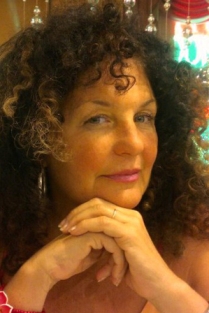
Silence then filled the house, until it was punctuated by the tidal sounds of grief.  And, just like the tides, the grief now ebbs and flows between moments of gentle motion and moments of crushing force.  Behind that grief, though, and behind the rituals we perform to externalize that grief, there remains a giant silence.  It is strange to me that the silence is not experienced as emptiness.  It is not a void or a vacancy or a nothing.  It is an active presence, that is, the silence itself.  It is a deep mystery to be experienced in its own right, without the error of imposing upon it the productions of noise.  For, the silence of bereavement is a fathomless place from which to hear something we could not have heard before.   The silence is holy. Continue reading “A Moment of Silence by Natalie Weaver”

Honoring Our Dead, Holding their Stories by Marie Cartier

MarieCartierforKCETa-thumb-300x448-72405Next Saturday, November 1,  is the holiday Día de Muertos, or Day of the Dead. This is a Mexican holiday that has currency now throughout the world—but especially in California. After all, in 2014 Latinos will surpass whites in California demographics. It is prevalent at this time in Southern California to see sugar skulls decorated—to even have children make decorated sugar skulls and honor the dead. The holiday provides a focal point for a centered observance and prayer dedicated to those who have died in the past year. It is connected to the other holidays at this time, particularly Halloween where as we Wiccans often say “the walls between the worlds are thin.”

Another tradition celebrated at this time is creating an altar for loved ones—or several altars or ofrendas. The altars can hold sugar skulls, photos and artifacts of the deceased, and marigolds. Marigolds are a symbol of death and are referred to as “the flower of death.” Marigold petals might mark a path from a home to a grave in a village so that the dead can find their way back for this holiday. Marigolds make arches and decorations in and around the altars/ofrendas for the scent of the marigold is purported to draw the dead back for the Day of the Dead reunion. The holiday has its roots in indigenous Mexican holidays and continues back possibly 4,000 years to Aztec rituals honoring the goddess Mictecacihuatl, the Queen of the Underworld. Continue reading “Honoring Our Dead, Holding their Stories by Marie Cartier”

Fannie Lou Hamer’s Commitment to Life by Elise M. Edwards

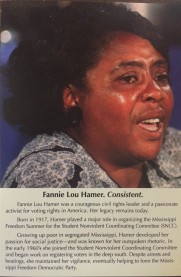
Elise EdwardsA few weeks ago, I came across a postcard that I was given at a conference last year. I got the postcard (advertisement?) because it has a picture of Fannie Lou Hamer on it, and in my home and office, I like to display images and quotes from inspirational women, especially black women. Hamer was a sharecropper from rural Mississippi who became a leader within the civil rights movement in the United States. I was happy to have something with her likeness on it. It was only later that I looked at the text on the front and back of the card, which read in part, ”Often called the ‘spirit of the Civil Rights Movement,” Hamer worked tirelessly on behalf of the rights of others—including the unborn. [She said,] ‘The methods used to take human lives such as abortion, the pill, the ring, etc. amounts to genocide. I believe that abortion is legal murder.’” I realized then that the card was distributed by an organization called Consistent Life, who, in support of a “consistent ethic of life,” is “committed to the protection of life threatened by war, abortion, poverty, racism, capital punishment and euthanasia.”

I was conflicted about the ushamere of Hamer’s image for this organization’s purposes. It is true, Hamer did have those views about abortion and birth control. But I did not know if her image and story was being manipulated for a particular political and religious agenda—one I do not align myself with. I put the card in a box of other images and quotes. I didn’t display it, but I didn’t throw it away, either, which is why I came across it again a couple weeks ago as I was cleaning and decorating my home office. I had the same misgivings about the image as before, and I set it aside again. Continue reading “Fannie Lou Hamer’s Commitment to Life by Elise M. Edwards”

The Dangers of Learning Your Lesson by Abigail Smith

Abigail TreeIt’s been almost two years since I lost someone I loved. The relationship was short, tortured, unhealthy (as all my romantic relationships have been, but that’s another story…) However, I fell particularly hard for this one. When we separated, the pain was unthinkable. I was surprised by how deep it ran. I didn’t know until he was gone how much I really cared about him.  I became physically sick, and even now there are days when I only have to bring him to mind to conjure a familiar pressure behind my eyes and in my throat.
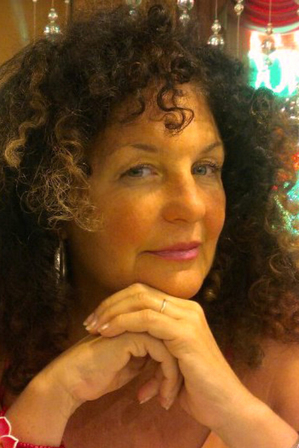

Why did he leave? Why did I love him so much? What went wrong?  How can I stop suffering from this? I’ve discovered that satisfactory answers are nonexistent.

All I could find were platitudes. “It’s his loss.” “Now you know his true colors.” “You’ll find someone else eventually.”  And then there are the hollow religious comforts like, “God has someone better.”  Unsurprisingly, these flippancies don’t help much, but they are predictable and forgivable. Continue reading “The Dangers of Learning Your Lesson by Abigail Smith”

Feminist Bookstores and the Disappearance of Sacred Space by Marie Cartier

MarieCartierforKCETa-thumb-300x448-72405In my book Baby, You Are my Religion: Women, Gay Bars, and Theology Before Stonewall I talked about the importance of the gay women’s bar (and gay men’s bar) as sacred space for pre-Stonewall homosexuals—how the community space of the gay bar was the only public space for pre-Stonewall homosexuals and how it galvanized and concretized a community that had no other way of connecting. It was “home.”

I was so fortunate to do two readings and signings for People Called Women, the feminist bookstore from Toledo, Ohio — and Ohio’s only feminist bookstore — when they brought their “traveling bookstore” which goes to feminist events (they also have their mortar and brick store in Ohio J which I was thrilled to visit) to Michigan Womyn’s Music Festival last week. I was thrilled that we were able to sell out of all the copies of my book that People Called Women brought “to the land” (Michfest). I was thrilled that so many women showed up to our event, told stories about early bar life, cried, shared hugs and created community — and bought books. It felt radical and “old school” feminist. It felt like something I have missed – that connection with a feminist bookstore–for Los Angeles lost our women’s bookstore in 1999 —15 years ago.

people called women- front of store
Marie Cartier w/ Gina Mercurio, owner of People Called Women, Photo by: Megan Morris

For many of us who came of age post-Stonewall in the mid 70s, 80s and late 90s, the gay women’s bookstores—or rather feminist bookstores — were these sacred “home” spaces. They were our “alternate church,” as I so label the pre-Stonewall bars.

I “came out” as a lesbian and as a feminist — in 1979. One of the first places I visited was New Words Bookstore in Cambridge, MA. New Words really did feel like that—“new words,” like parting the curtain onto a brand new world where I had access to language that finally made sense—a new way of communicating—that is what feminism felt like — like being able to talk and be heard and understood for the very first time. Continue reading “Feminist Bookstores and the Disappearance of Sacred Space by Marie Cartier”

Watching “Noah” Brought Me Closer to Humanity by Andreea Nica

Andreea Nica, pentecostalismAs a child, I enjoyed the story of Noah’s Ark. I would often imagine pairs of animals running for safety in Noah’s architecturally majestic haven. Practical questions didn’t enter my mind during this blissful period of naivety. I ignored the part where God expressed regret in creating humanity, or when Noah gets drunk and lies bare naked for his children to cover his shame. My bible study teacher would explain to us that the point of the story was that Noah, a holy man, trusted God and carried out his will.

Disclaimer: I understand that the film is not meant to be an exact representation of the story in the bible, but loosely based around it. Also, if you plan on watching the film, read at your discretion.

In the film, Noah’s character is played by leading actor Russell Crowe, who appears strong, confident, and zealous in his trust in God – all necessary qualities to fulfill God’s demand of killing off the rest of humanity because of their wickedness. Later in the film, Noah realizes that he and his family are also wicked leading to his revelation, ahem, God’s revelation, that humanity must cease with Noah’s family. This doesn’t pan out too well with his children and wife. It was also bad news for Emma Watson, the orphan girl Noah’s family saves and raises as their own, who after accepting that she is barren is miraculously healed and gives birth to two girls. Noah decides that the female infants must die according to God’s will to end humanity. Continue reading “Watching “Noah” Brought Me Closer to Humanity by Andreea Nica”

Goodnight, Sweet Friends by Natalie Kertes Weaver

Natalie Weaver

Yesterday, to this day of my writing, two of my friends died.  Both endured years of struggle against cancers, and both finally yielded to death at nearly the same hour.  I received notices of their passing within moments of one another.  We sat vigil with the family of one of my friends until late in the evening, while the other friend was prepared for repatriation in the land of her ancestors.

In the home where we sat vigil, I entered the room where my friend had passed away.  I wanted to feel the last fading traces of her physical presence.  I don’t know whether any part of her was there or not, but I was grateful to be in the place where she had been.  The room was very full.  It held the medical equipment that had briefly sustained her life for the last few days, but it was mostly stuffed with the clutter and the souvenirs of a life.  Porcelain trinkets, formal family portraits, travel photographs, colorful shot glasses collected from the cities she had visited, and everything covered with a fine layer of dust. Continue reading “Goodnight, Sweet Friends by Natalie Kertes Weaver”

Nelson Mandela to hell? by amina wadud

Amina Wadud 2 I am Muslim, by choice, practice and vocation

As I am transiting back into America from Asia, Nelson Rolihlahla Mandela made his final transition from our collective human lives to the next dominion. (I mention my transition only to apologize for not continuing with the third installment on Vipassana; sometimes real life—or death –gets in the way).

Instead, I want to say a few words about the man President Obama referred to as “the last great hero of the 20th Century.” First the personal glimpse: I got to shake hands with Mandela when he included Malaysia among those countries he visited upon release from a 27 year prison term. It was 1991 and I felt the wind of change. In a small country like Malaysia it’s easier to get up close and personal with a national guest of this stature. No big deal (but I did tell my friends I wouldn’t wash my hand for a week!).

The beginnings of my own deep considerations about gender in Islam were under way at this same time and in fact got their biggest boost when I visited South Africa for the first time. The whole nation was marking 100 days in the Mandela presidency. Every fiber in the air sparkled with the intensity of change. I became friends with South African Muslims who had struggled side by side with comrades from all races and religions in the movement to tumble apartheid. Sometimes they’d had to stand against conservative members of their own Muslim community to form such alliances. Continue reading “Nelson Mandela to hell? by amina wadud”