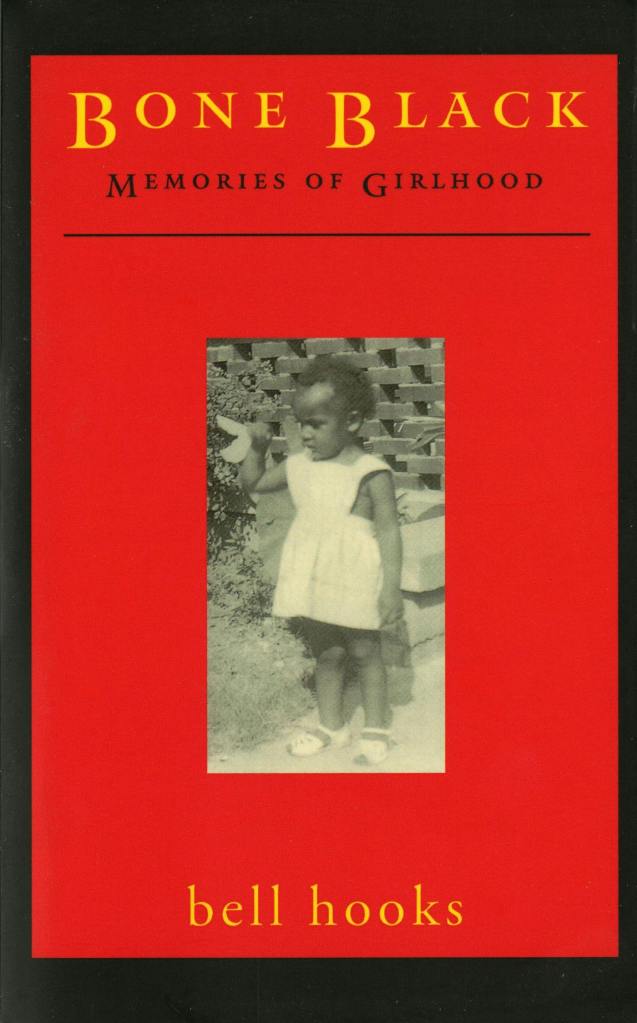
Reflections On Bone Black: Memories Of GirlHood by Zoe Carlin

Bell Hooks explores in the memoir Bone Black: Memories of Girlhood the extreme effects of race, gender, and class on her identity and self esteem as a Black woman. Each chapter of Bone Black showcases stories of Bell Hooks’ childhood experiences growing up in a racially segregated environment. Through these experiences, she shares how the mainstream beauty standard, the racism towards Black people, and the limitations imposed by class and gender have shaped her perceptions of herself and her worth. Hooks also discusses how white supremacy, the patriarchy, and societal neglect intertwine.

What particularly stood out to me is how her story and the themes mentioned connect to spirituality and are offering further ideas on resistance and empowerment. It also touches on connections with identity formation and our sense of self. For example, the memoir shared insight of how the beauty standards at the time were typically associated with being white. As a Black woman, Hooks shared how she had felt undesirable due to not being included in these standards that were set in place. She does not just reflect on the pain of being marginalized but she also delves into the complexity of being a Black woman in a masculine dominated world. Hooks had to navigate both the oppression of racist behavior by others around her and the misogyny of a patriarchal system that was determined to define her worth based on her appearance.

Continue reading “Reflections On Bone Black: Memories Of GirlHood by Zoe Carlin”

Virgin Mary Blue: A short story by Marie Cartier

Nicole stared at the blue water in the pool. It was so wet and so blue—Virgin Mary blue. It was so hot in Texas, she thought that over and over, ever since her parents moved the family to Fort Worth for her dad’s job.

            They were living at the Naval Air Station. It was 1965 and they did not have air conditioning in their apartment: with its one bathroom, two parents and four kids. The heat was an animal. To escape it she played in the mud between the buildings. This was nothing like the woods of New Hampshire, but here they were and they weren’t going home—maybe ever. That’s what her mother said.

Continue reading “Virgin Mary Blue: A short story by Marie Cartier”

From the Archives: Preserving the Complete History: Remembering Japanese Internment Camps

This was originally posted on May 28, 2017

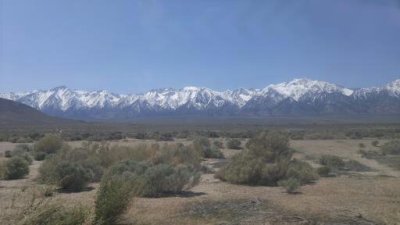
A couple of months ago I did a day trip to visit the historical site of one of the 10 internment camps which were formed due to Executive Order 9066 issued on February 19, 1942. Manzanar Relocation Camp is located between the Sierra Nevadas and the Owens Valley. Manzanar held over 11,070 Japanese Americans from 1942–1945. EO 9066 forced 120,000 American citizens to leave everything and become in all accounts prisoners; two-thirds of those were native-born American citizens. This executive order largely focused on people living on the West Coast of the United States to eliminate the possible threat of a secondary attack. They were relocated far inland and the majority of the camps were outside of the West Coast. While this was done in the 1940s, our current climate is looming to make it seem like there are forces in this world that are attempting to perform different forms of subjugation and confinement.

Manzanar, in the middle of nowhere California (and I mean nowhere—it takes over three hours to drive the more than 230 miles from Los Angeles and it is not directly accessible from Central California), is divided by the great Sierra Nevadas. This is one of the things that struck me when I arrived at Manzanar—the stark beauty and ruggedness of the mountains, the immense flat lines of the valley, and the complete isolation. Due to being so close to the Nevadas and the desert valley conditions, the weather can be extreme. Many of the detainees documented the harshness of the weather conditions, from the high winds to the stark cold at night, and the barely adequate buildings to shelter them from it.

Continue reading “From the Archives: Preserving the Complete History: Remembering Japanese Internment Camps”

From the Archives: Does the Term “Women of Color” Bother You? By Grace Yia-Hei Kao

Moderator’s note: This marvelous FAR site has been running for 10 years and has had more than 3,600 posts in that time. There are so many treasures that have been posted in this decade that they tend to get lost in the archives. We are beginning this column so that we can all revisit some of these gems. Today’s blogpost was originally posted August 11, 2015. You can visit it here to see the original comments.

Grace Kao

I recently came back from a weeklong camping retreat for Christian faculty and their families in beautiful Catalina (an island an hour’s boat ride away from the Southern Californian mainland). This year’s conference theme was “Power Revealed: Gifts, Dangers, and Possibilities.” Not surprisingly, the topics of race, race relations, and institutional racism came-up repeatedly in sessions and informal conversations.

Continue reading “From the Archives: Does the Term “Women of Color” Bother You? By Grace Yia-Hei Kao”

Diversifying Marvel and the Monolith of Superheroes by Anjeanette LeBoeuf

It’s been some time since I penned a FAR post. Much has changed and much has stayed the same. I have since moved to a different part of the United States and have started a new teaching position at a large university. Yet, I am still a scholar who seeks out the connection between feminism, gender representation, religion, and popular culture. Which brings me to this new post.

Continue reading “Diversifying Marvel and the Monolith of Superheroes by Anjeanette LeBoeuf”

We Are Not Oppressed Because We Remember by Chasity Jones

Many questions are asked of us as a community, but the answers which are so complex that we should be commended for even attempting to answer, are heard- if they are not interrupted- but rarely understood. As a Black mother and wife, I have accepted the fact that no one will understand my struggle outside of other Black mothers and wives. After being asked questions about how my community relates to slavery, I am convinced that no one outside of my Black American community will ever understand how slavery has impacted our lives, identities, family structures, trauma, and deaths. Furthermore, it has yet to be understood how the past of slavery continues to impact these areas as a people.

Firstly, although slavery has left an immense imprint on our racial memory, the Black community is not stuck in slavery simply because we bring it up. It is brought up because it is a part of our story and we should not be made to feel ashamed of it. Just because you are tired of hearing about it or uncomfortable does not mean that Black Americans should be made to feel as though should avoid speaking of our history. Some many pro-Black groups and movements emphasize and celebrate the achievements of Black Americans before, during, after, and despite slavery. However, these movements threaten the dominant culture, and much of their achievements are ignored or perceived as threats and terrorism. It is hard to educate ourselves and our children about our ancestor pre-enslavement because our legacy, history, sacred knowledge, and culture were destroyed and our memories were erased and replaced with the bible and colonialist interpretations of scripture. Many of these scriptures are interpreted to justify slavery and are still used to justify police brutality, mass incarceration, and psychological warfare on Black Americans. Nevertheless, we do what we can to celebrate ourselves and our heritage. In doing so, we cannot ever forget slavery.

Continue reading “We Are Not Oppressed Because We Remember by Chasity Jones”

Blinded by the White by Marcia Mount Shoop

mms headshot 2015White supremacy culture is on full display day in and day out in America.  You don’t have to strain to see it—the President’s recent comparison of the impeachment proceedings to a lynching is the latest example.
Of course, even such an extreme example is still defended by white people of all shapes and sizes: senators, voters, talking heads, and the offender himself.  The grotesquery of such a distorted perspective is emblematic of a sickness in our country to be sure.

But there are even more sinister forms of white supremacy that afflict our collective lives.  They are harder for many white people to see. And they are, therefore, harder for us to believe. This kind of whiteness is the whiteness that blinds us. This is the whiteness that creates the conditions for the extremes to be mistaken for the whole problem.  But more importantly, this is the kind of whiteness that creates the conditions for whiteness to be even more tenacious in some dangerous and annihilating ways.

Continue reading “Blinded by the White by Marcia Mount Shoop”

Greenness, Whiteness, Blackness, and the Nature of the World by Marisa Goudy

There’s magic in hiking alone, but as women, we’ve been taught to worry about venturing far on our own. In fact, we’ve been taught to worry about a lot more than that.

Though once I merely shrugged off the warnings and the horror stories, confident that I was wrapped in some sort of “not me” protective veil, I don’t usually take my safety for granted anymore. Maybe it’s because I’ve outgrown the belief that I’m invincible. Maybe it’s because I’m a mother and have a different understanding of the fragility of life and the female body. Maybe it’s because that murderer on the Appalachian Trail went by the nickname “Sovereign,” appropriating the powerful, beautiful word that is so essential to my life’s work.

This particular day, however, my desire to be outside was more compelling than my new bend toward caution. I called my husband to tell him just where I’d be, joking that he needed to know where to look for me if I didn’t pick up the girls from camp on time.

Continue reading “Greenness, Whiteness, Blackness, and the Nature of the World by Marisa Goudy”

Coming to Terms with Privilege: A Personal Reflection by Elise M. Edwards

elise-edwardsIn my two previous posts, I shared my recent experience talking about privilege at a church near me.  Today, I will wrap up this short series with a more personal reflection about privilege from a Christian perspective.  Last month, I was thinking theologically about what those of us who have privilege should do with it.  But, as feminists and womanists, acknowledging our privilege can be complicated.  Most of us in this FAR community do possess some forms of privilege while, at the same time, we lack other forms of privilege.  Each of us remains the same person wherever we go, yet our status can change when we switch contexts.  As a black woman, I do not have white privilege or male privilege.  But I am privileged when it comes to education and class and physical ability.  I am a Christian who works at a Christian university in a part of Texas that is culturally predominantly Christian. So that’s a form of privilege.  Although as a single woman without children, I don’t fit the cultural norm where I live, my sexual orientation and cis-gendered identity afford me some privilege, too.

Continue reading “Coming to Terms with Privilege: A Personal Reflection by Elise M. Edwards”

What Can We Do to Weaken Privilege? by Elise M. Edwards

elise-edwardsIn my previous post, I talked about discussing the concept of privilege (male privilege, white privilege, and class privilege) with nuance.  Earlier that week, I had led a workshop at a local church on “Fine-tuning Privilege,” using Peggy McIntosh’s 1989 essay “White Privilege: Unpacking the Invisible Knapsack” as a resource.  (If you are unfamiliar with it, take a few minutes to read it and reflect upon it.)  Part of my talk was about naming and understanding privilege.  Discussion and comprehension are not enough, though.  We must counter it.

One strategy for fighting privilege is making it visible. The recipients of privilege are often unaware that they have to systemic advantage over others. Privilege, used in the context of racism, sexism, heterosexism, classism, and religious dominance, is not something earned on merit alone. In the essay linked above, McIntosh describes it like this: “I have come to see white privilege as an invisible package of unearned assets which I can count on cashing in each day, but about which I was meant to remain oblivious.” These are conditions built into our culture that some groups receive which benefit them to the detriment of others. Making privilege visible means naming it and calling it out. Wage gaps, digital divides, and racial profiling practices exist; ignoring them perpetrates the problems.

Continue reading “What Can We Do to Weaken Privilege? by Elise M. Edwards”