The Difficult Issue of the Origins of the Buddhist Nuns’ Order by Oxana Poberejnaia

oxanaThe origins of the Buddhist Nuns ‘ Order are a contentious issue in Theravada Buddhism. Paradoxically, it is also the issue that is not discussed a lot. Which is surprising, as in current Buddhism there is a gaping hole where a Theravada Bhikkhuni (Nuns) community should be. The prevailing view is that the nuns’ full ordination line was irrevocably lost long in the past and cannot be restored.

There are separate attempts here and there to bring Theravada Nuns’ Order back, including Ajahn Brahm’s ordaining a group of nuns in Dhammasara Monastery in Australia in 2009. This resulted in severe criticism by some Theravada religious leaders and expulsion of Ajahn Brahm and the monastery he leads from the organisation of the Sangha of Wat Nong Pah Pong.

AniPemaChodronMahayana Nuns receive full ordination, as it is considered that historically the Order did not lose continuity since the Buddha’s times. However, for both Theravada and Mahayana something called “The Eight Garudhammas” – the eight heavy rules – remain a painful issue. These are the rules that the historical Buddha is supposed to have given the first nuns to whom he gave ordination. These eight rules were the condition on which the Buddha would even allow women to become Bhikkhuni.
Continue reading “The Difficult Issue of the Origins of the Buddhist Nuns’ Order by Oxana Poberejnaia”

Breaking The Silence About Sexual Violence by Vanessa Rivera de la Fuente

Vanessa Rivera de la Fuente. Rape CultureMy last article for Feminism and Religion had a very brief reference to an episode of sexual violence; since its publication I have received emails from women who decided to tell me their experiences with rape and abuse.

I am deeply grateful, ladies. I read each one of your stories. I am honored by the trust you placed in me to open your heart and let me go in to see your sorrow and hopes. My soul found solidarity in your words and I recognized myself in your struggle with physical and emotional scars, with your courage to pick up the pieces and coming back from the ashes to pursue justice, inner peace and build new self confidence.

Breaking the silence is not easy. We live in a culture where “women are prettier the more they remain quiet.” We’re taught rather to accept violence without complaints; if we talk, we will be blamed and vilified, isolated, ashamed or mocked. Rape is frequent topic of jokes and the medicine many males recommend for disciplining women who don’t behave “as a woman should.” Continue reading “Breaking The Silence About Sexual Violence by Vanessa Rivera de la Fuente”

Mother Blessings and the Power of Ritual by Molly

Mollyblessingway 116You are the
most powerful
intelligent
inspirational

Woman

Close to my heart.

You continue to
become
exponentially more amazing.

Always giving
others the step UP.

Force of the cosmos
connecting the Web

You are.

Thank you.

–Phanie


Last week, my friend sat on the floor during my mother blessing ceremony and wrote the above poem for me. When she gave it to me she said, “I’m not like you, I don’t write things and share them on the internet.” It was very powerful to receive the gift of written word from someone who does not often write, but who knows how deeply writing speaks to me.  Continue reading “Mother Blessings and the Power of Ritual by Molly”

Survivorship to Thrivorship in Sedna’s Ocean by Carolyn Lee Boyd

carolyn portrait

 These past three months I have learned the wonderful, important word “survivorship.” At the cancer center where I receive care, “survivorship” means life’s physical, emotional, mental, spiritual, economic, social, and political aspects affecting the quality and quantity of life after treatment.

“Survivorship” also perfectly describes what I have seen over and over working with older women, especially those who have made their lives masterpieces of this art. The deaths of loved ones, the loss of home and country, devastating illness and lifelong disability, violence from family and discrimination and hate from strangers – through it all they have found a strength and power that they have used to make their lives and that of others more meaningful and impactful. In fact, almost all older, and many younger, women I know have been transformed by their own kind of survivorship into someone beyond who she imagined she would ever be.

Survivorship also describes the courage, persistence, strength, wits, guts, intelligence, and wisdom of the global community of women necessary to overcome the trauma, violence, violation and repression of at least the past several thousand years. It is what has brought women through to where we are now.  Women’s spirituality as a force and a movement is also a heroine of survivorship. Through millennia of being repressed and dressed up in the garments of patriarchal practices to suit their needs, the traditions and spirit of the Female Divine have survived and we now see Her reclaiming Her place in our spiritual lives, theology, and world history.

Continue reading “Survivorship to Thrivorship in Sedna’s Ocean by Carolyn Lee Boyd”

The Ocean Refuses No River: Building Our Spiritual Home by Carolyn Lee Boyd

carolyn portrait

 Every day when I drive past one of New England’s ubiquitous small white wooden churches, I am reminded of how in the 17th and 18th century, these simple buildings were the first to be constructed in the center of a new town. They were the focal point of the community, the people’s “spiritual home.” Over the years I have also yearned for and found spiritual homes in the Congregational church I grew up in, the Unitarian Universalist church I attended in my 20s, and the space holding women’s spirituality circles I attended for a decade.

These are all places where I and my spiritual life have been nurtured and affirmed, where I have been both comfortable and challenged. Each has been unique, and perhaps one benefit of being a “wanderer” among spiritual places is gleaning the lessons and virtues of many “homes.”  Yet, each of these is only a reflection of the one truest “home” not yet discovered, but yet still perceived, that is a deep well connecting the infinity of universal spirit to who I most essentially am as I live my everyday life.

Continue reading “The Ocean Refuses No River: Building Our Spiritual Home by Carolyn Lee Boyd”

Painting Martha Graham by Angela Yarber

angela

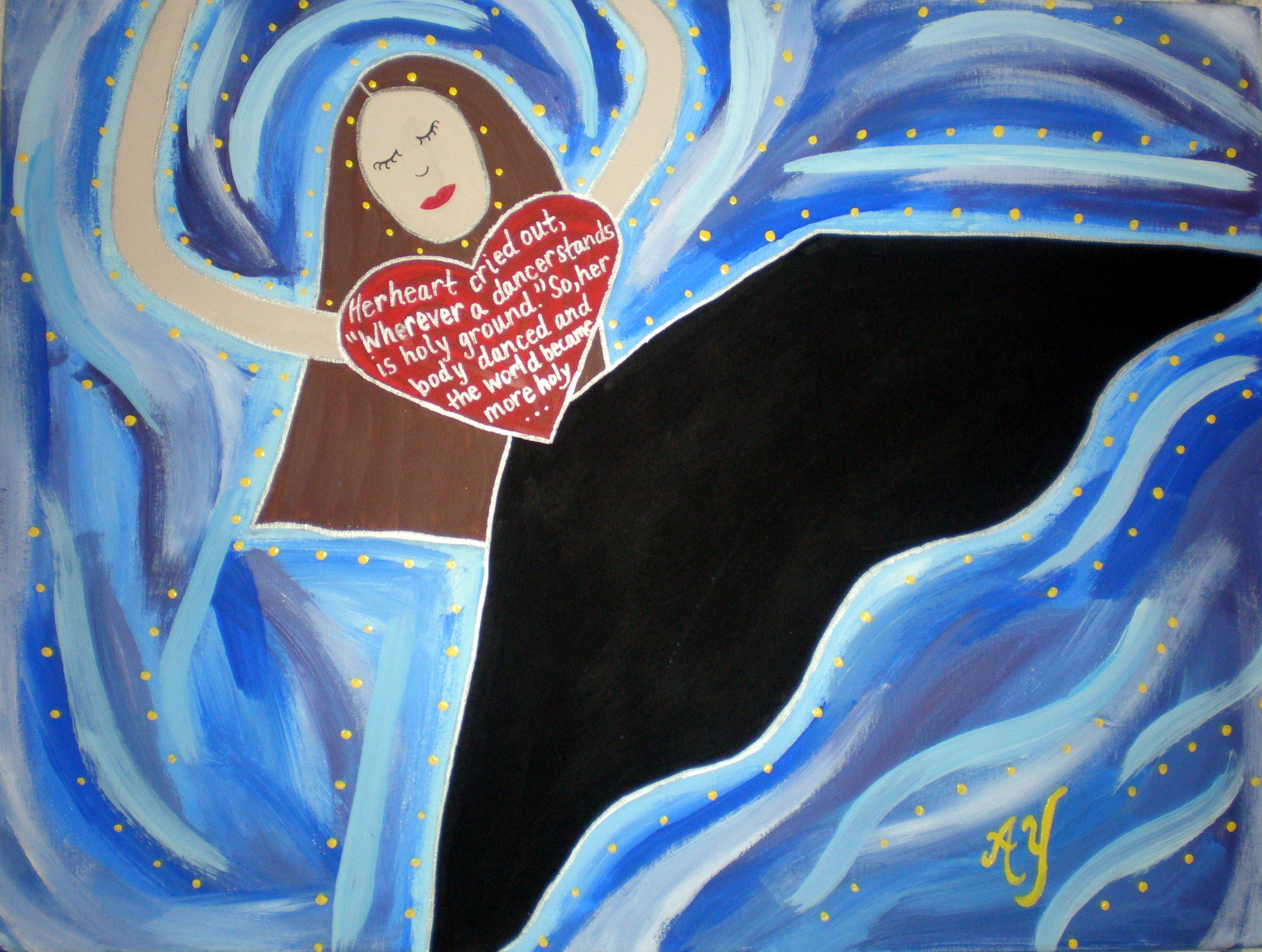
Joining Virginia Woolf , the Shulamite, Mary Daly, Baby Suggs, Pachamama and Gaia, Frida Kahlo, Salome, Guadalupe and Mary, Fatima, Sojourner Truth, Saraswati, Jarena Lee, Isadora Duncan, Miriam, Lilith, Georgia O’Keeffe, Guanyin, Dorothy Day, Sappho, Jephthah’s daughter, Anna Julia Cooper, the Holy Woman Icon archetype, Maya Angelou, and all my other Holy Women Icons with a folk feminist twist  is the dancing revolutionary Martha Graham. So, as the contemporary and modern dancers on So You Think You Can Dance continue to amaze us this summer, let us remember from whence they came.

Martha Graham’s contribution to the world of dance cannot be overestimated. She is regaled as the Picasso of the dance world, revolutionizing it by introducing an entirely new quality of movement known as modern dance. Not only did Graham revolutionize the dance world, like Isadora Duncan before her, she also made great contributions to feminist spirituality. One of her most famous statements may well have been “wherever a dancer stands is holy ground.” Like most dancers who are so in tune with their bodies, Graham new the holiness therein, the ways in which the body can express the ineffable when words alone simply cannot. “The body never lies,” she famously reminds us.

Martha Graham Continue reading “Painting Martha Graham by Angela Yarber”

Writing Holy Women Icons by Angela Yarber

angelaFor two years I have had the great privilege of writing a monthly article about one of my Holy Women Icons with a folk feminist twist for Feminism and Religion. Virginia Woolf , the Shulamite, Mary Daly, Baby Suggs, Pachamama and Gaia, Frida Kahlo, Salome, Guadalupe and Mary, Fatima, Sojourner Truth, Saraswati, Jarena Lee, Isadora Duncan, Miriam, Lilith, Georgia O’Keeffe, Guanyin, Dorothy Day, Sappho, Jephthah’s daughter, Anna Julia Cooper, the Holy Woman Icon archetype, Maya Angelou, and many others that will follow in the months and years ahead have guided, empowered, and inspired me as an artist, activist, feminist, scholar, and preacher.

I knew from that outset that writing about them would deepen my relationship with each of these amazing women. I also knew that their power and efficacy monumentally increases when they join together. This colorful cloud of witnesses has filled myriad galleries, reminding viewers of the powerful women who have paved the way for us today. Many have left the group, finding a resting place in the homes, offices, and galleries of friends, colleagues, and strangers who have purchased or commissioned an icon along the way. And those that remain erupt the hallways of my home with a cavalcade of color, daily reminders of who I am called to be and become.

Between researching their stories, painting them, hanging them in galleries, and selling them, I knew that one day I would bind their stories together in a book. So, it is with tremendous joy that this dream has become a reality. Parson’s Porch Publishing, a non-profit publishing house whose mission is to “turn books to bread” by giving their profits to feed the poor, has lifted up the stories and images of nearly fifty of my beloved Holy Women Icons in a book. So, along with originals, commissions, and prints, Holy Women Icons are now available as a book and as individual greeting cards. It is my sincere hope that by binding the stories of these holy women together, they may provide inspiration and empowerment for all readers, binding all our diverse stories together in a collective cry for beautiful, unabashed, prophetic justice for all. Continue reading “Writing Holy Women Icons by Angela Yarber”

My Afternoon with Amina Wadud: Some Pearls of Wisdom for a Warm Autumn in Santiago by Vanessa Rivera de la Fuente

Vanessa Rivera de la Fuente. Amina WadudAlbert Einstein said that there are two ways for understanding life: One, to believe nothing is a miracle; the other, to believe everything is a miracle. I think life is a bit of both. There are experiences that result from a chain of events we can easily recognize. Others are just a gift. My meeting with Amina Wadud was of the second kind – a beautiful gift from life in the beginning of the autumn in Santiago of Chile.

Meeting The Lady

Since I converted to Islam, around 5 years ago, and started my path now as a feminist Muslim, it is not possible to explain one without the other in my life history- the presence, words and activities of Amina Wadud have been a source of inspiration for me.

Her book, Quran and Woman, was the first approach to and basis for an Islamic Feminism that stands with strong feet against misogyny and fundamentalism in the name of religion. Her courage when she dared to preach a jutba (sermon) and lead a mix prayer – something still forbidden officially for women in Islam – led us to question our  physical place and its symbolic meaning in the mosque. Her vocation as a globetrotter, talking, meeting, and encouraging people in the world to build new meanings and communities based in freedom of spirit, made me understand that the message of Islam and its different reading on gender, is not only on behalf of Muslim women or Muslims in general, but is on behalf of all humankind, like a whole family looking for social justice and freedom, passengers in this big mosque and madrassa that is Allah’s creation.

Continue reading “My Afternoon with Amina Wadud: Some Pearls of Wisdom for a Warm Autumn in Santiago by Vanessa Rivera de la Fuente”

Goodnight, Sweet Friends by Natalie Kertes Weaver

Natalie Weaver

Yesterday, to this day of my writing, two of my friends died.  Both endured years of struggle against cancers, and both finally yielded to death at nearly the same hour.  I received notices of their passing within moments of one another.  We sat vigil with the family of one of my friends until late in the evening, while the other friend was prepared for repatriation in the land of her ancestors.

In the home where we sat vigil, I entered the room where my friend had passed away.  I wanted to feel the last fading traces of her physical presence.  I don’t know whether any part of her was there or not, but I was grateful to be in the place where she had been.  The room was very full.  It held the medical equipment that had briefly sustained her life for the last few days, but it was mostly stuffed with the clutter and the souvenirs of a life.  Porcelain trinkets, formal family portraits, travel photographs, colorful shot glasses collected from the cities she had visited, and everything covered with a fine layer of dust. Continue reading “Goodnight, Sweet Friends by Natalie Kertes Weaver”

Encountering “the Change” as a Personal Exodus and Liberation by Michele Stopera Freyhauf

Freyhauf, Durham, Gender, John Carroll, Menopause, Celebration, ExodusThe story of Exodus, through a liberation lens, has different meanings depending on the person’s experience in life.  I recently experienced my own kind of liberation, a freedom from decades old enslavement.  Through this realization, I celebrated with many other women with the reminder – you are not alone!

The story of the Exodus is a familiar one. It is a text of oppression, journey, and freedom – a freedom that finds us in new surroundings, a place of revelation and transformation.  Many have written about the Exodus text found in the Hebrew Scriptures from different ideological lenses and social locations.  For me, I propose to apply this to menopause (also known as the “change”).

It is not too far fetched to look at menopause as a transformative event in a woman’s life.  For a woman like me, who struggled with the disease Endometriosis since my teen years, menopause it is not only transformative, but liberative.  The only effective treatment for this disease (for me) was the injections of Lupron Depot that put my body in “medical menopause.” Because of that experience,  I felt like my  body was being liberated from disease – this disease that debilitated me monthly or, at the very least, caused me tremendous pain.

A few weeks ago, I had the experience of attending a musical with a group of friends. I am not in the habit of blogging about my personal life, but I cannot help but wonder if my story and experience might help another.  The problem about “the change” is that we joke about it and usually face it with unbelievable dread.  I propose to look at the “change” as a positive – a new beginning, with a reminder to all women out there – you are not alone!

I received this revelation several months after my surgery at a musical named – you guessed it – Menopause!  What started out as a much needed get together of friends turned into an awakening and celebration. Something that has me celebrating the change – even as I fan myself through the hot flashes (I prefer “personal summers”), tear-up during emotional commercials for no reason (something I haven’t experienced since pregnancy), clinching my teeth due to a quick-igniting temper that causes me to exercise remarkable restrain (and you thought patience was a gift to children and teens), to searching every cabinet for that holy grail of comfort food – chocolate.  As I reflected on that evening, it occurred to me that I was living my own exodus story and the very thing that enslaved me can no longer hurt me – I am now free – renewed and emerged, but still in a strange wilderness that holds different challenges. Continue reading “Encountering “the Change” as a Personal Exodus and Liberation by Michele Stopera Freyhauf”