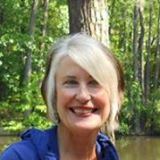
When I teach my Human Spirituality course to college students, I include a section on factory farming. Merriam-Webster defines factory farming as “a large industrialized farm; especially: a farm on which large numbers of livestock are raised indoors in conditions intended to maximize production at minimal cost.”
This sterile definition does not reflect the barbaric conditions in which chickens, pigs, cows, and sheep are raised in order to “maximize production at minimal cost.” For example, chickens are kept in cages with slanted floors, their beaks removed without anesthesia, and artificial lights kept on most of the day in order to increase egg production. Sows are kept immobile in metal cages, unable to nurse their young except through the slats of those metal cages. Male calves are taken away from their mothers at birth and placed in small cages to become veal after a few months. Male chicks, having no “value” in a factory farm setting, are placed on a conveyor belt that leads to being “ground up” alive. I’ve only scratched the surface of the horrors. Continue reading “But…They’re Just Animals by Esther Nelson”
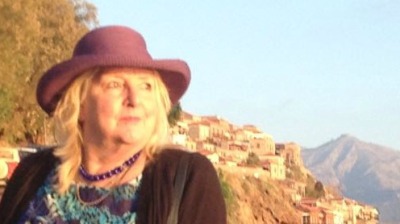
As I was writing this story, my Word program froze several times, and I lost what I had written. This has never happened before. The fifth time, it occurred to me that Artemis was not happy with the way I was telling the story of her life and death. I lit a candle and prayed for her spirit to fly free like the gulls over the sea that I could see out my window and began again. The words in italic are the ones she added.
Yesterday morning I heard the church bells tolling a plaintive, “dong, dong, dong,” as they do when someone dies. Quite a few people die in our village in winter, and I did not wonder who it might be. You didn’t think of me? A few hours later, I saw the death notice on a telephone pole next to my car. My friend and neighbor Artemis died. The words “Theos voithos,” “with the help of God,” came immediately to my mind. Continue reading “Releasing Artemis by Carol P. Christ”
Remembering to be thankful may just be a privileged illusion that individuals in positions of power get to write about in the December of each year to self-congratulate themselves about being actually able to be able to be thankful. It may just seem like people who write about being thankful are complaining or pontificating that being thankful is in itself a chore.
With the holidays just around the corner and the frazzled, crisp ping of anxiety, rush, and panic take over the air around us, it is easy to forget to stop and “smell the roses.” In times where teaching positions continue to shrink and more universities switch to adjunct labor, fees and class costs continue to rise, or just simply life becomes a little more complicated, due to the nature of balancing life, activism, work, friendships, or relationships, remembering to remind myself to be thankful is another task, I find adding to the never-ending list of stuff I always seem I have to do.
However, remembering to be thankful, scheduling it into one’s daily schedule are vital to our success as new and emerging faculty or activists or just in general because being thankful reminds us that we have aspects of our lives that are worth being thankful for. Remembering to be thankful proves that we are in some way, connected to a larger sense of life that, at times, grants our wishes, wants, or desires, brings us despair, and then allows us to get through it, or even makes us feel alive.
As I sit back and look at the personal and professional landscape around me I understand that I have a lot to be thankful for both consciously and unconsciously. Most recently at AAR, I participated on a panel in response to Bernadette Barton’s Pray the Gay Away. During the course of our panel, the conversation of chosen vs. biological families came up. Most recently, my mentor and panel moderator, Dr. Marie Cartier, talked about the same topic here on FAR and the difficulties many of us experience in regards to our chosen families vs. our biological families. With the holiday season all around us, and regardless of what or if, you celebrate it or not, it is quite hard to get away from it all without realizing who your “family” is and whether or not you’re close or connected with them can be traumatizing during these times where we’re taught or expected to be with them.
After our discussion on the panel and then at the hotel bar, people discussed the pains and traumas in relation to not having a biological family to go home to during the holidays. Sitting there and listening to the conversations, I realized that, for once in my life, I had nothing to say. Continue reading “Remembering to Be Thankful by John Erickson”
“The tools are unimportant; we have all we need to make magic: our bodies, our breath, our voices, each other.”
–Starhawk
As November drew to a rainy close, we had a small family full moon ritual on our back deck and incorporated a simple gratitude ritual into it. The sky was overcast so we couldn’t actually see the moon, but my four-year-old daughter wanted to get out glow sticks left over from Halloween. We had so much fun dancing around with them and making patterns together in the dark night. We sang a chant I recently made up:
Hallowed evening
Hallowed night
We dance in the shadows
We offer our light.
We did a simple gratitude practice by placing corn kernels in a jar, one for each thing we are grateful for from the past month. We started out slowly and taking turns and then we sped up and the gratitude offerings came tumbling out, over one another. Even the one-year-old added corn, rapidly yet with great concentration to make it actually go in the jar. We drummed and called out, “We are ALIVE! We are GRATEFUL! We are POWERFUL! We are CREATIVE!” When we finally decided to close our ritual and go back inside, the moon peeked out from behind the clouds to briefly say hello and it felt like a blessing on the magic we’d just created together.
As we went back inside, I felt relaxed, happy, and connected. For being something very simple, not particularly pre-planned, and semi-chaotic, it felt like one of our deepest and most connected personal family rituals. The quote above from Starhawk floated back into my mind and I reflected that when I try “too hard” to get things ready for a perfect ritual, I often end up feeling a disappointed. Sometimes I feel like giving up on holding ceremonies with my children entirely. Last year, as we prepared to walk our Winter Solstice Spiral, the baby had a poopy diaper that extended up his back. I often end up snapping critically at whomever isn’t doing it “right.” My boys make fart jokes. My husband gives long-suffering sighs. Our circle looks more like a lopsided peanut. Our humming together discordant and off-key. As we lie on the ground together on the Spring Equinox to do our “Earth Listening” practice together, the kids wiggle and fight, pushing one another off the blanket and exclaiming in loud voices so no one can hear what we’re listening for. We listen to a shamanic drumming CD, but the only one to reach a trance state is the baby as I pace back and forth with him in a baby carrier. The four year old ends up crying because she doesn’t see anything and she wanted to see something cool. Martyrpriestess emerges to complain that she doesn’t know why she even bothers trying to do nice things for anyone if this is how you’re all going to act.
I recently finished reading Under Her Wings: The Making of a Magdalene, by Nicole Christine. A theme running through the book was the concept of “As Above, So Below and As Within, So Without.” I read this book as part of my research for my dissertation about contemporary priestessing and as I read, I kept thinking, I want to hear from the Mamapriestesses, from the Hearth Priestesses! Where are the other practicing priestesses with children at home? I noticed in Christine’s book that the bulk of her work took place after her children were grown and, to my mind, she also had to distance or separate from her children and her relationships in order to fully embrace her priestess self. I notice in my reading and my research group that many women seem to come to priestess work when the intensive stage of motherhood has passed, or they do not have children. Is there a very good reason why temple priestesses were “virgins” and village wise women were crones? Where does the Mamapriestess fit?
As I read Christine’s book and witnessed her intensive self-exploration, discovery, and personal ceremonies and journeys, I realized that in many ways personal exploration feels like a luxury I don’t have at this point in my parenting life. How do we balance our inner journeys with our outer processes? Christine references having to step aside and be somewhat aloof or unavailable to let inner processes and understandings develop, since our inner journeys may become significantly bogged down in groups by interpersonal relationships, dramas, venting, chatting, and so forth. For me, this distance for inner process exploration isn’t possible in the immersive stage of life as a mother. And, yet, I also know in my bones that I’m not meant to give it up. How does the As Within and the So Without actually work?
I return to our Full Moon gratitude ritual. My oldest son, 12, whose height is rapidly extending into manhood, totes his tiny brother on one hip with practiced ease, offering his own glow stick and helping my little one hold his into the air. He expresses gratitude for the fun he’s been having this month with his new video game and, “I’m grateful for you for doing things like this with us, Mom.”
My second son, 9, my bravest child, crawls willingly into the darkness under the deck to retrieve lost glow sticks, poked purposefully down porch cracks by the one year old. He returns, triumphant, holding the bundle of sticks aloft.
My daughter, nearly five, tips her face back, looking up at me with eyes alight, “I’m glad to be a Goddess Girl!” she calls out…
Molly has been “gathering the women” to circle, sing, celebrate, and share since 2008. She plans and facilitates women’s circles, seasonal retreats and rituals, mother-daughter circles, family ceremonies, and red tent circles in rural Missouri. She is an ordained priestess who holds MSW and M.Div degrees and she is currently writing her dissertation about contemporary priestessing in the U.S. Molly’s roots are in birth work and in domestic violence activism. She has worked with groups of women since 1996 and teaches college courses in group dynamics and human services. Molly is the author of Womanrunes: a guide to their use and interpretation, Earthprayer, Birthprayer, Lifeprayer, Womanprayer, and The Red Tent Resource Kit. She has maintained her Talk Birth blog since 2007 and writes about thealogy, nature, practical priestessing, and the goddess at her Woodspriestess blog. Molly and her husband Mark co-create original birth art jewelry, figurines, and goddess pendants at Brigid’s Grove.
Note: If you have children at home, I’d love to hear from you about the Mamapriestess topic! If you do not have children by choice, how does this play into your spiritual work? If you do not have children and that is not by choice, how does this play into your spiritual work?
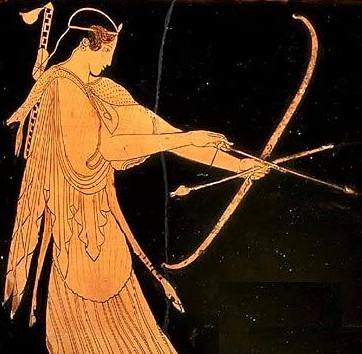
The 2015 Nobel Prize for Medicine was awarded in part to a Chinese woman (Tu) for her identification and isolation to treat malaria of a chemical known as Artemisinin. The name of that chemical derives from the fact that it is found in varying amounts in the ‘family’ (technically, genus) of plants known as Artemisia. The name of that family derives from its association with the goddess Artemis.
Because Tu’s work began in China in the 1960s it is understandable that even if she knew this about Artemisia (a term I use to refer to any one plant or all of the plants of that family) it would not have been a ‘careerbuilder’ for her to point it out to those for whom she was working. It was bad enough that she was a woman. At that place and time, however, if she had said or done something that could be associated with Western culture her name might not even be known today.
Nevertheless, because those awarding the Nobel Prize are free from discrimination or intimidation, it is startling that in the explanation provided for the award no mention is made of the Western legacy of Artemisia. To begin with, the very fact that the Prize was being awarded to a woman for a plant named after a goddess should have elicited at a sense of uncanniness that arguably deserved mention. Be that as it may, the failure to mention that Artemisia has a long history of being used medicinally in the West not only as an insect repellent but also to treat fever–a common symptom of malaria–is simply inexcusable.Continue reading “Artemis As Artemisia: Ancient Female Spirituality & Modern Medicine by Stuart Dean”
Having spent the past year and a half immersed in the study of Celtic Goddesses, I am intrigued by the sharing of many of their attributes, symbols, and associations – shape-shifting, magical birds, and apple orchards in the Otherworld to name just a few. One other common thread found in so many Celtic Goddesses is the existence of many contradictory folk tales about them. Their stories, like the otherworldly mists of the Celtic countryside, which materialize suddenly, obscure reality and then melt away again, exist on the frontier of myth and reality.
Chlíodhna (pronounced Kleena), Celtic Goddess of Beauty, the Sea and the Afterlife, is such a Goddess.
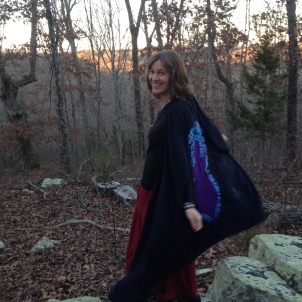
“Human connections are deeply nurtured in the field of shared story.” –Jean Houston
“The universe of made of stories, not of atoms.” –Muriel Rukeyser
This month I went searching for a quote for one of my Red Tent Initiation students. She had shared some powerful reflections about the vulnerability required to reveal our personal stories—there can be a lot of risk, sometimes shame, and more, bound up in our ability to uncover ourselves and speak our truth. What I wanted to communicate with her was the idea that in sharing our stories, including the painful pieces, we free other women to do the same. Our courage to be vulnerable, to be naked, to be flawed, to experiment with ideas, concepts, or ways of being gives permission for other people to do the same.
In 2012, I went to a dancing workshop at Gaea Goddess Gathering. The facilitator mentioned that when facilitating ritual, you have to be willing to look a little ridiculous yourself, have to be willing to risk going a little “over the top” yourself, because in so doing you liberate the other participants—“if she can take that risk and look a little goofy doing so, maybe it is okay for me to do it too.”
After a lot of digging around, I found the quote! I should have known it was from one of my favorite authors and sister FAR blogger, Carol Christ, who said:
“When one woman puts her experiences into words, another woman who has kept silent, afraid of what others will think, can find validation. And when the second woman says aloud, ‘yes, that was my experience too,’ the first woman loses some of her fear.”
This is part of what makes Red Tent Circles so powerful. When women are willing to dig into the questions, activities, and processes, to turn them over, to explore how they work in their own lives…they lose some of the fear and they encourage others to lose their fear too. Continue reading “Story Woman by Molly”
One of the most famous Catholic icons is the model for a Haitian Vodou goddess who protects lesbians.
Traditional images of Erzulie Dantor, the Vodou defender of lesbians, are based on the Black Madonna of Czestochowa. They even share the same two scars on the dark skin of the right cheek.
Every year more than 100,000 people view the original Black Madonna of Czestochowa icon in Poland at one of the most popular Catholic shrines on the planet. John Paul II, the Polish pope, was devoted to her. Few suspect that the revered icon of the Blessed Virgin Mary has a lesbian connection. Continue reading “Black Madonna Transforms into Vodou’s Lesbian Defender by Kittredge Cherry”
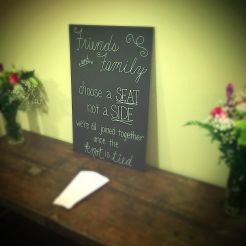
On Saturday, September 19, 2015 I married two of my best friends Andrea and Cindy in holy matrimony in Appleton, WI.
Don’t urge me to leave you or turn back from you.
Where you go, I will go, and where you stay, I will stay.
Your people will be my people and your God my God.
Where you die, I will die, and there I will be buried.
May the God deal with me, be it ever so severely, if even death separates you and me.
–Book of Ruth 1:16-17
On Saturday, September 19, 2015 I married two of my best friends Andrea and Cindy in holy matrimony in Appleton, WI. Having been ordained since 2009, I truly never thought I’d ever get the chance to use these credentials until they asked me a few months back. Although my answer was an automatic yes, I sought to make sure that my homily and the words of advice I gave them on their special day were something unique, not always heard at wedding ceremonies. Continue reading “#LoveWins by John Erickson”
Finding ourselves together in Crete after attending a conference, four friends and I set out to visit the caves of Eilitheia in Amnissos and Agia Paraskevi in Skoteino. As we drove along the coast toward Amnissos, I recalled that caves have been understood as sacred from the dawn of religion. When people knew the earth as their mother, the cave, the opening in the earth was her vagina and womb, the passageway to her deepest mysteries, the secrets of birth and rebirth.
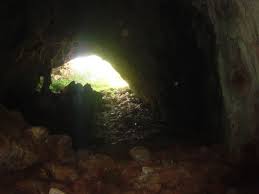
The Eilitheia Cave is in the hills above the ancient port of Amnissos. We arrived in the morning, accompanied by the guard who came with us to unlock the gate. The cave has one large, long room, with a wide mouth, and a low ceiling. There is a belly stone near the entrance that women rubbed to insure conception. Near the center of the cave, in shadowy darkness, are two stalagmites, one squat and the other tall, surrounded by the remains of ancient walls that enclosed the sacred space. The guard told us that they were worshipped as the Mother, seated, and the Daughter, standing. Their heads were chopped off with the blow of an ax. In the back of the cave there are small pools of water, used for healing
As our eyes adjusted to the darkness, we felt that we too had entered into the womb of the Mother. Naomi sat by the Daughter stalagmite, while I leaned against the Mother. We chanted to Her and sang, aware of the bemused but accepting presence of the guard, who retreated to the entrance of the cave. As we turned to leave, Mara crouched at the cave’s entrance to take a picture, her short, full body the image of the Mother Goddess, her wispy blonde hair capturing the light, crowning her like a halo. Slowly, we emerged from the cool depths, the place of ancient mysteries, into the light and warmth of the midday sun.
We visited the Skoteino Cave late in the day, after lunch and a refreshing swim in the sea. To reach the cave, we ascended into the mountains, passed through the small village of Skoteino, and turned right down a dirt road. Above the cave is a small church dedicated to Agia Paraskevi, the patron saint of eyesight. I had been to the cave eleven years earlier with my husband, Roger, on the saint’s name day, July 26th. That day the locals celebrated first in the church, where they decorated the icon of Agia Paraskevi with flowers and lit candles, and then in the cave, where they roasted lamb, sang, and danced. It is likely that this cave has a continuity of worship from ancient times to the present day.
The first time I visited the cave of Skoteino, which means dark, I thought it was a single, huge, high-ceilinged, cathedral-like room, adorned with stalagmites and stalactites. In the meantime, I had learned that beyond the first room, there are three more levels, the final one, totally dark. Mardy offered to lead the way. Two young German men, emerging from the depths, told us the way down was not easy, as there was no clear path.
Marie, unsure of her footing, stayed near the entrance. Naomi, afraid of the unknown, perched on a rock at the back of the first room holding her candle. Mara, Mardy, and I braved the descent. We did not know what awaited us in the dark. With candles and small flashlights, we climbed and slid, sensing a way down. The rocks were cool, damp in some places, but not slippery. There were no sharp edges because the rocks had been smoothed by water. Encouraging each other we reached a place where it looked like the next descent would be though a hole or narrow opening. We still had faint light from the mouth of the cave. The final passageway was unknown, frightening, inviting. We paused, eyes fixed on the dark opening. Mardy broke the silence saying that we should turn back because the sun was about to set.
I made the ascent more rapidly than the others, my body urging me on until I reached the first level. As I walked slowly up the path that meandered through the first large room, I could see two women before me with candles, and two behind me coming up from the depths. I could almost see Persephone coming up from the underworld, torch in hand. Surely it was in a place like this that the Eleusinian Mysteries began.


 When I teach my Human Spirituality course to college students, I include a section on factory farming. Merriam-Webster defines factory farming as “a large industrialized farm; especially: a farm on which large numbers of livestock are raised indoors in conditions intended to maximize production at minimal cost.”
 is story, my Word program froze several times, and I lost what I had written. This has never happened before. The fifth time, it occurred to me that Artemis was not happy with the way I was telling the story of her life and death. I lit a candle and prayed for her spirit to fly free like the gulls over the sea that I could see out my window and began again. The words in italic are the ones she added.

 “Human connections are deeply nurtured in the field of shared story.” –Jean Houston
 Don’t urge me to leave you or turn back from you.
 ea and Cindy in holy matrimony in Appleton, WI. Having been ordained since 2009, I truly never thought I’d ever get the chance to use these credentials until they asked me a few months back. Although my answer was an automatic yes, I sought to make sure that my homily and the words of advice I gave them on their special day were something unique, not always heard at wedding ceremonies.


 Feminism and Religion