Living in an Ever-Changing Co-Creative Universe by Carolyn Lee Boyd

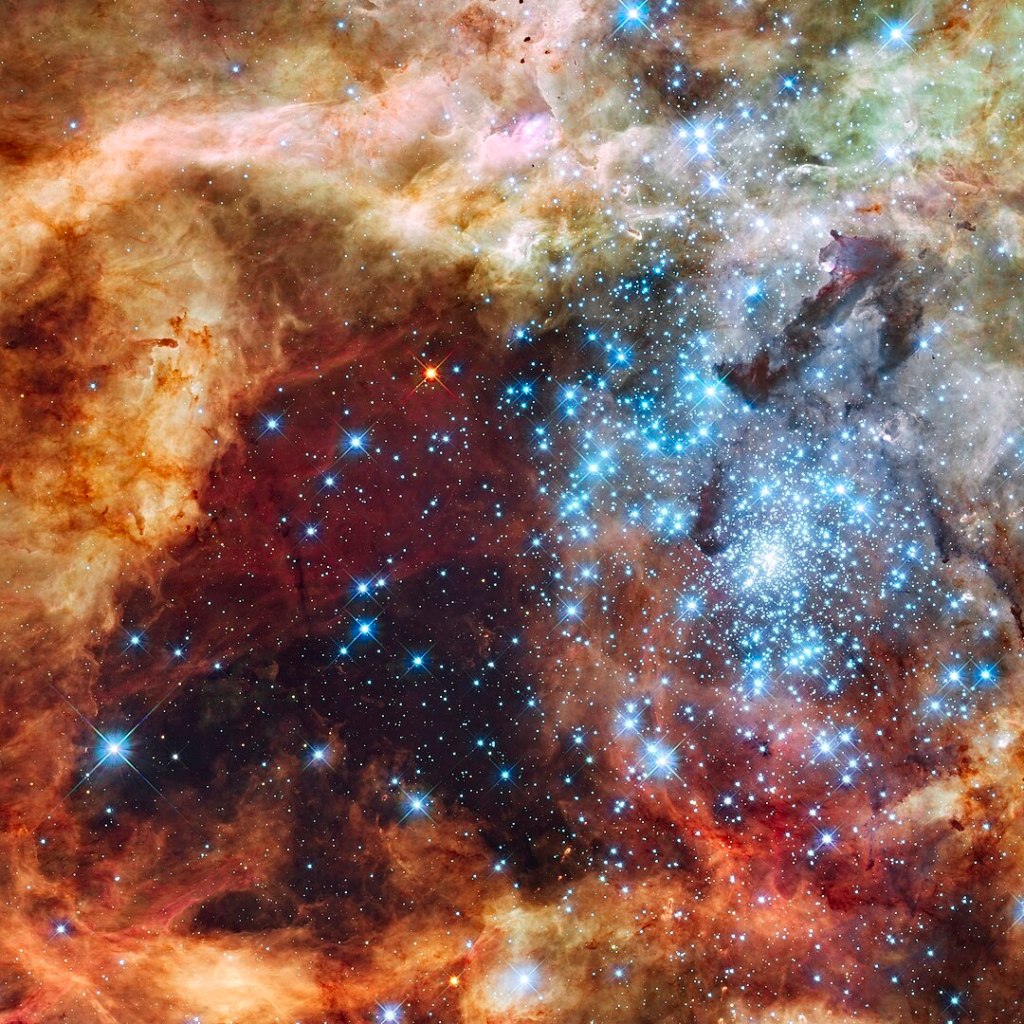
Grand Star Forming Region. These stars are only a few million years old.

Imagine living in a co-creative universe where all beings, including the Divinity and humans, are ever co-evolving reality in a way that nurtures life. What kind of a world would that be? Feminist theologian and FAR contributor Carol Christ brilliantly describes how these ideas, part of an approach called process philosophy, deeply resonate with Goddess thealogy in her 2003 book She Who Changes: Re-Imaging the Divine in the World

She writes “process philosophy states that all life in is process, changing and developing, growing and dying, and that even the divine power participates in changing life. Humans and other beings are not things (substances or essences) situated in empty space, as has often been thought by philosophers and scientists, but are active processes ever in relation and transition…” (3). In fact, “the whole universe is alive and changing, continually co-creating new possibilities of life” (45). Further, “Process philosophy asserts that feeling, sympathy, relationship, creativity, freedom, and enjoyment are the fundamental threads that unite all beings in the universe, including particles of atoms and the divinity” (3). 

Continue reading “Living in an Ever-Changing Co-Creative Universe by Carolyn Lee Boyd”

Summer Lessons, by Molly M. Remer

Let us be gentle with ourselves 
as we cross the threshold 
into summer, 
as we both open our hearts to change 
and open our hands to choice. 
It is now that we both let things go 
and celebrate what is flourishing, 
what is thriving and growing 
and calling us onward. 
Let us be soft and supple, 
luminous and languorous. 
Let us practice the discipline of pleasure 
and the liturgy of delight. 
Let us protect wide margins for magic,
commit to our own life’s unfolding 
and swim freely 
in the current of the sacred 
that is always available 
to receive us 
and welcome us home.

Today, I sit missing the orioles and thinking about cycles of change, how things grow and decline, and how we can choose to be present or not with what we see and feel. I tip my head back in the green filtered light of morning and discover berries beginning on the mulberry trees. The wild raspberries and blackberries too are tipped with small, firm caps of green. I am feeling the sort of overdue clarity that descends when I finally realize I can let something go, that not everything is mine to carry or mine to fix. I know that this clarity too will come and go, but for now, I welcome it, feeling the cool wind stirring my hair and brushing my shoulders as I enjoy the sunshine and the sound of hawks on the wing. There is a powerful hope in these blue sky days and for now, I bask in the sensation of both remembering and reclamation.

This year, as we tip into summer in the Northern hemisphere, the temperatures in my own Midwestern biome have been surprisingly cool, peaceful and rainy. In an era of climate change, this slow entry into the heat of the year has felt welcome and encouraging. Something that continues to inspire and teach me this year has been to start where my feet are, to return again and again to where I am on this earth and in my body. In a culture that encourages fragmentation and distraction, distance, discord, and dis-embodiment, this practice of return is an act of both rebellion and reclamation.

I have been writing for Feminism and Religion for 13 years. This year, sitting down to write and reflecting on the life lesson of starting where my feet are, I decided to go back through my past summer posts here to discover the other lessons I have learned from summers gone by. I chose thirteen lessons to share from past summer posts:

Continue reading “Summer Lessons, by Molly M. Remer”

Legacy of Carol P. Christ: WHAT DOES “GOD INTEND”?


This post was originally published on Oct. 29, 2012 

Indiana Republican candidate Richard Mourdock’s statement that pregnancies resulting from rape are “something God intended” not only shows an appalling lack of empathy and distain for the experiences of raped women, it also is bad theology.

The controversy ignited by Mourdock provides a good opportunity to discuss the theological mistake of “divine omnipotence” also known as the “zero fallacy.”  Mourdock’s belief that God intends the pregnancies of raped women is rooted in the notion that “whatever happens” is the will of God.

The theological category of “divine omnipotence” means that God is all-powerful.  It also means that God has all the power. From this it is said to follow that everything that happens must in some way be the will of God.  Such views are held not only by many devout believers, but also by everyone else who asserts that “there must be a reason” when bad things happen.

The notion that a good God is responsible for all the events that occur in the world is rendered questionable by every bad thing that happens–particularly by bad things that happen to good people. This was the question of Job, and there has never been a satisfactory answer to it. If God can intervene to stop the innocent from being harmed, why does he not do so?  God’s failure to stop rape suggests that either that God is not good, or that a good God chooses a really bad outcome, or that God is not the cause of everything that happens in the world.

Charles Hartshorne called the notion of divine omnipotence the “zero fallacy.” Continue reading “Legacy of Carol P. Christ: WHAT DOES “GOD INTEND”?”

The Field of Belonging, by Molly Remer

May we be resilient
in the face of conflict and change.
May we lean in,
reach out,
root down,
and deepen into
the practices that nurture us
and sustain us.
May we cultivate wise discernment.
May we persist in reclaiming our power
and our attention.
May we embody our prayers.
May we dance bravely
on the bones of the coercive systems
that try to drag us down.
May we lift our heads
to meet the eyes of life.
May we persist in seeing,
in being,
in lifting our resilient and stubborn joys
up to soar.

I know we are weary, overwhelmed by how much damage can be done by sweeps of pen and distant deciding, callous disregard seeming to seep into all the edges and change how the world feels to live in. We may feel frozen with indecision, unsure of what to do or how to help or what to say. So much asks for our attention and our time, asks us to look and to not turn away. We wonder what there is to celebrate in the face of so much anger and so much need. It is hard to feel so small and human, hard to keep hoping, to trust in our own inherent magic and that goodness and beauty are still at work amid the pain. 

Continue reading “The Field of Belonging, by Molly Remer”

Legacy of Carol P. Christ: “The Divine Mystery”?

carol-christ

This post was originally published on Nov. 11th, 2013

“The mystery of God in feminist theological discourse” is the subtitle of Elizabeth Johnson’s widely read She Who Is. The notion that God is “a mystery” is rarely questioned in feminist theologies. But maybe it should be.

Although it is true that the finite cannot encompass the infinite, and that all knowledge is rooted in particular standpoints, I do not agree that the first and last thing to be said about the divine power is that it is “a mystery.” Indeed as I will argue here, speaking about God as “a mystery” obscures more than it “reveals.”

christina's loveThe notion that Goddess or God is “a mystery” is rooted in notions of “a God out there” that most spiritual feminists reject. Goddess or God “in” the world is, I suggest, not unknown, but known, not hidden, but revealed–in the beauty of the world and in ordinary acts of love and generosity.

The notion that God is “a mystery” is a well-worn trope in Roman Catholic theology. Protestants make similar claims when they speak of  the hiddenness of God Continue reading “Legacy of Carol P. Christ: “The Divine Mystery”?”

Legacy of Carol P. Christ: Exciting New Research on Matriarchal Societies

This post was originally published on Aug. 5th, 2011

The following is a guest post written by Carol Christ, Ph.D., a pioneer and founding mother of the Goddess, women’s spirituality, and feminist theology movements, and director of the Ariadne Institute.  She is also the author of multiple books including Rebirth of the Goddess.

Although there are some of us who disagree, the “party line” in the fields of Religious Studies and Archaeology—even among feminists– is that there never were any matriarchies and that claims about peaceful, matrifocal, sedentary, agricultural, Goddess-worshipping societies in Old Europe or elsewhere have been manufactured out of utopian longing.

I myself and most other English-speaking scholars defending Marija Gimbutas’s theories about Old Europe have studiously avoided the word “matriarchy” (speaking rather of “matrifocal, matrilineal, and matrilocal” societies) because the very word “matriarchy” conjures up the image of female-dominated societies where women ruled, waged wars, held men as slaves, and raped and abused men and boys. In fact, this fantasy tells us far more about patriarchy than about it does about matriarchy. Continue reading “Legacy of Carol P. Christ: Exciting New Research on Matriarchal Societies”

Legacy of Carol P. Christ: SHE WHO CHANGES*

This was originally posted on May 21, 2012

She changes everything She touches and everything She touches changes. The world is Her body. The world is in Her and She is in the world. She surrounds us like the air we breathe. She is as close to us as our own breath. She is energy, movement, life, and change. She is the ground of freedom, creativity, sympathy, understanding, and love. In Her we live, and move, and co-create our being. She is always there for each and every one of us, particles of atoms, cells, animals, and human animals. We are precious in Her sight. She understands and remembers us with unending sympathy. She inspires us to live creatively, joyfully, and in harmony with others in the web of life. Yet choice is ours. The world that is Her body is co-created. The choices of every individual particle of an atom, every individual cell, every individual animal, every individual human animal play a part. The adventure of life on planet earth and in the universe as a whole will be enhanced or diminished by the choices we make. She hears the cries of the world, sharing our sorrows with infinite compassion. In a still, small voice, She whispers the desire of Her heart: Life is meant to be enjoyed. She sets before us life and death. We can choose life. Change is. Touch is. Everything we touch can change.

Continue reading “Legacy of Carol P. Christ: SHE WHO CHANGES*”

Legacy of Carol P. Christ: “THE DIVINE MYSTERY”?

This was originally posted on November 11, 2013

christina's love

“The mystery of God in feminist theological discourse” is the subtitle of Elizabeth Johnson’s widely read She Who Is. The notion that God is “a mystery” is rarely questioned in feminist theologies. But maybe it should be.

Although it is true that the finite cannot encompass the infinite, and that all knowledge is rooted in particular standpoints, I do not agree that the first and last thing to be said about the divine power is that it is “a mystery.” Indeed as I will argue here, speaking about God as “a mystery” obscures more than it “reveals.”

Continue reading “Legacy of Carol P. Christ: “THE DIVINE MYSTERY”?”

Legacy of Carol P. Christ: Reading Plato’s Allegory of the Cave as Matricide and Theacide

This was originally posted on October 22, 2012

When I read Plato’s allegory of the cave as an undergraduate, I was told it had something to do with the idea that the “form” of a table is more “real” than the table itself. I must confess that I had no idea what this could possibly mean.

As a graduate student, I struggled with philosophical and theological ideas rooted in Platonism.  Rosemary Radford Ruether named the flawed worldview created by a “classical dualism” that separates mind from body, spirit from the world, rationality from emotion, and male from female.  Her ground-breaking essay “Mother Earth and the Megamachine” clarified the difficulties I was having.

Continue reading “Legacy of Carol P. Christ: Reading Plato’s Allegory of the Cave as Matricide and Theacide”

Remembering “The Burning Times,” Part 2: Healing by Beth Bartlett

You can read part 1 here.

The effects of “the burning times” are still with us. I can feel this in my own body. As Starhawk put it so vividly, “the smoke of the burned witches still hangs in our nostrils, . . . remind[ing] us to see ourselves as separated. . . in competition with each other, alienated, powerless and alone.”[i] However, she continues, “the struggle also continues.” That struggle is the impulse toward wholeness, healing. That journey toward healing begins with remembering and acknowledging past harms, so that we may better understand who we are and the ways these continue to live in our bodies, psyches, and culture in order to address them.

In South American indigenous cultures, trauma is recognized as susto, or “soul wound,” and it is on that level that healing needs to happen.[ii]  To quote Shirley Turcotte, “Healing from trauma is a spiritual matter, a relationship matter, and there are places in recovery that require a precious spiritual response.”[iii] The women’s spirituality movement continues to be one such precious response. The work of Starhawk and others to reclaim the word “witch” and to revive and reimagine a tradition of valuing immanence, the sacredness of the earth, and the ability to change the world for the good has been invaluable in this.[iv] In her examination of the reasons for the persecution of witches, Starhawk names the “war on immanence” as one of three factors.[v] If the spirit was not present in the earth itself, then people had to rely on priests and the Church for access to a transcendent god. 

Continue reading “Remembering “The Burning Times,” Part 2: Healing by Beth Bartlett”