 “The Grace of Sophia is an openly ‘syncretistic’ work.”
Continue reading “The Boldness of Grace Ji-Sun Kim by Grace Yia-Hei Kao”

Exploring the F-word in religion at the intersection of scholarship, activism, and community.

“The Grace of Sophia is an openly ‘syncretistic’ work.”
Continue reading “The Boldness of Grace Ji-Sun Kim by Grace Yia-Hei Kao”
 Love is defiant. In a cruel world of violence and vengeance, love is the ultimate rebellion: the only thing that can beat back the forces of death and destruction.
It is an interesting coincidence that when both Jewish and Christian communities were rehearsing our respective salvation narratives, the world outside of synagogues and congregations was consumed with the story of The Hunger Games, a young adult novel turned Hollywood hit. This trilogy chronicles the coming of age and struggle for freedom of Katniss Everdeen, a 16 year old citizen of the post-apocalyptic nation of Panem.
As we in the Christian tradition journey through the Easter season, the dystopic world of the Hunger Games invites us to re-imagine resurrection in light of a crucified world.
We first meet Katniss as she sets off for the annual Hunger Games, a state sponsored television show, a cross between the pseudo-reality shows of Survivor and Fear Factor and the very real, ancient Roman gladiator battles. Invented by the Capitol as a form of perpetual discipline and punish for a past rebellion of the 12 (once 13) districts, the Games require each district to send two children, or tributes, to star in a live broadcast battle in which the adolescent scapegoats kill one another until only one remains.
There is a reason why our nation has been captivated by this tale and it is not because it is so fantastical that we cannot imagine it. Continue reading “Re-Imagining Resurrection in Light of The Hunger Games by Tiffany L. Steinwert”
 Maundy Thursday – the imitation of Jesus’ act of service and submission is re-created. Controversy surrounds the “disciples” – must they be all men? Are women allowed? Who steps into Jesus’ role? Men, women, or both? Why, when it comes to imitating the act of humility and priestly service (rooted in our baptismal call), does a distinction of gender need to made at all?
As I progressed towards the intersection, I looked up to witness a grand procession of men dressed in white albs with stoles that often contained subtle hints of gold, worn in a manner to distinguish their role as priests and deacons. They moved slowly down the sidewalk entering the Cathedral to begin their celebration of the Chrism Mass – a celebration of priesthood and priestly service within the Diocese where all priests and deacons gather to celebrate and re-affirm their commitment to ministry and service to the Church. It is also during this Mass that the oils used in sacramental celebrations, used by each church, are blessed by the Bishop.
As I continued to watch, I could not help but search the processional line for those with a hair color other than gray. I wanted to see how many young priests were in that processional line. What I found was no surprise – an aging group of men with the sporadic appearance of younger priests. The numbers stood as a staunch reminder that we, as a Church, may be faced with a severe shortage of priests in the future. Something already known and planned for by the Diocese in its campaign to consolidate and close parishes.
Another sad observation was put on public display – the absolute absence of women. Continue reading “Do Man-Made Laws Trump the Authority of Jesus? Reflecting on the Meaning of Humility, Priestly Service, and the Issue of Women’s Ordination by Michele Stopera Freyhauf”
 I make a distinction between power and authority. Authority is a personal characteristic based on a relationship of trust between me and a text, a person, or their work. Power, on the other hand, is operative with or without trust.
This past weekend, I had the honor of participating in a workshop on Living Texts: Celebrating Feminist Perspective and Theo/alogy, Authority, and the Sacred in the Academy. The workshop was organized for the Women’s Caucus of WECSOR, a regional association of national organizations who study religion. I was delighted to connect with new friends, mentors and sisters interested in feminism and religion, including some of my co-contributors on this site –Theresa Yugar, Sara Frykenberg, and Corinna Guerrero . There were two panels that shared our reflections about authority from either student perspectives or diverse professional perspectives. I shared my experiences as a student. This workshop was a gathering where women scholars in religion could discuss the challenges and promises of our voices in the academy. Because our dialogue was so inspiring to me, I thought I’d continue the discussion here. Continue reading “My Feminist Perspective of Authority – Part 1 by Elise M. Edwards”
 At the outset, I need to name and own my identities as a large white male. I have privilege and voice that makes me hesitant to even write to the audience of this blog. While I consider myself a feminist, I have met some who have told me that as a man I cannot be a feminist. Such folks have told me that I lack the existential knowledge of the systemic pressure put on women, and at best I can be an ally. With that said, if it was not for feminism in theology, I do not know if I could be a theologian.
When I first began attending church as an adult, I went because I hungered for community, for authentic relationships. My tradition has more female clergy than male clergy, and like many churches, the mothers of the church often have been the true leaders. The church I grew up in had a female board president, a female pastor, and I grew up assuming female leadership was part of religious life. For me, religion was about community and I was far more certain of my salvation through community and relationships than with any kind of doctrinal stance. Then I came to seminary, and saw just how different my experience had been from most folks. Classmates were part of traditions that might ordain women, but wouldn’t provide them with the opportunity for prestigious positions. Professors made blatantly sexist comments, and this was in a “liberal” school. Continue reading “Feminism In Theology By Andrew Tripp”
Quite a number of years ago I had a conversation with one of my professors, a feminist theologian, who posed the question “Why do I need a man to purify my baby with the waters of baptism? Is there something wrong or impure about the blood and water from a mother’s womb – my womb?” Before you jump and shout the words Sacrament or removal of original sin, this question bears merit in exploring, especially in today’s world where women are taking a serious beating religiously, politically, and socially. In today’s world, violations and rants are causing women to stand up and say STOP! This is MY Body. This outcry was provoked by chants of ethical slurs against women– Slut! Prostitute! Whore! The cry got  even louder when the issue of religion and government was raised in the fight of healthcare coverage of contraception. The cry got even louder with the enactment of the laws in Virginia and Texas (and many other states to follow suit) that forces women to undergo transvaginal ultrasounds in early stage abortions. The mandatory insertion of a wand into a woman’s vagina (mandated by the government, mind you), is a violation and has women crying RAPE!
The memory of this conversation did not re-appear by chance, it was prompted by a book I read for my History of Sexuality Class – Imperial Leather: Race, Gender, and Sexuality in the Colonial Context by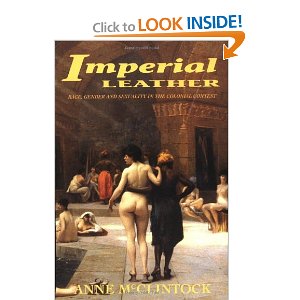 Anne McClintock who addresses the notion of baptism through origins, property, and power. So many things are currently being taken away from women and reading McClintock’s assertion regarding male baptism is perplexing. She believes that male baptism or baptism by a man takes women’s role in child bearing and diminishes it. These are the same men who historically treated and regarded women as vessels. She further asserts that this act is a proactive removal of creative agency with respect to a woman’s ability to have the power to name. That is, the last name of the child belongs to the husband. A point that supports the notion that patrimony marks the denial of women. Anyone doing genealogy encounters a perplexing struggle to identify mothers because their names are essentially erased from memory and rarely attached to a child’s name. Continue reading “Is Baptism a Male Birthing Ritual? By Michele Stopera Freyhauf”
 I’m a teacher’s assistant for an undergraduate course at New York University called, “What is Islam?” The other day in class, my professor asked the students whether or not the Qur’an is considered a “book”. Fraught with anxiety over inheriting such a problematic scholarly tradition of defining and delineating what “religion” is, I kept quiet. While my professor was aiming more for something sounding like, “a book is read, while the Qur’an is recited,” I kept thinking about the physicality and sacrality of the Qur’an (among other authoritative religious texts) and the way it is handled, revered, preserved, loved, an constantly under interpretation. It was about a week later when news broke out that U.S. soldiers in Afghanistan were guilty of burning several copies of the Qur’an on their military base, followed by an unfortunate slew of casualties including at least 30 Afghan deaths and five US soldiers. Continue reading “Beyond “Liberal” Female Piety or “Women Read the Qur’an Too” by Amy Levin”
 In the first part, I posed the question about whether or not the so-called “Curse of Eve” could be interpreted alternatively from the traditional understanding of Genesis 3:16a (the result of Eve’s disobedience being the punishment of painful childbirth for all generations of women). I considered an alternate interpretation of “sorrow” rather than “pain” for the verse, a lens through which the punishment could then be seen as impacting the God-human relationship rather than as a condemnation of pain.
I would like to further examine the consequences of this consideration. What if we were bold enough to interpret both the punishments of Adam and Eve (toiling over the land and pain in childbirth, respectively) as symbolic for all of humankind—and, furthermore, as speaking specifically of the God-human relationship? After all, men certainly aren’t the only ones who have toiled in the fields to bring forth food (I say this specifically thinking of a female farmer who lives down the road from me, and remembering her 10-14 hour days laboring over her harvests). Nor are all women subject to painful childbirth; in fact, the documentary Orgasmic Birth specifically devotes its study to women who find the experience of birth both sensual and ecstatic. If interpreting the Scriptural “curses” as literal and final, these not-so-exceptional exceptions would seem to contradict God’s decree. Yet when interpreting the punishments as indicative of a schism in relationship between God and humankind, the implications can be more clearly understood. Continue reading “The “Curse of Eve”—Is Pain Our Punishment? Part 2 by Stacia Guzzo”
After considering Virginia’s Transvaginal Utrasound Bill in light of the womanist critique, I wonder if religiously-motivated lawmakers considered that they alone do not have access to God’s intentions, but that the divine spirit is operative in a pregnant woman as well, would they be so willing to negate her moral agency?
On Tuesday, the senate in Virginia approved a law that would require women to get an external ultrasound before an abortion. This is a scaled-back version of an original bill that mandated transvaginal ultrasounds prior to abortions. According to this Washington Post article, opponents like Sen. Janet D. Howell describe the measure as “state rape,” since it is the state, not the woman and her doctor who decides that she must undergo this procedure requiring the insertion of a probe into the vagina. Although proponents of the bill say that it is designed to give women more information about a fetus’ gestational age and development, most would agree that it is ultimately intended to discourage the women from having an abortion. This is why bloggers like Kendra Hamilton believe that religion is the motivation behind this and the other 5 abortion-related bills introduced in the Virginia General Assembly connected to issues of women’s sovereignty over their bodies. Yet, as I heard about these bills, another religious response came to mind – one that expresses horror and condemnation of coercive practices regarding women’s childbearing. Continue reading “Get Your Laws off my Body! by Elise Edwards”
 The reason I am speaking about death today is two-fold. First, I have been somewhat preoccupied with the concept of death since entering a new decade of my life. I no longer believe in the evangelical vision of heaven I learned about in my youth; but as an uncomfortable “un”-Christian, I also have no satisfactory vision to replace it. Or rather, there are many visions I find appealing, but none that I “believe in,” as I had believed in heaven. My family is getting older, my parents have been sick in the last few years, and I often feel that I have more to lose now than I used to.
My second reason for considering death today is that last Wednesday, Mimi, our family cat of 24 years—yes, 24—passed away. After spending all nine of her lives living, Mimi could no longer eat and was suffering. My mother had her put down after we all said goodbye; we held a funeral for her and buried her among the lilies in our yard, her home.
My sisters and myself were very, very saddened by Mimi’s passing; but my mother took it hardest of all. Mimi had been her companion, her friend, her lap warmer, her snuggle buddy, her alarm clock and, we often joked, her favorite child for over two decades. I wanted to comfort my mother; but my protest that it didn’t matter what the (her) Church said, Mimi was with the God/dess, was maybe, not very helpful. It perhaps, only reminded her that in her view, I too am not going to heaven.
I remember sitting in church, as a child being told that animals did not have souls and that there was no “kitty heaven.” That was perhaps, one of the first times in my life that I thought, “that’s just ridiculous,” in a church. Not just ridiculous, but mean and cruel even. “What,” I thought, “is the point in saying such a thing?”  Continue reading “Where do Cats Go?: Reflections on Death Post Patriarchal Christianity by Sara Frykenberg”
 Feminism and Religion