“The Lord loves everyone and died for everyone, and He wants all to be saved…the best lesson that can be learned from everything that has happened is that one finds happiness, joy and satisfaction in obedience to the Church.” – Bishop Bruskewitz
One of the most misunderstood concepts in the Catholic Church is excommunication. Many believe that excommunication is a complete termination or separation from the Catholic Church. To say this another way, if excommunicated, you are no longer Catholic or part (a member) of the Catholic Church. None of these statements are true. By baptism, you are a member of the Catholic Church and no one can take that away.
Much of the misunderstanding stems from the way excommunication was used in the Middle Ages; a means of coercion to control kings and other high ranking officials. Obedience to the Church meant that you will spend eternal life in heaven. Disobedience to the Church meant a complete separation from the Church; a ban against receiving Eucharist, a banishment of your soul to the eternal flames of hell. Excommunication was the highest form of punishment and the most meaningful (and effective) tools of control. When a person was excommunicated, there was even a public ceremony – a bell tolled for the excommunicant, as a bell that would chime for the dead, the Gospels were closed, and a (baptismal) candle would be extinguished. This ceremony signified eternal darkness and death. Continue reading “The Impact of Excommunication in the 21st Century (Part I) – Spiritual Redemption or Hegemonic Power by Michele Stopera Freyhauf”
The Gospel of “Jesus’ Wife” is certainly at the center of a battle that was last seen when questions of authenticity were raised about the James (Jesus’ brother) ossuary. In a New York Times article, September 30th, Judith Levitt states that this document adds weight to theological and historical flaws surrounding the issue of the ordination of women. The Vatican believes that their theology is still sound, calling the document a forgery.
The Gospel of “Jesus’ Wife.” [www.boston.com]Frankly we do not need this document to validate the existence of female deacons and disciples – we have the biblical text and writings of the early church to validate this position.
Nor do we need this document to show that the standing from the Vatican’s point of view of ordaining women is theologically and historically flawed.
“In 1976, experts of the Pontifical Biblical Commission determined that there were no scriptural reasons preventing women’s ordination. The Congregation for the Doctrine of Faith overturned the commission’s judgment and instead wrote its own statement (Inter Insigniores, 1976) stating that women do not image Jesus who was a man; and therefore only male priests can adequately represent Christ.” – Women’s Ordination Conference
The prophetess Miriam, Aaron’s sister, took a tambourine in her hand, while all the women went out after her with tambourines, dancing; and she led them in the refrain: Sing to the LORD, for he is gloriously triumphant; horse and chariot he has cast into the sea.”(NAB, Exodus 15:20-21)
The Song of Miriam is not a story of death and destruction, but rather liberation. It is a poetic celebration of God’s liberation of the Israelites from the oppressive Egyptians, which, according to Bernhard W. Anderson in “The Song of Miriam Poetically and Theologically Considered,” marks the beginning of the Israelite tradition (292). Phyllis Trible in “Bringing Miriam out of the Shadows” states that this act marks the end of the Exodus, which was started by Miriam, not Moses (169, 172). The act of liberation reveals God’s action in humanity. Gerald Janzen in Exodus believes this act also moved the Israelites “to fear the LORD and believe in the LORD and in his servant Moses” (109). The uniqueness of this passage is that the most unlikely person leads – this person is not a man but rather a woman.
This brief passage in the Hebrew Scriptures is revelatory – Miriam is revealed for the first time. She is a prophetess, Aaron’s sister, and the role of leader of the victory dance to honor the Divine Warrior.
Spiritual Power is arguably the most dangerous power of all. In the wrong hands, it gives the power to make judgments even about the eternal fate of another person. It needs a sign on it at all times saying, ‘Handle with extreme care.’ The greater the power a person exercises, the more need there is for checks and balances before it is used and accountability after it is used.” – – Bishop Geoffrey Robinson
May 6th, I addressed the issue of abuse of power in the Catholic Church and how we seem to be unraveling any kind of progress made since Vatican II. Since writing that article, the Leadership of the LCWR met with Vatican Officials and expressed their concerns openly. A dialogue occurred and left no resolution, just information that the leadership will discuss with the community at their August meeting. That meeting will reveal their next step in this controversy – concede and follow the conditions and rules sets forth by the CDF or disband and form a new religious community or maybe there will be another option revealed.
I have to ask though – Was this a meaningful meeting or was it meant to pacify the Sisters and their supporters? Will the Vatican change its stance? Certainly, the U. S. Catholic Sisters have not been
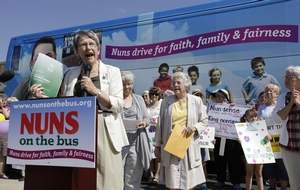
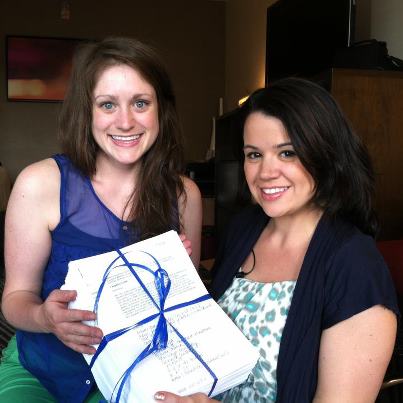
pacified, nor have their supporters. For example, there is a “Nuns on the Bus” tour traveling around the United States, prayer services for the Sisters, #nunjustice and #whatthesistersmeantome campaigns on Twitter. Even the Women’s Ordination Conference delivered a petition containing over 57,000 signatures to the Vatican in support of the Sisters. Certainly, the support for the sisters and their mission is not dwindling, but growing stronger every day.
As for the Vatican, a change in their position is doubtful, but we can continue to pray. I am, however, very discouraged by a statement attributed to Pope Benedict that indicates a desire to have a smaller more faithful Church of Catholics then a large Church of people who do not adhere to Church Teaching – seeking out a small, strong, holy community.
Obviously, it is my hope that this statement was taken out of context, but I have to be honest and say
Women’s Ordination Conference delivering Petition Picture reprinted from WOC’s page on Facebook
that my hope is filled with doubt. This is not the first time I have heard clergy make this statement. Priests have made this statement in my presence – wanting a more faithful flock and dismissing those that do not adhere to their interpretation of Church teaching. This stance does not bear fruit, but is rather a power play – a play that can be called many things – misogynist, arrogant, non-pastoral, cold-hearted, and frankly un-Christian. It also plays with a person’s spiritual fate and in many cases their soul. The psychological impact of something like this is dangerous for some. Some ordained will go so far as to withhold sacraments or even compromise the person’s status in the Church, including their role in ministry, for the sole purpose of inducing compliance – a tactic that dates to the medieval period.
I am all of these things and more. By the recent attacks by the hierarchy of the Catholic Church, I am beginning to think I am the problem. I seem to stand foreverything the Vatican and USCCB seek to silence. Is it because of my organizational ties with the U. S. Vowed Religious and Girl Scouts, or my writings as a Feminist and Theologian? Maybe the answer is simply – because I am a woman.
According to the criticisms launched by the USCCB and the Vatican, I seem to be part of the problem rather than the solution. Why is this so? It was not until I started my journey in ministry that my idealistic “Catholic” bubble popped – not so much by me, but by those in ministry and leadership, by those that did not like laity to pose questions and think critically about their faith beliefs, and by those that do not like people who do not fit within the preconceived mold of what a “good Catholic” should be. This ideological construct is difficult enough when you are part of a Church community, but when you begin to embrace leadership as a woman, question teachings, exercise your canonical rights, your peers and even people you thought were your friends, no longer talk or associate with you. The betrayal is vicious and runs deep – it is behavior not becoming of a minister or one who professes the Catholic faith.
If the attack on you is not enough, these same people victimize your children through their words and behavior. It is a difficult position for anyone to survive spiritually. For children of the Church who bear witness to this hypocritical behavior, a journey begins – they search for meaning within the spiritual realm and become disgruntled with anything that resembles organized religion. A place where one seeks community and spiritual nourishment becomes a place of oppression and starvation. If attacking family is not enough, let’s start attacking groups that promote community – groups like the Girl Scouts of America.
At the end of this month, the Leadership Conference of Women Religious will meet to formulate a response to a Vatican trap whose cunning is best appreciated within the long tradition of religious authorities who craft impossible dilemmas for those they perceive as threats.
Two millennia ago, the chief priests sent someone to ask Jesus, “Should we pay taxes?” If Jesus said yes, he would pit himself against Jewish resistance to Roman occupation and therefore, in Jewish eyes, against God. If he said no, the Romans could execute him for sedition. Instead, Jesus famously replied, “Render to Ceaser what is Ceaser’s and to God what is God’s.”
In the fifteenth century, Joan of Arc’s ecclesiastical inquisitors asked her, “Do you know yourself to be in God’s grace?” If Joan answered yes, she would commit heresy because the Church had long taught that no one could be certain of being in God’s grace; if no, they could interpret her answer as an admission of guilt. Joan looked them in the eyes and replied, “If I am not in God’s grace, may God put me there; if I am, may God so keep me.” Continue reading “Vatican Lays a Cunning Trap for American Nuns by Mary Johnson”
“Now the Vatican says that nuns are too interested in “the social Gospel” (which is the Gospel), when they should be more interested in Gospel teachings about abortion and contraception (which do not exist). Nuns were quick to respond to the AIDS crisis, and to the spiritual needs of gay people—which earned them an earlier rebuke from Rome. They were active in the civil rights movement. They ran soup kitchens.” — Roman Catholic Women Priests (via Facebook)
I once had a conversation with my New Testament Professor about the issue of women ordination. He was optimistic and thought there might be a possibility that change was in the air – that was six years ago. The basis for his statement had to do with language. Of the journals and articles read, he felt the language used was more inclusive and that once people adjust to this discrete change in gender inclusive language, change for women in the Church can come.
This letter was written to to Rev. Edward Dougherty, M.M., Superior General and the Maryknoll Community on August 8, 2011 in response to the call for Fr. Roy Bourgeois to recant his stance on women’s ordination in the Catholic Church.
My Brothers,
I have been a Catholic priest for 39 years and Maryknoll has been my faith community, my family. So it was with great sadness that I received your letter of July 27, 2011 (Second Canonical Warning), stating I must recant my belief and public statements that support the ordination of women, or I will be dismissed from Maryknoll.
In my ministry over the years I have met many devout women in our Church who believe God is calling them to be priests. Why wouldn’t they be called? God created men and women of equal dignity and, as we all know, the call to be a priest comes from God.
My brothers, who are we to reject God’s call of women to the priesthood? The Holy Scriptures remind us in Galatians 3:28, “There is neither male nor female. In Christ Jesus you are one.” How is it possible for us to say that our call from God, as men, is authentic, but God’s call of women is not? Continue reading “A Response to the Maryknoll Community on Women’s Ordination by Fr. Roy Bourgeois”
Maundy Thursday – the imitation of Jesus’ act of service and submission is re-created. Controversy surrounds the “disciples” – must they be all men? Are women allowed? Who steps into Jesus’ role? Men, women, or both? Why, when it comes to imitating the act of humility and priestly service (rooted in our baptismal call), does a distinction of gender need to made at all?
As I progressed towards the intersection, I looked up to witness a grand procession of men dressed in white albs with stoles that often contained subtle hints of gold, worn in a manner to distinguish their role as priests and deacons. They moved slowly down the sidewalk entering the Cathedral to begin their celebration of the Chrism Mass – a celebration of priesthood and priestly service within the Diocese where all priests and deacons gather to celebrate and re-affirm their commitment to ministry and service to the Church. It is also during this Mass that the oils used in sacramental celebrations, used by each church, are blessed by the Bishop.
As I continued to watch, I could not help but search the processional line for those with a hair color other than gray. I wanted to see how many young priests were in that processional line. What I found was no surprise – an aging group of men with the sporadic appearance of younger priests. The numbers stood as a staunch reminder that we, as a Church, may be faced with a severe shortage of priests in the future. Something already known and planned for by the Diocese in its campaign to consolidate and close parishes.
“These were very simple rituals and yet they were so powerful.”
Jeanette Stokes’ 25 Years in the Garden is on my bedside table. It’s a book I read several years ago with a small group of feminist Christians when I was living in Blacksburg, Virginia. The following passage from one of her essays got me to thinking back to the 2012 PANAAWTM conference (Pacific, Asian, and North American Asian Women in Theology and Ministry) I had attended just two weeks ago:
“Rituals are part of everyday lives: reading the newspaper, checking the weather, waiting for the mail to come, or talking with a family member at the end of the day. Rituals can also mark the extraordinary events in our lives: the birth of a child, the death of a loved one, a birthday, marriage, anniversary, or divorce” (Stokes, 2002, p. 37).












 Feminism and Religion