“Vaginas are Everywhere!”: The Power of the Female Reproductive System by John Erickson

Nice girls don’t say the word vagina.

I have a beautiful picture of vagina hanging on my wall.  However, for the longest time it was in the back of my closet, with a plastic bag covering it.  I wasn’t ashamed of it but my ex-boyfriend, like most gay men, refused to have it on the wall where he could see it.  He is now long gone; the vagina is now out and proud.

I bid on the picture one fall during a showing of the Vagina Monologues at Claremont School of Theology.  One of my best friends was in the show and I had always loved its powerful message.  I walked out of the theatre, waiting for my friend, and there it was: the picture of the vagina.  I found myself caught up in its beauty.  Its gaze had mesmerized me.  The outlying layers of red, the contours of its shape, they all began to mold into a figure before my eyes.  While I have never thought of myself as a religious person, I realized that at that moment I was no longer looking the old photo but rather I was staring at the outline of the Virgin Mary.  At that moment, I realized that I had to have the picture.

My ex boyfriend was ashamed of the photo.  I let him shame me into putting it in the back of my closet and cast it away like it was nothing.  Like the experience, call it religious or not, had never happened.  When we ended our relationship, I found myself inconsolable and pacing up and down my stairs in a never-ending cycle of sadness and downheartedness.   As I was pilfering through our items, I came about the picture.  I saw it and for a split second, I was no longer sad. Continue reading ““Vaginas are Everywhere!”: The Power of the Female Reproductive System by John Erickson”

The Crime of Being a Girl Scout: The Sin of Raising Strong Female Leaders by Michele Stopera Freyhauf

Cradle Catholic and Woman

Educated by the U. S. Vowed Religious

Support the U. S. Catholic Sisters

Support, Minister, and Live the Social Gospel

Theologian, Feminist, and Critical Thinker

Former Girl Scout Leader of Three Troops

Former Girl Scout

I am all of these things and more.  By the recent attacks by the hierarchy of the Catholic Church, I am beginning to think I am the problem.  I seem to stand for everything the Vatican and USCCB seek to silence.  Is it because of my organizational ties with the U. S. Vowed Religious and Girl Scouts, or my writings as a Feminist and Theologian?  Maybe the answer is simply – because I am a woman.

According to the criticisms launched by the USCCB and the Vatican, I seem to be part of the problem rather than the solution.  Why is this so?  It was not until I started my journey in ministry that my idealistic “Catholic” bubble popped – not so much by me, but by those in ministry and leadership, by those that did not like laity to pose questions and think critically about their faith beliefs, and by  those that do not like people who do not fit within the preconceived mold of what a “good Catholic” should be.  This ideological construct is difficult enough when you are part of a Church community, but when you begin to embrace leadership as a woman, question teachings, exercise your canonical rights, your peers and even people you thought were your friends, no longer talk or associate with you. The betrayal is vicious and runs deep – it is behavior not becoming of a minister or one who professes the Catholic faith.

If the attack on you is not enough, these same people victimize your children through their words and behavior.  It is a difficult position for anyone to survive spiritually.  For children of the Church who bear witness to this hypocritical behavior, a journey begins – they search for meaning within the spiritual realm and become disgruntled with anything that resembles organized religion.  A place where one seeks community and spiritual nourishment becomes a place of oppression and starvation.  If attacking family is not enough, let’s start attacking groups that promote community – groups like the Girl Scouts of America.

So, what is the USCCB’s problem with the Girl Scouts of America?  Basically, this organization is under fire for suspected deviant thinking and positions that stand opposed to Church teaching. Continue reading “The Crime of Being a Girl Scout: The Sin of Raising Strong Female Leaders by Michele Stopera Freyhauf”

Vatican Lays a Cunning Trap for American Nuns by Mary Johnson

At the end of this month, the Leadership Conference of Women Religious will meet to formulate a response to a Vatican trap whose cunning is best appreciated within the long tradition of religious authorities who craft impossible dilemmas for those they perceive as threats.

Two millennia ago, the chief priests sent someone to ask Jesus, “Should we pay taxes?” If Jesus said yes, he would pit himself against Jewish resistance to Roman occupation and therefore, in Jewish eyes, against God. If he said no, the Romans could execute him for sedition. Instead, Jesus famously replied, “Render to Ceaser what is Ceaser’s and to God what is God’s.”

In the fifteenth century, Joan of Arc’s ecclesiastical inquisitors asked her, “Do you know yourself to be in God’s grace?” If Joan answered yes, she would commit heresy because the Church had long taught that no one could be certain of being in God’s grace; if no, they could interpret her answer as an admission of guilt. Joan looked them in the eyes and replied, “If I am not in God’s grace, may God put me there; if I am, may God so keep me.” Continue reading “Vatican Lays a Cunning Trap for American Nuns by Mary Johnson”

Hoy, Canto de Mujer Que Se Libera – Un Canto de Ada María Isasi-Díaz, By Michele Stopera Freyhauf

“Yo soy mujer en busca de igualdad, no aguantar abuso ni maldad. Yo soy mujer y tengo dignidad, y pronto la justicia serd una realidad.  Mujer, tù eres mujer, porque supiste ver, la realidad de tu poder. Hoy canto al Dios del Pueblo en mi guitarra, un canto de mujer que se libera” – From “Mujeristas: A Name of Our Own!” – Ada María Isasi-Díaz [i]

Translation:  I am woman searching for equality; I will not put up with abuse and wickedness.  I am a woman and I have dignity, and justice will soon be a reality.  Woman, you are woman, because you have known how to recognize the fact that you are powerful.  Today I sing to the God of my people with my guitar, I sing a song of a woman who liberates herself.

Labels, names, and categories can evoke prejudice and oppression.  Ada Maria Isasi-Díaz, the founder of Mujerista Theology, wrote:

To be able to name oneself is one of the most powerful abilities a person can have.  A name is not just a word by which one is identified.  A name provides the conceptual framework and the mental constructs that are used in thinking, understanding and relating to a person. [ii]

These words relate to U. S. Hispanic women, who, according to Isasi-Díaz, struggle against ethnic prejudice, sexism, and in many cases classism [and who] have been at a loss as to what they should be called.[iii]  In finding that common name, lyrics from three different songs inspired Isasi-Díaz who developed the term “Mujerista Theology,” replacing Hispanic women’s liberation theology:

“Yo soy mujer en busca de igualdad, no aguantar abuso ni maldad. Yo soy mujer y tengo dignidad, y pronto la justicia serd una realidad.  Mujer, tù eres mujer, porque supiste ver, la realidad de tu poder. Hoy canto al Dios del Pueblo en mi guitarra, un canto de mujer que se libera” [iv]

For Isasi-Díaz, mujerista unifies Hispanic women and embodies strength.  Mujeristas are those:

Ada Maria Isasi-Díaz
Picture From Drew University’s website
  • Who desire a society and a world where there is no oppression.
  • Who struggle for a society in which differences and diversity are valued.
  • Who know that our world has limits and that we have to live simply so others can simply live.
  • Who understand that material richness is not a limitless right but it carries a “social mortgage” that we have to pay to the poor of the world.
  • Who savor the struggle for justice, which, after all, is one of the main reasons for living.
  • Who try no matter what to know, maintain, and promote our Latina culture.
  • Who know that a “glorified” self-abnegation is many times the source of our oppression.
  • Who know women are made in the image of God and, as such, value ourselves.
  • Who know we are called to birth new women and men, a strong Latino people.
  • Who recognize that we have to be source of hope and of a reconciling love.
  • Who love ourselves so we can love God and our neighbor.[v] 

For Isasi-Díaz, Mujerista Theology is defined as:

“a process of enablement for Latina Women, insisting on the development of a strong sense of moral agency, and clarifying the importance and value of who they are, what they think, and what they do….mujerista theology [also] seems to impact mainline theologies, the theologies which support what is normative in church, and, to a large degree, in society.”[vi]

Continue reading “Hoy, Canto de Mujer Que Se Libera – Un Canto de Ada María Isasi-Díaz, By Michele Stopera Freyhauf”

Abuse of Power in the Catholic Church: Undoing Almost Fifty Years of Progress – Part I, by Michele Stopera Freyhauf

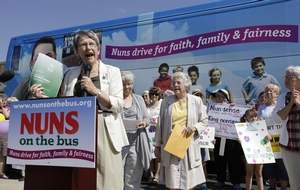
“Now the Vatican says that nuns are too interested in “the social Gospel” (which is the Gospel), when they should be more interested in Gospel teachings about abortion and contraception (which do not exist).  Nuns were quick to respond to the AIDS crisis, and to the spiritual needs of gay people—which earned them an earlier rebuke from Rome. They were active in the civil rights movement.  They ran soup kitchens.” —  Roman Catholic Women Priests (via Facebook)

I once had a conversation with my New Testament Professor about the issue of women ordination.  He was optimistic and thought there might be a possibility that change was in the air – that was six years ago.  The basis for his statement had to do with language.  Of the journals and articles read, he felt the language used was more inclusive and that once people adjust to this discrete change in gender inclusive language, change for women in the Church can come.

He was right about change coming.  The result was not equality and ordination for women, but an attempt to silence and force these women back into their habits and cloisters. Continue reading “Abuse of Power in the Catholic Church: Undoing Almost Fifty Years of Progress – Part I, by Michele Stopera Freyhauf”

The Inquisition of Today and U.S. Women Religious by Ivone Gebara

Statement from Ivone Gebara, writer, philosopher and theologian from Brazil on the Vatican action against U.S. religious women. 

Translated from Portuguese. Reprinted with permission. 

Once again, we watch dumbfounded as the Congregation for the Doctrine of the Faith directs a “doctrinal assessment of” or a “calling attention to” or the “punishment of” those who, according to the CDF, break away from the proper observance of Catholic doctrine. Only this time, the CDF is not pointing an accusatory finger at a person, but rather at an institution that brings together and represents more than 55,000 women religious in the United States- namely, the Leadership Conference of Women Religious, known by its acronym LCWR.

Throughout their long history, these women religious developed and continue to develop a broad educational mission which advances the dignity of many people and groups both within and beyond the United States. Most of these women belong to diverse national and international congregations.

In addition to their Christian and humanistic formation, they are intellectuals and professionals in various fields of knowledge. They are writers, philosophers, biologists, sociologists, lawyers and theologians. They have broad backgrounds and their expertise is recognized nationally and internationally. They also are educators, catechists and human rights activists. In many situations, they set their lives at the service of those affected by injustice or set themselves in opposition to the grave actions taken by the government of the United States. Continue reading “The Inquisition of Today and U.S. Women Religious by Ivone Gebara”

Home At The Margins With My Sisters By Xochitl Alvizo

My faith is in living and being shaped into the divine way of life that happens at the margins, with others who also see that a new world is needed and are willing to participate with one another in creating it.

I wasn’t always a student of theology – obviously. So the summer before I started my masters program at Boston University, I spent my days reading primers in theology. As I read, I started to notice a trend; chapter by chapter, authors would discuss a specific theological topic or doctrine and toward the end of the chapter would usually add, almost as if an afterthought, the critiques or insights from feminist theology regarding the particular theological doctrine or theme being discussed. Even back then, before feminism had even had the chance to seep into my bones, I wondered why feminist theology, along with the other liberation theologies mentioned, was always presented as an afterthought, a footnote, clearly not as important as the theological perspective from which the authors happened to be speaking. I knew though, even from my first reading of these feminist theological perspectives at the margins of these primers, that feminist theology rang true and was important to me; what I didn’t know or understand was why it didn’t seem to shape “mainstream” theology in a central way but was instead relegated to afterthoughts by the authors of these primers. Continue reading “Home At The Margins With My Sisters By Xochitl Alvizo”

The Need for a Positive Counter-Narrative of Religious Involvement in Feminism by Ivy Helman

I’ve admired JC for years.  That’s Joan Chittister, OSB the Benedictine nun of course.  I first saw her speak when I was in graduate school and she visited Yale.  I’ve also read a number of her books.    Her life is an example of how religious people support feminist ideals.    There is a story in Beyond Beijing: The Next Step for Women: A Personal Journal that I would like to share with you

Chittister began her historic journey on the Peace Train to the UN Conference on Women in Beijing in 1995.  As she  entered a conference room to register as a Peace Train participant, she was handed a large manila envelope.  To her surprise it was filled with condoms. At first, she thought that the woman who handed them to her meant to hand them to someone else.  However, Chittister was told (quite emphatically according to her) that she should distribute the condoms to the health workers she encounters while on the train and in the small towns she visits along the way to Beijing.  Eventually after much thought, Chittister decided to do just that and stuffs the manila envelope into her backpack.  Trying to find some humor in what she considered an awkward situation for a nun to be in she remarked, “Now all I have to do is to try not to die in front of some bishop with condoms in my backpack.”

My first reaction to this story is to laugh along with her.  I am also struck by her thoughtfulness to share the story publicly.  She could have been given the envelope, quietly distributed the condoms and then never told a soul.  But, no.  She includes the account of this feminist action she undertook in her book for the world to read.  What an amazing amount of courage and integrity this woman has! Continue reading “The Need for a Positive Counter-Narrative of Religious Involvement in Feminism by Ivy Helman”

A Response to the Maryknoll Community on Women’s Ordination by Fr. Roy Bourgeois

This letter was written to to Rev. Edward Dougherty, M.M., Superior General and the Maryknoll Community on August 8, 2011 in response to the call for Fr. Roy Bourgeois to recant his stance on women’s ordination in the Catholic Church.

My Brothers,

I have been a Catholic priest for 39 years and Maryknoll has been my faith community, my family. So it was with great sadness that I received your letter of July 27, 2011 (Second Canonical Warning), stating I must recant my belief and public statements that support the ordination of women, or I will be dismissed from Maryknoll.

In my ministry over the years I have met many devout women in our Church who believe God is calling them to be priests.  Why wouldn’t they be called?  God created men and women of equal dignity and, as we all know, the call to be a priest comes from God.

My brothers, who are we to reject God’s call of women to the priesthood?  The Holy Scriptures remind us in Galatians 3:28, “There is neither male nor female. In Christ Jesus you are one.”  How is it possible for us to say that our call from God, as men, is authentic, but God’s call of women is not?   Continue reading “A Response to the Maryknoll Community on Women’s Ordination by Fr. Roy Bourgeois”

Do Man-Made Laws Trump the Authority of Jesus? Reflecting on the Meaning of Humility, Priestly Service, and the Issue of Women’s Ordination by Michele Stopera Freyhauf

Maundy Thursday – the imitation of Jesus’ act of service and submission is re-created.  Controversy surrounds the “disciples” – must they be all men?  Are women allowed?  Who steps into Jesus’ role?  Men, women, or both?  Why, when it comes to imitating the act of  humility and priestly service (rooted in our baptismal call), does a distinction of gender need to made at all?

As I progressed towards the intersection, I looked up to witness a grand procession of men dressed in white albs with stoles that often contained subtle hints of gold, worn in a manner to distinguish their role as priests and deacons.  They moved slowly down the sidewalk entering the Cathedral to begin their celebration of the Chrism Mass – a celebration of priesthood and priestly service within the Diocese where all priests and deacons gather to celebrate and re-affirm their commitment to ministry and service to the Church.  It is also during this Mass that the oils used in sacramental celebrations, used by each church, are blessed by the Bishop.

As I continued to watch, I could not help but search the processional line for those with a hair color other than gray.  I wanted to see  how many young priests were in that processional line.  What I found was no surprise –  an aging group of men with the sporadic appearance of younger priests.   The numbers stood as a staunch reminder that we, as a Church, may be faced with a severe shortage of priests in the future.  Something already known and planned for by the Diocese in its campaign to consolidate and close parishes.

Another sad observation was put on public display  –  the absolute absence of women. Continue reading “Do Man-Made Laws Trump the Authority of Jesus? Reflecting on the Meaning of Humility, Priestly Service, and the Issue of Women’s Ordination by Michele Stopera Freyhauf”