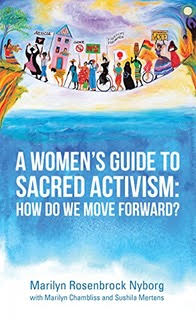
Time to Heal the Ancestral Wounds From the Burning Times by Marilyn Nyborg

My work has been in the areas of social justice and the empowerment of women. Until somewhere in 1990, I saw a series of films from women in Canada on the Early Modern European Witchcraft trials which included “The Burning Times”. (Still available on You Tube.)  The film talked about three centuries of Witch burnings. The narration and graphics really shocked me and awakened an interest.  Intuitively I recognized the way in which women have embedded the limitations and pain of that era from centuries ago.  I now know it to be called ancestral wounding. 

Not to say the abuse of women began there.  It didn’t.  But the intensity of three centuries of extreme violence on women have impacted us and cultures through time: sowing the limitations and lack of respect for women into cultures globally.

Continue reading “Time to Heal the Ancestral Wounds From the Burning Times by Marilyn Nyborg”
Thirst for Knowledge, Thirst for Rain: Women’s Seeds and Symbols in Southern Morocco by Laura Shannon

Last week, once again, I had the good fortune to bring a small group of dancing friends to southern Morocco. As always, our travels there unfolded in a blessed and beautiful way, rich in experiences of ancient Berber/Amazigh culture and encounters with local women.

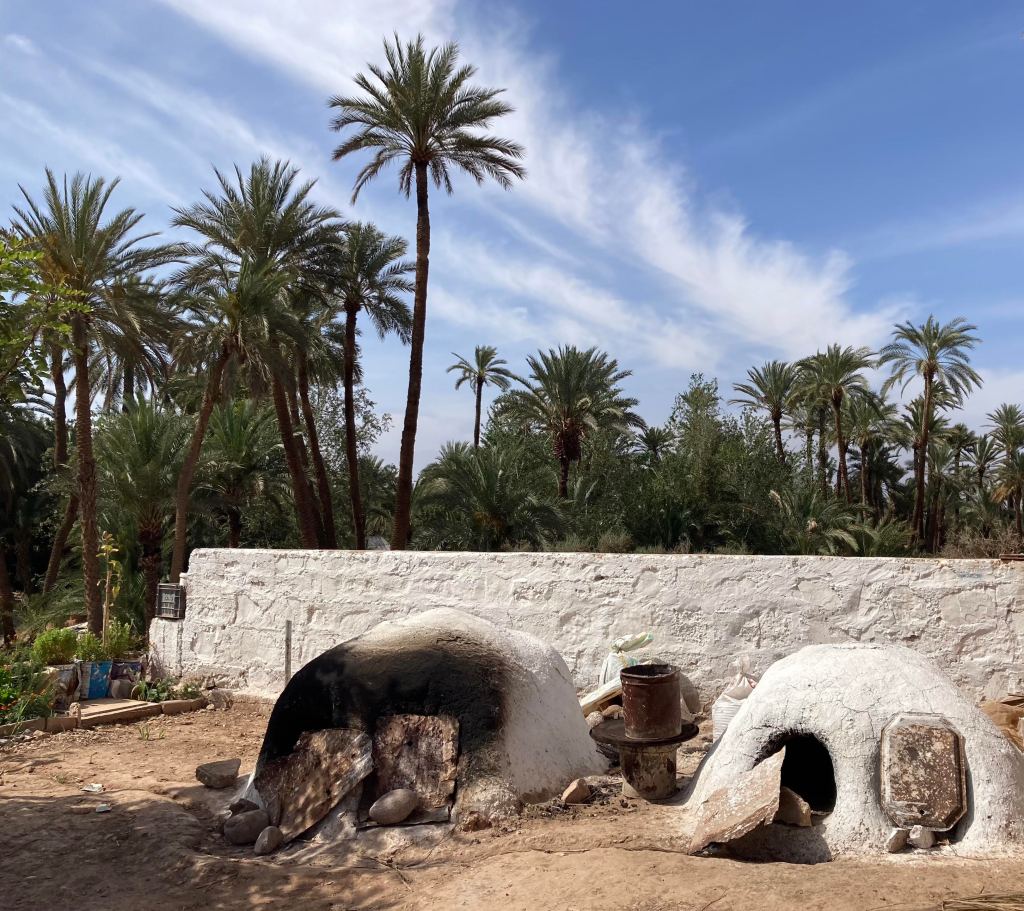
At Tioute oasis in the foothills of the Anti-Atlas mountains, we bought unleavened flatbread baked in rounded clay ovens. 

Bread ovens at Tioute oasis, southern Morocco. Photo: Laura Shannon
Continue reading “Thirst for Knowledge, Thirst for Rain: Women’s Seeds and Symbols in Southern Morocco by Laura Shannon”

RACHEL KADISH:  TRANSCENDENCE AND TEXT, part 2 by Theresa C. Dintino

THE SYMBOL OF THE GENIZAH

Being a non-Jew, the first word I had to look up while reading The Weight of Ink was  genizah—a hiding place or the act of hiding sacred texts until they can receive proper burial in the earth. In Jewish tradition this is a required honoring of the written word, especially if it is writing about God. It can also mean depository or treasure; something hidden away in time with hope for more welcome in the future that finds it.

Genizah was the perfect word for me to have etched into my mind with regard to The Weight of Ink as it set the stage and opened a space in my heart for a novel which concerns itself with the power of writing and words through time. The story is centered around human lives engaged in passionate intellectual pursuits, the love of books and learning, and imaginations set afire by the academic.

Continue reading “RACHEL KADISH:  TRANSCENDENCE AND TEXT, part 2 by Theresa C. Dintino”

RACHEL KADISH:  TRANSCENDENCE AND TEXT, part 1 by Theresa C. Dintino

Moderator’s Note: This post is presented as part of FAR’s co-operation with The Nasty Women Writers Project, a site dedicated to highlighting and amplifying the voices and visions of powerful women. The site was founded by sisters Theresa and Maria Dintino. This was posted on their site on November 7, 2023

I love recognizing Toni Morrison’s influence on a writer as I am reading a book. Reading Rachel Kadish’s novel, The Weight of Ink, immediately sunk into Jewish reality, life, and experience without any explanation or apology, I sniffed a familiar point of view, a ghost of novels prior, detected the faint fingerprints of a giant. I liked it and when I recognized it for what it was, I thought to myself, Good for her.

Kadish had taken Toni Morrison’s advice to black writers that says you don’t have to explain yourself to white readers and applied it to not explaining herself to non-Jewish readers.

Why not?

Continue reading “RACHEL KADISH:  TRANSCENDENCE AND TEXT, part 1 by Theresa C. Dintino”

Mountain Mother: Symbol from the Past, Beacon for the Future by Jeanne F. Neath

Dreaming of and working toward creating an earth- and female-centered future is proving to be my best strategy for surviving and enjoying the ecologically and politically problematic present. Current realities and predictions for the future, such as those made by climate scientists, are certainly grim. What else can we expect in a global society that puts male power and profit above the needs of people and planet?

Those in power cannot possibly undo today’s polycrisis as they are too invested, personally and financially, in the status quo. They cannot even begin to dream of the transformations called for. This is something that we women can do that they cannot. We are the ones who give birth, create new life. We can certainly dream up and create new ways of living.

Continue reading “Mountain Mother: Symbol from the Past, Beacon for the Future by Jeanne F. Neath”

The Eleusinian Mysteries:  Alchemical Grain, Part II by Sally Mansfield Abbott

Part 1 was posted yesterday. You can read it here.

The Eleusinian Mystery Rites derived from early planting and harvest festivals, agricultural rites from the late Neolithic. They celebrated the growth of the plant from a seed in the ground, but their purpose was also to convey a new way of seeing, an opening of the eyes, the Epotopia.  The golden grain signified the alchemical gold of a new consciousness, the miracle of a plant turning to gold.  Through fasting, initiates experienced a ritual identification with grief and loss, followed by a return of life and joy, a rebirth, Persephone’s triumphant return from Hades. Demeter was a giver of agricultural rites, but she laid down spiritual laws as well, hence her title of Thesmophoria, or Lawgiver.

Demeter offers a benediction to Metaneira who proffers wheat, a symbol of the Mysteries
Continue reading “The Eleusinian Mysteries:  Alchemical Grain, Part II by Sally Mansfield Abbott”

The Eleusinian Mysteries:  Alchemical Grain, Part I by Sally Mansfield Abbott

This post is dedicated to the memory of Mara Lynn Keller, who passed away on 12/23/23. Mara was an expert on the Eleusinian Mysteries, and much of this post is based on her scholarship. Mara was a life-long friend and ally of Carol Christ’s, going back to their days in the Ph.D. program at Yale. She co-founded the Women’s Spirituality program at the California Institute of Integral Studies (CIIS) with Eleanor Gadon (The Once and Future Goddess). Mara was an unusually warm, welcoming, and generous presence, and must have been a fabulous teacher.

The Eleusinian Mystery Rites were practiced in Athens and Eleusis from 1450 BCE to 329 CE, a period of almost 2,000 years, before they were expressly forbidden by the newly Christian Roman Empire, and years later the temple was destroyed. The Rites had originated on Crete, and continued to be practiced in Knossos and in the caves there for many centuries. It is likely no coincidence that the origin of the Mysteries in Eleusis in 1450 BCE is the same date as the fall of Knossos.

Continue reading “The Eleusinian Mysteries:  Alchemical Grain, Part I by Sally Mansfield Abbott”

Women’s Woven Voices at the Parliament of the World’s Religions by Brecia Kralovic-Logan

Imagine walking into a space surrounded by the woven stories of 1,000 women from around the globe and feeling you are at home. The Women’s Village at the Parliament of the World’s Religions conference in Chicago in August of 2023 offered a place where women could feel welcomed, safe, understood, honored, and inspired. It was surrounded by the color and texture of the Women’s Woven Voices project tapestry.

I am the founder of the international, collaborative, art project- Women’s Woven Voices- that supports women in claiming their powerful voices through writing, weaving, and sharing their stories. For six years I had been inviting women to reflect on their lives, write about their strengths, challenges, joys and what made them feel whole, and then, weave a strip of cloth to represent their story. I collected the woven “Story Cloths” and stitched them together into a collective tapestry. Having stitched over 1,000 stories into the tapestry from women from 10 different countries, I applied to participate in the Parliament as an art installation and then joined the Women’s Task Force to create a very special space for the thousands of women who would be attending the Parliament.

Continue reading “Women’s Woven Voices at the Parliament of the World’s Religions by Brecia Kralovic-Logan”

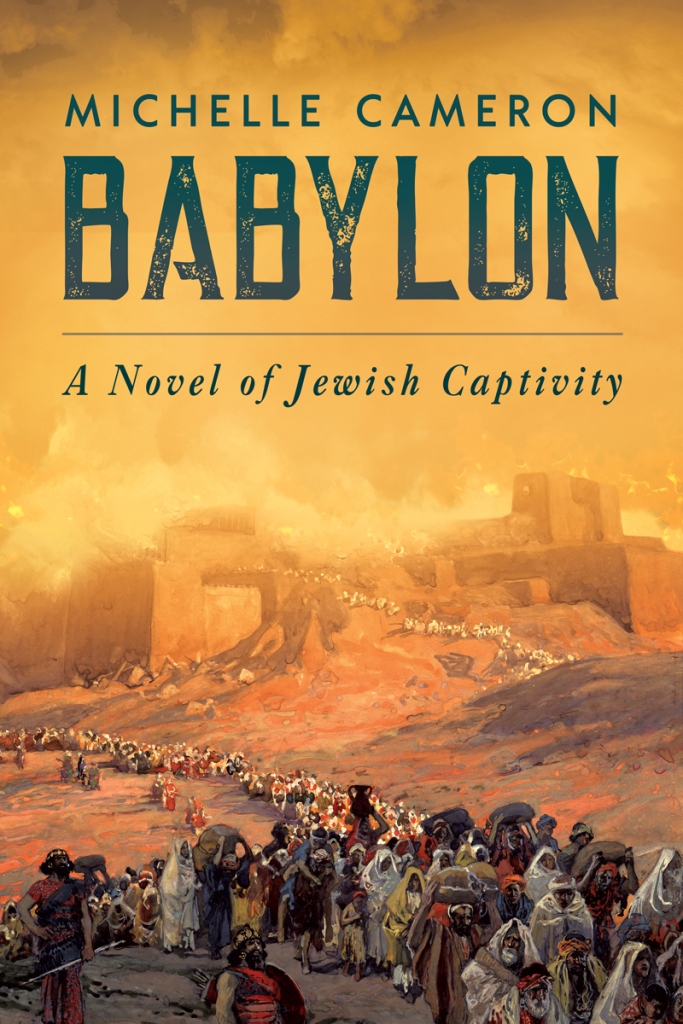
The Queen of Heaven Cakes: Asherah and Ishtar by Michelle Cameron

When one nation conquered another in antiquity, vanquished peoples typically switched allegiances to that country’s gods, since those deities were clearly stronger than their own. In my novel, Babylon: A Novel of Jewish Captivity, the prophet Daniel warns against this tendency, so the Judean exiles would remain faithful despite their captivity:

“You may be tempted to slip away from your Hebrew roots. Many of us struggle to remain steadfast to our faith. We are seduced by the lure of the gods of Ishtar and Marduk, Sin, Damkina, and Ea. Their temples overflow with riches and their ways are strange and compelling.

Continue reading “The Queen of Heaven Cakes: Asherah and Ishtar by Michelle Cameron”

Why We Need to Bring Back God as a Woman, part 1 by Caryn MacGrandle

26,000 years ago, life was precarious and dangerous.  And so the human race revered the Mother.  Mother Earth, who provided food amidst scarcity, protection from the dangers of the wild and healthy babies who grew to adulthood.

The Goddess.

In her many forms.

Some of these Goddesses.

Venus of Willendorf.  The artifact known as the Venus of Willendorf dates to between 24,000–22,000 B.C.E., making it one of the oldest and most famous surviving works of art.

Continue reading “Why We Need to Bring Back God as a Woman, part 1 by Caryn MacGrandle”