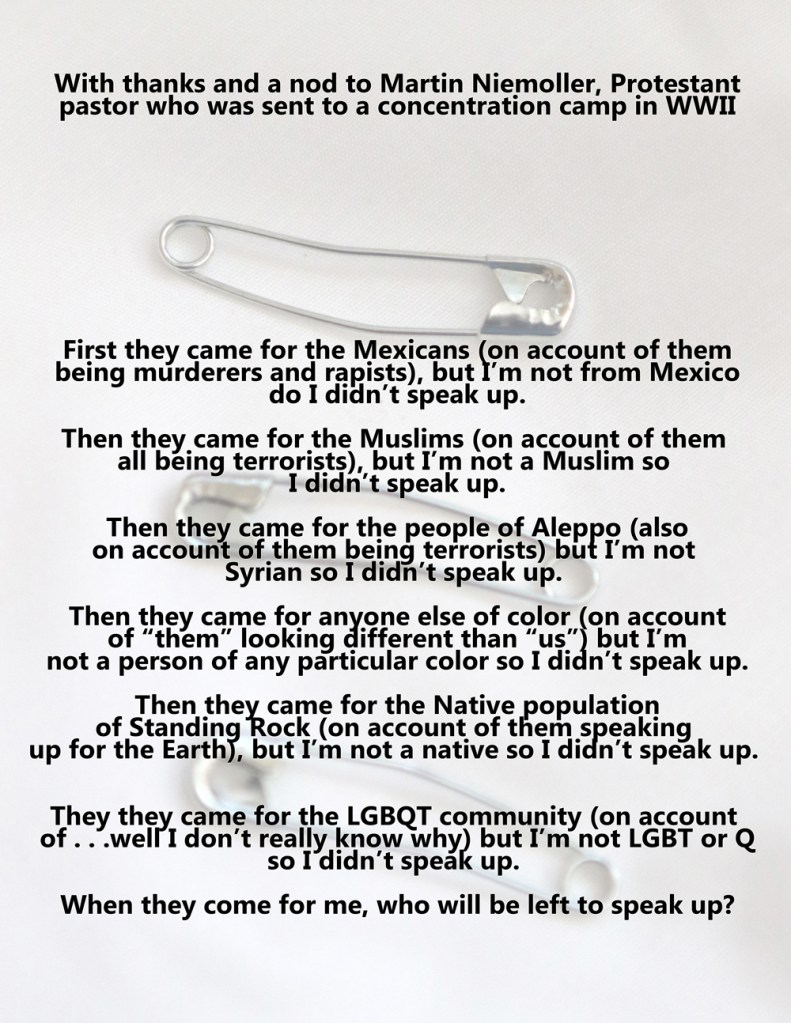
I made this poster 8 years ago and am devastated to have to dust it off again. The safety pins came from a British idea when Brexit was passed. People would wear the safety pins on their clothes to let anyone feeling vulnerable know that they would be “safe” with them.
The political finger pointing for Harris’ loss is beyond noxious. I have heard all manner of scapegoats; Biden, the Obamas, VP candidate Walz, Harris for saying too much of one thing, not enough of another, the progressives, Liz Cheney and even George Clooney. . . .blah blah blah
How can we make sense of a world where women voted for a misogynistic abuser. Black and brown people voted for a white supremist. Latinos voted for a policy of mass deportations targeting their brethren. Youth voted for a climate denier affecting their future. And so on. Think of all the women who voted for a world where they, their daughters and their granddaughters can be denied basic healthcare. It’s a true-to-life Cinderella scenario whose stepmother cut the toes off her own daughters to please a prince. Or Chinese mothers who would bind their own’s daughter’s feet, thereby crippling them in the service of marriage.
Beguines excelled at this. By the Middle Ages, the belief in many Christian circles was that one did not go directly to heaven but to a sort of “holding place” after death to be cleansed of their sins before being allowed into heaven. Eventually “the medieval church also taught that people could pray for the souls in purgatory and that their prayers would effectively aid those souls in their transition from purgatory to heaven”(108).
It’s important to note that these women were esteemed by the communities they lived in as spiritually gifted, able to intercede with God on their own without permission from the church, clergy or men. This is radical for the time.
“Beguines, as we have seen, were understood to have extraordinary spiritual powers. People believed that having a beguine intercede before God on their behalf was an assurance that their petition was heard by God—and perhaps in no instance more than for “those poor souls in purgatory.” And beguines believed that they did indeed exercise the authority to release countless souls from purgatory. Many of the stories included in the vitae of beguines grapple with the fate of the deceased in purgatory (or hell)”(109).
Moderator’s Note: This piece is in co-operation with The Nasty Women Writers Project, a site dedicated to highlighting and amplifying the voices and visions of powerful women. The site was founded by sisters Theresa and Maria Dintino. To quote Theresa, “by doing this work we are expanding our own writer’s web for nourishment and support.” This was originally posted on their site on July 5, 2022. You can see more of their posts here.
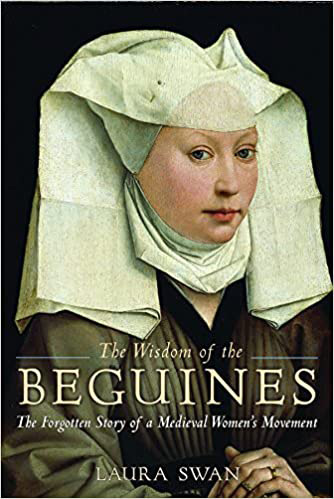
Around 1200 AD in Europe, communities of women often called beguines began to form. These women were not nuns, they were devout and devoted to the tenets of Christianity but did not belong to any church. They were independent communities of women who often created their own industry, trade or other means to produce income. They were self-sufficient and generally concerned with helping the poor, especially women. They lived in convents. This was the origin of that word.
“These women were essentially self-defined, in opposition to the many attempts to control and define them. They lived by themselves or together in so-called beguinages, which could be single houses for as few as a handful of beguines or, as in Brugge, walled-in rows of houses enclosing a central court with a chapel where over a thousand beguines might live—a village of women within a medieval town or city”(2).
After being nailed as a witch I separated myself from the word and witch power in general. The word witch had a very dark side and could be used in the same frightening manner as it had been during medieval times to label and to expel any woman who lived on the edge (source of my original sense of unease). Especially one who lived alone in the woods and loved animals like I did.
Why had I been singled out? I was an outsider whose crime was to animate nature. Anything associated with nature was suspect if not ‘evil’.
Feminists beware. If you claim to be a witch – recall that the word is loaded. Personally, I think the label has backfired reducing our overall power as women. Perhaps making us more suspect than we already are.
The Ones You Love, Poetry and Prose 1968-2024 is a half-century retrospective love letter from Harriet Ann Ellenberger to friends, family, and lovers; lesbian and overall feminism; lesbian feminist literature and theater; Nature; and those who have been victimized by war. Infusing the book is her overarching love of freedom, not only for herself, but for women, for humanity, and for the Earth. Harriet has been using her authorial and editorial gifts for her entire adult life to move our planet away from extinction into new ways of being, and has now collected her best writings, both prose and poetry, into a single volume. The book is both a brilliant, truthful, unglossed portrait of herself as well as a glimpse into feminism, and lesbian feminism in particular, over decades through one woman’s experience. She often notes in introductions to various pieces that she no longer completely agrees with what she wrote so long ago, but she does not edit out these views, (speaking of her “younger fiery-feminist self,” she says “I’m proud of her courage and proud of the work she undertook” (11)) which offers us a better understanding of both her own progression of thoughts and ideas as well as what issues and points of view were of concern at the time.
Of her most well-known achievement, she writes, “On July 4, 1976, the 200th anniversary of the American Revolution, Catherine Nicholson and I published the first issue of Sinister Wisdom, which has since become the longest-lived lesbian literature and arts journal in the world” (11). She explains the journal’s expansive perspective: “We exist in the interface between a death culture and the faint beginnings of a culture of — not humans — but life-lovers, a culture that embraces animals, plants, stars and those women who choose the future at the risk of their ‘sanity’ and security” (17). This is a vision she has carried with her ever since.
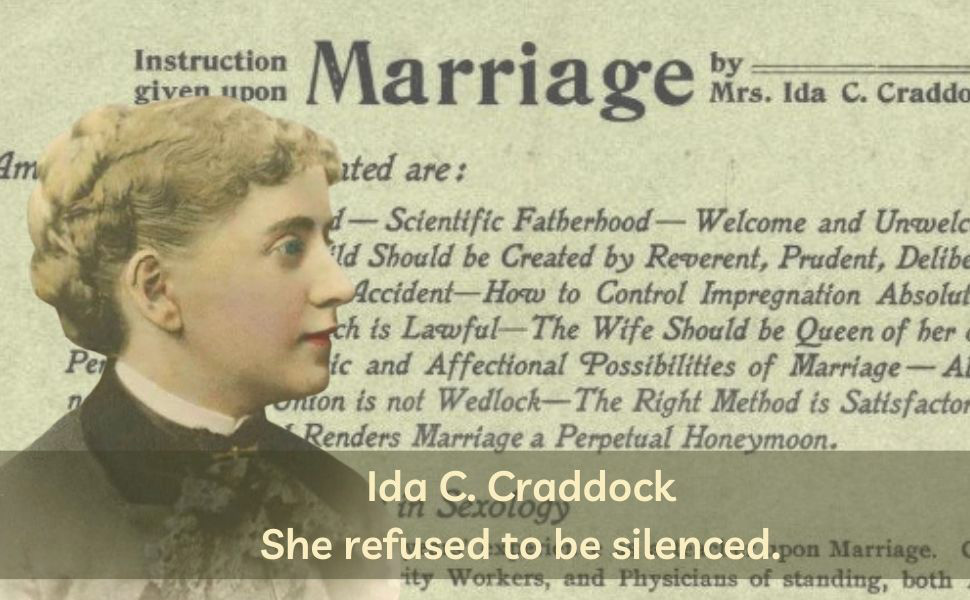
“I would lay down my life for the cause of sex reform, but I don’t want to be swept away. A useless sacrifice.” Ida C. Craddock, Letter to Edward Bond Foote, June 6, 1898
In 1882, Ida C. Craddock applied to the all-male undergraduate school of University of Pennsylvania. With the highest results on the entrance tests, the faculty voted to admit her. But her admission was rejected by the Board of Trustees, who said the university was not suitably prepared for a female. (U of P only became co-ed in 1974)
With her aspirations blocked, Ida left home determined to leave her mark on women’s lives by studying and writing about Female Sex Worship in early cultures. At the time, little information was available to women about sexual relations. To do her research, Ida resorted to having male friends take books forbidden to females, such as the Karma Sutra, out of the library for her.
An unmarried woman, she turned to spirituality and the practice of yoga, a newly introduced practice to the American public at the time, as a way to learn about sex. In her journals, she describes her interaction with angels from the borderlands, and in particular, her sexual experiences with Soph, her angel husband through what was likely tantric sex.
Stepping into the autumn season offers time to think about summer. Time to think about what happened during those hazy, lazy, crazy days. Digesting. Re-wording. Steeping one’s self in recent memories and drawing forth, indeed permitting to re-surface, what touched us most deeply. For me, The Beatles song, Eleanor Rigby, was conjured. That imagined woman. That fictional woman. And her voice and her voicing. Buried she was, in a church, along with her name. Nobody came.
What is it that invites this negation of voice? Voices? Voice-ing? Particularly those of womyn? No matter class, culture, creed. This question continues to journey with me, as I myself, note the accumulation of years. As I breathe the beauty of my Grand-Children’s energies. And with-ness their lives unfold. Unfold in a world that is slowly, ever so slowly, yet determinately, and with unceasing tenacity, resurrecting the lost voices of womyn. Too long buried and silenced.
As a young witch hungry for feminist sisterhood and spiritual wisdom in the 90s, before the blooming of the internet, I discovered a mag called The Beltane Papers. I remember devouring an article featuring channeled material of women killed during the European witch hunts. This transmission revealed past voices of everyday people living their lives until they were snagged by the slow creep of an increasingly oppressive cultural trajectory. What struck me was the normalcy of their voices, the deceased echoes of regular women trying to make sense of events beyond their control until they were taken by a system that destroyed them. What stayed with me is the author’s observation that even at their violent end these women’s voices remained “incredulous”.
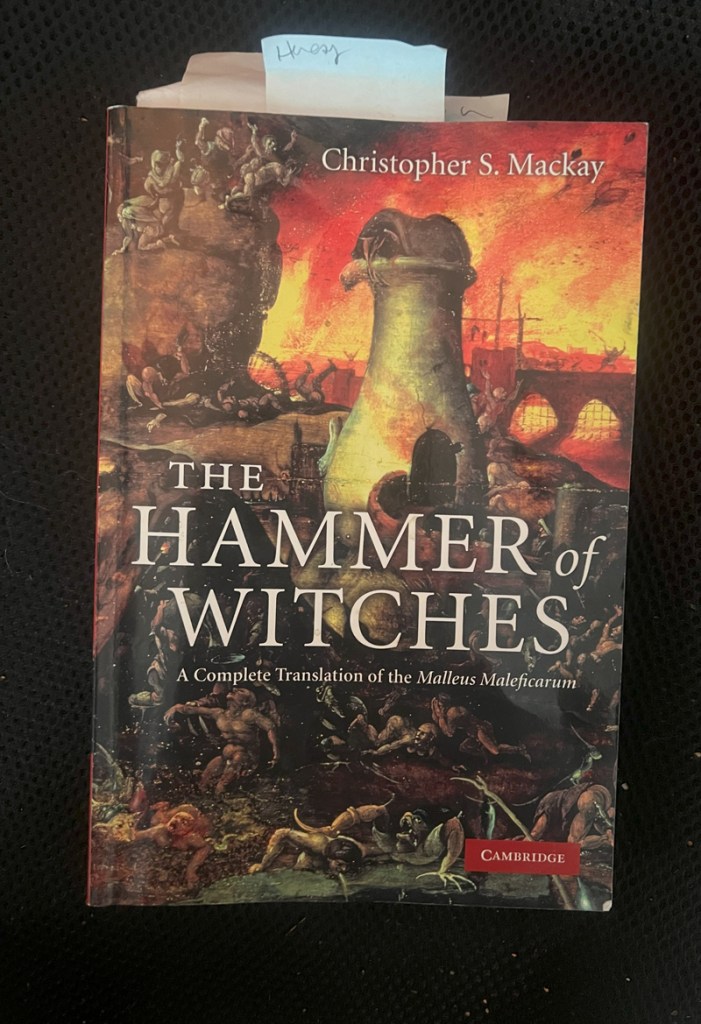
Decades, and seemingly lifetimes later, I completed my dissertation for my PhD in Religion and Philosophy in which I excavated some of the subaltern history of my European Ancestors and their female shamanic practices. At one inevitable point in my research – kicking and screaming – I reluctantly faced the inquisitions and witch trials. After waving a sage wand and cracking a sacred beer, I cracked open the Malleus Maleficarum, the infamous “Hammer of the Witches”.[1] This notorious guidebook, a how-to for career Christian Inquisitors written by two Dominican Friars[2] during the Middle Ages, details moral arguments supporting the legalized suppression, interrogation, and eradication of women designated by the church-state as heretics.
The story of how Cerridwen, the witch goddess, brews a magic potion full of awen (inspiration) which is then accidentally imbibed by the boy Gwion Bach, is well loved across the Western world, especially by neo-Druids. Gwion Bach is then reborn as Taliesin, the greatest bard in Britain. It is a typical heroes tale, with Cerridwen as the muse and initiatrix.
Or is it? This tale has always left a funny taste in my mouth, and when I recently read The Broken Cauldron by Lorna Smithers, I understood why. In the oldest version we have of this tale, Gwion Bach doesn’t accidentally taste the awen. He steals it.
My introduction to Matilda Joslyn Gage (1826-1898) goes back to my long-standing interest in her son-in-law, L. Frank Baum. I regularly teach Baum’s The Wonderful Wizard of Oz in my children’s literature courses, and I always point out the book’s feminist qualities. I mention, for example, that Dorothy Gale, the central character in the novel, is one of the first female characters in American literature to go on a bona fide quest. When I first started teaching this book, I wondered what caused Baum, a male writing in the late nineteenth century, to write such a feminist book. One day, while preparing for class, I came across a reference to Gage. This reference stated that Gage was a leading suffragette during the second half of the nineteenth century and that she lived with Baum and his family in Chicago when Baum was launching his career as a children’s author. After reading more about Baum’s life, I realized that Gage played a major role in shaping his nontraditional views on gender roles. However, I was still not sure what role she played in the development of women’s rights.