A Poem for Enheduanna by Nan Lundeen

Cuneiform Tablet from Nippur, Sumeria
(Modern Iraq) 2300 – 2100 BCE
Mary Harrsch from Springfield, Oregon, USA,
CC BY 2.0 <https://creativecommons.org/licenses/by/2.0&gt;,
via Wikimedia Commons

In beautiful synchronicity, I received an invitation to submit a poem to an anthology in the voice of a female-identified persona around the same time I first learned of Enheduanna. The first named author and poet was mentioned in my New Moon Womyn’s Circle. When I looked her up, I was flabbergasted. I am a poet, a feminist, and a long-time student of Women’s Spirituality, and yet the world’s first author—a high priestess who worshipped a female supreme deity, was unknown to me.

I learned that Enheduanna was a brilliant poet who wrote with majestic metaphors, who shared her emotions, and who grappled with concepts of the divine as a female supreme deity in and with nature, and with whom she experienced a personal relationship. She lived and wrote around 2300 B.C.E. Scholars say they do not have the specific dates of her birth and death, but they do know that she served as high priestess for 40 years at the city of Ur in what is now Iraq.

Continue reading “A Poem for Enheduanna by Nan Lundeen”
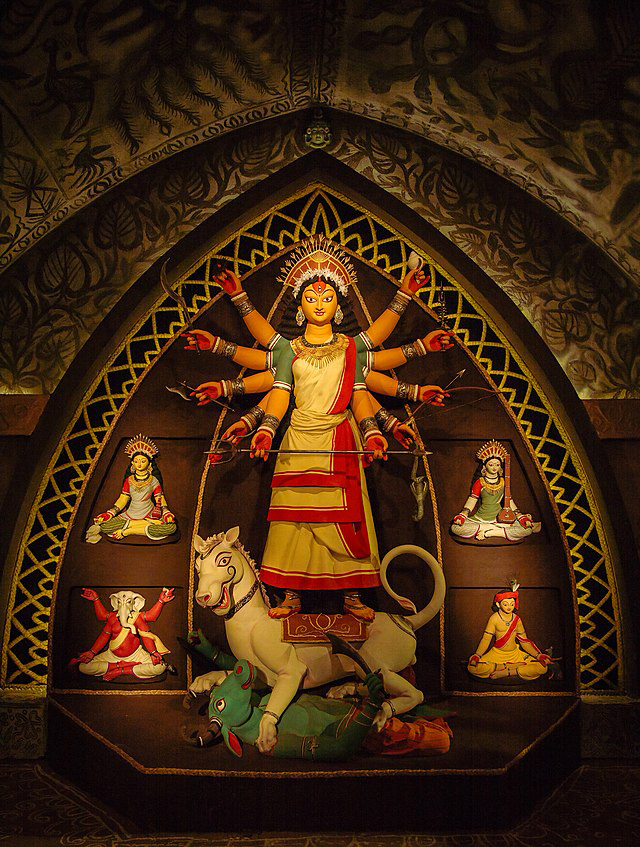
Durga Rising: Feminism as Fierce Compassion By Beth Bartlett

In her FAR post earlier this year,[i] “Why Feminism Needs the Fierce Goddesses,” Susan Foster argues that a “flagging” feminist movement needs the revitalizing energy of the “fierce goddesses” of ancient times to challenge the patriarchal forces that seem to be on the rise as increasingly we find women’s lives and freedoms constrained. She writes, “the dark goddesses of ancient times have been submerged in our psyches, but they serve as a repository of fierce energy, of female rage against injustice.”  She continues, “It’s important and healthy for us as women to reclaim our anger, using it to protect ourselves and fight for our rights in systems that are oppressive.”

Reading this, I immediately thought of Beverly Wildung Harrison’s, “The Power of Anger in the Work of Love,” and China Galland’s, The Bond Between Women: A Journey to Fierce Compassion. Anger as the work of love; fierce compassion.  In this time of mass shootings, insurrection, the ongoing assault on women, LGBTQ, and BIPOC peoples, when rage seems so easily fueled by hate, envy, and greed, it is the rage based in love and compassion that is most needed.  This is the rage of the fierce dark goddesses who are moved to act against injustice, the rage of the feminism I love. With its source in love and compassion, it is a rage that rebels in the best sense of the word – that at once refuses injustice and affirms dignity and respect, that speaks truth to power, that is grounded in solidarity and friendship, and values the immanence of the earth, the water, the body, and the divine spark in all beings.[ii] 

Continue reading “Durga Rising: Feminism as Fierce Compassion By Beth Bartlett”

From the Archives: “What If We Touched Ourselves Lovingly Every Day?” by Trelawney Grenfell-Muir

This was originally posted on June 5, 2020

I watched her hand stroke along my arm, so gently, so lovingly. Her voice whispered, “I love you, Trelawney. I love you, Trelawney.” The soft, tender caress felt poignant, healing, magical. I wept with gratitude.

It was my own hand stroking me. My own voice.

I want you to take a moment and imagine the person you love best in the world. Is there anyone? Is there someone you love utterly, you think of with pure, unconditional, compassionate, embracing, affirming, tender, protective, loyal, sacred love? Close your eyes a moment and let that feeling of pure love fill your heart until you understand that feeling with every fiber of your being. Do you have that Love? Truly feel it and know it with all your heart, soul, mind, and strength?

Continue reading “From the Archives: “What If We Touched Ourselves Lovingly Every Day?” by Trelawney Grenfell-Muir”

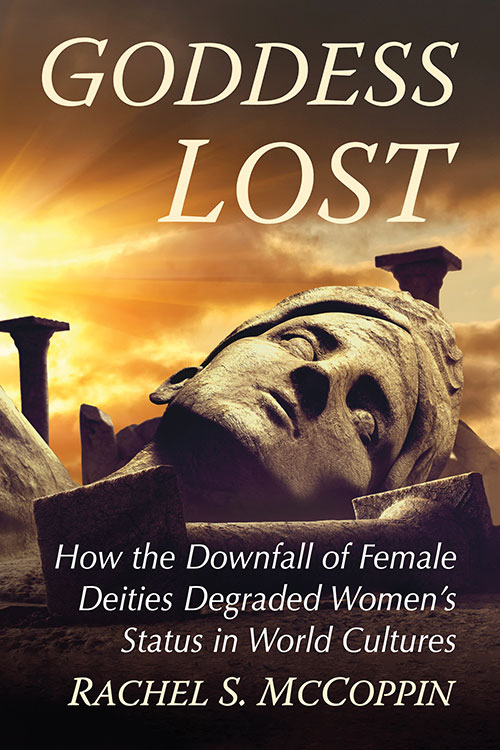
Goddess Lost: How the Downfall of Female Deities Degraded Women’s Status in World Cultures by Rachel S. McCoppin; book review by Margot Van Sluytman

She Who Knows

What then is my repentance?
If not, by rote this repetition?
“Godde is.”
“Godde is.”
“Godde is.”
“Love.”
And my face tastes
The beating heart
Of the sun’s call
For reclamation of
SHE Who Is.
SHE Who Is: knows me.
She, who also, is.
©Margot Van Sluytman

From the moment I saw the title, Goddess Lost: How the Downfall of Female Deities Degraded Women’s Status in World Cultures, by Rachel S. McCoppin, I knew I would have to read it. When it arrived in my mailbox and I saw the cover, I was imbued with inspiration. Then I read two sentences in the Preface, which articulate what for me, and for many, is one of the most vital, powerful, and, as yet, under-addressed, facts.

Continue reading “Goddess Lost: How the Downfall of Female Deities Degraded Women’s Status in World Cultures by Rachel S. McCoppin; book review by Margot Van Sluytman”

Channeling the Divine: A Creative Process by Brenda Edgar

Last year, I completed a life-changing yoga teacher training and spiritual development program at Supreme Peace Yoga and Wellness in Louisville, KY.  One of its components was the creation of Soul Collage cards which were prompted by facilitator Jodie Tingle-Willis’s guided meditations.

The Soul Collage process is not only a profound way of connecting to the divine within and around us; for me, it is also a powerful vehicle for channeling poetry from this same source.  My results from this multi-step creative process have led me to explore some pleasantly surprising spiritual terrain.

As an example, the card above was created after a visualization exercise around the idea of community—specifically, the small cohort of women in our training program, and the influence they had on me as we worked and learned together:

After some time had passed, I revisited the card and asked it once again to inspire me creatively.  The result was this poem, which evokes an indigenous vision quest—an experience I have not had outside of this creative journey.

Continue reading “Channeling the Divine: A Creative Process by Brenda Edgar”

Remember! by Mary Gelfand

“There was a time when you were not a slave, remember that.
You walked alone, full of laughter, you bathed bare-bellied.
You say you have lost all recollection of it, remember! ….
You say there are no words to describe it;
You say it does not exist.
But remember.  Make an effort to remember.
Or, failing that, invent.”

From Les Guerilleres, by Monique Wittig, mid-20th Century French feminist writer

The first time I heard this quote from Wittig was in the mid-1990s when I took ‘Cakes for the Queen of Heaven,’ an introduction to feminist thealogy and the Great Goddess, created by the Women & Religion committee of the Unitarian Universalist Association.  Cakes was my introduction to Carol Christ, feminist thealogy, and the Goddess.  It changed my life forever.  I’ve been teaching this program for close to twenty years now and as my understanding of women’s history and the role of patriarchy in our suppression has deepened, I continue to find new resonances with Wittig’s words.

“There was a time when you were not a slave, remember that.”  This statement is relevant to all oppressed peoples and especially to women.  History tells us that enslavement was a part of European culture long before Africans were kidnapped into slavery on this continent.  Enslavement of the defeated was a common aspect of war, dating back to Biblical times.  Many aspects of the feudal system dominant in western Europe for centuries were little better than slavery. 

Continue reading “Remember! by Mary Gelfand”

Dancing for Rain: Life-Giving Gift from Heaven to Earth by Laura Shannon 

Since ancient times people have danced for rain, the life-giving gift from heaven to earth. Rain rituals were seen as important work and were usually performed by women, traditional bringers of life and fertility. Both bearing and raising children, and cultivating the land to nourish the community, are activities dependent on, and psychically equated to, rainfall. Women’s ability to bring rain when necessary was a key belief of indigenous European culture and is found in many places today. Many women’s dances, songs and rituals in Eastern Europe and the Near East express this connection, and women’s folk costumes often feature long fringes representing water. 

Continue reading “Dancing for Rain: Life-Giving Gift from Heaven to Earth by Laura Shannon “

The Vows We Make, by Molly Remer

I make a vow of self-sovereignty,
a declaration of wholeness,
a promise to myself that I will keep:
I vow to listen to my heart,
to claim my power and my voice.
I vow to live my own magic,
to step into the center of my own life
and live from there.
I vow to live a life
that includes space for me,
to stand up for what I need,
to listen to my longings,
to honor my inner call,
to do my own work with trust.
I vow to never abandon myself.
I vow to inhabit my own wholeness
in all ways.

In February, I signed up for a Vow of Faithfulness class with WomanSpirit Reclamation. Guided by Patricia Lynn Reilly (of “Imagine a Woman” and A God Who Looks Like Me fame) and Monette Chilson, the class was based on Patricia’s book, I Promise Myself: making a commitment to yourself and your dreams. Structured as a seven week online women’s circle, the class took us on a deep dive into vow-making, culminating in a vow ceremony in which we made a public (to the class that is) declaration of our own vows to ourselves. As the class unfolded, I found myself reviewing past vows as well as sensing new vows bumping up against my consciousness, whispering to be heard.

Continue reading “The Vows We Make, by Molly Remer”

From the Archives: Awakening to the Mystery of Absolute Beginnings by Carolyn Lee Boyd

This was originally posted on February 1, 2013

As I rise at 5:30 each morning, my spirit reawakens in a between-the-worlds realm of absolute beginnings. For those few minutes of quiet and slowly revealing dawn light, I revel in mystical newness, endless possibility, a horizon that is only the future.  By 7 am, when I can hear cars on the road and see television screens through windows as I walk to work, normal, plodding space-time has taken over, leaving just a shimmer to linger in my memory.

I remember living all day with this feeling of being at the very beginning of my world when I was a young child and everything that I did and thought was for the first time. I believed this sense was lost forever when I was later taught by society, as so many of us are, that I was only the tiniest, most ordinary mite in a world already built many eons ago by people with a much brighter genius than me. 

And then, on my 25th birthday, I heard Merlin Stone speak about When God Was a Woman As I truly envisioned the Divine with a female face for the first time in my life, I felt a joyful excitement as if I had been transported back to that first second in human history when the insight dawned that a sacred presence exists within ourselves and all of creation that is unseen, but real, and that it can be expressed and shared. Because I had never been taught about Goddess or how to interact with Her, I was able to discover and act on what I knew intuitively within myself about Her in a way that was completely my own. With great fervor I began my own individual journey of the spirit and found that this exhilarating profound newness never left me because the territory I was exploring was completely unfamiliar to me in my own experience.

Continue reading “From the Archives: Awakening to the Mystery of Absolute Beginnings by Carolyn Lee Boyd”

From the Archives: Who Owns the Sacred? A Personal Search beyond (European) Indigenous Knowledge by Eline Kieft

This was originally posted on Jan 17, 2020

For almost 35 years nature has been my sacred place. As an 8-year old, I started to pray to Mother Earth even though the protestant tradition in which I grew up only recognised ‘God the Father’. I went outside in my inflatable rowing boat to seek solitude (as an only child in a quiet family!) on a small island in the lake of our local park. I practised rowing and walking quietly to not break the sacred silence. I collected herbs to brew infusions in my little thermos flask with boiled water brought from home. I sung to the moon, and danced my love for all creation back through my moving body. Over the last 15 or so years, I spent many days and nights at Neolithic monuments, dreaming in ancestral burial mounds, time traveling in stone circles in Cornwall, Wales, Scotland, England, Ireland and Brittany. This nature-based practice evolved naturally, and later incorporated my training with the Scandinavian Centre for Shamanic Studies and the School of Movement Medicine. Nature is where I reconnect most easily with the Sacred, and listen to the whispers on the great web of life in which all of nature is a great teacher. Nature, for me, is a strong place of prayer, solace, awe, reverence, gratitude, joy, guidance, reconnection, healing and transformation. 

Continue reading “From the Archives: Who Owns the Sacred? A Personal Search beyond (European) Indigenous Knowledge by Eline Kieft”