From the Archives: It’s Time to Revisit A Christmas Carol By Barbara Ardinger

This was originally posted on January 3, 2021

Scrooge … became as good a friend, as good a master, and as good a man, as the good old city knew…. Some people laughed to see the alteration in him, but he let them laugh, and little heeded them; for he was wise enough to know that nothing ever happened on this globe, for good, at which some people did not have their fill of laughter….. His own heart laughed: and that was quite enough for him. … It was always said of him, that he knew how to keep Christmas well, if any man alive possessed the knowledge.

You no doubt recognize this as the conclusion of A Christmas Carol by Charles Dickens, who wrote the book in six weeks in 1843 because the holidays were coming and he was nearly broke. He had to earn some money. The book was so immediately successful that it went into a second printing right before Christmas and has been in print ever since. There’s a memorable movie called The Man Who Invented Christmas (2017), starring Dan Stevens as an unstable Dickens. As the movie tells the story, most of the characters in the novel turn up in Dickens’ “real life” and either inspire or force him to write the book. Scrooge (Christopher Plummer) follows him all over London and forces him to confront his childhood. The climax is both dramatic and satisfying.

Continue reading “From the Archives: It’s Time to Revisit A Christmas Carol By Barbara Ardinger”

The Ancestor Story by Sara Wright

During the last few years I have spent hours listening to the haunting cries of Sandhill cranes, awaiting them at the river, stunned each time as I glimpsed a flock float to the ground, great gray wings extended to break their fall as talons touched earth, attended to enthusiastic family greetings and muted conversations, felt a sense of devastating loss when these birds circled overhead to say goodbye each year before heading north to breed (while I lived in New Mexico), and then discovering to my joy that they live and breed here in Maine. I still experience the same hunger to glimpse families in Fryeburg each October and lose time watching their loving family dynamics. I continue to feel intense grief and loss at crane leave-taking remaining baffled by the intensity of my own responses. In the last week I think I have finally uncovered the roots of the story behind the cranes and me…

 These birds are prehistoric in origin and have the strongest family ties. The families never break up and when separated greet each other joyously even after a few hours as small groups fly to different feeding areas. Incredibly poignant. There is always one that stands watch at night, a protector, so the others can sleep in peace, one leg extended, usually in water. I am in love with these birds but until a few days ago did not understand the powerful pull their presence exerts over me.

Continue reading “The Ancestor Story by Sara Wright”

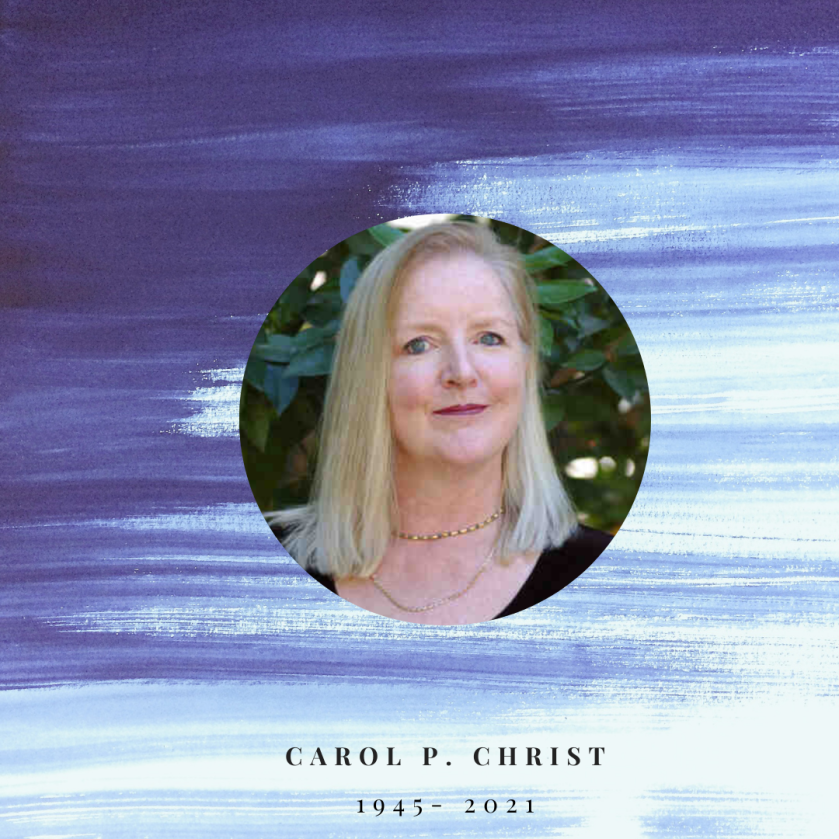
Legacy of Carol P. Christ:“Ursula Niebuhr, Ursula Niebuhr”: Unacknowledged Co-author of Great Works of Theology?

This was originally posted on August 26, 2019. It fits in with our new project of Unsung Heroines.

A few days ago while watching the movie The Wife, I kept hearing the words “Ursula Niebuhr, Ursula Niebuhr,” in my mind. I knew the reason was Ursula’s unacknowledged collaboration on the work of Reinhold Niebuhr, which I discovered while writing an earlier blog on uncredited co-authors.

I had not been particularly interested in seeing The Wife because I assumed it was the familiar story of the woman who gives up her career interests when she marries. Want to become a rabbi? Marry one. Want to become an artist? Live with him and become his muse. This is a very old story, and for me, not a very interesting one.

Continue reading “Legacy of Carol P. Christ:“Ursula Niebuhr, Ursula Niebuhr”: Unacknowledged Co-author of Great Works of Theology?”

FRAME THE CHAOS by Esther Nelson

No matter how much we may want absolute control over our own lives and destiny, most of us realize that’s just not possible. Life itself is chaotic—both on a global and individual level. War, famine, drought, earthquakes, tsunamis, pandemics, poverty, sickness, ignorance, disability, divorce, and ultimately death comes calling for everybody living on planet Earth—a planet which will no doubt  eventually die as well. 

How do we maneuver through such dire straits?  Can we make sense of and find meaning in our day-to-day chaotic existence both as members of individual families/communities and as global citizens? Perhaps so, however, it’s impossible to tackle the tumult all at once. Hence, the title of this essay—“Frame the Chaos.”

Thanks to my former colleague Dr. Cliff Edwards for this phrase, gleaned from his reading of Gilles Deleuze, French philosopher (1925-1995). “Chaos is defined not so much by its disorder as by the infinite speed with which every form taking shape in it vanishes.  It is a void that is not nothingness but a virtual, containing all possible.”

Continue reading “FRAME THE CHAOS by Esther Nelson”

Willful Women, Feminist Killjoys, and Jesus: Reflections on Sara Ahmed’s Living a Feminist Life by Liz Cooledge Jenkins

I’ve been thinking about willful women and feminist killjoys—two main guiding images in feminist scholar Sara Ahmed’s book Living a Feminist Life (Duke University Press 2017).

The idea of the willful woman (or willful girl, or willful person) is something I can easily get behind. The way I understand it, it has to do with women getting in touch with our own wills and being willing to speak and act and live out of our wills. Particularly if these wills turn out to exist in opposition to the things other people might will for us.

It’s about learning to stand up for ourselves, learning to affirm our full humanity in a world that often expects…less. It’s a way of consciously, intentionally being willing to be called “willful” as a negative thing—as in, stubborn, selfish, antagonistic, difficult—because the affirmation of our own wills is worth it.

I like all of this and find it helpful. Be willful. Expect pushback and penalties for it. Be willful anyway.

Continue reading “Willful Women, Feminist Killjoys, and Jesus: Reflections on Sara Ahmed’s Living a Feminist Life by Liz Cooledge Jenkins”

Re-Anointing the Body by Eline Kieft

How ‘at one’ are you with your body, and what reasons might there be if your body-sense got separate(d) from your soul-sense?

This piece starts with the difference between feminine and masculine spirituality, and introduces a few reasons why living in a physical body isn’t always easy.

It then invites a shift to the beloved body and how we can start to re-instate our body as a sacred place and love it from within.

Continue reading “Re-Anointing the Body by Eline Kieft”

ClubQ…. #702 by Marie Cartier

I have written about this before

And, no doubt, I will write about it again.

This morning we woke to the news of

Another mass shooting, a mass shooting is defined as four or more people shot in a single violent outburst.

So, this time last night there were five killed, and eighteen injured—a mass shooting

Last night at a gay bar in Colorado Springs, ClubQ

The only place, so described by its patrons, for anyone queer in Colorado Springs to go.

I am visiting Denver for a conference and to see friends.

Queer friends.

I don’t live here anymore.

But I know that gay bar without ever entering it.

The sense of being me, being here, I could have gone

There last night and screamed in joy for the drag queens…made it rain with compliments and dollar bills for one of them named Del Lusional….and others.

I could have been happy in that club with chosen family that I had never met before

And I could have been one of those who screamed as I watched someone die, or as I was shot.

I wasn’t there last night. But I know that bar without ever having entered it.

I know those people and how they would have made me feel welcome. How they would have made me feel

Part of things. How they would have made me family.

2.

The only thing that stops a bad guy with a gun is a good guy with a gun, says the GOP narrative.

But no one with a gun stopped the guy at ClubQ

I am a woman with a pen and a notebook. Age sixty. With queer friends crying and angry Because we’ve been here before: Pulse where 49 were killed and the only thing stopping this from being another Pulse was a good guy without a gun.

The GOP has ramped up its hate on the gay population- let’s take down gay marriage, and even a politician who advocates execution for gays.

And so here we are: an assailant with an assault rifle in a gay bar. He had a history of violence on his own mother

And yet, here he is entering a queer club with a gun.

In Colorado my friends mark themselves safe from the mass shooting at Colorado Springs

But are we …?

Can I mark myself safe from gun violence? homophobia?

From the random and now expected crazy cycle of hate.

Today was Trans Remembrance Day in Colorado Springs and because of the shooting last night “the only place to go” is shuttered today.

But nobody is more resilient says my friend, than gays, than drag queens, than trans kids, than butch dykes,

The queer community has a history of resistance, my friend says… I say we have a history of claiming geography in contested spaces. We will do it again and again we both say.

I let hope flutter. There will be a vigil in California where I live. There will be a vigil in Colorado. There will be vigils. There will be prayers. And thoughts.

And…

There were 38,000  gun-related deaths in the US this year. The GOP passed no gun control laws There were 2 instances of voter fraud. The GOP passed 361 voter suppression laws.

This is America.

3.

What’s it gonna take? Asks most of Americans who support gun control.

The GOP opposes gun control overandoverandover and here we are: the not so new anymore normal.

And make no mistake: this is normal now. This is America

Where a public space is defined by

Fear.

Where are we gonna go now? Asks the queer folk of Colorado Springs and indeed we can all ask that—where are we gonna go now?

Where are we gonna go now? Asks a drag performer on the news who hid in the dressing room with the door locked and two friends. They threw themselves on the floor. They saved themselves just in time.

Because five people were murdered in the five minutes that the gunman opened fire on a crowded dance club before two people took him down. A former vet and a performer in high heels. A veteran of several wars, a military guy there with his family to watch his daughter’s friend do drag. He tackled the assailant and took him down. And told the performer to kick the assailant with her high heels.

How I love queer community and our allies. How I love how we love.

And…in five minutes before he rushed the guy five people died.

Where are we gonna go now?

There is no safe place for us now, says another performer on the news.

And my friend who I am visiting says, if someone can kill twenty-five children in a classroom in Sandy Hook and… it. Has. Only. Gotten. Worse. I mean, she says, what’s it gonna take?

If that’s where we are—where are we gonna go now?

It’s Thanksgiving week here in the US, the end of November.

It’s number 702 in terms of mass shootings this year.

Is that it, America? Are we done?

What’s it gonna take? Is this really our new, not so new, normal?

Number 702… is that it, America, for this year?

There were 702 as I write this poem, but as I edit it I look up the number and now…there are 706. Can we get to a point where we answer- that’s it. We are not 706 and counting.

We are 706…and done.

For now, I mark myself safe– from despair.

And…I mark myself lucky to be alive. And…

I mark myself loved. I mark myself part of this chosen family.

There is nothing this kid with a gun could do to make me change who I am, says my friend.

I look for the rainbow.

And I agree.

And I mark myself

Proud.

–Marie Cartier

November 21, 2022

Denver , Colorado

Number of Mass Shootings in America This Year Compared to Past Years (insider.com)

Mass Shooting Tracker

Bio

Marie Cartier is a teacher, poet, writer, healer, artist, and scholar. She holds a BA in Communications from the University of New Hampshire; an MA in English/Poetry from Colorado State University; an MFA in Theatre Arts (Playwriting) from UCLA; an MFA in Film and TV (Screenwriting) from UCLA; an MFA in Visual Art (Painting/Sculpture) from Claremont Graduate University; and a Ph.D. in Religion with an emphasis on Women and Religion from Claremont Graduate University.

The Problem of Jehosheba: Reading One Biblical Character in Two Different Feminist Ways by Jill Hammer

Tucked away in II Kings 11 is the story of a mother-daughter feud that is personal, political, and ultimately fatal. Jehu, a charismatic military commander, is anointed by Elisha as the next king of the northern kingdom of Israel. Jehu kills the previous king of Israel, Jehoram, and also Jehoram’s mother Jezebel (yes, that Jezebel—the famous/infamous queen). As part of his violent rise to power, Jehu also kills Ahaziah, king of the southern kingdom of Judah. Ahaziah’s death should mean that Athaliah (Atalya), who is queen mother of Judah as well as the daughter of Jezebel, cedes power to a new king and a new queen mother. Instead, according to the Book of Kings, Athaliah has the rest of the king’s sons and grandsons murdered, and seizes the throne for herself. 

All seems lost for the Judean line, except that Jehosheba (Yehosheva), wife of the high priest Jehoiada and sister of the murdered King Ahaziah, saves one of Ahaziah’s sons, along with the child’s wetnurse, and hides them both in the Temple. Jehosehba keeps the boy, Joash, and his nurse in the Temple until he is six years old. At that time, Jehosheba’s husband, the high priest, anoints Joash king, stages a coup, and executes Athaliah as a usurper. Jehosheba’s action saves the Davidic line. The collection of Jewish legends known as Otzar Midrashim lists Jehosheba as one of the righteous women of the Jewish people.

Continue reading “The Problem of Jehosheba: Reading One Biblical Character in Two Different Feminist Ways by Jill Hammer”

Aging and the Ancestral Dark? by Sara Wright

Unfortunately, an inner darkness has been with me all fall hiding in the corners of my mind and disturbing my body creating headaches and stomach troubles during the day. Although I attempt to protect myself from a culture that I cannot control by not listening to news, watching television, movies or perusing social media I am painfully aware of the fact that politicians on an international level cannot even agree to discuss what to do about climate change – this after 30 years of doing absolutely nothing – creating in me a mindless fury that leaves me in black despair. The time of acting locally and thinking globally is long past. Thinking and doing must occur on a global level. Novelist Richard Powers states the obvious: “People can better imagine the end of the end of the world before the end of Capitalism”. Then we can move to the moon.

I have also been forced to acknowledge how difficult this year has been on a personal level. Aging is affecting my energy level, increasing the severity of depressed states, my sense of inner and outer balance. I am vulnerable and know it although I do my best to begin each day with gratitude as I first peer out at my beloved trees, a little nuthatch or chickadee, gaze at a silver crescent, or celebrate a pale pink dawning.

Continue reading “Aging and the Ancestral Dark? by Sara Wright”

Legacy of Carol P. Christ: His Terror

Moderator’s Note: This was originally posted on March 25, 2019. AND the issues are still with us and as vivid as ever.

The first two parts of Susan Griffin’s Woman and Nature, “MATTER” and “SEPARATION,” are written in the authoritative voice of western philosophy and science that declares matter to be dead and the body an impediment to thought, and proceeds to separate the mind from the body. All of this, Griffin suggests, is based in the fear of death.

As Griffin notes, in this equation woman is identified with the body and her voice is silenced. Re-reading these parts of Woman and Nature for the umpteenth time for a class I am teaching felt even more painful than it had before. I was reliving parts of my own story.

I was brought up in the tract home suburbs of post-war Los Angeles in a world of women. Both of my grandmothers played central roles in my upbringing, introducing me to nature and the spirit of life they experienced as we explored trails the Los Angeles County arboretum before it was fenced or when we frolicked in the waves and picked up sand dollars at the seashore south of San Francisco. When I was ten years old my family moved to a new neighborhood that was almost entirely made up of families like ours with small children, fathers who worked, and mothers who stayed home.

Continue reading “Legacy of Carol P. Christ: His Terror”