It was a strange thing. I even felt a little self-conscious about it, but it’s just where I was at the time.
I arrived in Mazatlán two days after my dad died. The wake was well on its way and people were already at the funeral home, including my mom and sister. I see my dad in the coffin – it was an open casket with a glass top so you could still see him. I said hi to him like I would on any other day – “Hi papa” – waving toward him from a couple feet away as I greeted the folks already there. I felt no sadness, no grief, no need to cry.
I then went and stood by my mom’s side as she wept over the coffin, talking to him and gesturing as if caressing his face over the glass top. I put my arm over her shoulder. I stood with her in her grief. I felt sad for her – I wanted her to be ok. But me, I felt fine. People would hug me and cry as they did, expressing their condolences or their own grief. I would hug folks back, but there was no part of me that needed to cry – I just wasn’t there yet.
It took me over a week before I felt like crying – before I did cry. People said it was shock; that was why I didn’t cry. At the time, I didn’t know what it was – I just knew that I felt fine, until I didn’t. Today, ten months since my papa’s death, I don’t think it was shock, it was just the fact that he wasn’t who was before me, who I was feeling—it was my mom, grieving, and she was my focus. She was who was before me, and I tended to her.
In feminism becoming a ‘wise’ crone is acknowledged (it is certainly true that experience brings insight), but the vulnerabilities associated with aging remain hidden. I wonder how much of this silence has to do with shame? Does our culture’s obsession with youth keep us quiet? If so this attitude isolates women from one another when older women need each other’s support more than ever. Lately, I find myself keenly aware that I need to write about the changes that are occurring in my own life so that I remain visible to myself if not to others.
When it comes to the challenges of aging the silence is deafening.
Turn, Turn, Turn
It’s May Day. At dawn I scoop water from the brook, first pouring some on the earth and then, returning to the house, I bless the floor of the log cabin that is my home. I light candles for intentions… Too sensitive to light (phototrophic) I am acutely aware that the wheel is turning her face towards the harsh white glare of summer.
When we seek immortality or spiritual “rebirth,” are we not saying that there is something wrong with the “birth” that was given to us through the body of our mothers? In She Who Changes and in “Reading Plato’s Allegory of the Cave as Matricide and Theacide,” I asserted that our culture is “matricidal” because it is based on the assumption that life in the body in this world “just isn’t good enough.”
What is so wrong with the life that our mothers gave us that we must reject it in the name of a “higher” spiritual life? The answer of course death.
Can we love life without accepting death?
Can we love our mothers if we do not accept a life that ends in death?
Jesus was said to have encouraged his disciples to leave their wives and families in order to follow him. When he was told that his mother and brothers were outside and waiting to speak to him, he is said to have said:
“Who is my mother, and who are my brothers?” And stretching out his hand toward his disciples, he said, “Here are my mother and my brothers! For whoever does the will of my Father in heaven is my brother, and sister, and mother. (Matt. 12:48-50)
Originally posted on February 7, 2021. You read the original comments here.
Here’s a simple spiritual practice that I’ve been doing for longer than I can remember. During the regime of the Orange T. Rex, I started doing it at bedtime to calm my mind so I could go to sleep. We’re hopefully living in a more optimistic and peaceable time now, but that’s no reason not to add a new spiritual practice to our lives. I hope you’ll like this one and will try it for yourself.
We’re accustomed to seeing people praying with rosaries or reciting mantras and counting repetitions with strings of beads. We can do that, too. But how about using a simpler “tool” to keep track of our mantras and affirmations—our own hands?
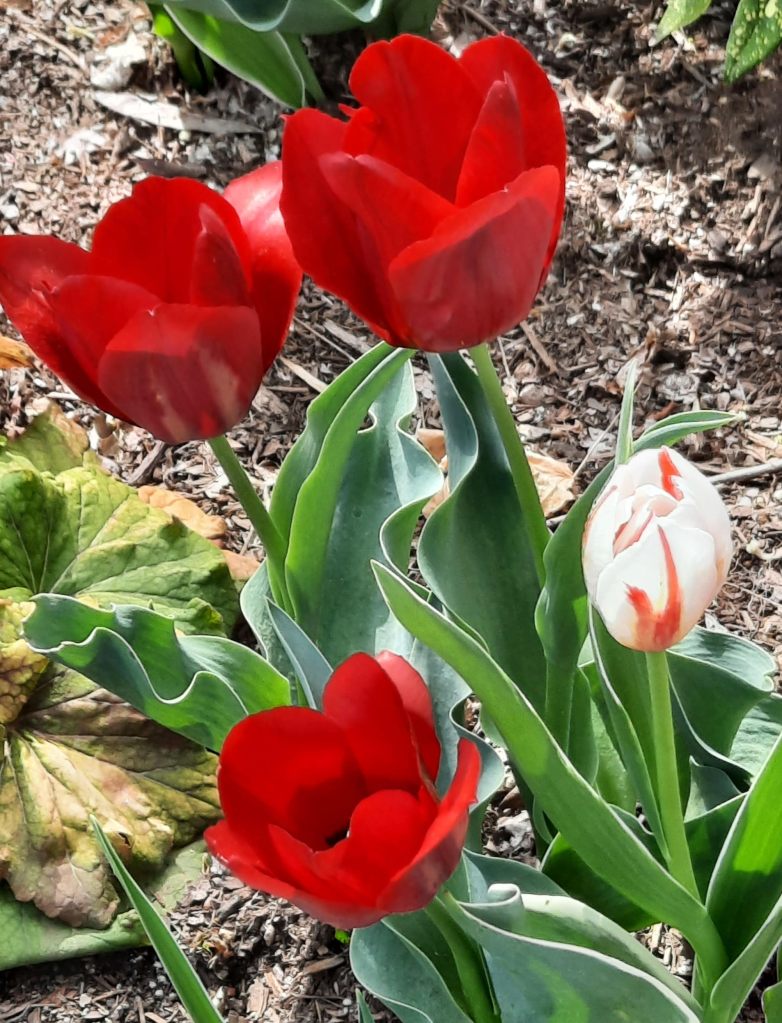
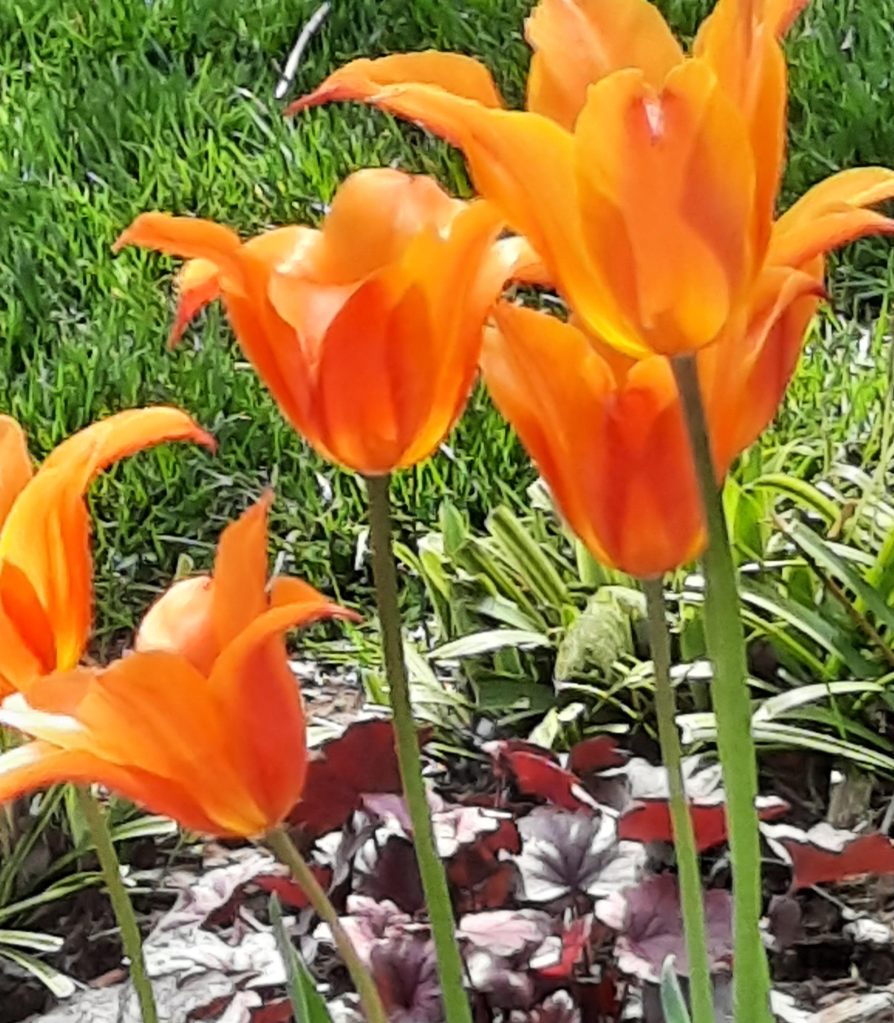
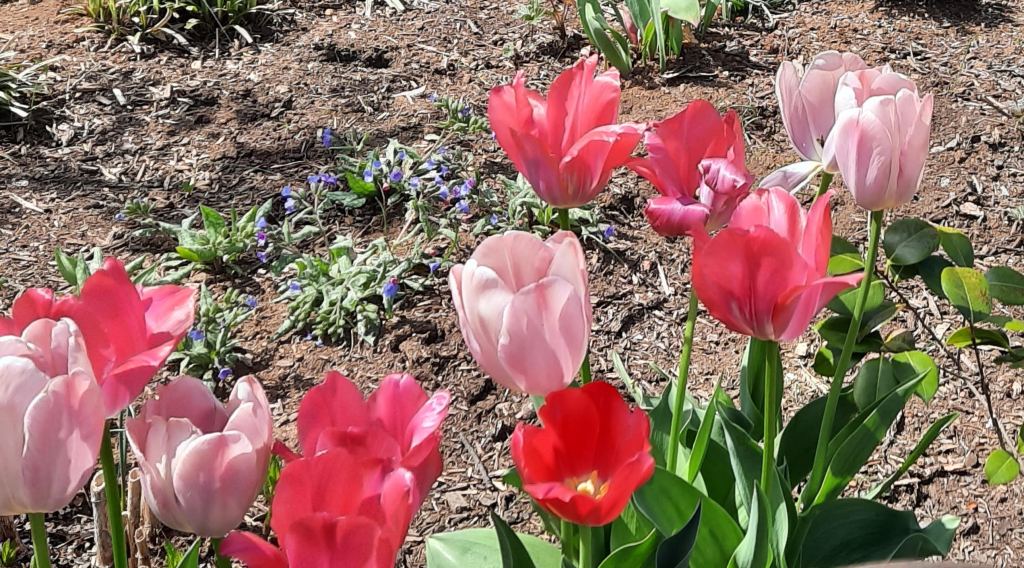
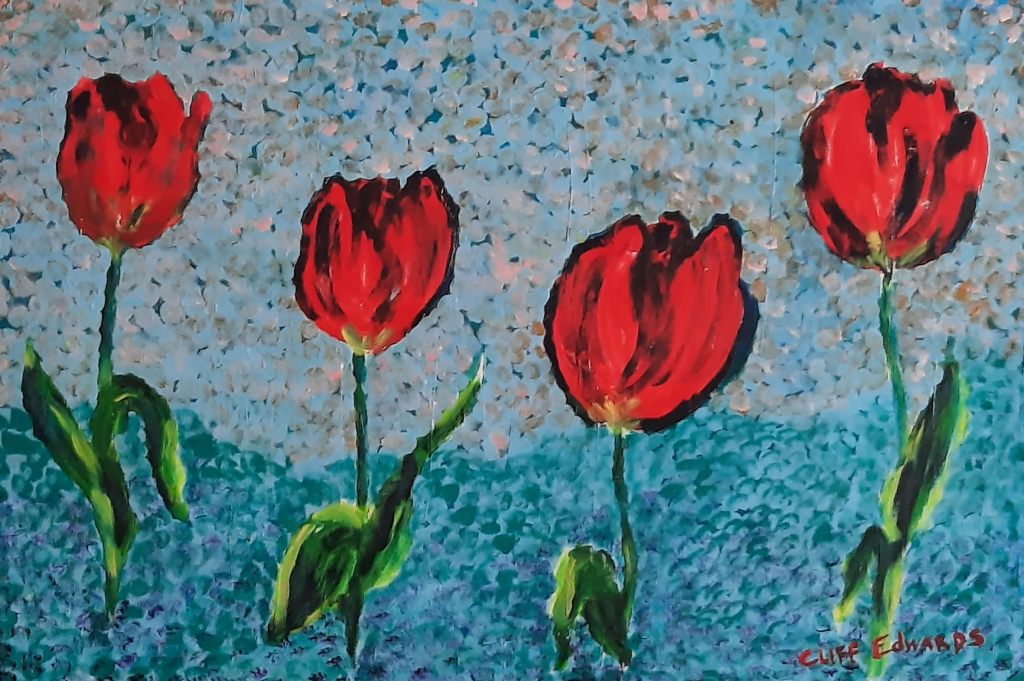
I’ve been blown away this Spring by the abundant beauty and sheer number of tulips planted throughout Roanoke, Virginia, a city I’m beginning to think of as “home.”
If I were to pick a favorite flower, it would be the tulip, yet I find it impossible to look at a tulip without being reminded of my religious upbringing regarding “salvation” as represented in the acronym of Calvinism’s “Five Points.” Each tulip displays five petals in its flower. Each petal stands for one point.
T=Total Depravity
U=Unconditional Election
L=Limited Atonement
I=Irresistible Grace
P=Preservation and Perseverance of the saints.
When my (now ex-) sister-in-law delivered her first baby one Spring, I gave her a pot of tulip plants, reminding her that T-U-L-I-P was the basis of our faith. The plant didn’t live to the following Spring, portending perhaps my future abandonment of T-U-L-I-P doctrine—doctrine being an interpretation of Scripture. T-U-L-I-P lays out an understanding of soteriology (doctrine explaining human salvation) hammered out by the French theologian John Calvin (1509-1564) and developed further by his Protestant followers.
Calvin had pushback to his five points from Dutch theologian Jacobus Arminius (1560-1609) and his disciples who disagreed vehemently with Calvin. Both Calvinists and Arminians claimed to be Christian, believing Christ to be the ultimate sacrifice for sin and necessary for blissful, eternal life. The discussion/debate remains an intramural one.
Seeing and engaging the world through a T-U-L-I-P lens does damage to the human spirit. It’s especially harsh on those people who have been systematically marginalized throughout patriarchal history—women, the LGBQTIA+ community, poor people, and Black/Brown people (especially in the US). After all, marginalized people have been considered “depraved” (first leaf of the tulip) by those who have power in our hierarchical society to develop and enforce doctrine that keeps the status quo for those in the upper echelons. But, I’m getting ahead of myself.
What is salvation? How does it happen? Who gets to be saved? Why are some saved and not others?
Today these questions don’t plague me as they once did. I find them curiously interesting, but not personally relevant. Nevertheless, these very questions and T-U-L-I-P, as a viable explanation for the human condition, used to hold me in their grip, crippling me while sucking joy from living in the here and now.
A brief explanation of T-U-L-I-P:
TOTAL DEPRAVITY—Not only have human beings inherited original sin (sin being the transgression of divine law), but are totally incapable of doing any good whatsoever without God’s intervention and help. Sin has infiltrated our thinking, emotions, and will. Only God can break through that murkiness before we can receive the free gift of salvation accomplished by Jesus’ death and resurrection.
(The following four points are dependent on the “truth” of the first point.)
UNCONDITIONAL ELECTION—God chooses who will be saved (the “elect”) for his own purposes, not based on anything an individual may or may not do. Nevertheless, we humans are responsible to see/believe the “truth.” (Huh?)
LIMITED ATONEMENT—Christ (the ultimate sacrifice for sin) did not die for everybody—only for those “elect” that God gave to Christ. Not everybody can be or will be saved.
IRRESISTIBLE GRACE—Those whom God “elects” to salvation cannot ultimately resist the offer or internal call of God’s grace for salvation.
PERSEVERANCE (AND PRESERVATION) OF THE SAINTS—Once Christians have been saved they cannot lose their salvation. God will see to it that the “elect” will persevere in the faith to the end.
So, why is this at all pertinent? Because our religious communities’ theological doctrines (handed down from our ancestors) have seeped into the social fabric of society. How often have we (those humans not “equal” to other humans) been told we don’t know things, don’t measure up, and will never achieve? We are lacking in countless ways and only our “betters” can enlighten and save us. (This is one way “total depravity” has worked into the interstices of society.)
T-U-L-I-P, Re-imagined:
Instead of Total Depravity, might we consider Total Perfection? We come into the world completely vulnerable and gradually learn to navigate our particular circumstances through the various communities we belong to. We express ourselves within the boundaries of our humanity. We love, hate, cry, get angry, and express joy. In much of Buddhist thought, these emotions are just that—emotions. We retain our perfection while being “angry Buddha,” “sad Buddha,” or “happy Buddha.” Emotions are not a moral issue. We are perfect in our humanity.
What about Unconditional Love, not Unconditional Election? What if we were to give ourselves and those who cross our path unconditional love? No judgment, no agenda to mold people into this or that—only acceptance of our perfect humanity?
Why not Limited Experience instead of Limited Atonement? We are human and bound by what we often call “laws of nature.” We fall at times. We forget what we need to be doing. Ideally, our family and community are supportive in ways that teach and encourage us, not limiting or withdrawing their support as we explore our environment.
Let’s talk about Irresistible Beauty, not Irresistible Grace. Beauty surrounds us. Beautiful art arrests us every day—both in the natural world and in the art humans produce. Navajo people focus on walking in beauty, meaning walking in harmony with all things—people, objects, animals, and life itself!
Pensive Perseverance rather than Perseverance (and preservation) of the Saints although the latter sounds good as long as “saints” refers to all people traversing the earth. Pensive (or critical thinking) Perseverance will enable us to flourish as we discover our own path.
My revision of Calvin’s acronym doesn’t answer all of life’s BIG questions, however, I do think a revised version of T-U-L-I-P—one that doesn’t straight-jacket our humanity would better nurture and sustain us on life’s journey. Perhaps we can begin with contemplating, planting, and even painting the earthy, garden-variety tulips that flourish in the springtime!
Painting by Cliff Edwards
BIOEsther Nelson is a registered nurse who worked for several years in Obstetrics and Psychiatry, but not simultaneously. She returned to school (Virginia Commonwealth University, Richmond, Virginia) when her children were in college and liked it well enough to stay on as an adjunct professor. For twenty-two years, she taught courses on Human Spirituality, Global Ethics, Christian-Muslim Relations, Women in the Abrahamic Faiths, and Women in Islam. She is the co-author (with Nasr Abu Zaid) of Voice of An Exile: Reflections on Islam and the co-author (with Kristen Swenson) of What is Religious Studies? : A Journey of Inquiry. She recently retired from teaching.
I am pissed! I wrote this blogpost the day after Beltane when the leaked draft of the Supreme Court majority opinion regarding Roe v. Wade was leaked to the public. I was up anyway feeling the effects of PTSD. Lessons that Carol P. Christ wrote about and brought to my own consciousness were rattling around my head. The first is her definition of patriarchy: “patriarchy is a system of male domination in which men dominate women through the control of female sexuality with the intent of passing property to male heirs.” This definition was part of a 3-part series she wrote (and we recently re-posed in her legacy posts) beginning here.
They are all well worth reading.
I was raped in 1977 when I was 22 years old. This after being abused by my father. I never got pregnant, but I was suicidal after the rape. Had I been pregnant without recourse to ending it, I would without a doubt have stabbed myself in the stomach or reached for that metal coat hanger. (I was too young to face pregnancy when my father abused me.) Had the result been my own death, that would have been warmly welcomed on my part. To this day, I still self-mutilate at times when stress becomes too much.
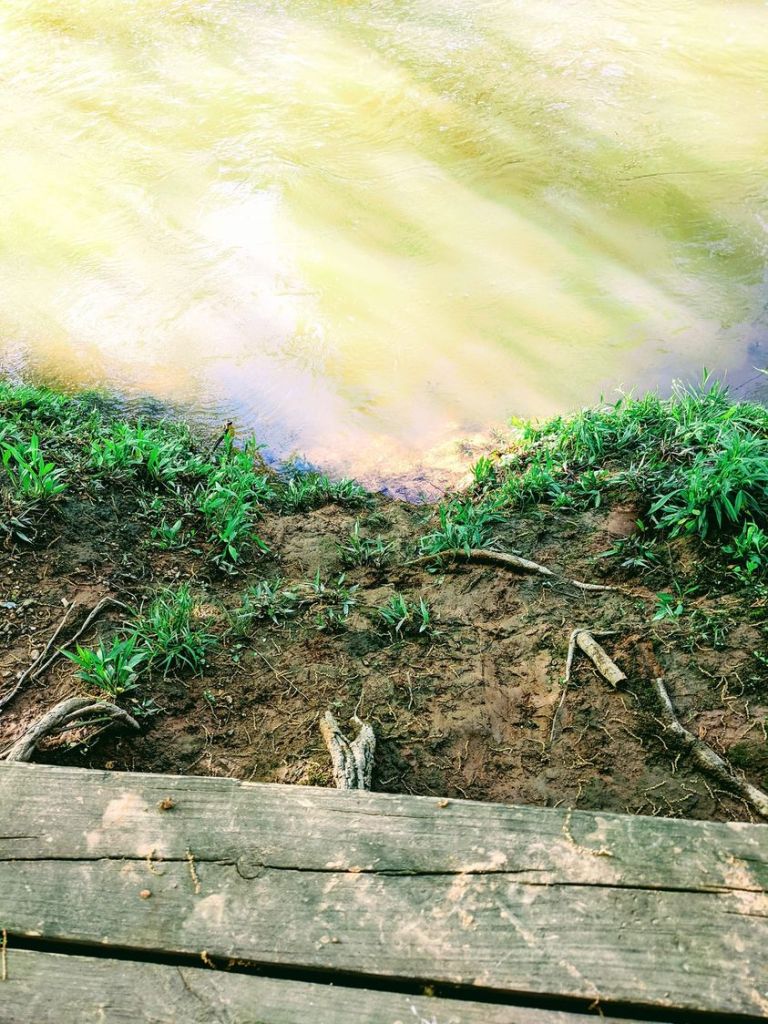
Yesterday I fell into the river. I had had a long afternoon and had gone to escape for a bit sitting on a bench by the river I live by. I had just gotten done with reading about Venus, Mars, Jupiter and Neptune all being in Pisces. ‘Drip, drip, drip or maybe a huge wave.’ Elsaelsa – The Astrology Blog I had also just gotten done with a Yemaya Mother of the Ocean meditation that I had done for Circle a while back. And as I got back up to go home, I slip-slided all the way down the steep incline in front of the bench.
Plop. Into the river.
I was holding my wallet, my phone, my keys, my glasses and a water bottle. I instantly lost the water bottle but managed to hold the rest above water. I tried to start back up the river bank. And could not. ‘Woman Accidentally Falls Into Raging River and Dies’. My heart rate went up. Okay, it wasn’t raging. I reminded myself that I most likely would not die as I can swim, and I could just go down river to a less steep bank.
But it was most disconcerting.
I forced myself to take a deep breath, threw all my stuff up the significantly steep bank and tried again. My shoe fell off. I was in panic mode. ‘Just get out of the river, Caryn’
This post was originally posted on February 5, 2018
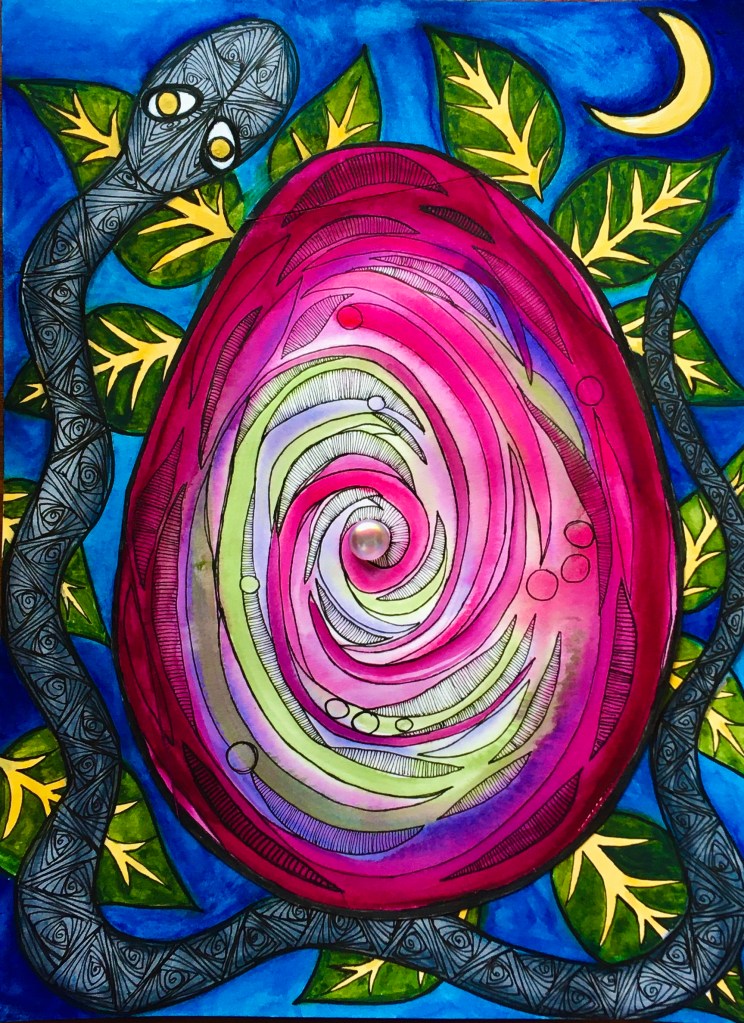
The symbol of the Goddess is as old as human history. The most ancient images of the Goddesses from the Paleolithic era are neither pregnant nor holding a child. In Neolithic Old Europe the Goddess was most commonly linked with birds or snakes and only rarely portrayed as mother. Yet we tend to equate the Goddess with the Mother Goddess. I suspect that images of the Virgin Mary with Jesus on her lap and prayers to God as Father have fused in our minds, leading us to think that the Goddess must be a Mother Goddess and primarily a Mother.
In a recent blog, Christy Croft reminded us that in our culture, women’s experiences of mothering and motherhood are not always positive:
[The mother] doesn’t always appear in our stories in simple or easy ways. Some of us mother children we did not or could not grow in our bodies; some of us birth babies who are now mothered by others. Some of us are not mothers at all. Some of us had mothers who could not love us unconditionally, or did not have mothers in our lives, or had mothers who brought us more pain and humiliation than comfort, from whose effects we are still recovering, are still healing.
Art by Deb Pollard Materials: Watercolor, markers, and vintage pearl button on paper.
In 1989 I was 37 years old. My body’s sacred work, centered around eggs, hormones and fertility, strongly governed my everyday existence. I’m sure that influence is strong for all women of that age, mothers or not, body conscious or not. I was directing a large women’s choir in Asheville, Womansong, composing and arranging for the women’s voices, as well as leading ritual-like rehearsals in a seated circle on the floor (pretty sure I can’t do that any more!) where I would often read my latest poems.
Now I know that the egg of our own existence was carried in our mother’s wombs while in our grandmother’s bodies. I can see how my imagination in 1989 would go further and further afield, to women’s relations with all the egg-bearers, flora and fauna, of our amazing Earth. Quite a family we are!