Legacy of Carol P. Christ: What Was Your Childhood Religious Tradition And Do You Still Follow It?

This post was originally published on Nov. 26th, 2012

Recently, in an interview with the Women’s Living History Project of Claremont Graduate University, I was asked: What religious tradition did you identify with as a child and how did it impact your childhood? and: Is your tradition the same today that you had when growing up?

I was surprised that the interview questions didn’t ask anything about feminism, experiencing exclusion in patriarchal religions, or belief.  My religious and political convictions, which are intertwined, have alienated me from family members.  Therefore, I was suspicious of questions that seemed to have been formulated by someone for whom religion and family go together, and for whom believing or not believing (!) did not seem to be an important issue.

After expressing criticism of the questions, I agreed to work with them.  My answer to the first question was that I did not have a single religious tradition as a child. I had four.  Continue reading “Legacy of Carol P. Christ: What Was Your Childhood Religious Tradition And Do You Still Follow It?”
As a Hen Gathers by Elanur Williams

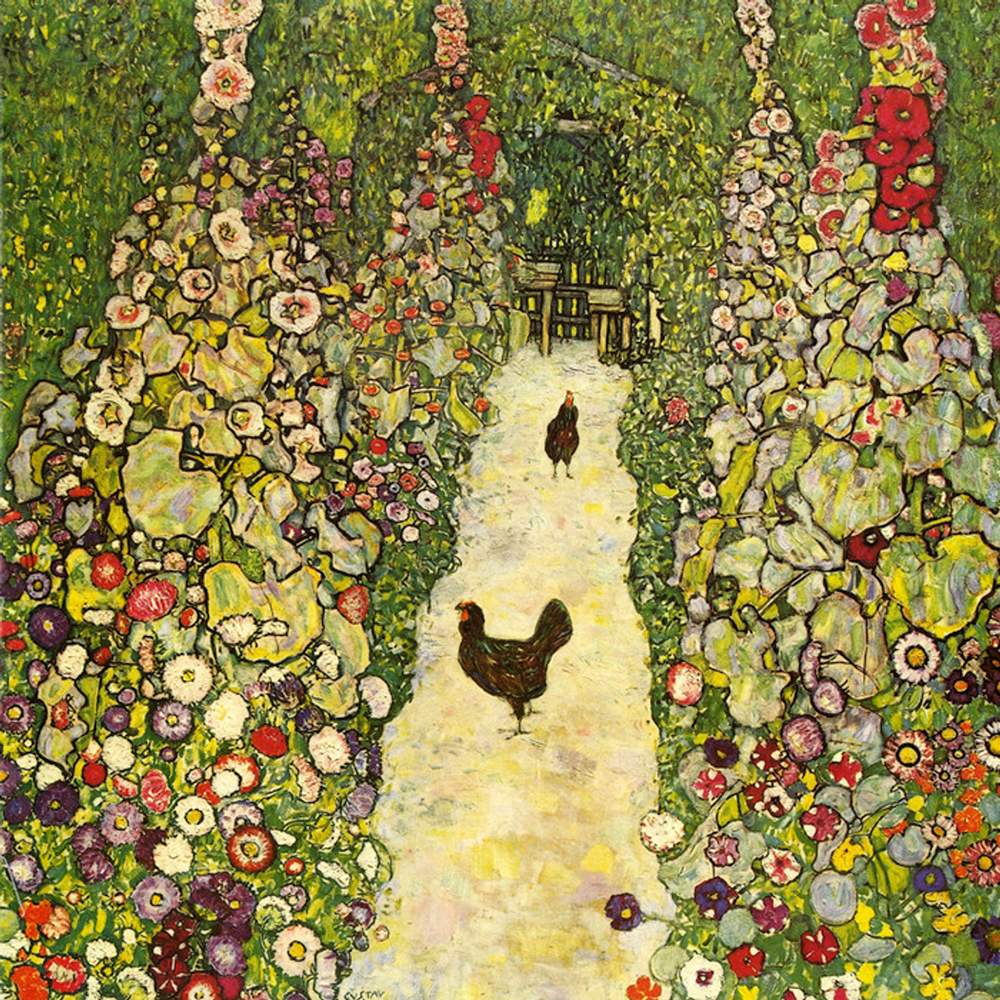
Gustav Klimt, Garden Path with Chickens, 1916

In the early years of my childhood, my family lived for a short time on a poultry farm in Bandırma. Hens wandered freely, unconfined. The contours of that land have long since changed, replaced by refrigerated depots and industrial freezers that hum along the highways, the relentless march of capital. In the Gospels of Luke and Matthew, Jesus laments: “How often have I desired to gather your children together as a hen gathers her brood under her wings, and you were not willing.” These days, I find myself returning to the image of the mother hen—a figure who embodies a special wisdom that is seldom named, yet deeply and instinctively known.

Although I did not have a religious upbringing, I grew up embracing aspects of many faiths. My spiritual background is Alevi, and after inviting the Presbyterian faith into my life following my marriage, I find these layered identities influence each other in ways that are both intricate and transformative. In her sermon Who Is Jesus? Mother Hen, Reverend Agnes Norfleet lingers on the vulnerability of the mother hen metaphor, questioning what strength a hen can possibly offer in the face of the fox—Herod—and, more broadly, in the face of violence at large. Reverend Norfleet asks why Jesus does not invoke a more forceful or fiercer maternal figure—a lion, perhaps, or a bear? What does this choice imply for our activism and understandings of leadership? What unique wisdom does the mother hen offer?

Continue reading “As a Hen Gathers by Elanur Williams”

The Wisdom of Cerridwen: Transforming Her Cosmic Brew by H. Bryon Ballard

Moderator’s Note: This is the Preface to the recently published anthology, The Wisdom of Cerridwen: Transforming Her Cosmic Brew.

Cerridwen, ancient Queen,
Dark Mother, take us in.
Cerridwen, ancient Queen,
Let us be reborn.
—a Reclaiming chant

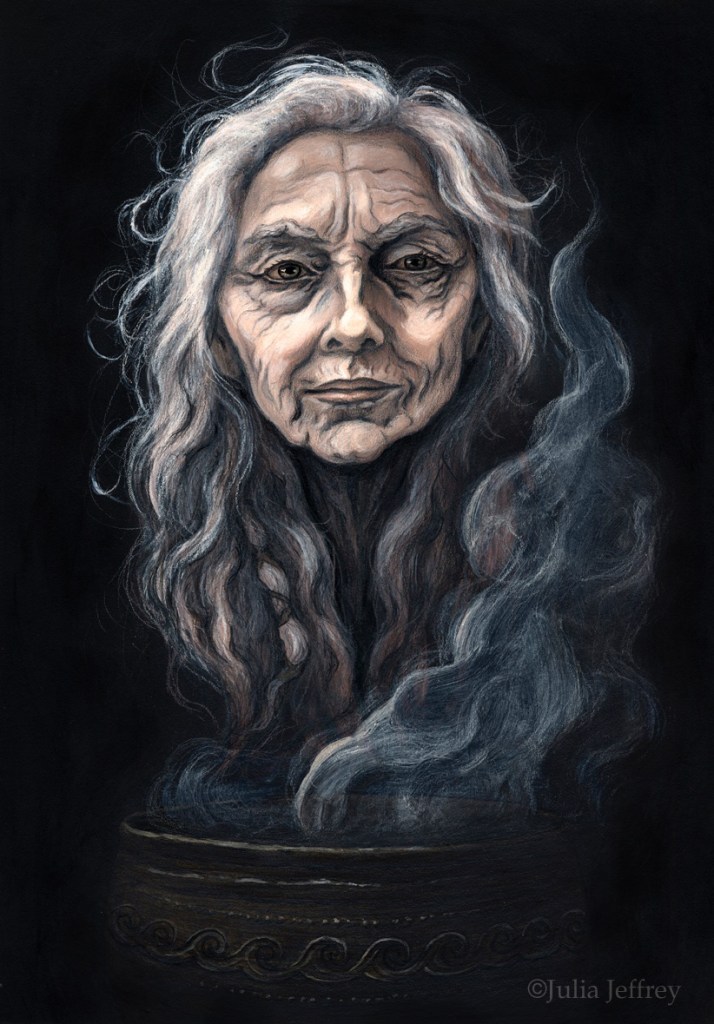
The Cauldron, Julia Jeffries

Open these pages and relish the words of this divine Mother, this wild Sister, this trickster and keeper of the Cauldron of Eternity! Spend time with Her. Learn Her sacred ways, Her stories, Her lore.

I learned the chant above at the Glastonbury Goddess Conference where I taught several years ago. I often use it in both my private meditations and in public rituals. It is simple but direct, quite unlike the Goddess it honors. I learned how to pronounce Her name from a Welsh-speaking colleague who gave it a rolling “r” and an emphasis on the second syllable. Keh-RRRHID-wen. Try it. So delicious to say.

Continue reading “The Wisdom of Cerridwen: Transforming Her Cosmic Brew by H. Bryon Ballard”

Do Women Really Need the Goddess? by Collie Collier

It’s been several years now since I first read ecofeminist thealogian Carol P. Christ’s revelatory prose regarding the necessity of the Goddess in a woman’s life:

A symbol’s effect does not depend on rational assent, for a symbol also functions on levels of the psyche other than the rational… The symbols associated with … important rituals cannot fail to affect the deep or unconscious structures of the mind of even a person who has rejected these symbolisms on a conscious level—especially if the person is under stress… Symbol systems cannot be simply rejected, they must be replaced. Where there is not any replacement, the mind will revert to familiar structures at times of crisis, bafflement, [celebration,][1] or defeat.[2]

Reading those words was an unexpected shock—I felt like a previously unknown weight was abruptly lifted off my shoulders! As a young tween, I’d consciously refused Christianity for a somewhat naïve equality-based form of feminism—but I’d still unwittingly internalized the organized religion’s misogynistic teachings. Since then, I’ve worked to encourage the Goddess, in all Her multiplicity of forms, in both my life and the lives of women and genderfluid persons all around me.

Continue reading “Do Women Really Need the Goddess? by Collie Collier”

The Loving Tree By Janet Maika’i Rudolph

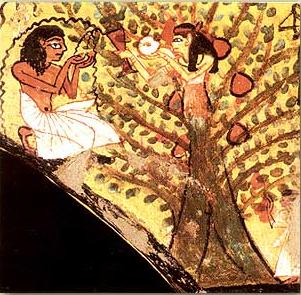
from Egyptian tomb of Pashedu ca. 1314-1200 BCE

Once there was a tree who loved two young children, twins, a boy and a girl.

Thay came everyday to play under her canopy. 

Gather her leaves and play fairies of the forest.

Climb her trunk and play in her branches

And sleep with their backs against her trunk

They loved the tree and the tree loved them. 

Time went by and the twins grew older.

They didn’t come to visit the tree as often.

One day when they did come, the tree asked them to play but they responded they needed money because they wanted to go on dates.

The tree responded, take my apples to sell.  But leave enough behind for the squirrels and birds and other animals so they can eat too. Leave enough behind for the seeds.

Continue reading “The Loving Tree By Janet Maika’i Rudolph”

We are now on Bluesky

Check us out. Follow us!

@feminism-religion.bsky.social

The Dark Goddess Los Angeles by Arianne MacBean

“Welcome to Hollywood! What’s your dream?” the character Happy Man says in the opening scene of Pretty Woman, a movie that epitomizes mythic Los Angeles, a place where fairy tales come true. The Dark Goddess Los Angeles, with Her lure of wealth and transformation, Her persona of glamour and aspiration, where even a down-and-out sex worker can be saved by a lawyer with a fear of heights and “save him right back.” Los Angeles calls out a westward invocation of promise. But as much as She pledges, She deceives. Her thick air, dense with unseen harmful toxins, a costly nutrient. Her sinewy highways, the blood lines of her body, sites of daily catastrophe. Our pilgrimage is the slow crawl of passing car crashes on the opposite side of the freeway divider wall. Our mantra, That could have been me. That could have been me.

Spiderweb of Freeways

I’ve been hating LA for thirty-five years. Hating Her May Grey and Her June Gloom. Hating Her maze-like web of concrete highways, Her center-less-ness. Only in Los Angeles are the freeways archetypes, “Take The 2 to The 5 to The 110 to The 10.” I’ve never felt lonelier – alone in my apartment, alone in my car, alone in my thoughts. But over time, I’ve learned to love traversing Los Angeles’ arteries. I have had some of my most profound ideas, my most aha moments, while flowing through Her pulsing veins. The neither here-no-thereness of this city is pregnant with patient possibility. Anything can happen in Her spaciousness, Her waiting.

Continue reading “The Dark Goddess Los Angeles by Arianne MacBean”

Mountain Song on May Day by Sara Wright

I moved to the mountains to move mountains, to find peace in the hidden crevices of an endangered planet.
We pull out her hair, clumps at a time
, self-harming her* in a myriad of new ways.
Wildfires burn up our forests, floods destroy precious lowlands. Loggers strip the possibility of new life from the soil. Our childhood stories become our adult lives: The Giving Tree who gave it all. . . .
The land doesn’t break; just dips and hides in private caves.
I moved to the mountains so that the predators of my past wouldn’t find me.
 Their spirits crawl out from unvisited graves.

[Excerpted from the poem, Mountain Life by Rebecca Rogerson.

They slip past the disappearing forests of canopied evergreens that once shaded and protected Ki’s children. [Ki is short for Kin – more on what this word means in Part 3.]

Continue reading “Mountain Song on May Day by Sara Wright”

Legacy of Carol P. Christ: The Morning After Pill and Obama’s Daughters

carol p. christ 2002 colorThis post was originally published on May 13th, 2013

By now it should be clear to feminists that when Barack Obama thinks about women, he does not view us as independent individuals, but rather as he said in his 2nd term inauguration address–to my consternation—as “our” mothers, wives, and daughters.  Obama does not address us–he addresses the men he expects to make decisions for us.  I almost wrote a blog on this egregious error in perception and judgment on the part of the President in January, but in order not to be seen as nit-picking, I held my tongue.  The recent decision of the White House to continue to restrict the availability of the Plan B , brings this question to the fore again.

Plan B is a brand name for the “morning after pill.”  If taken within 3 days of unprotected intercourse, it will prevent conception.  There is now a much cheaper generic version as well.

After reviewing the effects and side effects of Plan B, the Federal Drug Administration found it safe and reliable and advised the US Department of Health and Human Services that it should be made available without prescription or age restrictions.  In late 2011, the Obama administration and Kathleen Sibelius made the unprecedented decision to overturn the recommendations of the FDA and to allow Plan B to be purchased without prescription only by women age 17 or older.  Just over a month ago, US District Court Justice Edward Korman of New York ruled that the Plan B and the generic alternatives should be made available without restriction.  Before the ruling could take effect, the Obama administration lowered the age restriction to 15, while announcing that it would appeal Justice Korman’s decision to make the morning after pill as available as aspirin.

“Current and former White House aides said Obama’s approach to the issue has been heavily influenced by his experience as the father of two school-age daughters.”   Continue reading “Legacy of Carol P. Christ: The Morning After Pill and Obama’s Daughters”

Kedoshim: On Women, Patriarchy, and Respect.

The Torah portion for today’s blog is Kedoshim (Leviticus 19:1-20:27), which was read by Jewish communities yesterday, May 10, 2025.  Among scholars, it is part of what is often referred to as the Holiness Code, Leviticus 17-26 (Note 1).  Kedoshim covers all manner of topics: from what fabric to wear to how to treat one’s neighbor and from keeping Shabbat to when one can eat the fruit of newly planted trees.  These, what I will call prescriptions, all fall under the general reasoning that one does these things so that one can be holy like the deity is holy.  In a way, the Holiness Code then is an apt name for this section.  But, what can we take from this parshah from a (eco)feminist point of view?  To answer this question, I will be using the methodology I have laid out in a previous blog and ask three questions.

Continue reading “Kedoshim: On Women, Patriarchy, and Respect.”