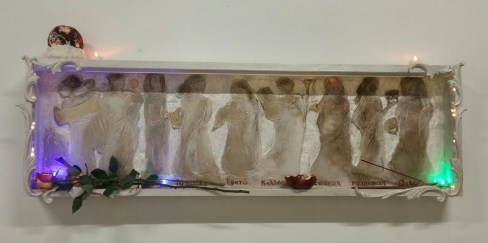
I remember being blown away when I read Judith Plaskow’s book, Standing Again at Sinai: Judaism from a Feminist Perspective, shortly after it was published in 1990. She writes, “The need for a feminist Judaism begins with hearing silence.” She notes it’s a “silence so vast [it] tends to fade into the natural order….” Women’s presence throughout Judaism has not been reflected in Jewish scripture, Jewish law, or in liturgical expression.
Plaskow zeroes in on the story in Exodus where the entire Israelite congregation, gathered at the base of Mt. Sinai, eagerly anticipates entry into the covenant, “the central event that established the Jewish people.” Before this communal event, the covenant had been entered into by way of the individual patriarchs—Abraham, Isaac, and Jacob. The particularly disturbing verse for Plaskow is Exodus 19:15: “Be ready for the third day; do not go near a woman.”
The specific issue Moses addresses is ritual impurity since the emission of semen renders both parties that engage in coitus temporarily unfit to engage with the sacred. Both women and men need to be ceremonially purified before approaching the holy. However, Moses does not say “Men and women do not go near each other.” At this crucial juncture in Jewish history, “Moses addresses the community only as men.” The text makes women invisible. Clearly it was men’s experience that shaped Torah.
Plaskow writes that “[Jewish] women have always known or assumed our presence at Sinai.” Exodus 19:15 “is painful because it seems to deny what we have always taken for granted. Of course we were at Sinai; how is it then that the text could imply we were not there?”
Why make a big deal of this? Can’t the text, asks Plaskow, be relegated to a time in history “way back then” when people and communities accepted gender inequality as the natural order? Why not just accept the past for what it was and get on with things? Because Torah (Hebrew Bible) is not “just” history, “but also living memory.” When the story of Sinai is read and recited in services as part of the lectionary reading over and over again, year after year, “women each time hear ourselves thrust aside anew, eavesdropping on a conversation among men and between men and God.” Continue reading “Of Monument(al) Importance by Esther Nelson”


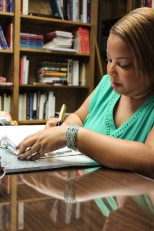 A few weeks ago, I was asked to give the invocation for a luncheon at my university. Baylor University was celebrating our presidential inauguration and there were several events leading up to the installation of the university’s 15th president. The inauguration was historic because it ceremonially marks the beginning of a term for our first female president, Dr. Linda A. Livingstone.
 Last week while responding to a comment on my blog, I suddenly remembered a series of incidents in which men I did not know exposed themselves to me in public places. The first time occurred at a park around dusk during an outing with a group of girls. I was about 11, I may have wandered away from the group, or I may have been with others. What I remember is seeing a man with his pants down sitting on a park bench, possibly the first time I ever saw an adult man’s penis. I told or we told, but the man was not reported by the adults. Fast forward to the beautiful gardens of the Palace Schoenbrunn in Vienna where I was confronted by a penis while lost in thought when I was 19. I ran, but said nothing. In my 20s at the early showing of movies in New York City men would sit next to me and jerk off into paper bags.


 Some of the most brutal weapons ever used against me were crafted and wielded by my own hands, forged in grief and self-loathing out of the words of others. In my better moments, I recognize that while another’s frustration with me frequently may be justified, any cruel words towards me never are, and are more a reflection of their speakers’ relationship with themselves than of any facts about me.
 I was asked by my sculpture teacher to make a monument. “A monument to what,” I asked? “Anything,” he answered. The only parameter seemed to be that the work was produced in wood. Having seen some interesting stone and marbleizing paints, I had the immediate idea to transform the wood into a marble-like appearance. Marble, for some reason, probably because it is the cemetery standard, seemed like the right medium for a monument to me.