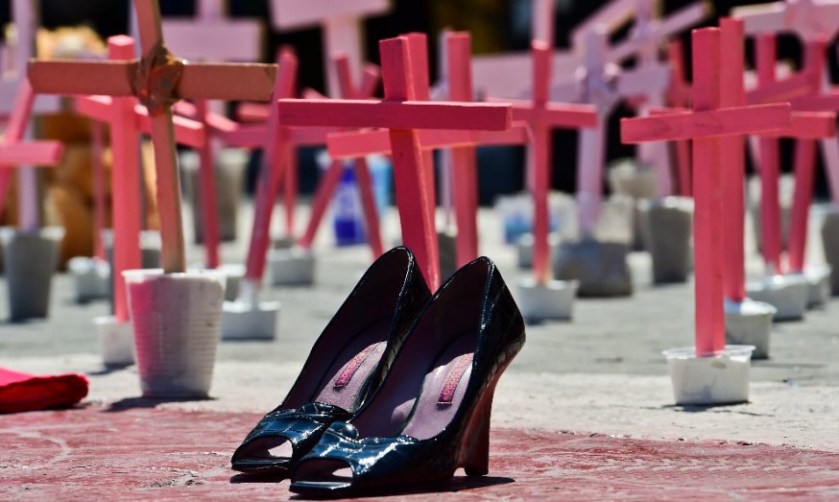
And not softly..
More than 2000 died by feminicide … More than 700 disappeared in Argentina … And more in Latin America and the world.
A few days ago they found Micaela dead. Her family, friends and my fellow activists searched for her for days, campaigned on social networks, shouted her name everywhere, without quitting and accepting her death—totally avoidable. Micaela Garcia, a 21-year-old girl, raped and murdered by a repeat sexual offender who was questionably released by Judge Carlos Alfredo Rossi in Argentina. Micaela is one more victim of the depredation with which colonial and capitalist patriarchy attacks the lives of women in Latin America.
I just completed my first six months in South Africa. I live in Cape Town. I love this city, I am delighted by its colors and flavors. I am studying a Master’s in Women and Gender Studies—a goal I had longed struggled for.
In my trip from my home to the university, I think of Micaela Garcia and also of Stasha Arend and Tracy Roman—two girls killed in Cape Town recently. Their lives were violently interrupted while they were returning home. At the end of each of my days, 27 women will be raped, likely by someone they know. Some of them will be killed and thrown in the garbage or into a soccer field, or half-buried in an abandoned house; even in death it seems that we have no right to some dignity.
No matter where, death is my guest and part of my landscape; the scenario of its violence has as background the Andean Cord or Table Mountain. It is the same, because it is the same indolence when it comes to the life of a woman, here or there. And I think: I can move my city and even change the country, and start a new life, even with another name, and my life will remain insignificant because I am a woman—a woman of color, from the south, with all the oppression surrounding me in the air.
How to deal with that pain? Well, I have enrolled as a Rape Crisis facilitator. It is not only for solidarity; it is for survival. Do you see what I see? How could I just watch?
The body of a murdered woman is becoming something so common that daily dead had to receive their own name to describe this horror: FEMICIDE. In Mexico, Susana Chavez coined the slogan “Ni Una Más” (Not One More) to lead the fight against femicides. The writer and activist was herself found murdered in 2011.
About two years ago, women from all over Latin America got together to claim “Ni Una Menos, Vivas nos Queremos” (Not One More, We Want Us Alive). And I wonder why this clamor is not yet worldwide, if everywhere patriarchy is killing us, one by one, on our way home and in broad daylight, with no shame or remorse.
Patriarchy is killing us and many murders only matter while selling magazines and newspapers. Then, the rest is silence, as the silenced femicides of indigenous women whose bodies oppose the last stronghold in territorial conflicts against agro-business or mining corporations, as silenced as those women murdered in the “tranquility of their houses” in the name of love for their jealous partners, as silenced as the girls kidnapped on the way to school to appear later killed with their hands and feet tied, with signs of having been raped.
It is no longer just about reporting and visibilizing, but also about counting them: 57 femicides in the first 43 days of 2017 in Argentina, 3 this week in Chile, 27 rapes per day in Cape Town, all of those lost in the trafficking networks. The hunting of women is systematic. Human beings have bad memories, and who has no memory tends to repeat the horrors. As Karina Bridaseca says:
We must check the systematicity. The bodies, found, disappeared, the bones in the desert, are claimed today and always. Our strength is to have managed to gather them all, to alter the regime of the invisible. This feeds the hope of making the account closed. What is important is that today we all share the same language and demand that the account closes.
Patriarchy is killing us … and not softly. Every time the news reports another woman or girl dead, I check my mother, my sister, my daughter, my friends in Chile. I double check my close friends in Cape Town, to know that they are as I saw them last time: OK. And then I can sleep, knowing that they have returned home.
In Santiago de Chile and in Cape Town we must count, dead or alive. Hope for the figthers and memory for those who are no longer here. We won’t stop asking about all of you. We want to know you have returned home. Our lives must matter.
 Vanessa Rivera de la Fuente works in community development, gender equality and communication for social change. She has led initiatives for women’s empowerment in Ecuador, Peru, Argentina, Morocco and South Africa. As a Gender Justice advocates with a broad scope of interests, she is a social and digital entrepreneur committed with the strengthening of grass roots organizations and the developing of an independent pathway of thinking, research and academic writing around Gender, Politics and Religion. Loyal lover of books, cats and spicy chai.
Photo: Artivism installation. Crosses represent the women dead and shoes, the gender bias of femicide. Shoes are one of the first things found at the site of a murder.


 The concept of divine omnipotence is the ultimate expression of male dominance as control. Divine omnipotence is the view that everything that happens in the world happens according to the will of a divinity, who is in control of everything that happens in the world. When someone dies or great suffering occurs, we are told, “everything happens for a purpose,” “it was meant to be,” or “everything happens according to the will of God—or Goddess.” In our recent book Goddess and God in the World, Judith Plaskow and I criticize and reject this view on both rational and moral grounds.
 This is the post where we are going to enter the world of fan conventions. Fan Conventions can be considered anything that carries a fan base – film, television, comics, books, actors, or genres of literature. Fan conventions have evolved to include aspects of role-playing, costume play, and direct interaction with the producers, actors, and writers of the selected item.
 Spring is here in the northern hemisphere and with it the return of light in the yearly round of seasons.
  Much of our lives lack the rich culture of ritual that I think would help us repair the relationships we have with our own bodies and with the earth. The Rg Veda is one of the oldest collection of hymns from India. In them, I find a playful and introspective expression of desires and fears that, at first, did not seem to me to hold much wisdom for a modern contemplative. But lately, I have been noticing how the speakers communicate to or about the earth, and how their lives seem centered around trying to take a part in creation. Mostly, these hymns are stories and supplications for rain, cows, victory in battle, and a long life. But there is a deep understanding of the power and divinity in the universe that is the very earth-based wisdom that our humanity-in- crisis needs. If the Qur’an is God calling for humanity to be grateful, the Rg Veda is a model of a humanity that could be nothing else.
 Katey Zeh, M.Div is a strategist, writer, and educator who inspires communities to create a more just, compassionate world. She has written for outlets including Huffington Post, Sojourners, Religion Dispatches, Response magazine, the Good Mother Project, the Journal for Feminist Studies in Religion, and the United Methodist News Service. Her book Women Rise Up will be published by the FAR Press in March of 2018. Find her on Twitter at @kateyzeh or on her website
  The reason for this blog, and for writing it on this day, is to celebrate and remember the life and legacy of Sor Juana Inés de la Cruz.
 As I write, Bakken crude oil is moving through the Dakota Access Pipeline under the Missouri River at Lake Oahe Reservoir, crossing treaty lands and waters that the Sioux Nation never ceded to the United States Government.
  I have recently watched one of these real life entertainment documentaries. This one was on plastic surgery. A woman went under the knife to enlarge her breasts. The female presenter, wearing sterile white, peeped into the operation theatre and, facing the camera, said excitedly: “This operation might be life-changing!”
 I thought: “Yes, precisely.”
